Some artists reach for oil paint. Others prefer watercolor, charcoal, clay, marble, or a tablet that costs more than a used car. Then there is VistulArt, the Warsaw-based artistic duo who looked at plywood, nails, and sewing thread and apparently thought, “Yes, that should be enough to build a face, a mood, a shadow, a story, and possibly make everyone ask, ‘Wait… how?’”
Behind VistulArt are Dagmara Świrska and Dariusz Plutecki, a real-life couple and self-taught artist duo creating unconventional works that look “painted,” but are made only with sewing thread. Their pieces sit in the fascinating space between string art, optical illusion, algorithmic design, portraiture, and contemporary fiber art. The result is not embroidery in the traditional sense and not painting in the usual sense. It is thread behaving like light, color, pencil shading, and brushstroke all at once.
Their viral collection of 36 thread-based works is easy to admire at first glance: portraits, cultural icons, expressive figures, and art-historical references appear with surprising clarity. But the longer you look, the stranger and more impressive it becomes. There is no hidden paint underneath. No ink. No dye. No secret printed image doing the heavy lifting. The visual effect comes from countless lines of thread pulled across a board between carefully placed nails. In other words, it is less “paint by numbers” and more “paint by patience, math, and a heroic tolerance for tangled thread.”
What Makes These Sewing Thread Artworks So Unusual?
Traditional string art often uses nails to outline a recognizable shape, then fills that shape with colorful thread. Many people know it from craft kits, classroom projects, or charming wall decor spelling out words like “home,” “love,” or “coffee” because apparently our walls need emotional support too.
VistulArt pushes the technique much further. Their works are closer to photorealistic string art, where thread does not simply fill an outline. Instead, thread becomes the image. Every crossing line contributes to tone, shadow, texture, and depth. The nails may act as anchor points, but the real drawing happens in the air between them. The eye blends thousands of fine lines into something that feels almost painted.
The materials are simple: a plywood board, several hundred steel nails, and sewing thread in different colors, types, and thicknesses. The process, however, is anything but simple. A single piece may involve thousands of thread connections and several kilometers of thread. One portrait-style work can require the discipline of a craftsperson, the planning of an engineer, and the nerves of someone who has made peace with the phrase “start over.”
The Couple Behind VistulArt
Part of the charm of the project is that VistulArt is not just a studio name. It is a collaboration between two people whose relationship and creative practice are intertwined. Dagmara and Dariusz describe themselves as self-taught artists from Warsaw, Poland, and their partnership brings together different ways of thinking: analytical, emotional, technical, and imaginative.
That balance matters. Thread painting is not only about hand skill. It demands planning before the first strand is pulled. The artist has to understand how lines will overlap, how colors will blend from a distance, and how density can create darkness while spacing can create light. In that sense, each piece is part artwork and part visual equation. The final image may feel soft and organic, but underneath it is structure, repetition, and calculation.
It is easy to romanticize artist couples as two people sipping espresso under perfect studio light while inspiration politely arrives at 10:00 a.m. sharp. In reality, collaborative art usually involves negotiation, problem-solving, long hours, and many small decisions that nobody sees. Which thread color should dominate a shadow? Should a line cross the eye or stop before it? Is the tension too tight? Is the image readable from across the room? Can the piece survive transport? And, most importantly, who moved the scissors?
How Can Thread Look Like Paint?
The magic of these works comes from how the human eye reads overlapping lines. A single thread is thin and simple. Hundreds or thousands of threads, however, begin to form gradients. Where many strands overlap, the image becomes darker or more saturated. Where fewer strands cross, the board shows through and creates highlights. When thread colors are layered thoughtfully, they can produce optical mixtures similar to the way dots of color work in pointillism or pixels work on a screen.
That is why VistulArt’s pieces can look painterly even without a drop of paint. The thread behaves like a drawing tool, but not in the usual line-by-line sketching method. It works more like a network. The image emerges from accumulation. From up close, the viewer sees threads, angles, gaps, and nails. From farther away, the threads soften into a portrait, a face, a costume, a famous pose, or a dramatic scene.
Distance Changes Everything
This is one of the most satisfying features of thread art: it rewards both close inspection and distance viewing. Stand near the piece and it feels almost architectural. You notice the pins, the tension, the tiny decisions, and the physical reality of the medium. Step back and the subject suddenly appears with surprising clarity. It is the artistic equivalent of watching a magic trick and then being invited backstage, only to realize the backstage work is even more impressive than the trick.
String Art, Fiber Art, and the Long History of Thread
Although VistulArt’s method feels fresh and contemporary, thread has been used as an expressive visual medium for centuries. Embroidery has long allowed artists and makers to create linear patterns, pictorial compositions, decorative surfaces, and symbolic images. Unlike woven textiles, where structure is often bound to a loom, embroidery and related thread techniques give makers freedom to draw, fill, layer, and improvise.
String art also has a mathematical side. The educational technique known as curve stitching is often associated with Mary Everest Boole, a 19th-century mathematician and teacher who used stitched lines to help students understand geometry and mathematical patterns. Straight lines, when arranged in repeating sequences, can create the illusion of curves. That idea still feels wonderfully strange: the curve is not technically drawn, yet your eye insists it is there.
Modern and contemporary art have also made more room for fiber as a serious medium. Museums and craft institutions increasingly recognize textiles, thread, yarn, felt, weaving, quilting, and fiber sculpture as powerful forms of artistic expression. The old divide between “fine art” and “craft” has been challenged by artists who use everyday materials to address memory, identity, labor, technology, design, and beauty. VistulArt fits naturally into this broader movement: their thread works are handmade, technically demanding, and visually ambitious.
Why These 36 Pics Captured So Much Attention
The internet loves a good “you won’t believe what this is made of” moment, and VistulArt delivers exactly that. At first glance, the works look like stylized paintings or digital portraits. Then comes the reveal: they are made only from thread stretched between nails. That twist gives the viewer a small jolt of surprise, the kind that makes people zoom in, share the image, and begin inspecting every corner like amateur detectives with excellent taste in craft.
The 36-piece gallery also works because the subjects are varied and expressive. Some pieces reference famous cultural figures. Others echo well-known artworks, cinematic moods, or emotionally charged portraits. The range shows that the technique is not a one-trick novelty. It can handle bold contrast, delicate features, dramatic lighting, graphic silhouettes, and subtle expression.
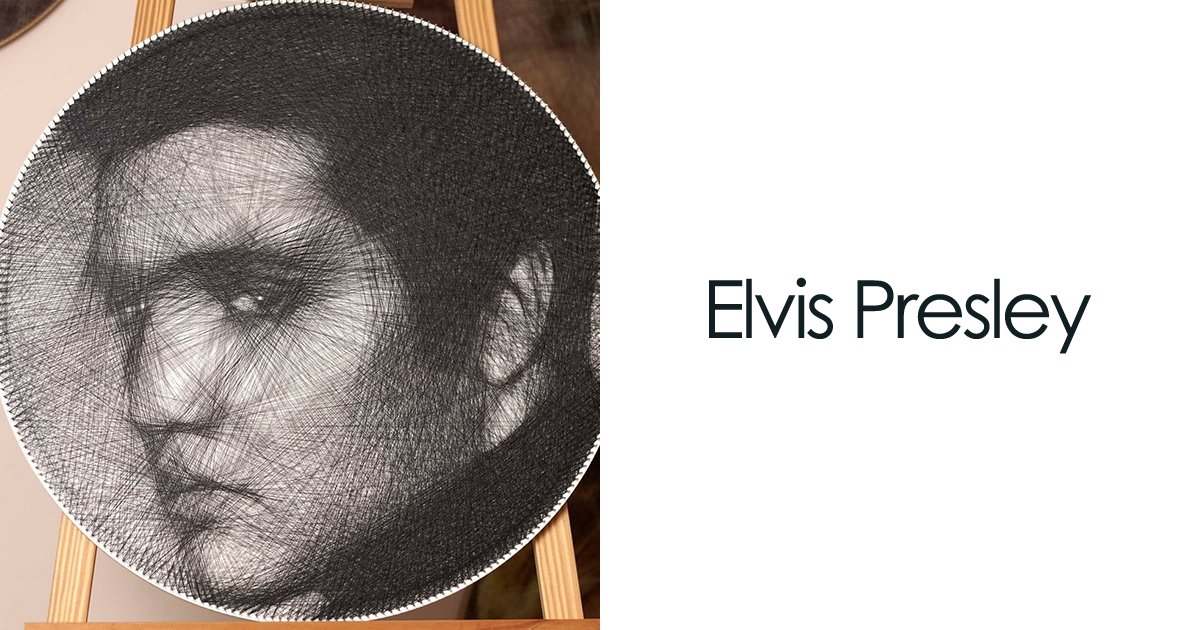
One example often associated with the collection is an Elvis Presley portrait built from a circular plywood base, thousands of connections, and a surprisingly limited thread palette. That kind of restraint is important. A viewer might assume realism requires dozens of colors, but VistulArt shows that placement, density, and contrast can do enormous visual work. Sometimes two thread colors, intelligently arranged, can sing louder than a full rainbow. Elvis would probably approve, possibly with a hip shake.
The Beauty of Limits
Many artists talk about creative freedom, but limits can be just as powerful. VistulArt’s rule is strict: thread, wood, and nails. No paint. No hidden underdrawing doing the visible work. No traditional brushwork. That limitation gives the art its identity.
When an artist limits the tools, every decision matters more. A painter can blend pigment directly on the surface. A thread artist has to build that blend through line direction, color selection, thread spacing, and the order of crossings. A painter can soften an edge with a brush. A thread artist has to suggest softness through geometry. A painter can revise a shadow quickly. A thread artist may need to rethink an entire sequence of lines.
This is why the work feels so satisfying. It is not just beautiful; it is visibly solved. Each piece feels like a puzzle that became a portrait. The constraint makes the final image more impressive because the viewer understands, at least partly, how stubborn the material must be. Sewing thread is not paint. It does not melt, smear, or politely blend. It stretches, knots, frays, and occasionally behaves like it has personal objections. Turning it into a convincing image requires unusual patience.
Where Technology and Handwork Meet
Photorealistic string art often sits at the crossroads of traditional craft and computational thinking. Even when the final work is handmade, the planning can involve algorithmic logic: deciding which points connect, how many lines are needed, where density should increase, and how the image will read from a distance.
That does not make the art less human. In fact, it highlights the human role even more. Technology can help map possibilities, but the hand still has to execute the work. Thread tension has to be controlled. Nails have to be placed accurately. Materials have to be chosen. Colors have to be tested. Mistakes have to be fixed. The final object is physical, tactile, and vulnerable to real-world conditions.
In a digital age, that physicality feels refreshing. We are surrounded by images that appear instantly and disappear just as quickly. A thread painting insists on slowness. It says, “This face took time. This shadow traveled through someone’s hands. This line crossed the board because a person made it happen.” That is a quiet but powerful message.
Why Thread Art Feels So Human
Thread carries emotional associations. It reminds us of clothing, mending, family labor, domestic skill, quilts, embroidery, repairs, and keepsakes. Many people have memories connected to thread: a grandmother sewing, a parent fixing a button, a school project, a favorite jacket, a costume, a handmade gift. When thread becomes fine art, it brings those associations with it.
VistulArt’s pieces benefit from that emotional charge. The works may be precise and technical, but the material remains familiar. That contrast is part of the appeal. The viewer sees something ordinary transformed into something extraordinary. A spool of thread, the humble little object that usually waits in a drawer next to safety pins and mystery buttons, suddenly becomes capable of portraiture.
Experience: What It Feels Like to Discover Thread Painting for the First Time
The first time you encounter a thread painting like the ones created by VistulArt, your brain may need a moment to update its software. From a distance, the image looks like a painting, maybe a stylized print, maybe even a digital artwork. Then you move closer and notice the nails. Then the thread. Then the crossing lines. Then you realize the entire image is built from tension, spacing, and repetition. It is a small artistic plot twist.
That discovery changes how you look at the work. You stop asking only, “Who is the subject?” and begin asking, “How did they make this readable?” The portrait becomes both an image and a process. You notice how the darkest areas are created by thicker clusters of thread, how lighter areas breathe through empty space, and how a single diagonal line can contribute to multiple parts of the picture. It feels almost musical: one note is simple, but layered notes become harmony.
For anyone who has tried even a basic string art project, VistulArt’s work feels especially humbling. A beginner quickly learns that thread has opinions. Pull too hard and the line warps. Pull too softly and it sags. Wrap the wrong nail and the pattern goes rogue. Choose the wrong color and the whole mood changes. Even a small design can become a negotiation between intention and material. Now imagine scaling that up into detailed portraits with thousands of connections. Suddenly, the phrase “handmade art” feels too small.
There is also something encouraging about this kind of work. It proves that innovation does not always require rare materials. Sometimes the most exciting ideas come from rethinking what ordinary materials can do. Wood, nails, and thread are not glamorous on their own. Together, in the hands of patient artists, they can produce faces, movement, drama, and atmosphere. That is a useful lesson for creators in any field: limitations are not always obstacles. Sometimes they are the doorway into a recognizable style.
Thread painting also invites viewers to slow down. Online, we often swipe past images in seconds, giving each one the attention span of a goldfish with a busy schedule. But these works ask for more. They ask you to zoom in, step back, compare, and wonder. The reward is not only the finished picture but the realization that the picture is held together by hundreds or thousands of small decisions. It becomes a reminder that patience still has visual power.
For couples, collaborators, and creative partners, VistulArt’s story adds another layer. Making art together requires trust. One person’s decision affects the other’s work. A shared project can become a shared language, full of experiments, corrections, discoveries, and probably a few debates about whether a shadow needs three more lines or thirty. That collaborative spirit is visible in the finished works. They feel engineered and emotional at the same time, which may be exactly why they stay in the mind after the first surprise fades.
Conclusion
VistulArt’s unconventional sewing thread artworks prove that art does not need traditional paint to be painterly. With plywood, nails, and miles of thread, Dagmara Świrska and Dariusz Plutecki create images that are precise, emotional, tactile, and unexpectedly cinematic. Their work belongs to a larger story of contemporary fiber art, where everyday materials are no longer treated as secondary to “serious” art but are recognized as powerful tools for expression.
The 36-picture collection stands out because it combines surprise with substance. Yes, the material trick is impressive. But beyond the “wow” factor is a deeper pleasure: seeing patience become image, seeing mathematics become mood, and seeing thread behave like paint without pretending to be anything other than thread. In a world full of instant visuals, VistulArt reminds us that slow art can still stop people in their tracks.
Note: This article is an original editorial feature inspired by VistulArt and the wider context of thread painting, string art, embroidery, and contemporary fiber art. It does not reproduce the original 36 images or copy the original gallery text.