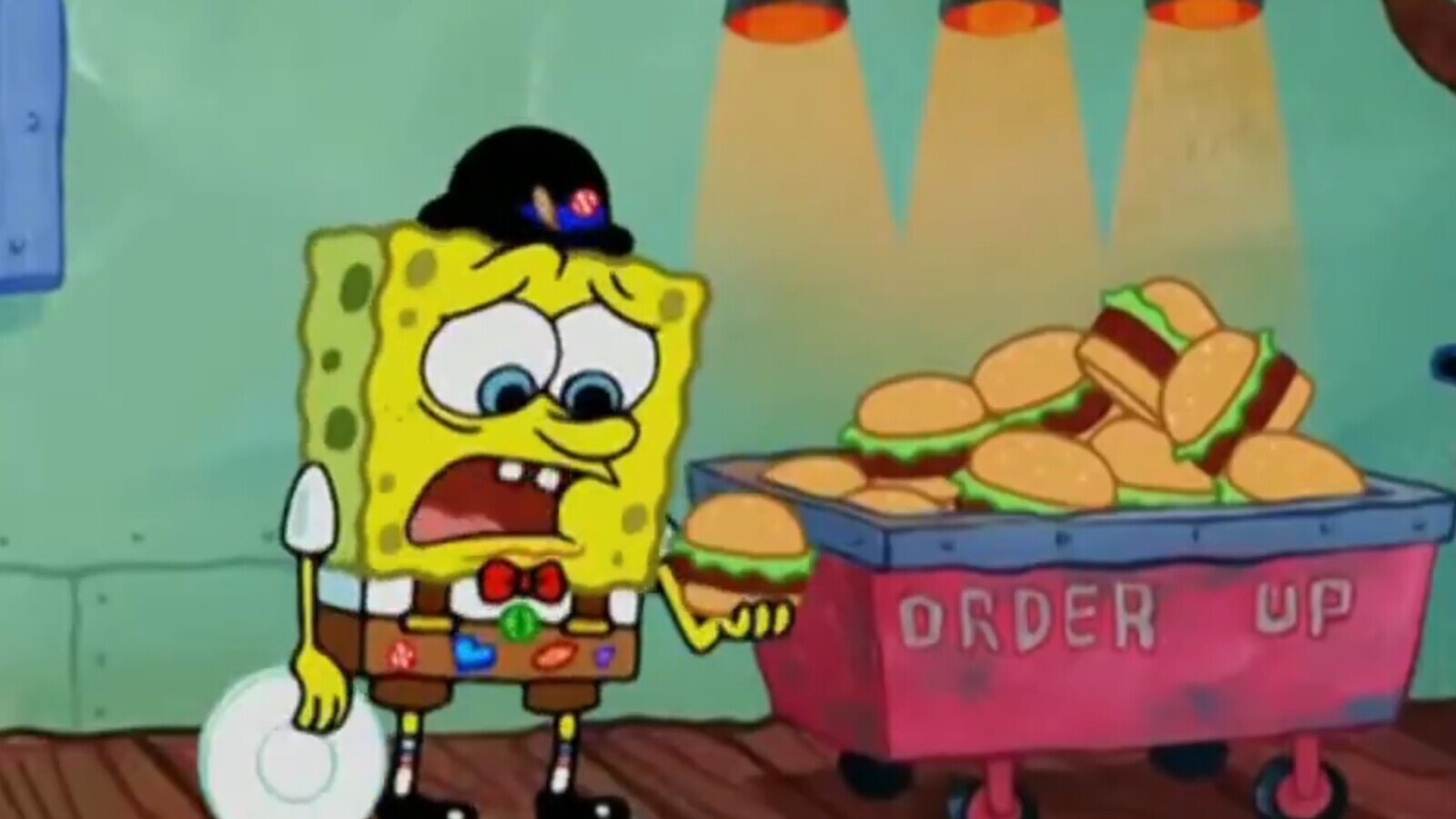
There are few things more humbling than realizing a cartoon sponge may have understood the modern internet before the rest of us did. Long before people were arguing about AI slop, fake trailers, synthetic influencers, cloned voices, and low-effort content swamping every feed from here to Neptune, SpongeBob SquarePants aired a scene that now feels weirdly, almost uncomfortably prophetic. Fans keep pointing to one particular clip from the episode “Selling Out,” and honestly, they have a case.
In that episode, the Krusty Krab is sold off, industrialized, and transformed into a polished but soulless corporate machine. Out goes messy human craft. In comes a conveyor belt, gray sludge, and a system so obsessed with efficiency that taste, judgment, and joy get pushed overboard. If that sounds a little like the current internet’s relationship with generative AI, well, welcome aboard. The pineapple under the sea has entered the group chat.
This is why the clip resonates so strongly in 2026: it does not just resemble AI-generated content. It resembles the entire mood around it. The exhaustion. The uncanniness. The sense that everything is becoming faster, flatter, cheaper, and somehow more irritating at the exact same time. That is what fans mean when they call it a prediction of our AI purgatory. Not that SpongeBob literally foresaw chatbots and image generators, but that it absolutely nailed the feeling of living inside a machine optimized for output instead of meaning.
The SpongeBob Scene Everyone Keeps Bringing Back
The now-famous comparison centers on “Selling Out,” a SpongeBob SquarePants episode in which Mr. Krabs sells the Krusty Krab and the restaurant becomes “Krabby O’Mondays,” a corporate knockoff version of itself. The transformation is the joke, but it is also the warning. The food is no longer lovingly made one at a time. It is extruded by machine. The place looks busier, shinier, and more “modern,” but it feels spiritually refrigerated.
That is the part fans cannot stop talking about. The episode understands a truth that keeps showing up in the AI era: scale is not the same thing as quality. Automation can create more stuff, more quickly, more cheaply, and with much less friction. But it can also flatten the human fingerprints that make something worth caring about in the first place. In Bikini Bottom, the Krabby Patty becomes gray goop. Online, the equivalent is the flood of text, videos, images, songs, and ads that look almost finished but feel dead on arrival.
And that “Code Red: Free Thinker!” bit? It lands even harder now. In the age of algorithmic sameness, original taste can feel like a system error. The joke works because many people already suspect that the internet is becoming hostile to anything slow, handcrafted, idiosyncratic, or inconveniently human.
Why Fans Think It Predicted Our AI Purgatory
Automation without soul
The most obvious parallel is the replacement of craft with throughput. The Krusty Krab once had a process. It may have been chaotic, greasy, and extremely dependent on SpongeBob’s heroic commitment to burger excellence, but it had care. Krabby O’Mondays has none of that. It has a system. It has speed. It has uniformity. It has branding. What it does not have is flavor, in every possible sense of the word.
That is exactly the criticism many people now make about generative AI when it is used as a substitute instead of a tool. The issue is not that computers can assist creative work. The issue is the growing temptation to use them to skip the thinking, skip the polishing, skip the accountability, and then dump the result into the world at industrial scale. It is content as gray sludge with a garnish.
The look of abundance, the feel of emptiness
Part of what makes AI purgatory feel so maddening is that it often looks impressive at first glance. There is always more to see. More images. More copy. More “content.” More output than any human could reasonably make in a day. Yet abundance has a funny way of becoming exhausting when the material lacks point of view. You stop feeling entertained and start feeling processed.
That is why the term “AI slop” caught on so quickly. It is not just an insult. It is a description of texture. Slop is shapeless. It is edible in theory, but unsettling in practice. It fills space without delivering satisfaction. That same sensation now hangs over plenty of algorithmically generated media, from uncanny ads to suspiciously polished product photos to video clips that exist for no reason other than to get one more distracted thumb to pause for a second and a half.
The machine keeps moving because the machine keeps moving
The “Selling Out” clip also feels predictive because it captures a larger corporate logic: if something can be automated, standardized, and scaled, somebody somewhere will try it. That logic has become a defining feature of the AI boom. Companies do not always pitch AI as art. Often they pitch it as productivity, efficiency, speed, cost savings, or “content velocity,” which is a phrase that sounds like it should only be spoken by a man wearing wireless earbuds and no socks.
But the downstream effect is cultural. Ads start looking off. Websites get padded with suspiciously generic prose. Search fills up with pages that say a lot while meaning very little. Music platforms get flooded with machine-made tracks. Social feeds become obstacle courses of weird videos, fake scenes, and uncanny images designed to trigger curiosity before your frontal lobe has had time to object.
This Isn’t Just About Bad Art. It’s About Trust.
That is why the SpongeBob comparison hits harder than a simple “cartoon predicted the future” joke. Our AI purgatory is not just a creative quality problem. It is a trust problem. Once enough synthetic junk enters the system, everything becomes a little shakier. Is that trailer real? Is that quote real? Is that book list real? Is that helpful article actually written by a person who knows what they are talking about, or by a machine remixing other machines?
Recent years have given people plenty of reasons to be skeptical. Media outlets have been embarrassed by AI-assisted errors and fake bylines. Fake movie trailers have spread widely because they look just plausible enough to fool casual viewers. Entire online niches now revolve around pumping out cheap, strange, highly optimized videos built for attention rather than information. None of this requires every single AI use case to be bad. It just requires enough bad or lazy uses to poison the atmosphere.
That poisoned atmosphere is what makes the “Selling Out” clip feel so current. Krabby O’Mondays is not scary because it is futuristic. It is scary because it is hollow while pretending to be premium. That is the same reason people recoil from obviously synthetic brand campaigns or mass-generated content farms. The irritation is not only aesthetic. It is moral. People feel they are being served a shortcut and told it counts as care.
How the Internet Turned into Krabby O’Mondays
You can see the parallels almost everywhere now. On social platforms, AI-generated videos and images increasingly blend into ordinary scrolling. Some are merely silly. Some are manipulative. Some are funny for five seconds and then spiritually exhausting for five hours. In news and entertainment spaces, fake trailers and synthetic clips travel because they are cheap to make and easy to distribute. On streaming platforms, AI-generated music keeps multiplying. In marketing, brands keep discovering that audiences can smell artificiality from several zip codes away.
Even the children’s internet has become part of the conversation. Critics have raised concerns about AI-generated videos aimed at kids, arguing that low-quality synthetic media can distort reality, hijack attention, and crowd out more thoughtful content. Which makes the whole SpongeBob angle even more ironic: one of the most beloved children’s shows on television now serves as a shorthand for explaining why people are worried about a low-trust, machine-made media environment.
And then there is the workplace layer. AI anxiety is not only about what ends up in your feed. It is also about the suspicion that executives want the shiny benefits of human creativity without the inconvenience of employing so many humans. That fear may be oversimplified in some cases, but it is not imaginary. The rhetoric around automation, efficiency, cloning expertise, and “scaling” human roles has become common enough that many workers hear the conveyor belt starting long before management finishes its slide deck.
To Be Fair, Not All AI Is Slop
This is where nuance matters. The lesson of the SpongeBob clip is not “all technology is evil” or “all AI-assisted work is fake.” That would be lazy, and ironically, a little slop-like in its own way. AI can be useful. It can help with research, drafting, translation, accessibility, editing, logistics, and repetitive tasks that do not require deep originality. Some creative teams also use AI intentionally, transparently, and with genuine craft. The result is not automatically soulless just because software touched it.
The difference is whether the human being remains the author of the work’s judgment. Are people using AI to support an idea they already have, or using it to avoid having one? Are they disclosing the process honestly, or hoping nobody notices the seams? Are they improving the audience experience, or merely lowering production costs while asking us to clap for innovation? The public has become surprisingly good at sensing the difference.
That is why some AI projects succeed while others get roasted like a cheap krabless patty. People are not allergic to new tools. They are allergic to feeling conned. If a brand or publisher uses AI with intention, taste, disclosure, and actual human oversight, audiences may shrug and move on. If it feels like a conveyor belt dumped out a bland imitation and slapped a logo on top, the reaction is usually immediate: absolutely not, my good sponge.
What SpongeBob Really Got Right
What “Selling Out” understood, years ahead of the current AI discourse, is that people do not only consume products. They consume the values built into those products. A meal, a song, an article, a video, a drawing, a joke, an ad, a recommendation list, even a silly meme all of it carries a hidden message about how much thought, taste, and labor went into making it.
Krabby O’Mondays is funny because it strips those values bare. Corporate efficiency takes over. Human pride leaves the building. The product still exists, technically. But the relationship between maker and audience has been severed. That is the exact emotional logic behind so much contemporary frustration with AI-generated junk. The output is there. The relationship is not.
In that sense, the clip did not predict artificial intelligence so much as it predicted the cultural backlash to empty optimization. It predicted a world where convenience gets mistaken for creativity, where scale gets mistaken for value, and where audiences eventually rebel because they can tell when something has been made for them versus merely deployed at them.
The Real Experience of Living Through “AI Purgatory”
Living through AI purgatory does not usually feel dramatic. It feels cumulative. It feels like opening your phone for one harmless scroll and immediately bumping into a video that looks real until the third second, when a hand bends backwards, a shadow goes rogue, or a rabbit starts bouncing like physics signed out for lunch. It feels like seeing an ad and wondering whether the model is a person, a prompt, or a haunted mannequin assembled by committee. It feels like reading a paragraph online that is grammatically fine, structurally competent, and spiritually identical to a hotel lobby painting.
It also feels tiring in a very specific way. You begin to consume media with your guard up. You are no longer just asking, “Is this interesting?” You are asking, “Is this real?” “Was this checked?” “Did a human being care?” That extra layer of suspicion can make the whole internet feel less like a place to explore and more like a flea market where every item comes with a tiny possibility of being counterfeit. Sometimes the content is harmless nonsense. Sometimes it is misleading. Sometimes it is sloppily useful. But the constant need to assess it wears people down.
There is also the weird flattening effect. The old web was messy, uneven, and chaotic, but it often felt distinct. You could stumble across a blog post, a fan forum, a niche critic, a crank with a point, or a person writing with genuine obsession. AI purgatory can feel different. It can feel like the same tones, the same rhythms, the same broad conclusions, the same synthetic confidence recycled endlessly in new packaging. Plenty of content is still human and excellent, of course, but the background noise has gotten much louder. It is harder to hear the handmade stuff over the conveyor belt.
And then there is the embarrassment factor. Everyone has had a moment recently: believing a fake trailer for a beat too long, forwarding a suspicious image, pausing at a bizarre video, or reading a too-neat explainer before suddenly realizing it says absolutely nothing. These are tiny experiences, but together they create a shared cultural feeling of instability. You start wondering whether the internet is becoming less of a conversation and more of a machine hallucinating at scale while we all try to pick out the useful crumbs.
That is why the SpongeBob clip has such staying power. It gives people a visual metaphor for a mood they already know by heart. The conveyor belt. The gray sludge. The corporate smile. The replacement of care with output. The panic at anything resembling independent judgment. If you have spent even a few months navigating today’s feeds, search results, ads, and recommendation engines, you know exactly what Krabby O’Mondays feels like. It feels familiar. It feels funny. And it feels a little too real for comfort.
Conclusion
The reason fans keep saying SpongeBob SquarePants predicted our AI purgatory is simple: the show identified the emotional logic of the problem before the technology arrived. “Selling Out” understood that once systems prioritize quantity, efficiency, and control over care, taste, and craft, the result may still look like a product but it no longer feels alive. That is the internet anxiety packed inside today’s arguments about AI slop.
So no, SpongeBob did not literally foresee chatbots, image generators, or synthetic video pipelines. But it absolutely foresaw a world where the easiest thing to make becomes the hardest thing to trust. And in that sense, Bikini Bottom may have given us the sharpest cultural critique of the algorithmic age years before the rest of us had learned the phrase for it.