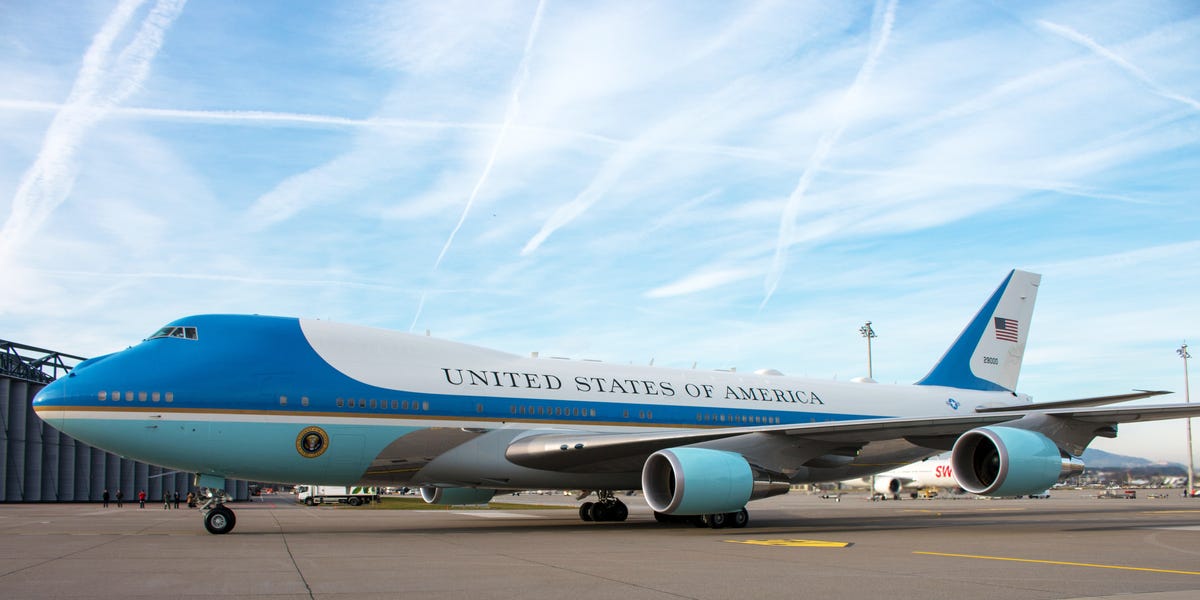
There are old airplanes, and then there is the president’s airplane: a flying White House with a paint job more famous than most celebrities and an age that would make a used-car salesman start speaking very carefully. The aircraft most Americans casually call Air Force One is not exactly young. The current presidential Boeing 747s entered service in the early 1990s, which means they are old enough to remember fax machines, cassette adapters, and people saying “the internet” like it was a mysterious weather pattern.
Yet these planes are not museum pieces. They still carry the president, staff, security personnel, journalists, and enough communications equipment to make an ordinary business jet feel like a paper airplane with Wi-Fi. The surprise is not that the aircraft are old. Many military aircraft fly for decades when maintained properly. The surprise is that the official replacement, the new VC-25B Air Force One, is still years away after a long series of delays, cost pressure, redesign work, production complications, and the very simple fact that building a presidential aircraft is not like ordering a new SUV with leather seats and a patriotic playlist.
This is the story of why the president’s plane is aging, why replacing it is so difficult, and why the next generation of Air Force One has become one of the most watched aviation projects in the United States.
First, Air Force One Is Technically Not One Plane
Here is the aviation trivia fact that ruins many dinner conversations: Air Force One is technically the radio call sign for any U.S. Air Force aircraft carrying the president. In everyday speech, however, people usually use the term to describe the two specially modified Boeing 747-200B aircraft assigned to presidential transport. Their Air Force designation is VC-25A, and their tail numbers are 28000 and 29000.
These aircraft are operated from Joint Base Andrews in Maryland and maintained for one of the most demanding transportation missions on Earth. When the president travels, the airplane is not merely a luxury aircraft. It is a command center, communications hub, emergency workspace, secure office, staff transport, press platform, and symbol of U.S. power rolled into one very large four-engine jet.
That combination is why replacing the presidential plane is so complicated. A normal airliner carries passengers from one airport to another. Air Force One must carry the president while supporting national command responsibilities, secure communications, medical readiness, and continuity of government. In other words, it is expected to be part airplane, part office building, part bunker, part newsroom, and part diplomatic stage. No pressure, Boeing.
How Old Is the Current Presidential Plane?
The first VC-25A, tail number 28000, flew as Air Force One on September 6, 1990, during President George H. W. Bush’s administration. The second aircraft followed soon after. That places the current aircraft at roughly three and a half decades of service. In normal consumer terms, this is like discovering that the president’s ride is from the same era as early cell phones, shoulder pads, and desktop computers that sounded like they were summoning aliens.
However, age alone does not mean unsafe. Military aircraft can remain highly capable for decades when they receive constant maintenance, inspections, upgrades, and careful operation. The U.S. Air Force does not treat these aircraft like an old family van with a mysterious noise under the hood. The VC-25A fleet is maintained by specialized teams, and the aircraft receive extensive attention because the mission allows no casual “we’ll fix it next weekend” attitude.
Still, age creates real challenges. Parts become harder to find. Older systems require more support. Maintenance can become more expensive. Some components are no longer produced in the same way, and modern communications demands have grown far beyond what designers imagined when the original aircraft were built. The airplane may still look timeless from the outside, but inside the program, keeping a 1990s presidential 747 ready for global duty is a serious technical job.
Why the Boeing 747 Became the Presidential Icon
The Boeing 747 has always had a special kind of drama. Its upper deck, long hump, and massive wings make it look like it is wearing a crown. That is why the “Queen of the Skies” nickname stuck. When the VC-25A entered presidential service, the 747 was the obvious symbol of American reach: huge, long-legged, powerful, and unmistakable on any airport ramp.
Inside the current Air Force One, the president has office space, conference areas, secure communications, staff areas, press seating, food service capability, and medical support. The aircraft can also be refueled in flight, giving it extraordinary range. That does not mean every trip involves aerial refueling, but the capability matters because presidential travel must be prepared for unexpected situations.
The exterior design also carries history. The famous blue-and-white livery traces its identity to the Kennedy era, when industrial designer Raymond Loewy helped create a look that felt presidential without looking like a flying parade float. The result became one of the most recognizable aircraft designs in the world. It is clean, elegant, and serious. It says “head of state,” not “airport shuttle with a flag sticker.”
The Replacement: Meet the VC-25B
The official replacement aircraft are known as the VC-25B. They are based on the Boeing 747-8, the final and largest generation of the 747 family. Compared with the older 747-200B platform, the 747-8 is longer, newer, more capable, and designed with more modern systems. The Air Force ordered two of them to become the next presidential aircraft.
But turning a 747-8 into Air Force One is not as simple as adding a conference table and painting “United States of America” on the side. The VC-25B requires secure mission communications, upgraded electrical systems, defensive systems, a medical facility, executive interiors, autonomous ground operations features, and specialized systems that allow the aircraft to support presidential duties during normal travel or national emergencies.
That is where the calendar started to lose its sense of humor. The 2018 agreement set a $3.9 billion firm-fixed-price contract for two completed presidential aircraft, with delivery originally aimed for 2024. That date has slipped. Current reporting and Air Force budget discussions point to the first official VC-25B arriving around mid-2028, with the overall program years behind the original schedule.
Why Is the New Air Force One So Delayed?
There is no single villain in this story, unless you want to blame “complexity,” which is satisfying but hard to put in a courtroom sketch. The delays involve several overlapping problems: supply chain issues, specialized labor needs, security clearance requirements, wiring design work, interior supplier transitions, and the challenge of modifying aircraft for an unusually sensitive mission.
Because the aircraft will carry the president, many workers involved in the program need appropriate security clearance. That narrows the labor pool. The aircraft also contains systems that cannot be treated like ordinary commercial-airliner equipment. Every change must be tested, certified, protected, and integrated with other mission systems. A delay in one section can ripple through the whole program like a dropped suitcase on a crowded boarding bridge.
The fixed-price structure adds another layer. In a firm-fixed-price contract, the contractor accepts more risk if costs grow. Boeing has already recorded major financial charges connected to the VC-25B program. For taxpayers, fixed-price contracts can sound attractive because they limit government exposure. For contractors, they can become painful when the job turns out to be more difficult than expected. In this case, “more difficult than expected” may be the understatement of the decade.
The 747 Production Line Is Gone, Which Makes Everything Trickier
Another awkward detail: Boeing has ended 747 production. The final 747 was delivered in 2023, closing more than half a century of production. That means the Air Force is preparing to operate a future presidential aircraft based on a model that is no longer rolling fresh off the assembly line. This does not make the aircraft obsolete, but it does make training, parts planning, and long-term sustainment more important.
To help with that transition, the Air Force has moved to acquire additional 747-8 aircraft for training and sustainment support. These extra aircraft are separate from the two official VC-25B replacements. They can help crews, maintainers, and planners learn the newer 747-8 platform while also supporting parts availability. That is not glamorous, but logistics rarely is. Logistics is the part of aviation that keeps the glamorous part from becoming a very expensive lawn ornament.
The Temporary “Bridge” Aircraft Adds a Twist
The story became even more unusual with the addition of a separate Boeing 747-8 connected to Qatar. This aircraft has been described as a temporary bridge aircraft while the official VC-25B program continues. It has attracted political criticism and public debate because of its origin, cost implications, and role in presidential transport. It is important to separate this aircraft from the official Boeing-built VC-25B replacements.
The bridge aircraft may help fill the gap, but it does not erase the fact that the official replacement program remains delayed. It also shows how urgent the aging-aircraft problem has become. When a temporary presidential 747 becomes part of the discussion, it is a sign that the schedule is no longer just a line in a budget document. It is a real operational issue.
Why Not Just Buy a Smaller Modern Plane?
At first glance, using a smaller twin-engine aircraft might seem logical. Modern long-range jets are efficient, comfortable, and cheaper to operate than a giant four-engine 747. Many world leaders use aircraft smaller than the VC-25A. But the U.S. presidential mission is unusually demanding. The aircraft must carry a large traveling party, secure communications gear, staff, security teams, press, food, medical capability, and specialized equipment.
It also needs range, redundancy, and symbolic impact. Air Force One is not just transportation. It is a visible piece of national identity. When it lands overseas, it functions like a flying embassy with wings. A smaller jet could perform some travel tasks, but replacing the full mission profile of the VC-25A is not simply a question of passenger seats and fuel burn.
That said, the 747’s era is ending in commercial aviation. Airlines have moved toward efficient twin-engine wide-body aircraft such as the Boeing 777, Boeing 787, and Airbus A350. The presidential fleet is therefore something of a magnificent exception: a four-engine jumbo jet still asked to perform a mission so unique that ordinary airline economics do not fully apply.
What Makes Air Force One Different From a Luxury Jet?
People often imagine Air Force One as a luxury aircraft, and yes, it is comfortable. But comfort is not the main point. A private luxury jet is built around convenience and prestige. Air Force One is built around command, security, reliability, and continuity. It must allow the president to communicate securely with military and civilian leaders, receive briefings, make decisions, and continue operating during a crisis.
The aircraft includes medical capability, secure communications, space for staff and advisers, accommodations for the traveling press, and support systems that go far beyond ordinary VIP aviation. Cargo aircraft often travel ahead to move vehicles, helicopters, and other support equipment. Presidential travel is not a single aircraft taking off. It is a carefully choreographed operation involving security, logistics, communications, and contingency planning.
That is why the replacement process is slow. Every system must work with every other system. Every modification must satisfy safety, security, and mission requirements. The result is an aircraft that looks like a 747 from the outside but is something far more specialized underneath.
The Cost Question: Why Is It So Expensive?
The price of the next Air Force One fleet often creates sticker shock. Billions of dollars for two airplanes sounds outrageous until you remember that these are not standard airliners. The government is paying for design, modification, testing, certification, unique communications systems, security features, defensive capabilities, specialized interiors, and long-term mission integration.
Still, cost overruns and schedule delays deserve scrutiny. Major defense programs have a long history of optimistic timelines and painful reality checks. The VC-25B program is now a case study in how difficult it can be to combine commercial aircraft, military requirements, presidential expectations, cybersecurity, secure communications, and national-symbol design into one project.
The humor is easy: America can land robots on Mars, but getting a new presidential 747 on time is apparently harder than convincing a toddler to leave a toy store. The serious point is that complexity carries cost. When a project has few direct comparisons, every problem is harder to predict.
Why the Old Plane Still Matters
Despite its age, the current VC-25A remains one of the most recognizable and capable aircraft in government service. It has carried presidents through historic moments, international summits, crises, campaigns, and state visits. Tail number 29000 played a critical role on September 11, 2001, when President George W. Bush and his staff were moved under extraordinary security pressure. Tail number 28000 carried President Barack Obama on his historic 2016 trip to Cuba. These aircraft are not just machines; they are part of the modern presidency.
That history is one reason the replacement feels so significant. The current aircraft are familiar. They look “right” to many Americans because they have appeared in news coverage for decades. Replacing them is not like changing office printers. It is changing one of the visual symbols of the presidency.
What Happens Next?
The next few years will be crucial. The Air Force must keep the VC-25A fleet mission-ready while the VC-25B program continues toward delivery. Boeing must complete modifications, testing, certification, and integration work on aircraft that need to meet extraordinary requirements. The government must manage costs, oversight, schedule pressure, and public expectations.
If the first official VC-25B arrives around mid-2028, the current aircraft will remain central to presidential travel for several more years. That means the “old” Air Force One will keep doing a very modern job: moving the president safely while acting as a command center in the sky.
Experience Section: What the Air Force One Delay Teaches Anyone Who Travels, Builds, or Plans Big Projects
The story of the president’s old plane and delayed replacement offers a surprisingly relatable lesson: replacing something important is often harder than buying something new. Anyone who has tried to upgrade a home computer, renovate a kitchen, restore an old car, or switch a business to new software knows the feeling. At first, the plan sounds simple. Then the contractor calls. Then the part is unavailable. Then the old wiring is weird. Then the “quick upgrade” becomes a season-long documentary called Why Did We Start This?
Air Force One is that experience at national scale. The current plane still works, but it is old. The replacement is better on paper, but it must be customized so deeply that “newer” does not automatically mean “ready.” This is a useful reminder that complex systems are not replaced in one clean jump. They overlap. The old system must keep working while the new one is built, tested, fixed, tested again, certified, and finally trusted.
Travelers see a similar version at airports every day. A new terminal may look beautiful, but if the baggage system fails, nobody cares about the ceiling design. A new aircraft may have better fuel efficiency, but if the crew is not trained and the maintenance network is not ready, it cannot deliver its full value. Big upgrades require people, parts, procedures, testing, and backup plans. The glamorous reveal is only the last five percent of the work.
The Air Force One replacement also shows why maintenance deserves more respect. Most people notice machines only when they fail. But the current VC-25A fleet keeps flying because teams inspect, repair, update, and protect it constantly. The same is true for bridges, hospitals, power grids, school buses, and yes, the family laptop that somehow survives 47 browser tabs. Maintenance is not the boring opposite of innovation. It is the reason innovation has time to arrive.
There is also a lesson about deadlines. A date on a contract can be firm, official, and beautifully printed, but reality does not read press releases. Supply chains break. Skilled workers are scarce. Requirements change. Special parts disappear. Projects involving security and custom engineering are especially vulnerable to delays because there are fewer shortcuts. When the mission is presidential travel, “close enough” is not a strategy.
Finally, the story explains why symbols are hard to replace. Air Force One is more than transportation. It is a moving image of national leadership. People recognize its colors, shape, and arrival ceremony. Changing that symbol takes time because the aircraft must satisfy engineering demands and public expectations. The next Air Force One must fly safely, communicate securely, support the president, and look like it belongs in history books. That is a lot to ask from one airplane, even one as large as a 747.
So yes, the president’s plane is surprisingly old. But it is also surprisingly capable, carefully maintained, and still central to American leadership. Its replacement is coming, just not quickly. Until then, the current Air Force One will keep doing what it has done for decades: taking off under bright lights, carrying enormous responsibility, and reminding everyone that even the most powerful office in the world sometimes has to wait for the new model.
Conclusion
The current presidential aircraft may be old by ordinary aviation standards, but it remains a remarkable machine. The VC-25A fleet combines history, engineering, symbolism, and national security in a way few aircraft ever have. Its replacement, the VC-25B, promises newer technology and improved capability, but the path to delivery has been slowed by cost, complexity, and the extraordinary demands of presidential transport.
The result is a fascinating contradiction: one of the most powerful symbols of modern America is flying on an aircraft platform that began presidential service in 1990, while its high-tech successor is still years away. For now, the old Air Force One remains on duty, proving that age is not everythingespecially when the maintenance team is probably more attentive than a five-star hotel concierge with a checklist and a security clearance.
SEO Tags
Note
This article is based on publicly available information from official U.S. government, aviation, defense, and aerospace sources as of May 2026. Program schedules, delivery dates, aircraft roles, and budget details may change as the VC-25B replacement effort continues.