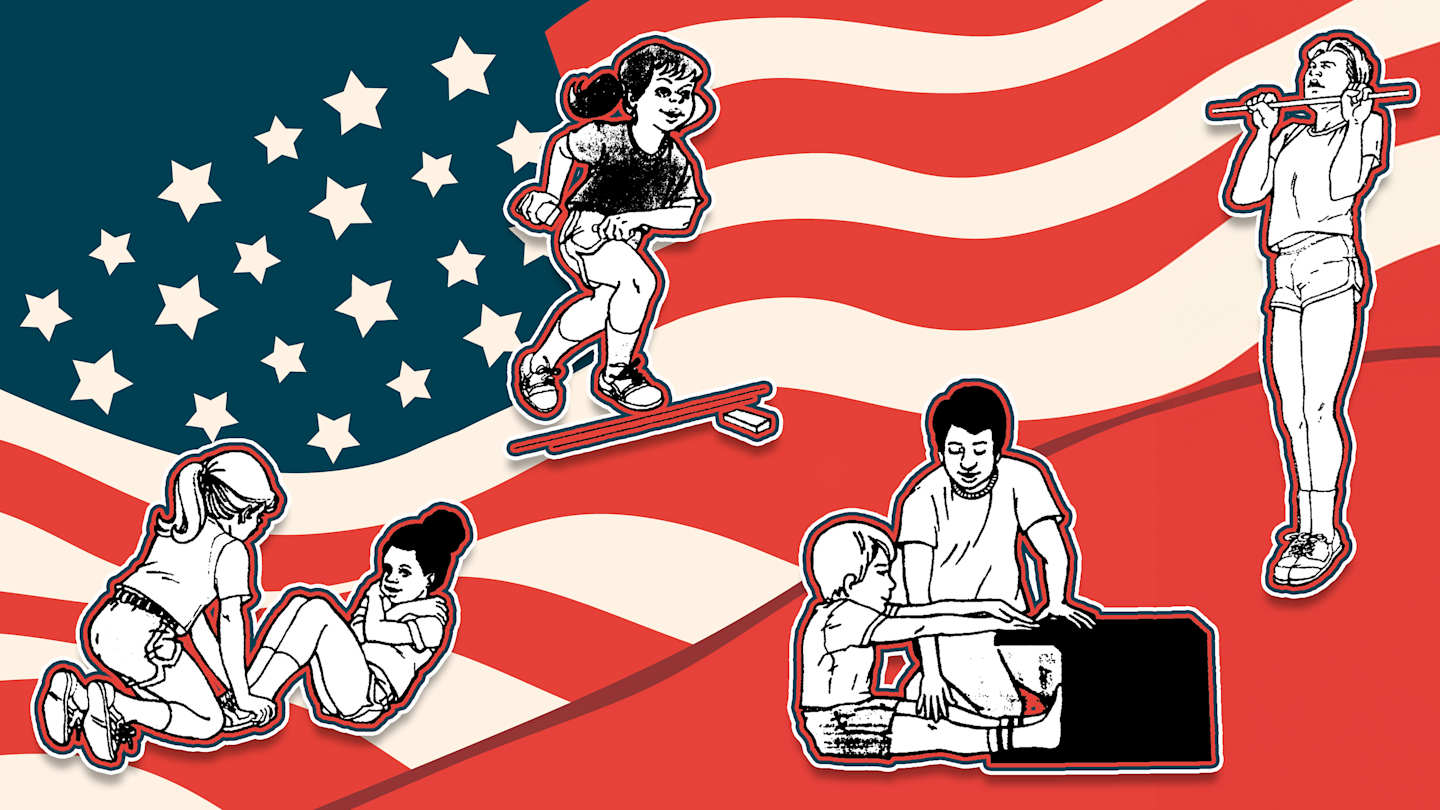
If you grew up in an American school, chances are you remember at least one of these scenes: a mile run that felt spiritually longer than a presidential term, sit-ups performed with the grim determination of a campaign staff in October, or the shuttle run, which somehow made a gym floor feel twice as slippery and three times as judgmental. The Presidential Fitness Test became one of the most recognizable rituals in American physical education. But its origins were not simply about gym class, exercise, or seeing who could crank out the most pull-ups before lunch.
The roots of the Presidential Fitness Test run deep into Cold War anxiety, national pride, changing ideas about childhood health, and a uniquely American habit of turning big social worries into organized programs with official seals. What eventually became a familiar school fitness test started as something much larger: a national debate over whether American children were getting too soft for a country that liked to describe itself as strong, competitive, and ready for anything.
In other words, this was never just about toe touches. It was about the nation looking in the mirror, spotting a little slouch, and deciding the republic needed more calisthenics.
It Began With a National Panic in the 1950s
The story usually starts in the mid-1950s, when researchers and reformers drew public attention to an uncomfortable comparison: American children appeared less physically fit than children in parts of Europe. A study using the Kraus-Weber tests for minimum muscular fitness and flexibility found that a much higher percentage of U.S. children failed at least one part of the test than European children. That comparison landed like a thunderclap in a country already obsessed with competition, military readiness, and Cold War image-making.
This mattered because the United States was not living in a relaxed era. The nation had recently come through World War II, was shaped by the Korean War, and was now locked in a global rivalry with the Soviet Union. Strength was not just a personal virtue; it was a national brand. In that atmosphere, weak abs could sound suspiciously like weak civilization.
So when reports suggested that about 56 percent of American children failed at least one fitness component, compared with only about 8 percent of European children, the issue did not stay tucked away in medical journals or education conferences. It exploded into public conversation. Physical fitness became a matter of citizenship, preparedness, and national character. American adults were not merely asking whether kids were active enough. They were asking whether the country itself was losing its edge.
Eisenhower Turned Concern Into Federal Action
President Dwight D. Eisenhower did not invent concern about youth exercise, but he did give it a federal structure. In July 1956, he issued Executive Order 10673, establishing the President’s Council on Youth Fitness. The goal was to coordinate and encourage programs that would improve the fitness of American youth. That move gave the problem official status. It was no longer a scattered worry shared by doctors, teachers, and newspaper columnists. It now had a place in the machinery of government.
The early emphasis reflected the times. Fitness was tied to military preparedness, moral seriousness, and the idea of producing vigorous citizens. Eisenhower’s administration was responding to a broader fear that modern life was making Americans more sedentary. Mechanization was reshaping work. Television was becoming a powerful domestic force. Children, critics worried, were spending less time climbing, running, and moving, and more time sitting still and absorbing the soft comforts of postwar prosperity.
That combination of prosperity and panic is a big part of the Presidential Fitness Test’s origin story. The United States had become richer and more convenient, but convenience came with a new fear: what if comfort was making the country complacent?
The Original Idea Was Bigger Than a School Test
Here is the important twist: the Presidential Fitness Test did not appear overnight in the exact form many adults remember. What came first was a movement. The federal government wanted to raise the fitness level of American youth, encourage local programs, and give schools a framework for measuring progress. The test emerged from that larger campaign.
In 1958, the American Alliance for Health, Physical Education and Recreation published the first national Youth Fitness Test battery. That early battery focused heavily on performance-based skills. The logic of the era was clear: fitness was measured by what children could do, not just by what habits they were building. This was a practical and symbolic choice. It made fitness visible, measurable, and easy to compare.
And Americans do enjoy a scoreboard. Once fitness could be tested, ranked, and awarded, it became easier to turn national concern into school policy. A problem that had once sounded abstract now had stopwatches, score sheets, and very little sympathy for kids who had just eaten cafeteria spaghetti.
Kennedy Gave the Movement Its Swagger
If Eisenhower institutionalized youth fitness, John F. Kennedy gave it style, momentum, and a megaphone. Even before taking office, Kennedy signaled that physical fitness would matter to his presidency. After the 1960 election, he published the influential Sports Illustrated essay “The Soft American,” arguing that physical fitness was not a private luxury but a public necessity.
That message landed hard because Kennedy understood symbolism. He embodied youth, vigor, and motion. His administration quickly reorganized the council and elevated Charles “Bud” Wilkinson, the famous University of Oklahoma football coach, to direct the effort. Under Kennedy, the council became more visible, more media-savvy, and more closely associated with presidential leadership itself.
Kennedy’s approach made fitness seem modern, patriotic, and urgent. He was not treating it as a side issue for gym teachers to sort out quietly behind a rack of dodgeballs. He made it part of the national conversation. In doing so, he helped transform a bureaucratic initiative into a cultural phenomenon.
“The Soft American” and the Cold War Body
Kennedy’s central insight was political as much as athletic. A fit population suggested discipline, resilience, and national seriousness. An unfit population suggested drift. His rhetoric linked the physical condition of citizens to the future strength of the nation. In the Cold War context, that was powerful language. It implied that exercise was not merely self-improvement. It was part of democratic readiness.
This is why the origins of the Presidential Fitness Test cannot be separated from the larger anxieties of the age. The test was not born because policymakers suddenly fell in love with shuttle runs. It was born because the nation wanted a way to respond to a perceived weakness and to do so in a form that schools could implement at scale.
From Public Policy to Pop Culture
Kennedy’s fitness campaign was also famously media-friendly. The fifty-mile hike became a national sensation. So did promotional materials, school programs, and the wonderfully odd “Chicken Fat” song, written by Meredith Willson and sung by Robert Preston, which encouraged children to exercise in schools across the country. That campaign helped turn youth fitness from a policy concern into an everyday school experience.
Once fitness entered popular culture, it became easier to standardize. Schools were not just receiving a recommendation to promote physical activity; they were participating in a national story. The gym class test became a small local performance of a big national ideal.
When the Presidential Fitness Test Became a Familiar School Ritual
By the mid-1960s, the movement had matured into what many people came to know as the Presidential Fitness Test or the broader President’s Challenge framework. A 2010 White House task force report noted that the President’s Challenge was originally established in 1966 as the Presidential Physical Fitness Award. Over time, the test and awards system became one of the best-known ways American schools measured youth fitness.
The version many adults remember did not perfectly match the earliest 1950s test battery. Instead, the program evolved. In its later, most familiar form, it commonly included a one-mile run, sit-ups, pull-ups or push-ups, shuttle run, and sit-and-reach. These events were designed to measure endurance, strength, flexibility, and agility. They were simple enough to administer in schools and dramatic enough to feel like an event.
That matters because the test’s popularity depended on its practicality. Schools needed something repeatable, inexpensive, and easy to organize for large groups of students. The test fit that need. It also fit a broader cultural appetite for measurable performance. If you could run faster, jump farther, or do more repetitions than last year, that progress felt concrete. It looked like evidence that the national project was working.
Why the Original Test Focused on Performance, Not Wellness
One of the most interesting parts of this history is how much the early fitness movement emphasized performance-based measures rather than lifelong health. The first national youth fitness battery highlighted items like running speed, jumping, throwing, and upper-body strength. That reflected the dominant thinking of the period. Fitness was closely tied to athleticism, physical capability, and visible performance.
Today, that can seem a little old-school, because it was. The original concept was less about helping every child build sustainable healthy habits and more about measuring whether young people met a standard. It rewarded outcomes. It compared children to one another. It favored performance metrics that were easy to score and easy to celebrate.
From a historical point of view, this makes perfect sense. The program came out of a moment obsessed with readiness, competition, and proving American strength. It was not yet shaped by later public-health ideas that emphasized individualized progress, lifelong activity, and reduced stigma for children who were not natural athletes.
How the Philosophy Changed Over Time
The Presidential Fitness Test did not stay frozen in the 1950s. As physical education evolved, so did the ideas behind youth fitness assessment. SHAPE America’s historical materials note that the 1958 Youth Fitness Test was primarily skill-related and performance-based, while later decades increasingly distinguished health-related fitness from pure athletic performance. By 1980, a more health-related fitness test had emerged, and in time FITNESSGRAM became the major national model tied to health-focused assessment.
The biggest philosophical shift came in 2012, when the old model was formally revamped into the Presidential Youth Fitness Program. The new emphasis moved away from comparing children against one another and toward helping students pursue personal health goals. Official program language highlighted lifelong physical activity, health-related fitness, and minimizing comparisons between children.
That change says a lot about the origins of the original test. It reveals what the first version was not. It was not designed primarily around modern concerns about inclusion, student confidence, or individualized growth. It came from an older American mindset: if the nation seems soft, measure the softness, rank it, and try to fix it.
What the Presidential Fitness Test Really Reveals About America
The Presidential Fitness Test is often remembered as a quirky school tradition, somewhere between a civic ritual and a PE class stress dream. But its origin story reveals much more. It reflects a country anxious about decline, fascinated by measurement, and eager to use schools as a stage for national improvement.
It also reveals the American tendency to make large cultural arguments through children’s institutions. When adults worried about national weakness, they looked to schools. When they wanted proof of renewed strength, they looked to schools again. The gymnasium became a place where abstract fears about democracy, defense, masculinity, discipline, and modern life were converted into mile times and pull-up counts.
That is why the Presidential Fitness Test stuck in memory so powerfully. It was never only a test. It was a story about what the nation expected from its young people and what it feared they might become without structure, sweat, and at least one adult holding a clipboard.
The Experience of the Test: Sweat, Suspense, and the Sound of Sneakers on Waxed Floors
Even though the origins of the Presidential Fitness Test are rooted in policy and Cold War politics, its legacy lived in something much more ordinary: the experience of being a kid in a school gym. For generations of students, the test or one of its descendants was not an abstract federal initiative. It was a real day on the calendar, with real nerves, real laughter, and the unmistakable squeak of sneakers on a polished floor.
What made the experience memorable was the strange mix of seriousness and absurdity. On one hand, it was just gym class. On the other hand, the whole setup made it feel like a miniature national trial. Teachers held score sheets like election officials. Stopwatches clicked. Classmates counted each other’s sit-ups with varying levels of mathematical honesty. Someone always looked weirdly confident about the shuttle run, and someone else acted as if the mile was a form of constitutional punishment.
For athletic kids, the test could feel like a stage. It was one of the few school moments where speed, strength, and coordination became public currency. A fast mile or a clean set of pull-ups could turn a regular Tuesday into a personal parade. For less athletic students, the experience could feel very different. The test could be awkward, intimidating, or quietly humbling. That tension became part of the program’s long legacy and later fueled criticism of ranking children too aggressively.
Still, the shared experience mattered. Students remember waiting their turn for the sit-and-reach box, bargaining with their hamstrings, or trying to look calm before the mile run while secretly reconsidering every life choice that led to that exact morning. They remember classmates cheering, joking, groaning, and negotiating with gravity. In many schools, they also remember the cultural oddities attached to the program: posters, award certificates, and in earlier decades, even routines set to songs like “Chicken Fat.”
Those experiences turned the Presidential Fitness Test into more than a government-backed measurement tool. It became a piece of American school culture. It created a common language of effort and embarrassment, accomplishment and complaint. Mention the shuttle run to the right audience and you do not just start a conversation; you unlock a support group.
That everyday memory is part of why the topic still resonates. The origins may lie in reports, executive orders, and presidential rhetoric, but the afterlife of the test lived in school hallways, locker rooms, blacktop tracks, and multipurpose gyms. The policy became personal. The national concern became a childhood memory. And that is probably the clearest sign that the program succeeded, at least culturally. It made physical fitness feel like something the country cared about enough to institutionalize, dramatize, and hand directly to children in sneakers.
So yes, the origins of the Presidential Fitness Test involve Eisenhower, Kennedy, federal councils, and public-health debates. But the emotional legacy lives in the ordinary details: the whistle blast, the chalky gym air, the clipboard, the mile marker, the last desperate reach toward your toes, and the deep suspicion that the person counting your sit-ups may have been exercising executive discretion. History rarely arrives in such a sweaty package, but in this case, it absolutely did.
Conclusion
The origins of the Presidential Fitness Test tell a distinctly American story. It began with fear that the nation’s children were falling behind physically, grew through federal action under Eisenhower, gained cultural force under Kennedy, and became a school ritual through a mix of policy, publicity, and performance-based measurement. Its earliest forms reflected a country that prized toughness, comparison, and visible results. Later reforms reflected a different national mood, one more concerned with health, inclusion, and lifelong habits.
That evolution is what makes the story so compelling. The Presidential Fitness Test was never just about whether a child could run fast or touch their toes. It was a mirror held up to the country’s beliefs about strength, citizenship, education, and what schools are supposed to do. For a program remembered through mile runs and sore muscles, it carries a surprisingly big historical weight. Beneath every stopwatch was a national argument about what kind of country America wanted to be.