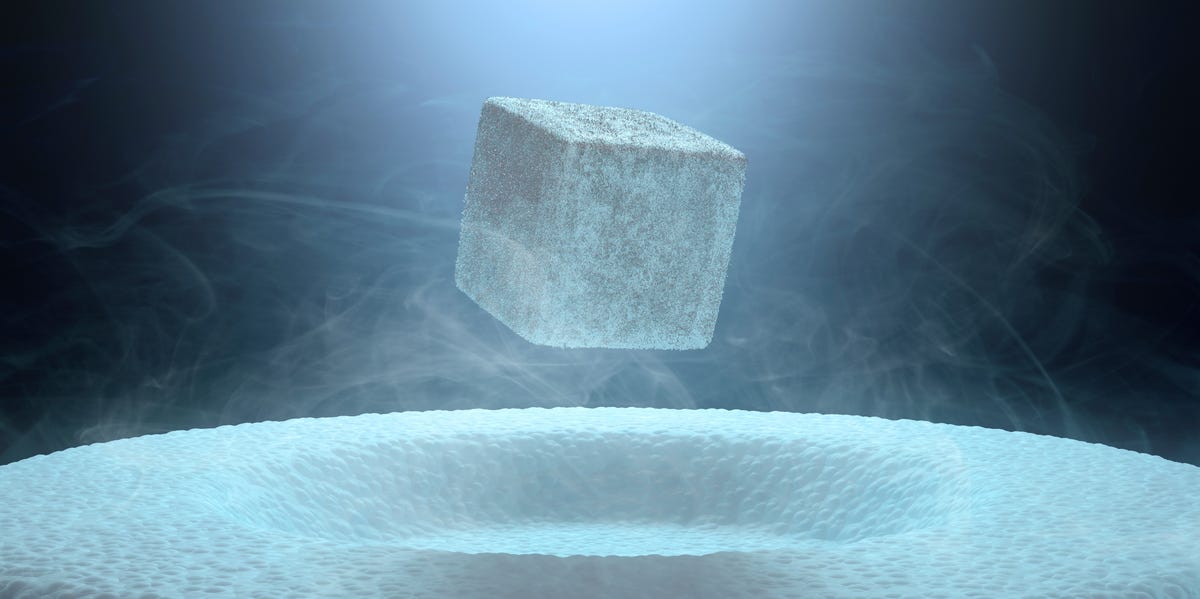
There are glamorous gemstones, and then there are useful gemstones. Strontium titanate falls firmly into the second category. It is not the crystal you buy to celebrate an anniversary. It is the crystal you might one day thank for helping quantum computers behave a little less like caffeinated squirrels in a thunderstorm.
That may sound dramatic, but quantum hardware earns the drama. Today’s most powerful quantum systems are astonishingly sensitive machines that need to operate at temperatures hovering near absolute zero. They do not merely prefer the cold. They demand it. A bit of extra heat, a little vibration, a noisy control line, or a poorly behaved interface can scramble fragile quantum states and turn a futuristic processor into an expensive science project with commitment issues.
That is why researchers are hunting for materials that do more than survive the cold. They want materials that improve in it. And that is where strontium titanate, a crystal once used as a diamond substitute in jewelry, has suddenly become the nerdy hero of the quantum world. New research suggests it may be unusually good at the kind of optical and electromechanical work that future quantum systems need most. Not because it makes quantum chips magically easy, but because it could make key cryogenic components better, more efficient, and potentially much quieter in the engineering sense of the word.
And in quantum computing, “quieter” is beautiful.
Meet the Unlikely Star: Strontium Titanate
Strontium titanate, often shortened to STO, does not sound like a gemstone because, frankly, it sounds like something a chemistry professor would assign for homework. Yet for decades it has been known as a bright, diamond-like crystal. It has also been studied as a “textbook” material in solid-state physics, the kind of substance researchers know well enough to stop bragging about at conferences. Which is exactly why its recent comeback is so fun.
Scientists at Stanford found that STO does something rare and valuable at cryogenic temperatures: instead of losing the properties engineers care about, it gets dramatically better. That matters because many materials with strong electro-optic or piezoelectric behavior become less useful when chilled. Quantum hardware, of course, insists on being chilled anyway. So engineers have been stuck in a mildly cruel materials-science plot twist: the machines need the cold, but the parts around them often hate it.
STO appears to break that pattern. At very low temperatures, it shows extremely strong electro-optic and piezoelectric nonlinearities. In plain English, electric fields can use it to steer light and mechanical motion with unusual strength. That makes it interesting for photonic switches, microwave-to-optical transducers, cryogenic positioners, and other devices that help a quantum computer move information around without wrecking it along the way.
Why Quantum Chips Love the Cold and Hate the Consequences
Cold keeps quantum states from unraveling
Many quantum platforms, especially superconducting ones, live inside dilution refrigerators because excess heat creates thermal noise that can destroy coherence. IBM has described these systems as sitting inside refrigerator hardware that helps qubits maintain superconducting behavior while facing as little thermal noise as possible. MIT researchers have also emphasized the same basic headache: heat causes errors in qubits, so the whole machine has to be kept just above absolute zero.
That part is hard enough. But the cruel joke is that a quantum computer cannot simply sit in a cold metal cocoon and meditate. It needs control electronics, readout systems, and communication links to the outside world. Those cables, interfaces, and support systems bring heat into the refrigerator. Add more qubits, and you usually add more wiring, more complexity, and more opportunities for trouble. Scaling quantum hardware is not just a software problem or a qubit problem. It is also a plumbing problem, an optics problem, and a “why is this one cable warming the whole setup?” problem.
Quiet matters almost as much as cold
When engineers call a quantum system “quiet,” they are not asking everyone in the lab to whisper. They mean low noise: less thermal agitation, fewer stray vibrations, lower electromagnetic interference, and less unwanted signal loss at crucial interfaces. Microsoft, IBM, NIST, and other groups all frame the challenge this way. Environmental disturbances corrupt qubits. Heat and control hardware can destabilize them. And when different kinds of quantum hardware need to talk to each other, the conversion step itself can add loss and noise.
That last point is especially important. Superconducting quantum processors speak microwave. Long-distance networks prefer optical photons traveling through fiber. A future modular quantum computer may need both. That means somebody has to translate. NIST describes this as quantum transduction: converting information between physical systems without losing quantum coherence. Easy to say. Painfully hard to do.
What Makes STO So Interesting
It does not just survive the cold. It flexes in it.
Stanford’s team found that STO’s electro-optic response at cryogenic temperatures is extraordinarily strong. The university’s reporting says the crystal shows electro-optic effects up to 40 times stronger than the most-used electro-optic material today. In tests at 5 kelvin, its nonlinear optical response was reported to be about 20 times greater than lithium niobate, a leading nonlinear optical material, and nearly three times better than barium titanate, which had been a top cryogenic performer.
That is not a small improvement. That is the sort of result that makes materials scientists sit up straighter and quietly cancel a few assumptions.
STO is also piezoelectric at cryogenic temperatures, meaning it can physically expand and contract in response to electric fields. That opens the door to electromechanical devices that can work in extreme cold without turning into sad little underperformers. In hybrid quantum systems, where light, sound, and electric fields may all need to cooperate on a chip, this is a big deal. Stronger coupling between these effects can make key components smaller, more efficient, and more useful.
The important nuance: this is not a miracle chip material
Here is the sober part. STO is not a magic dust you sprinkle over a quantum processor until error correction becomes easy. It does not automatically replace qubits, dilution refrigerators, cryogenic control electronics, or the brutal engineering discipline required to scale quantum machines.
What it could do is improve the supporting hardware that surrounds qubits: the switches, transducers, and cryogenic photonic or phononic devices that move signals around and link systems together. That still matters enormously. Quantum computing is increasingly a full-stack problem. If your interfaces are lossy, your transducers are noisy, or your control hardware dumps too much heat into the cryostat, the fanciest qubits in the world will not save you.
The Physics Trick Hiding Inside the Crystal
One reason STO is so compelling is that it lives close to a fascinating boundary in physics. It is often described as a quantum paraelectric, which is a wonderfully intimidating phrase for a material that is basically flirting with ferroelectricity without fully committing. A ferroelectric material has a built-in electric polarization. STO sits near that behavior, and near cryogenic temperatures the competition between order and fluctuation becomes especially interesting.
SLAC researchers recently explored how ultra-thin strontium titanate membranes can be pushed into ferroelectric behavior by strain, while Penn State researchers showed related low-temperature behavior in strontium titanate nanomembrane electronics tied to incipient ferroelectricity. Translation: STO seems to be parked in a scientifically delicious neighborhood where a small nudge, like strain, temperature, or isotope tuning, can dramatically change how it behaves.
Stanford’s researchers exploited exactly that. By substituting some oxygen atoms in the crystal with a heavier isotope, they nudged STO closer to quantum criticality. In perhaps the most delightfully precise sentence in this whole story, adding two neutrons to 33 percent of the oxygen atoms boosted the tunability by a factor of four. That is the kind of materials engineering result that makes you realize the future may be built not just with cleaner software, but with fussier oxygen.
How a Gemstone Could Help Build Colder, Quieter Quantum Chips
1. Better transducers for modular systems
One of the biggest long-term challenges in quantum computing is connecting separate processors. NIST has made it clear that large-scale distributed or modular quantum systems will need transducers that convert fragile microwave quantum states into optical photons and back again. If STO can support much more efficient cryogenic electro-optic devices, it could become part of the toolkit for making that translation cleaner and less lossy.
That matters because every bit of loss or added noise during conversion is bad news. A powerful transducer is not just a convenience. It is the customs officer for a future quantum internet, deciding whether delicate quantum information gets through in one piece or arrives looking like it lost a bar fight.
2. Lower overhead inside the cryostat
MIT and Microsoft have both highlighted a brutal reality of scaling quantum systems: room-temperature electronics and one-to-one control lines dump heat into cold environments. If cryogenic components become more efficient, more tunable, and less power-hungry, you reduce some of that burden. Not eliminate it, but reduce it.
That is where the phrase “colder chips” starts to make sense. STO does not refrigerate a processor by itself. Instead, it may help create components that work better while already cold, needing less brute-force support and introducing fewer disruptions. In practice, that can help the whole stack stay closer to the low-noise regime quantum hardware needs.
3. Quieter operation in the engineering sense
Noise is not just a qubit problem. It is a system problem. Better materials for switches, modulators, and electromechanical interfaces can help lower insertion loss, reduce unwanted coupling, and support cleaner signal handling at cryogenic temperatures. Stanford’s tech transfer materials go so far as to suggest that STO-based transducers could deliver efficiencies orders of magnitude beyond the current state of the art in some on-chip microwave-to-optical applications.
That is why STO is exciting. It may let engineers accomplish the same jobs with less drama.
Why Industry Is Paying Attention
This is not just a nice academic curiosity with a pretty crystal structure. Stanford noted that the work drew support from Samsung and Google’s quantum computing team. That is a strong hint that the materials bottleneck is now getting serious attention from companies that understand the whole system challenge.
Big tech has already learned that quantum computing will not be won by a single heroic qubit architecture alone. IBM has pushed superconducting systems. Microsoft is betting on topological qubits and atom-by-atom materials stacks. MIT has explored wireless cryogenic links to cut cable heat. NIST is working on hybrid architectures and transduction. The common thread is clear: scaling quantum hardware means fixing a lot of boring, beautiful engineering problems all at once.
STO fits neatly into that bigger story. It is not the headline-grabbing end product. It is the enabling material that might make other hard things easier. In advanced computing, that is often how revolutions actually happen.
What the Experience of This Technology Really Feels Like
Talk to people who work around cryogenic quantum hardware and you quickly discover that the experience is less like using a computer and more like negotiating with a small weather system. Everything is temperature, drift, vibration, calibration, and patience. The machine is cold enough to make outer space look warm, yet somehow still vulnerable to the tiniest nonsense. One imperfect cable, one noisy amplifier, one badly behaved material interface, and the whole setup starts acting like it has trust issues.
That is why a material story like STO feels bigger than a single paper. In real labs, progress often comes in annoyingly modest steps. A signal gets a little cleaner. A device needs a little less voltage. A component keeps its useful properties at 5 kelvin instead of giving up and becoming decorative. A transducer adds a little less background noise. None of those achievements make for flashy movie trailers, but together they are the difference between a system that barely works on Tuesday and one that works reliably enough to build on for the next three years.
There is also a very human side to this. Researchers do not experience quantum computing as abstract equations floating in a vacuum. They experience it through cooldown schedules, equipment logs, test structures, and long hours spent asking why a beautiful design suddenly became useless after integration. A more forgiving material changes that experience. It gives engineers more room to design boldly and less time chasing avoidable failure modes. It turns impossible-feeling constraints into merely annoying ones, which in research counts as a love letter.
Imagine the difference between building a bridge out of a material that gets brittle in winter and building one out of something that gets stronger when the temperature drops. That is roughly why STO is creating so much buzz. Quantum engineers are used to materials that behave well on PowerPoint slides and less well inside a cryostat. A crystal that becomes more capable in the environment where quantum hardware actually lives is not just interesting. It is emotionally reassuring. For once, the refrigerator is not the villain in the story.
The experiential payoff could also show up in how future systems are designed. A modular quantum computer, for example, may need superconducting processors deep in a dilution refrigerator, optical links to carry information over fiber, and transducers that bridge those worlds without wrecking coherence. If STO improves those bridges, the architecture becomes less like a fragile Rube Goldberg machine and more like an actual computing platform. That is the dream: fewer heroic workarounds, fewer thermally induced headaches, and less constant bargaining with the laws of physics.
And yes, there is something delightful about the symbolism too. A material once admired because it looked like a diamond may become valuable because it behaves better than expected in the cold. It is the scientific version of discovering that the quiet kid in the back row is secretly the one who knows how to fix the entire group project. Quantum computing has no shortage of flashy concepts. What it needs, more often than not, are dependable materials that do the hard jobs without adding chaos.
If STO keeps delivering, that may be its real contribution. Not glamor. Not hype. Just steadier, colder, quieter hardware. In this field, that is practically poetry.
Conclusion
Strontium titanate is unlikely to become a household name, and that is probably fine. Quantum computing history will remember the big processor launches, the million-qubit promises, and the flashy demos. But the real future of the field may depend just as much on enabling materials that make cryogenic systems cleaner, calmer, and easier to scale. STO looks like one of those materials.
It is a former jewelry crystal with elite low-temperature skills, a strong electro-optic and piezoelectric performer, and a reminder that quantum progress is often about improving the whole stack rather than worshipping a single chip. The gemstone angle is fun. The engineering implications are serious. And if this crystal helps quantum hardware run a little colder and a lot quieter, that will be more valuable than sparkle ever was.