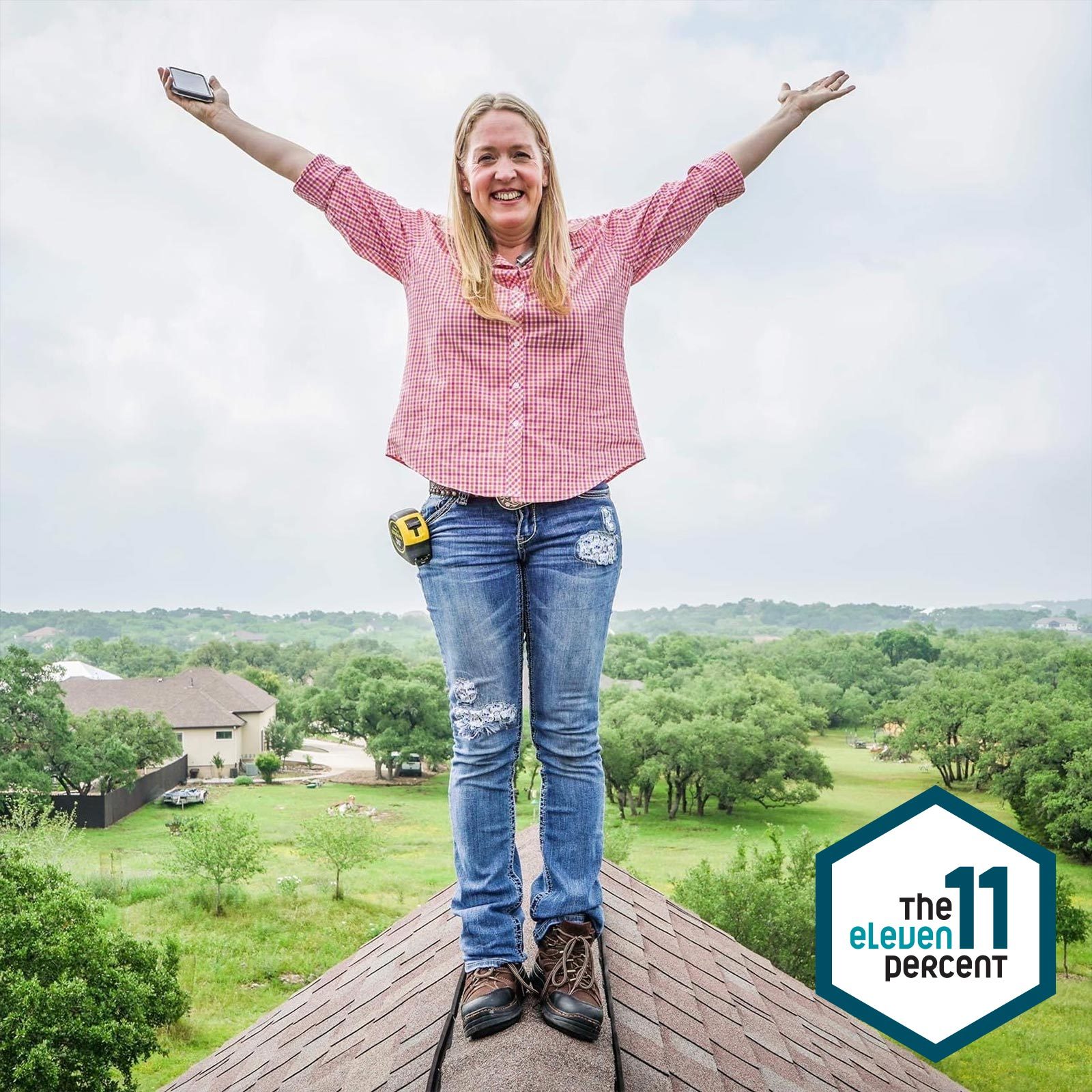
Some people “find their calling” in a quiet office with a nice ergonomic chair and a coffee mug that says Let’s circle back. Ami Feller found hers on a roof.
That contrast tells you almost everything you need to know about her story. Feller is not just a roofing contractor in New Braunfels, Texas. She is part of a larger shift in the skilled trades, where more women are stepping into jobs that were historically treated like a men-only club with a very dusty membership card. The title The Eleven Percent comes from a well-known framing of women’s representation in construction, and while the exact share has grown in recent years, the bigger truth remains the same: women are still dramatically underrepresented in the building trades, especially in roofing.
That is why Ami Feller matters. Her career combines technical skill, entrepreneurship, workforce advocacy, and community involvement in a way that makes her story bigger than one company or one market. She represents what modern roofing can look like when leadership is practical, inclusive, and unafraid to get a little dirt on its boots.
Who Is Ami Feller?
Ami Feller is the owner of Roofer Chicks, a woman-owned roofing company based in New Braunfels, Texas. Long before she was known as the face behind a recognizable local brand, she was a teenager working summers on her brother’s roofing crew in Iowa. She started on the ground crew doing cleanup, which is usually how the trade introduces itself: with debris, sweat, and zero glamor. Then she got her chance to move up onto the roof. Once that happened, the rest of the story practically wrote itself.
Feller studied at Iowa State University, earning degrees in transportation and logistics and German, which is not the most obvious academic route into shingles and flashing. Still, it turns out that business discipline, logistics thinking, and communication matter a lot in roofing. A good roof does not happen by vibes alone. It takes scheduling, materials, crew coordination, inspection discipline, and the ability to explain complicated problems to homeowners who did not plan to spend their week talking about underlayment.
After time in corporate roles, including work with companies such as DHL Express and Coca-Cola, Feller returned to roofing and eventually launched her own company in 2016. That move was not a tiny career pivot. It was a full leap from corporate structure back into a trade she already knew, loved, and understood from the inside out. In 2021, the company rebranded to Roofer Chicks, a name that is memorable, a little bold, and impossible to confuse with a beige consulting firm.
Why “The Eleven Percent” Still Matters
The phrase The Eleven Percent resonates because it captures a long-running imbalance in construction. Even as women’s participation in the construction workforce has improved, the field remains heavily male-dominated, and roofing is one of the most extreme examples. Industry organizations and employers have spent years pointing out the same problem: there is a labor shortage, there is demand for new workers, and yet the industry still struggles to recruit from half the population.
This is not just a fairness conversation. It is a business conversation. The roofing profession is projected to keep growing, driven by reroofing, storm repair, new construction, and even rooftop solar-related demand. At the same time, the broader construction industry needs a huge pipeline of skilled workers every year. In plain English: roofs keep aging, storms keep storming, and somebody still has to climb up there and do the job right.
Feller has spoken openly about how frustrating it is that so many women are never seriously encouraged to consider roofing at all. Her argument is refreshingly practical. If the industry is desperate for talent, why automatically ignore a massive pool of capable workers? That question is not radical. It is common sense wearing work boots.
A Roofing Career Built From the Deck Up
What makes Ami Feller especially compelling is that her credibility was not assembled in a branding workshop. She worked in the trade. She cleaned up jobsites. She learned operations. She became a foreman. She saw the work from labor, management, customer service, and ownership angles. That layered experience shows up in how she talks about roofing today.
Feller often describes being on a roof as peaceful, even spiritual. That probably sounds odd to anyone who thinks of roofing only as heat, ladders, and insurance paperwork. But tradespeople often talk this way when they truly love their craft. On a roof, you see the structure, the landscape, the weather pattern, the problem, and the fix all at once. It is technical work, but it is also deeply visual and tactile. For someone who is wired to solve problems in the real world, that is a pretty hard job to beat.
Her company’s public identity also reflects a broader philosophy. Roofer Chicks emphasizes communication, clean jobsites, transparent proposals, and a no-pressure customer experience. That is smart branding, yes, but it is also smart operations. Homeowners do not just buy shingles. They buy trust. They buy responsiveness. They buy the feeling that the contractor will still answer the phone after the check clears.
Roofer Chicks and the Business of Standing Out
In a crowded roofing market, standing out usually requires more than a catchy logo on a truck. Roofer Chicks has built its identity around a few qualities homeowners actually care about: detail, communication, workmanship, and accountability. According to the company’s public materials, it handles residential and commercial roofing, with strong emphasis on reroofs, repairs, and exterior protection. The brand has also expanded its offerings over time, which is a common move for contractors who understand that homeowners rarely experience roofing issues in isolation. Windows, doors, weather resilience, and exterior maintenance often travel in the same unhappy parade.
The company’s certifications also matter. Roofer Chicks is publicly listed with GAF as a Certified Plus contractor, and the business promotes FORTIFIED roof expertise along with other manufacturer and installation credentials. For consumers, those labels are not magic spells, but they do signal a commitment to training, systems knowledge, and quality standards. In a trade where bad installation can turn a major purchase into a very expensive regret, credentials help separate professionals from the “my cousin has a ladder” crowd.
Feller’s work also aligns with the growing interest in resilient roofing. Programs like FORTIFIED, developed to strengthen homes against severe weather, have become more relevant as homeowners think less about a roof as a decorative cap and more as a critical defense system. In Texas and across storm-prone regions, that perspective is not theoretical. It is survival mixed with property protection.
Women in Roofing: More Than a Nice Headline
Ami Feller’s story works because it is inspiring, but it also works because it is useful. She has repeatedly emphasized that roofing can offer women a real path into a stable, skilled career without demanding a long and expensive educational runway. That point matters in a country where many workers are rethinking debt, wages, job security, and what “professional success” is supposed to look like.
Roofing is demanding work. Nobody should pretend otherwise. It is physical, technical, weather-dependent, and safety-sensitive. But difficulty is not the same thing as exclusion. One of the most effective arguments in favor of more women entering roofing is that the trade requires a wide range of strengths: attention to detail, customer communication, crew coordination, sales, estimating, planning, product knowledge, and field execution. Some workers thrive on installation. Others excel in inspection, education, leadership, or service. The industry is bigger than the stereotype.
Organizations such as National Women in Roofing and NAWIC have helped push that message forward by providing mentoring, networking, education, and visibility. That support system matters because career confidence rarely appears out of thin air. People are much more likely to imagine themselves in a trade when they can actually see someone else doing it well.
The Community Piece Is Not a Side Note
One of the strongest parts of Feller’s profile is that she does not present roofing as an isolated hustle. Her public story is closely tied to community participation. She has been associated with local causes and business groups, and she serves in a leadership role with Comal County Habitat for Humanity. That connection makes sense. Roofing is one of the most concrete ways a contractor can affect daily life. A safe roof is security. It is sleep during a thunderstorm. It is fewer buckets in the hallway. It is one less emergency for a family already juggling enough.
There is also a deeper business lesson here. Contractors who stay visible in the community tend to build stronger trust over time. In local service industries, reputation is not an accessory. It is infrastructure. People want to know who you are, whether you show up, how you treat your team, and whether you care about the town beyond invoice day.
What Homeowners Can Learn From Ami Feller’s Approach
Even if you are not planning a career in roofing, Feller’s story offers a few smart lessons for homeowners choosing a roofing contractor.
1. Look for technical credibility, not just charisma.
A polished sales pitch is nice, but roofing is still a systems job. Ask about certifications, installation standards, warranty options, and storm-resilience practices.
2. Communication is part of the work.
Good contractors explain what they found, what they recommend, what it costs, and why. If you feel confused before the project starts, that feeling rarely improves once tear-off begins.
3. A cleaner, more organized process usually reflects a stronger company.
Homeowners often focus on materials alone, but process matters. Scheduling, cleanup, documentation, crew management, and follow-through are where good companies separate themselves from chaos with a business card.
4. Resilience is the new luxury.
In an era of stronger storms and rising repair costs, roofs that are installed with durability and weather resistance in mind are no longer “nice to have.” They are the adult version of buying a phone case before you drop the phone.
The Bigger Meaning of Ami Feller’s Story
Ami Feller is not interesting simply because she is a woman in roofing. She is interesting because she represents where the industry needs to go: more skilled workers, more training, more professionalism, more visibility for women, and more respect for the customer experience. Her story bridges old-school trade credibility with modern leadership.
And that is exactly why the title The Eleven Percent still lands. It reminds us that representation in construction has long been too low, but it also hints at momentum. The number may change. The mission should not. If the roofing industry wants to solve labor shortages, improve service quality, and reflect the communities it serves, it will need more stories like Ami Feller’s and more companies willing to act on them.
In the end, this is not just about one contractor in Texas. It is about what happens when talent meets opportunity on top of a roof and decides not to come back down unchanged.
Field Experience and Real-World Lessons From the Roof
To make Ami Feller’s story more than a profile, it helps to connect it to the everyday realities of roofing work. Ask almost any experienced contractor what separates the pros from the pretenders, and they will not start with brand names or slogans. They will talk about judgment. Roofing is full of tiny decisions that look small from the driveway and enormous from six feet away on a steep slope. Is the decking sound? Is the leak really where the stain suggests, or is water traveling from another point higher up the system? Is the flashing failure obvious, or is this one of those maddening cases where the roof only leaks when the wind hits sideways like it has a personal grudge?
That is where experience becomes priceless. A strong roofing contractor learns to read clues the way a detective reads a room. Nail pops, granule loss, brittle shingles, poor ventilation, soft decking, storm bruising, bad repairs from previous crews these are not random defects. They are part of a story the roof is telling. Ami Feller’s career reflects that kind of field literacy. She came up through the work itself, which means she knows that a roof is not just a product. It is a system, and systems fail when one weak link gets ignored because someone was in a hurry.
There is also the people side of the job, which never gets enough credit. Homeowners often call roofers during stressful moments: after hail, after wind, after a leak, after an insurance conversation that felt like reading a tax form underwater. A contractor who can calmly explain the situation, set expectations, and keep the project organized is doing more than selling a service. They are reducing chaos. That may be one reason Feller’s emphasis on communication and thoroughness resonates so strongly. Technical skill gets the roof installed. Professional communication gets the customer through the process with their sanity mostly intact.
Another real-world lesson is that roofing can be a surprisingly strong career path for people who want visible, measurable results. You start the day with a damaged or aging structure and end with something safer, tighter, and more durable. There is satisfaction in that. It is one of the reasons trade professionals often stay loyal to the work even when the conditions are tough. You do not have to wait six months for a quarterly report to know whether you accomplished something. The result is literally right above your head.
That is why Ami Feller’s story has staying power. It is not just about being unusual in the roofing world. It is about showing what long-term competence looks like in a trade that desperately needs more of it. Her path proves that roofing can offer independence, leadership, service to the community, and a meaningful livelihood. It also proves that when the industry makes room for more women, everybody benefits: companies gain talent, customers gain options, and the trade gains a broader, stronger future. Not bad for a profession many people only think about when rain starts dripping onto the dining room table.