Teaching upper elementary math can feel a little like trying to build a treehouse while half your class is asking for more rope, a few kids are already on the roof, and someone in the back is still wondering why trees exist. That is exactly why the CPA method matters. Short for Concrete, Pictorial, Abstract, CPA gives students a clear path from “I can touch it” to “I can draw it” to “I can solve it with numbers and symbols.” In U.S. education circles, you may also hear it called CRA, or Concrete, Representational, Abstract. Same idea, same mission: help students actually understand math instead of just surviving it.
For upper elementary learners, this approach is especially powerful. Grades 3 through 5 are packed with big mathematical ideas: multi-digit place value, multiplication and division, fractions, decimals, area models, and multi-step word problems. These topics are not tiny speed bumps. They are full-sized conceptual mountains. If students climb them with memorized tricks alone, they often slip. But when teachers use the CPA method intentionally, students build meaning first and procedures second. That leads to stronger retention, better flexibility, and fewer blank stares when the worksheet changes its hairstyle.
What Is the CPA Method in Math?
The CPA method is a progression for teaching mathematical concepts in a way that helps students move from hands-on understanding to visual reasoning and finally to symbolic fluency.
Concrete
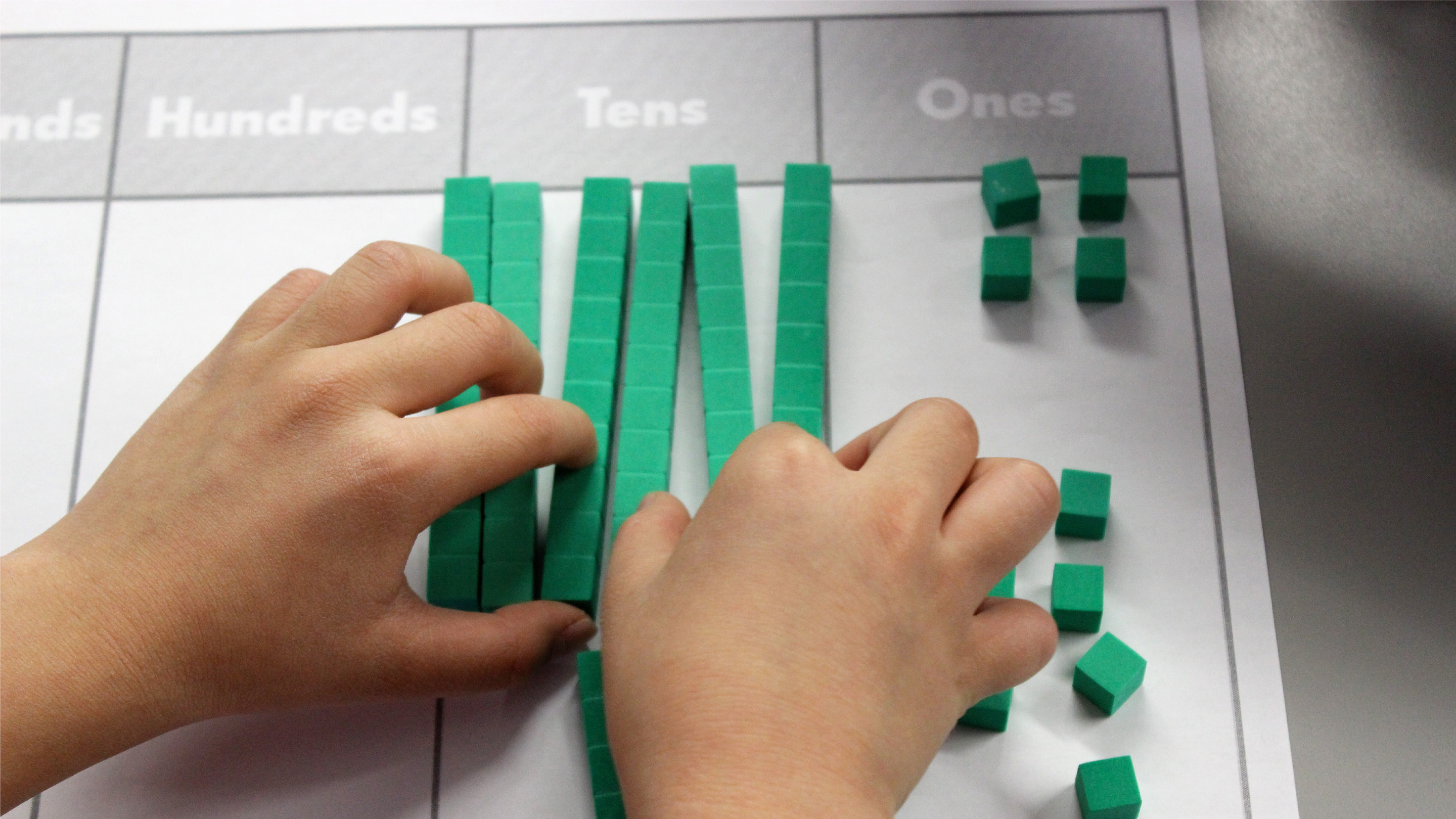
This is the hands-on phase. Students use manipulatives or physical models such as base-ten blocks, fraction strips, counters, place value disks, area tiles, number lines, or even folded paper. The goal is not to keep their hands busy just for the sake of it. The goal is to make invisible math visible. When students physically group, partition, trade, compare, or combine objects, they begin to see what the numbers actually mean.
Pictorial
In this phase, students move from physical objects to drawings, diagrams, and visual models. That may include sketches of base-ten blocks, tape diagrams, arrays, number lines, area models, or bar models. This stage matters more than many people realize. It acts like the bridge between the manipulative and the symbol. Skip it too quickly, and students may know how to use blocks without understanding how the idea transfers to paper.
Abstract
Now students use numbers, symbols, equations, and standard algorithms. But here is the important catch: abstract work should rest on understanding, not guesswork. The goal is not “students can do the steps because the teacher showed them the steps.” The goal is “students understand why the steps work.” That difference is small on paper and enormous in real classrooms.
Why CPA Works So Well in Upper Elementary
Upper elementary students are old enough to handle increasingly sophisticated mathematics, but they still need support to connect ideas across representations. This is the sweet spot for CPA. It respects students’ growing independence while still giving them the tools to reason deeply.
At this level, students are expected to move beyond simple computation. They must explain their thinking, compare strategies, justify answers, and solve unfamiliar problems. CPA supports all of that. It helps students understand place value as a structure, not just a chart on the wall. It helps them see fractions as numbers, not weird little sandwiches with a line in the middle. It helps them understand multiplication as groups, arrays, scaling, and area rather than a random fact family reunion.
CPA is also a strong fit for diverse classrooms. It supports students who need extra scaffolding, multilingual learners who benefit from visuals and modeling, and advanced students who can use multiple representations to extend and defend their reasoning. In other words, it is not a “remediation-only” strategy. It is quality math instruction for everybody.
How CPA Looks in Real Upper Elementary Lessons
1. Place Value and Multi-Digit Operations
Suppose you are teaching 4-digit addition with regrouping. In the concrete stage, students use base-ten blocks or place value disks to build each number. They physically combine the ones, see when a group of ten is formed, and trade ten ones for one ten. No mystery. No dramatic music. Just mathematics behaving logically.
In the pictorial stage, students draw quick sketches of the blocks or use a place value chart. They circle groups of ten and redraw regrouped values. In the abstract stage, they solve 2,487 + 1,356 using the standard algorithm, but they can explain why the regrouping happened. The procedure is no longer a magic trick performed by the teacher. It is a summary of what the model already showed.
2. Multiplication and Area Models
Upper elementary multiplication becomes much more meaningful when students start with arrays and area. In the concrete phase, students can build 23 × 4 with counters arranged into 23 rows of 4 or with area tiles split into tens and ones. In the pictorial phase, they draw an area model showing (20 + 3) × 4. Then, in the abstract phase, they write 20 × 4 + 3 × 4 = 92.
This does more than get the correct answer. It reveals the distributive property in action. Students begin to understand partial products and can later connect that understanding to larger numbers. Once they see the structure, they are more likely to solve unfamiliar problems with confidence instead of staring at the page like it insulted them personally.
3. Fractions
Fractions are where CPA earns a gold star and possibly a standing ovation. Many students struggle with fractions because the symbols arrive long before the meaning sticks. That is like handing someone sheet music before they have ever heard a song.
To teach equivalent fractions, students might begin with fraction strips, pattern blocks, or folded paper. They can see that one-half is the same quantity as two-fourths or three-sixths. In the pictorial stage, they sketch fraction bars or area models. In the abstract stage, they write equations such as 1/2 = 2/4 = 3/6 and explain how multiplying the numerator and denominator by the same number preserves value.
For addition of unlike denominators, CPA is just as helpful. Students use concrete fraction pieces first, then draw visual models, then move to finding common denominators symbolically. Suddenly the “why” behind the algorithm is not locked in a vault.
4. Decimals and Number Lines
Decimals often become less intimidating when students connect them to familiar models. Base-ten blocks work beautifully here, as long as the unit is clearly defined. If the flat represents one whole, then rods and small cubes can represent tenths and hundredths. Students can build decimals physically, sketch them in grids, and then write them in standard notation.
Number lines are another powerful tool. In upper elementary, they help students understand that fractions and decimals are numbers with positions, not just answers in a workbook. A student who can place 0.4, 0.75, and 1 1/2 on a number line is developing real number sense. That understanding later supports estimation, comparison, and operations.
5. Word Problems and Tape Diagrams
Word problems are often where math confidence goes to take a nap. CPA helps wake it up. In the concrete phase, students may act out a situation or use counters, cubes, or strips of paper. In the pictorial phase, they can draw tape diagrams, strip diagrams, or comparison bars. In the abstract phase, they translate the visual into equations.
For example, if Maya has 36 stickers and gives away one-fourth of them, students can model the quantity, partition it into four equal groups, and then determine how many stickers were given away. The diagram gives structure to the language. That is especially valuable in upper elementary, where word problems become more complex and language-heavy.
Best Practices for Teaching the CPA Method
Do Not Treat the Three Stages Like Separate Islands
CPA is not supposed to be “Monday is concrete, Tuesday is pictorial, Wednesday we pretend everyone is ready for abstract.” Strong lessons connect the stages. Students should move back and forth between models, drawings, and symbols. That constant linking builds transfer.
Use Purposeful Manipulatives
Not every manipulative is automatically helpful. If students are playing with blocks without understanding what they represent, the tool becomes a toy. Choose manipulatives that clearly map onto the math idea. Base-ten blocks, fraction strips, counters, tiles, and number lines tend to work well because their structure aligns closely with the concept being taught.
Ask Students to Explain the Connections
The strongest CPA lessons include rich questions: “How does your drawing match the blocks?” “What does this number mean in your model?” “Where do you see the regrouping in the picture?” “Why does this tape diagram fit the problem?” Those questions push students to make sense, not just perform.
Keep the Cognitive Demand High
CPA is not about making math easier by watering it down. It is about making math understandable without reducing rigor. Students should still solve meaningful tasks, discuss strategies, compare methods, and justify conclusions. The supports should increase access, not lower expectations.
Common Mistakes Teachers Should Avoid
One common mistake is moving to abstract notation too quickly. Just because students can use a manipulative does not mean they have internalized the concept. Another mistake is skipping the pictorial stage because it seems slower. In reality, skipping it often creates confusion later, which is the educational equivalent of saving five minutes now and losing forty next week.
Teachers also need to avoid over-explaining everything themselves. CPA works best when students build, draw, discuss, and reason. A classroom full of student talk, comparison, and reflection is usually a sign that the method is doing its job.
Finally, be careful not to assume CPA is only for struggling learners. Upper elementary students at all performance levels benefit from multiple representations. In fact, some of the richest mathematical conversations happen when confident students use models to prove why a shortcut works.
How to Plan a Strong CPA Lesson
A good CPA lesson begins with the mathematical goal, not the manipulative. Ask yourself: What big idea do I want students to understand? Then choose a concrete model that reveals that idea. Next, decide what pictorial representation will connect most naturally to the concrete model. Finally, determine which abstract notation, equation, or algorithm students should reach by the end.
For example, if the goal is understanding equivalent fractions, your sequence might be: fraction strips, sketched bars, then symbolic equations. If the goal is understanding the distributive property in multiplication, your sequence might be: tiles or arrays, area drawings, then partial products and equations.
Assessment should also happen across the stages. A student who gets the equation correct but cannot explain the model may still need support. A student who can draw a precise representation but makes a minor calculation error may actually understand more than the final answer suggests. CPA gives teachers better windows into student thinking, which is exactly what effective math instruction needs.
Why the CPA Method Builds Long-Term Math Strength
The real magic of CPA is that it helps students build durable understanding. And yes, this is the rare case where “magic” is just organized, evidence-informed teaching wearing sensible shoes. Students who learn through connected representations are more likely to remember concepts, transfer them to new problems, and explain their reasoning clearly. They are also less dependent on memorized steps that vanish the second the worksheet looks unfamiliar.
In upper elementary, that matters enormously. These grades lay the groundwork for middle school algebra, proportional reasoning, and more advanced problem solving. Students who understand quantity, structure, equivalence, and representation are far better prepared for what comes next.
The CPA method does not promise instant perfection. No approach can. But it gives teachers a practical, powerful framework for helping students make sense of mathematics. And when students make sense of math, they do more than get answers. They begin to think like mathematicians.
Classroom Experiences and Practical Reflections on the CPA Method
One of the most common experiences teachers report with the CPA method is that students become more willing to talk about math. That is a big deal. In many upper elementary classrooms, students are used to thinking that math means speed, silence, and one right answer. CPA changes that rhythm. When students build with blocks, draw models, and compare diagrams, the room sounds different. You hear things like, “Wait, mine shows the same thing another way,” or “I think your number line is missing the equal spaces.” That kind of talk is not noise. It is understanding happening out loud.
Teachers also notice that misconceptions are easier to spot. A student may write a correct equation by copying a procedure, but a drawing tells the truth fast. If a child draws unequal parts for fractions, misplaces a decimal on a grid, or builds 304 with three ones and four hundreds, the teacher gets immediate information. CPA turns hidden confusion into visible thinking, which is much more useful than discovering the problem after a test has already ruined everyone’s afternoon.
Another real classroom experience is that students who previously felt weak in math often become more confident. Hands-on tools and visuals give them an entry point. They are not locked out by symbols from the start. That matters for students with learning differences, multilingual learners, and students who simply need more time to process ideas. At the same time, stronger students are not held back. In fact, they often benefit from being asked to prove ideas across multiple representations. Explaining why an algorithm works using an area model or tape diagram is advanced thinking, not baby math.
There are practical challenges, of course. CPA lessons can take more planning. Teachers need to choose models carefully, connect them clearly, and resist the temptation to rush. Classroom management matters too. Manipulatives are helpful, but only when students know the purpose. Without structure, base-ten blocks can become tiny plastic confetti with academic branding. Strong routines solve that problem. Teachers who explicitly teach how to use, sketch, discuss, and put away tools usually find that the payoff is worth the setup.
Many educators also discover that CPA is most effective when used consistently rather than occasionally. A one-off lesson with fraction strips is fine, but a classroom culture built around representing thinking is far stronger. Over time, students learn to ask themselves useful questions: “Can I model this?” “Can I draw it?” “How does the equation match the picture?” That habit of moving between representations becomes a thinking strategy students can carry into new content and later grades.
Perhaps the most encouraging experience is this: students stop seeing math as a subject full of mysterious rules handed down from the ceiling. They begin to see patterns, relationships, and structure. They realize that numbers have meaning and that models are not decorations but tools for reasoning. For upper elementary teachers, that shift is huge. It means the class is not just covering standards. It is building mathematical understanding that lasts.
Conclusion
The CPA method for math gives upper elementary teachers a practical way to turn big, abstract ideas into understandable learning. By moving from concrete models to pictorial representations and then to abstract symbols, students gain more than procedures. They gain meaning, flexibility, and confidence. Whether the lesson focuses on place value, multiplication, fractions, decimals, or word problems, CPA helps students see the logic of mathematics rather than memorizing it from a distance. In a world full of shortcuts, that kind of deep understanding is still the smartest route.