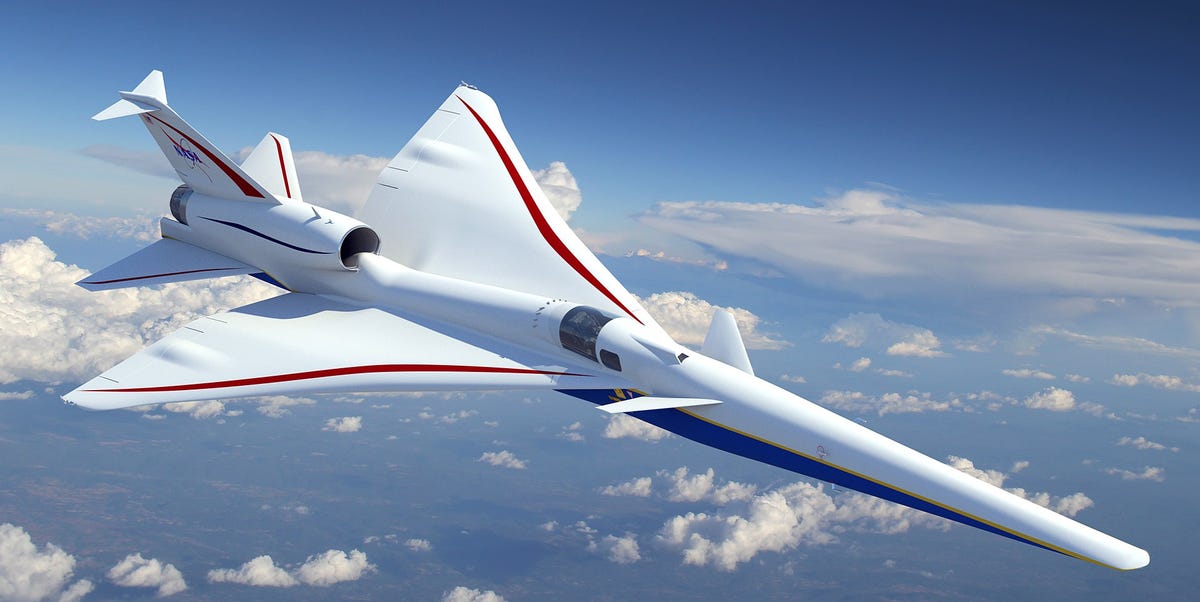
For anyone who grew up staring at jet contrails and wondering why commercial airplanes still take their sweet time crossing the country, NASA’s X-59 feels like aviation’s long-awaited plot twist. Built by Lockheed Martin Skunk Works for NASA’s Quesst mission, this needle-nosed experimental aircraft is not trying to be another loud, dramatic supersonic showoff. Its job is subtler, smarter, and possibly more important: prove that faster-than-sound flight over land can happen without rattling windows, scaring dogs, and making coffee cups jump like they’ve seen a ghost.
The latest progress on the NASA X-59 shows that the aircraft has moved beyond hangar photos and ceremonial unveilings into the serious, data-heavy world of flight testing. After its first flight in October 2025, the X-59 began a step-by-step envelope expansion campaign in 2026, flying higher, faster, and cleaner as engineers evaluate how the aircraft behaves in real air instead of computer models. That is where Skunk Works’ reputation meets NASA’s research discipline: bold design, careful testing, and absolutely no “let’s just wing it” energy.
What Is the NASA X-59?
The NASA X-59 is a one-of-a-kind experimental supersonic aircraft designed to reduce the loud sonic boom usually created when an aircraft exceeds the speed of sound. Instead of producing a thunderous boom, the X-59 is shaped to create a much softer “sonic thump” on the ground. That thump is the heart of NASA’s Quesst mission, which aims to collect real-world community response data and help regulators decide whether future commercial supersonic aircraft should be allowed to fly over land.
To be clear, the X-59 is not a passenger jet prototype. You will not be booking seat 14A on it, arguing over overhead bin space, or asking whether the single test pilot can turn the aircraft around because you left your earbuds at the gate. NASA describes it as an experimental research aircraft that will never carry passengers. Its purpose is to prove a noise-reduction concept at full scale and gather evidence that could influence the future of civil aviation.
The aircraft is approximately 99.7 feet long with a wingspan of about 29.5 feet. It is designed to fly at Mach 1.4, roughly 925 mph, at around 55,000 feet. That altitude is well above typical commercial cruise levels, and that speed could eventually help shape a future where coast-to-coast travel takes far less time. The X-59 is powered by a single General Electric F414-GE-100 engine, an engine that brings serious thrust to a very specialized airframe.
Why Skunk Works Matters
Lockheed Martin Skunk Works is one of the most famous names in advanced aircraft development. The division has been associated with legendary aircraft and research programs for decades, so its role in building NASA’s X-59 is not just a contractor credit tucked into the fine print. It matters because the X-59 requires exactly the type of engineering Skunk Works is known for: unusual shapes, tight tolerances, complex integration, and the ability to turn ambitious aeronautical ideas into metal, wiring, software, sensors, and flight-test reality.
Skunk Works designed and built the X-59 at its Palmdale, California facility. The aircraft was publicly unveiled in January 2024, giving the world a first clear look at its dramatic shape. The long nose, narrow fuselage, swept wings, and top-mounted engine are not there for style points, although admittedly the aircraft does look like a futuristic dart that escaped from a science museum. Every major design choice is connected to the goal of controlling shock waves so they do not combine into the sharp sonic boom associated with older supersonic aircraft.
The Big Milestone: First Flight
The X-59 completed its first flight on October 28, 2025, taking off from Lockheed Martin Skunk Works’ facility at U.S. Air Force Plant 42 in Palmdale, California, and landing near NASA’s Armstrong Flight Research Center in Edwards, California. That first flight was not a “let’s break the sound barrier immediately” moment. Instead, it focused on verifying initial flying qualities, air data performance, aircraft handling, and safe transfer to its new flight-test home.
That is how serious flight testing works. First flights are less like Hollywood and more like a very expensive, very careful health checkup. Engineers want to know whether the aircraft responds as expected, whether the systems behave properly, and whether the pilot can bring the aircraft home safely. The X-59 did exactly that, giving NASA and Lockheed Martin a successful opening chapter for the next stage of testing.
Following the first flight, Lockheed Martin and NASA moved into a broader flight-test campaign. Skunk Works continued to support initial testing while NASA prepared to expand the aircraft’s operating range. This is the point where progress becomes more than one headline. The real story is the accumulation of data: climb rates, system behavior, landing gear performance, control response, fuel system performance, avionics, hydraulics, structural loads, and pilot workload.
Second Flight and the Value of Caution
In March 2026, NASA’s X-59 made its second flight from Edwards Air Force Base. The flight was shortened after pilot Jim “Clue” Less saw a vehicle system warning in the cockpit and followed procedures by returning to base. NASA later reported that the warning was caused by incorrectly installed instrumentation, creating a false positive. The issue was resolved before the aircraft’s third flight.
That may sound like a setback, but in flight testing, discovering a false warning and fixing it is not failure; it is the job. Experimental aircraft programs are built around learning. A warning light during a test flight is not treated like an inconvenience. It is treated like data with flashing lights attached. The fact that the pilot returned safely, the aircraft behaved well, and the team identified the cause is part of how test programs mature.
The second flight also kicked off a series of dozens of planned test flights in 2026. NASA’s goal during this phase is to expand the aircraft’s envelope gradually, pushing the X-59 higher and faster while validating its systems and performance. That methodical approach is essential because the aircraft’s final mission depends on trust: trust in the airplane, trust in the data, and trust that its quiet supersonic signature is real.
Wheels Up: The X-59 Gets Sleeker in Flight
Another important milestone arrived in April 2026 when the X-59 completed its first wheels-up flight. Early test flights of experimental aircraft often keep the landing gear extended, which gives pilots and engineers a conservative configuration while evaluating basic performance. Once the team is satisfied with initial benchmarks, retracting the landing gear allows the aircraft to fly in a cleaner, more aerodynamic shape.
During its first wheels-up flight on April 3, 2026, the X-59 flew for about 90 minutes over the Mojave Desert, reaching approximately 20,000 feet and a top speed of about 460 mph. That milestone mattered because the aircraft’s streamlined profile is central to its low-boom design. With the landing gear tucked away, engineers can study how the aircraft performs closer to the configuration it will use during faster flight.
By April 10, NASA reported that the X-59 had completed eight flights. Soon after, the aircraft reached even higher and faster test points, including flights up to 43,000 feet and speeds between roughly 528 and 627 mph, depending on conditions. Those numbers still remain below the aircraft’s planned Mach 1.4 research speed, but they show a steady progression toward supersonic testing.
How the X-59 Reduces the Sonic Boom
The secret of the X-59 is not one magic gadget. It is the entire shape of the aircraft. When a traditional supersonic aircraft flies faster than sound, pressure waves build and merge into strong shock waves. Those shock waves reach the ground as a loud boom. The X-59’s long nose, narrow body, wing placement, and top-mounted engine are designed to prevent those shock waves from combining so aggressively.
Think of a sonic boom like a crowd all clapping at once in a small room. The X-59 tries to spread that energy out so the sound reaches the ground more like scattered applause from polite people at a library event. The result NASA wants is a low, soft thump rather than a sharp boom. If that sound proves acceptable to communities, it could change the conversation about supersonic flight over land.
This matters because current U.S. regulations restrict civil aircraft from operating over land at speeds greater than Mach 1 except under specific authorization. The historical reason is simple: sonic booms are disruptive. They can annoy communities, disturb wildlife, and create public opposition faster than an airline can lose your checked bag. NASA’s Quesst mission is designed to provide the data needed for regulators to consider new noise-based standards rather than relying only on a speed-based ban.
The eXternal Vision System: Flying Without a Front Window
One of the X-59’s most eye-catching details is what it does not have: a traditional forward-facing cockpit window. Because the aircraft’s long nose and low cockpit position are essential to its low-boom shape, the pilot cannot simply look straight ahead through a normal windshield. NASA’s solution is the eXternal Vision System, or XVS.
The XVS uses forward-facing cameras and cockpit displays to give the pilot a real-time view of the airspace ahead. A 4K monitor functions as the central visual reference, supported by additional flight data and augmented-reality-style guidance. In everyday terms, it is like replacing the front windshield with a highly engineered digital window. In aviation terms, it is a major systems-integration challenge that must be tested, validated, and trusted under demanding flight conditions.
NASA has emphasized that the XVS is part of what makes the X-59 possible. Without it, the aircraft’s low-boom geometry would create unacceptable forward visibility limitations. With it, the pilot gets the visibility needed for takeoff, approach, landing, and traffic awareness while the aircraft keeps the shape required for quiet supersonic research.
What “Envelope Expansion” Really Means
NASA’s latest progress updates repeatedly mention “envelope expansion,” which sounds like something that happens at an office supply convention but is actually a core part of flight testing. An aircraft’s flight envelope describes the range of speeds, altitudes, loads, and configurations in which it can safely operate. Expanding that envelope means carefully proving the aircraft can handle more demanding conditions.
For the X-59, envelope expansion includes flying faster, climbing higher, retracting the landing gear, testing control responses, checking structural loads, monitoring systems, and preparing for supersonic flight. Each test point builds confidence. Engineers compare real flight data with predictions from wind tunnels, computational fluid dynamics, simulations, and ground testing. If the aircraft behaves as expected, the team moves to the next test point. If it does something surprising, engineers investigate before continuing.
This process may look slow from the outside, but it is how high-risk aerospace innovation becomes reliable engineering. The X-59 is not merely trying to fly fast. It is trying to produce a measured sound signature that can be analyzed, repeated, and presented to regulators. That requires precision, not bravado.
Why Community Testing Is the Real Endgame
The X-59’s technical performance is only part of the story. NASA’s Quesst mission ultimately depends on community response testing. Once the aircraft is ready, NASA plans to fly it over selected U.S. communities and survey residents about what they hear. The goal is to understand whether the sonic thump is acceptable in real neighborhoods, not just in acoustic models or test ranges.
This is a smart approach because aviation rules affect people on the ground as much as passengers in the sky. A sound that looks acceptable on a chart may feel different when it happens above a home, school, farm, or office. NASA wants data from actual communities so future decisions about commercial supersonic flight over land are based on human response, not guesswork.
If the data shows that low-boom supersonic flight is acceptable, regulators in the United States and internationally could use it to develop new standards. That does not mean supersonic airliners will suddenly appear at every airport next Tuesday. Aircraft certification, airline economics, airport operations, fuel efficiency, emissions, and public acceptance all matter. But the X-59 could remove one of the biggest historical barriers: noise.
Why the X-59 Is Not the Next Concorde
Whenever people hear “supersonic travel,” the Concorde inevitably enters the chat wearing sunglasses. But the X-59 is not a Concorde replacement. Concorde was a commercial passenger aircraft built to carry travelers across the Atlantic at high speed. The X-59 is a single-seat experimental research aircraft built to study sound, aerodynamics, and public response.
The difference matters. Concorde’s economics were challenging, its routes were limited, and its sonic boom restricted overland operations. The X-59 does not solve every commercial challenge, but it directly targets the boom problem. In that sense, it is less like a new airliner and more like a key that might unlock a door future airliners could walk through.
Modern commercial supersonic aircraft would still need to prove they can be efficient, safe, sustainable, and economically viable. The X-59’s role is to help answer the noise question with real data. That is a narrower mission than “bring back supersonic travel,” but it is also more practical and scientifically useful.
What Progress Has Skunk Works Revealed So Far?
The progress revealed through Lockheed Martin and NASA updates shows a program moving from development into active flight research. The aircraft has been built, unveiled, powered, flown, transferred to NASA Armstrong, and entered envelope expansion. It has completed its first flight, returned safely from an abbreviated second flight, resolved a false warning issue, performed wheels-up testing, and climbed to higher altitudes while increasing speed.
Each milestone is meaningful because the X-59 is a custom-built aircraft with a mission that depends on extremely specific aerodynamic behavior. The aircraft must fly safely, reach its intended speed and altitude, and generate the low-boom signature NASA expects. Skunk Works’ development work created the physical aircraft; NASA’s flight-test campaign is now turning that aircraft into validated research data.
The visible progress also shows that the X-59 is not just a beautiful hangar queen. It is flying, gathering data, and moving toward the point where it can attempt the core mission: quiet supersonic flight and community response research. That is where the program’s impact could extend beyond aerospace enthusiasts and into future airline route maps.
Challenges Still Ahead
The X-59 still has major work ahead. It must continue expanding its flight envelope, complete supersonic test points, validate its sound signature, and support community overflight campaigns. Supersonic flight itself is demanding, but measuring and proving a quiet sonic thump is a different kind of challenge. The aircraft’s sound must be recorded, modeled, compared, and evaluated in ways regulators can trust.
There are also broader questions. Even if the X-59 succeeds, future commercial aircraft will need to balance speed with fuel use, ticket prices, maintenance costs, airport compatibility, and environmental requirements. The X-59 does not answer all of those questions, and NASA is not claiming that it does. Instead, it addresses a central technical and regulatory barrier that has shaped aviation policy for decades.
That is why the X-59 program is so interesting. It is both futuristic and practical. It dreams about faster travel, but it gets there through test cards, instrumentation checks, pilot procedures, acoustic data, and community surveys. It is the rare aircraft that can make aviation fans excited and policy analysts reach for a fresh notebook.
Experience-Based Perspective: What the X-59 Teaches About Innovation
Watching the X-59’s progress is a reminder that real innovation usually looks less like a lightning bolt and more like a carefully labeled checklist. From the outside, people see the sleek aircraft and imagine a dramatic leap into the future. Inside the program, progress is measured through design reviews, ground tests, engine runs, taxi tests, first flight, post-flight inspections, software updates, instrumentation fixes, and one cautious test point after another. It is not glamorous every minute, but it is how ambitious engineering survives contact with reality.
One useful lesson from the X-59 is that breakthrough ideas often require accepting awkward trade-offs. The aircraft’s long nose helps shape shock waves, but it blocks direct forward visibility. Instead of abandoning the design, NASA developed the eXternal Vision System. That is a powerful example for any technology project: sometimes the feature that creates the biggest advantage also creates the strangest problem. The answer is not always to simplify the goal. Sometimes the answer is to invent the missing tool.
Another experience worth noting is how the program treats setbacks. The shortened second flight could have been framed as bad news, but in experimental aviation, safe discovery is progress. A warning appeared, the pilot followed procedures, the aircraft landed safely, and the team traced the issue to a false positive caused by instrumentation. That is exactly the culture high-risk programs need. You do not ignore warning lights because you are excited about headlines. You listen to the airplane, land it, learn from it, and fly again when the issue is understood.
The X-59 also shows why public acceptance matters. Engineers can build a supersonic aircraft that performs beautifully, but if people on the ground hate the noise, the business case collapses. NASA’s decision to collect community response data recognizes that technology does not operate in a vacuum. It operates over homes, cities, schools, farms, and neighborhoods. The public is not an afterthought; it is part of the research environment.
For aviation enthusiasts, the X-59 is exciting because it makes supersonic travel feel possible again. For engineers, it is exciting because it pushes aerodynamic design, systems integration, and acoustic prediction into real-world testing. For travelers, it hints at a future where long trips could shrink dramatically. And for anyone who has ever been stuck on a six-hour flight beside a stranger aggressively unwrapping snacks, the promise of faster travel has a certain emotional urgency.
The most realistic takeaway is this: the X-59 is not promising instant supersonic airliners. It is doing something more valuable. It is building evidence. If the data supports the mission’s goals, future aircraft designers, regulators, airlines, and communities will have a stronger foundation for deciding what comes next. That is how aerospace progress usually happens: not in one giant leap, but in a sequence of disciplined flights that gradually make the impossible look normal.
Conclusion
Skunk Works’ progress on NASA’s X-59 marks one of the most important developments in modern supersonic aviation research. The aircraft has moved from concept and construction into active flight testing, completing major milestones such as first flight, wheels-up operations, higher-altitude flights, and continued envelope expansion. Its purpose is not to carry passengers but to prove that a carefully shaped supersonic aircraft can replace the disruptive sonic boom with a quieter thump.
If the X-59 succeeds, it could help regulators establish new noise standards for commercial supersonic flight over land. That would not automatically bring back the golden age of supersonic travel, but it could remove one of the biggest barriers that has kept faster-than-sound passenger flight out of everyday aviation. In short, the X-59 is not just a cool aircraft with a very long nose. It is a flying research instrument, a policy-shaping machine, and possibly the beginning of a quieter, faster chapter in air travel.