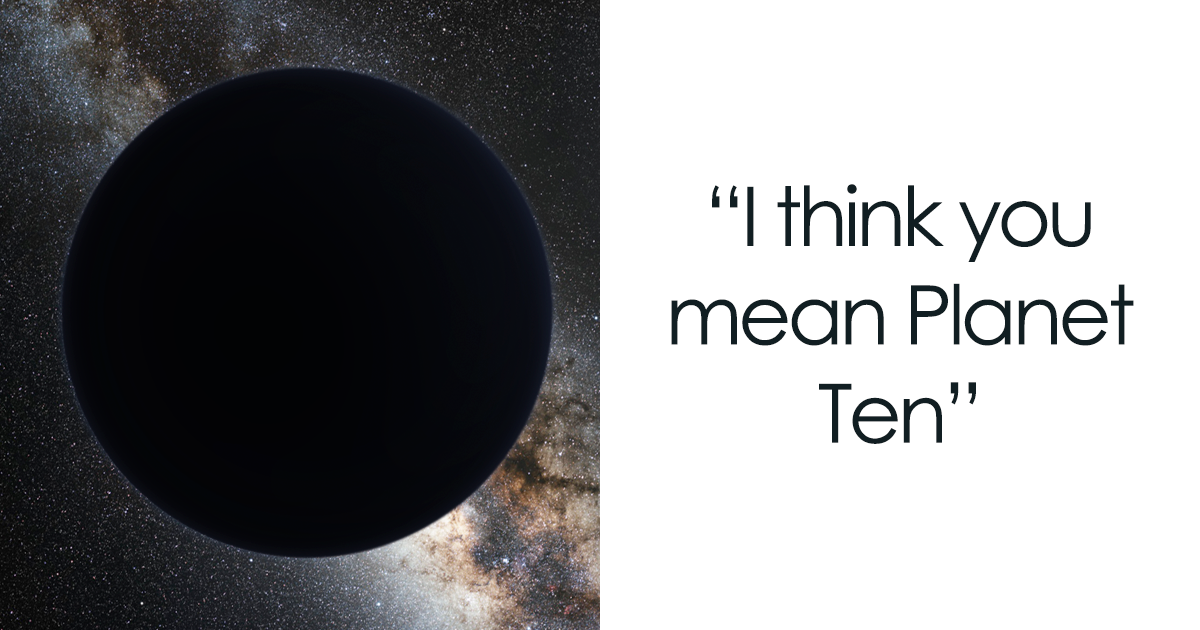
Every few years, the internet collectively looks up from its coffee, remembers space exists, and immediately starts yelling. This time, the cosmic drama has a familiar headline: scientists say there could be a ninth planet in our solar system. Naturally, Tumblr reacted the only way Tumblr knows how: with jokes, existential dread, Pluto loyalty, chaotic fan art energy, and the emotional intensity of a Greek tragedy performed by raccoons in hoodies.
The idea is not that astronomers have photographed a mysterious new world and hidden it behind a “coming soon” curtain. The proposed object, often called Planet Nine or Planet X, remains hypothetical. Scientists have not directly seen it. Instead, the case comes from the strange behavior of distant icy objects beyond Neptune, where the solar system becomes less like a neat classroom diagram and more like a garage where gravity has been storing weird stuff for 4.5 billion years.
So, is there really a ninth planet? Maybe. Is Pluto sitting somewhere in the cosmic group chat saying, “Interesting timing”? Almost certainly, at least in our hearts.
What Is Planet Nine?
Planet Nine is the nickname for a proposed, undiscovered planet that may orbit far beyond Neptune. The modern version of the hypothesis became famous in 2016, when Caltech astronomers Konstantin Batygin and Mike Brown argued that several distant objects in the Kuiper Belt seemed to share unusual orbital patterns. Their computer simulations suggested that an unseen planet could be gravitationally shepherding those objects into their odd paths.
In plain English: some tiny frozen bodies at the edge of the solar system appear to be moving in a way that makes astronomers suspicious. When scientists see objects behaving oddly, they do not immediately say, “Aliens!” They first say, “Gravity is probably doing something rude.”
If Planet Nine exists, it would likely be much more massive than Earth, possibly around five to ten Earth masses, and it would travel on a long, stretched-out orbit. One trip around the Sun could take roughly 10,000 to 20,000 Earth years. That means one Planet Nine birthday party would outlast human civilization, several ice ages, and at least three reboots of every superhero franchise.
Why Scientists Think Something Might Be Out There
The solar system does not end at Neptune. Beyond it lies the Kuiper Belt, a broad region full of icy bodies, dwarf planets, and leftovers from the solar system’s formation. Pluto lives there, along with other distant worlds such as Eris, Haumea, Makemake, Sedna, and many smaller trans-Neptunian objects.
Some of these faraway objects have orbits that are difficult to explain using only the gravitational influence of the eight known planets. A few appear clustered in ways that seem unlikely to be random. Others have high perihelia, meaning they never come close enough to Neptune for Neptune to easily explain their paths. Some even move on highly tilted or unusual orbits, as if the outer solar system had a secret choreographer.
Planet Nine is one possible explanation. A massive hidden planet could tug on these icy objects over millions or billions of years, shaping their orbits without announcing itself with a dramatic entrance. In astronomy, this is not a wild idea. Neptune itself was discovered after scientists noticed Uranus was not moving exactly as expected. In other words, “something unseen is pulling on something visible” has worked before.
But Has Planet Nine Actually Been Found?
No. This is the most important sentence in the article, so let’s put a little glitter on it: Planet Nine has not been confirmed.
NASA has repeatedly emphasized that the object remains theoretical. Batygin and Brown did not directly observe a planet in 2016; they proposed one based on mathematical modeling and orbital evidence. That is a serious scientific process, but it is not the same as a telescope image. Until astronomers capture clear observational evidence, Planet Nine remains a compelling possibility, not a confirmed member of the planetary family.
This distinction matters because the internet is very good at turning “scientists propose” into “scientists found” and then into “NASA is hiding a doom planet behind Saturn because Mercury is in retrograde.” That is not science. That is a comments section wearing a lab coat.
Why Finding Planet Nine Is So Hard
If Planet Nine exists, why can’t we simply point a telescope at it and say hello? Because the outer solar system is enormous, dark, and deeply inconvenient.
A planet hundreds of astronomical units from the Sun would reflect very little sunlight. An astronomical unit, or AU, is the average distance between Earth and the Sun. Neptune orbits at about 30 AU. Planet Nine, depending on the model, could be hundreds of AU away. At that distance, even a large planet would appear faint and slow-moving against a crowded background of stars.
Searching for it is like trying to spot a charcoal-gray marble drifting across a football stadium at night while everyone keeps moving the seats. Astronomers must compare images taken at different times, identify tiny points of light that shift position, and rule out stars, galaxies, asteroids, image artifacts, and cosmic “oopsies.”
Modern surveys have already ruled out large parts of the possible search area. Data from telescopes such as Pan-STARRS, the Dark Energy Survey, Subaru Telescope, and other sky surveys have narrowed the hunt. Yet “narrowed” in astronomy can still mean “please search an absurd amount of sky.”
Pluto, the Internet, and the Emotional Support Dwarf Planet
No article about a possible ninth planet can avoid the Pluto situation. Pluto was considered the ninth planet for decades after its discovery in 1930. Then, in 2006, the International Astronomical Union reclassified Pluto as a dwarf planet. Under the IAU definition, a planet must orbit the Sun, be mostly round, and clear its orbital neighborhood. Pluto checks the first two boxes but not the third.
Scientifically, this classification helps organize a messy solar system. Emotionally, it broke a generation. Many people did not read the fine print. They heard “Pluto is not a planet,” looked at their childhood posters, and felt personally betrayed by astronomy.
That is why Planet Nine triggers such big reactions online. To some, it feels like the universe is replacing Pluto with a mysterious new favorite child. To others, it is a chance to reopen the debate. Tumblr, being Tumblr, treated the news like a family reunion where Pluto shows up in sunglasses and says, “So, you found someone new?”
Why Tumblr Freaked Out
Tumblr has always been a perfect home for cosmic chaos. It loves fandom, mythology, science jokes, dramatic personification, and emotional overinvestment in nonhuman entities. A hypothetical planet beyond Neptune is practically designed for Tumblr. It is mysterious. It is distant. It may be lonely. It has no official name. It could be icy, enormous, and misunderstood. That is not just a planet; that is a character arc.
Reactions often fall into a few familiar categories. First, there are the Pluto defenders, who treat the possible discovery like an insult to an old friend. Second, there are the space nerds explaining orbital dynamics in surprisingly clear posts sandwiched between memes. Third, there are people demanding the new planet be named something ridiculous, dramatic, or mythologically perfect. Fourth, there are users who immediately create jokes about the solar system needing to update its relationship status.
The humor works because the science is genuinely fascinating and the emotional context is absurdly human. We are tiny mammals on a wet rock, arguing about whether another frozen rock-ball should count as family. There is something beautiful about that.
The Science Behind the Memes
The best internet jokes usually contain a kernel of truth. In this case, the truth is that the outer solar system is still poorly understood. Even after centuries of astronomy, we have not fully mapped the dark, distant region beyond Neptune. New objects are still being discovered, and each one can either strengthen or weaken the Planet Nine hypothesis.
For example, the discovery of 2023 KQ14, nicknamed Ammonite, added a new twist. Ammonite is a rare Sedna-like object with a very distant orbit. Its path does not align neatly with some of the other objects that were part of the original Planet Nine argument. That does not automatically disprove Planet Nine, but it complicates the story. Some scientists think it may mean a hidden planet, if real, is farther away than earlier models suggested. Others see it as evidence that the clustering argument may be weaker than once believed.
This is how science works. A hypothesis appears. Evidence supports it. New evidence challenges it. Models get revised. Nobody gets to slam a gavel and declare victory because a meme got 80,000 notes.
Could Planet Nine Be a Super-Earth?
One of the most interesting possibilities is that Planet Nine could be a type of world our own solar system does not currently have: a super-Earth or mini-Neptune. These planets are common around other stars, but our solar system has a gap between Earth and Neptune. We have small rocky planets and large gas or ice giants, but nothing in the middle.
If Planet Nine exists and has several times Earth’s mass, it could help answer a major question: did the early solar system once form another large planetary core that got pushed outward by Jupiter or Saturn? Some models suggest Planet Nine may have formed closer to the Sun before gravitational encounters tossed it into a distant, elongated orbit. In that version of the story, Planet Nine is not a random stranger. It is an exiled sibling.
That also explains why the idea grabs public imagination. A hidden world at the edge of the solar system sounds like science fiction, but it comes from real questions about planetary formation, migration, and gravitational history.
What Would Count as Proof?
Proof would require direct observation. Astronomers need to detect the object, track its motion, calculate its orbit, and show that it is massive enough to qualify as a planet under accepted criteria. A single fuzzy dot is not enough. A suspicious infrared signal is not enough. A cool animation with ominous music is definitely not enough, although it may be enough for a YouTube thumbnail.
The Vera C. Rubin Observatory is expected to play a major role in the search for distant solar system objects. Its wide-field survey capabilities could reveal many new Kuiper Belt objects and possibly confirm or rule out areas where Planet Nine might hide. Even if it does not find Planet Nine, it will likely transform our understanding of the outer solar system.
That is the exciting part. The search itself is valuable. Whether Planet Nine exists or not, astronomers will discover more about the Kuiper Belt, Sedna-like objects, dwarf planets, and the ancient gravitational reshuffling that shaped our neighborhood.
Why This Story Keeps Coming Back
The Planet Nine story keeps returning because it sits at the perfect intersection of science, mystery, nostalgia, and internet drama. It is not a settled fact, but it is not nonsense either. It is a serious hypothesis with real mathematical support, real skepticism, and real observational campaigns behind it.
It also reminds people that the solar system is not finished. Many of us grew up with the idea that the planets were a memorized list, like a cosmic roll call. Mercury, Venus, Earth, Mars, Jupiter, Saturn, Uranus, Neptune, and once upon a time, Pluto. But astronomy is not a laminated classroom poster. It changes as evidence improves.
That is uncomfortable and thrilling. The universe is not obligated to match our mnemonics. It keeps being larger, stranger, and less tidy than expected.
Common Myths About Planet Nine
Myth 1: Planet Nine has already been discovered
It has not. Scientists have proposed its existence, but no confirmed image or detection has established it as a real planet.
Myth 2: Planet Nine is Pluto coming back
Pluto is still there, still wonderful, and still classified as a dwarf planet. Planet Nine, if it exists, would be a separate and much more massive object.
Myth 3: Planet Nine is going to crash into Earth
No credible scientific model suggests that. The proposed planet would be extremely far away and moving on a long orbit in the outer solar system.
Myth 4: Scientists are just guessing
The hypothesis is based on orbital patterns, mathematical modeling, and simulations. That does not make it proven, but it does make it scientifically meaningful.
Experiences Related to the Planet Nine Buzz
One of the funniest experiences around the Planet Nine conversation is watching how different people react to the same headline. A science teacher might see it as a perfect classroom moment: “Today, students, we discuss orbital mechanics.” A casual reader might see it and think, “Wait, didn’t we already fire the ninth planet?” A Tumblr user might immediately write a three-act emotional reunion between Pluto and the mysterious newcomer, complete with betrayal, healing, and a soundtrack by an indie band with no capital letters.
For many people, the topic becomes less about memorizing astronomy facts and more about rediscovering curiosity. Someone who has not thought about the solar system since middle school may suddenly start reading about Kuiper Belt objects, Sedna, Neptune, dwarf planets, and why the word “cleared” matters in the definition of a planet. That is a wonderful side effect of viral science. A meme may be the doorway, but genuine learning can walk through it wearing moon boots.
There is also a shared emotional experience in realizing that science changes. Many adults remember being taught nine planets, then being told there were eight, and now hearing there might be nine again. That can feel confusing, but it is actually one of the best lessons science can offer. Knowledge is not a museum display behind glass. It is a living process. New observations can revise old conclusions. Better instruments can reveal objects we missed. A tiny dot in a telescope image can rewrite a chapter of our cosmic address book.
The Planet Nine discussion also gives families, classrooms, and online communities a playful way to talk about evidence. Instead of asking, “Do you believe in Planet Nine?” the better question is, “What evidence would convince us?” That shift is powerful. It turns astronomy from trivia into critical thinking. It teaches people to separate possibility from proof, excitement from exaggeration, and good science from viral nonsense.
Then there is the Pluto experience, which is practically a cultural event by itself. People defend Pluto with the passion usually reserved for sports teams, childhood pets, and favorite pizza styles. Planet Nine reopens that emotional file. It lets people joke about Pluto being replaced, promoted, avenged, or invited back to the planetary table. The humor may be silly, but it shows how deeply space stories can attach themselves to personal memory.
In the end, the best experience Planet Nine gives us is wonder. Whether it turns out to be a real hidden planet, a misleading orbital pattern, or a clue to some older event in solar system history, the search reminds us that the sky is not empty just because we have named the obvious things. There may still be worlds hiding in the dark. And somewhere online, Tumblr is ready with the memes.
Conclusion
The possibility of a ninth planet in our solar system is one of those rare science stories that feels both deeply technical and wildly emotional. On the scientific side, Planet Nine is a serious but unconfirmed hypothesis built around strange orbital patterns in the distant Kuiper Belt. On the internet side, it is a perfect storm of Pluto nostalgia, space mystery, and Tumblr comedy.
The smartest takeaway is simple: Planet Nine has not been found yet, but the search is worth watching. The outer solar system still has secrets, and every new discovery helps astronomers understand how our planetary neighborhood formed and evolved. If a hidden world is eventually confirmed, it will be one of the biggest solar system discoveries in modern history. If it is not, scientists will still learn something valuable about the strange icy frontier beyond Neptune.
Note: Planet Nine remains hypothetical. The article above is written for public education and entertainment while reflecting the current scientific distinction between “possible” and “confirmed.”