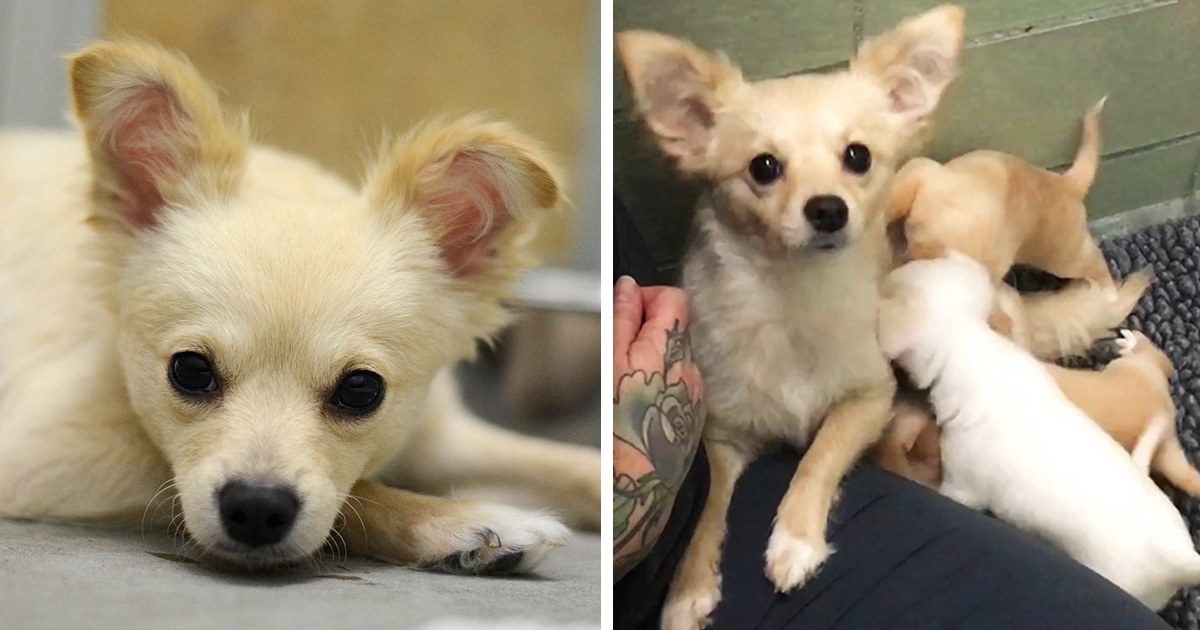
Some rescue stories begin with a dramatic chase, a storm drain, or a heroic leap over a fence. Cora’s began in a quiet shelter room, where the small Papillon-Chihuahua mix pressed herself into a corner and tried to disappear.
“`
Cora had been surrendered to Marin Humane in Novato, California. She was frightened, withdrawn, and unusually still. Staff members could have written off her behavior as the understandable stress of entering an unfamiliar kennel. Instead, they looked closer. During her intake assessment, they noticed physical signs that she had recently given birth.
That observation changed everything. Somewhere beyond the shelter walls, Cora had puppies who were still young enough to need their mother. After staff contacted the person who had surrendered her, they received permission to retrieve the litter. Soon, four tiny puppies were carried into Cora’s room.
The reunion that followed lasted only minutes, but it became the kind of animal rescue video that makes viewers whisper, “I am not crying; my eyes are simply leaking compassion.”
“`
A Frightened Mama Dog Arrives at the Shelter
“`
For many dogs, entering a shelter is overwhelming. The smells are unfamiliar, doors clang, other animals vocalize, and every predictable routine has suddenly vanished. Even a normally friendly dog may freeze, hide, pant, tremble, refuse food, or avoid eye contact.
Cora appeared especially shut down. She stayed near the back of the room and made herself small. It is tempting to label such behavior as sadness or depression, but responsible interpretation requires caution. A short video cannot diagnose a dog’s emotional or medical condition. Fear, pain, exhaustion, postpartum changes, separation from puppies, and the stress of surrender can overlap.
What mattered was that the shelter team did not assume her silence meant she had nothing to say. They read the evidence her body provided.
“`
The Clue That Led Staff to Cora’s Puppies
“`
Animal care professionals routinely check an incoming dog’s general health, body condition, skin, teeth, reproductive status, and behavior. In Cora’s case, staff recognized that she appeared to have recently nursed a litter.
That discovery created an urgent welfare concern. Very young puppies rely on their mother for warmth, nutrition, cleaning, security, and early behavioral learning. Nursing mothers also require monitoring because sudden separation may contribute to painful milk accumulation and other postpartum complications.
Marin Humane contacted the person connected to Cora’s surrender. Staff members persuaded her to let them collect the puppies and bring the canine family together. The four pups were not wandering through the wilderness like fuzzy explorers with a terrible sense of direction. They were at the former home, separated from their mother and initially unknown to the shelter.
That distinction does not make the reunion less powerful. It makes the shelter’s careful intake work even more important.
“`
The Moment Cora Realized Her Puppies Were Back
“`
In the widely shared footage, a staff member brings the puppies into Cora’s room inside a carrier. At first, Cora remains tucked into the corner. She watches cautiously, still unsure about the people, the room, and the mysterious box that has suddenly arrived.
Then the puppies begin moving and making noise.
Cora inches forward. Her nose goes to work before the rest of her confidence catches up. Dogs experience much of the world through scent, and familiar odors can provide information faster than any human explanation. Within moments, her posture changes. She approaches the carrier, investigates the puppies, and becomes animated.
Once the puppies are released, the room transforms into a tiny family traffic jam. The pups wobble toward their mother. Cora sniffs, circles, checks them, and settles into contact. The dog who had seemed almost motionless now has a clear purpose.
No speech, swelling soundtrack, or slow-motion editing is required. Her behavior tells the story: caution gives way to recognition, and recognition gives way to caregiving.
“`
Why the Reunion Mattered Beyond a Viral Video
“`
The emotional payoff is obvious, but the reunion also served practical health and developmental needs.
Young Puppies Depend on Their Mother
Newborn puppies cannot regulate their body temperature effectively and require frequent nursing. Their mother stimulates elimination during the earliest stage of life and provides protection, cleaning, warmth, and milk. As they grow, they begin weaning gradually rather than switching from nursing to independence overnight.
Puppies also learn from their mother and littermates. Through play, correction, and daily contact, they practice bite control, communication, frustration tolerance, and appropriate social behavior. Veterinary and canine organizations generally advise that puppies remain with their mother and litter until at least eight weeks of age, unless health or safety requires another plan.
Returning Cora’s litter therefore offered more than comfort. It restored a developmental environment the puppies still needed.
A Nursing Mother Has Physical Needs Too
A mother dog’s body does not instantly stop producing milk because her puppies are removed. Abrupt separation can leave mammary glands full and uncomfortable, and it may increase the risk of inflammation or mastitis. A recently nursing dog also needs adequate nutrition, water, rest, and veterinary assessment.
Reuniting the family allowed the puppies to nurse while staff monitored everyone’s condition. It also gave Cora a familiar role in a profoundly unfamiliar place.
“`
What Cora’s Reaction Canand CannotTell Us
“`
People naturally describe the video using human emotional language: Cora was heartbroken, then overjoyed. Those words capture what the moment feels like to viewers, but they should not be mistaken for a clinical diagnosis.
Dogs form attachments and can show genuine distress when separated from important social partners. They can also recognize familiar individuals through scent, sound, and learned associations. Cora’s shift from avoidance to active engagement after encountering her puppies strongly suggests that their presence was meaningful and reassuring to her.
Still, a wagging tail does not translate word-for-word into English, and a tucked body is not a psychiatric report. Context matters. The safest conclusion is also the most moving one: Cora behaved like a frightened postpartum dog, recognized her litter, and became noticeably more engaged once the puppies returned.
In other words, we do not need to invent a movie script for her. The observable facts are already good enough.
“`
What Marin Humane Did Right
“`
The happy ending depended on several ordinary-looking actions performed exceptionally well.
Staff Observed Before Judging
A withdrawn dog can be mislabeled as unfriendly, unresponsive, or difficult. Cora’s caregivers treated behavior as information rather than a personality verdict. They paired observation with a physical assessment and uncovered her recent pregnancy.
They Asked the Missing Question
Once staff suspected that puppies existed, they followed up. That sounds simple, yet animal welfare often turns on one person asking, “Is there more to this story?”
The answer led them to four vulnerable puppies.
They Protected the Family Unit
Instead of treating Cora and the litter as unrelated shelter intakes, Marin Humane reunited and cared for them as a family. Shelter medicine sometimes requires separation for disease control or safety, but when healthy mothers and dependent puppies can remain together, that arrangement supports both physical and behavioral welfare.
They Allowed Trust to Develop at Cora’s Pace
In the video, staff members do not drag Cora from the corner or push the puppies into her face. They place the carrier nearby and give her room to investigate. That low-pressure approach lets the dog gather information and choose to move closer.
For a fearful animal, choice can be a powerful ingredient in recovery.
“`
What Happened to Cora and the Four Puppies?
“`
The reunion did not end when the camera stopped. Marin Humane cared for Cora and her litter until the puppies were old and strong enough for adoption.
Because the story unfolded near the finale of Downton Abbey, staff gave the puppies names inspired by the series: Edith, Moseley, Carson, and Branson. This was an excellent naming strategy because “Puppy One Through Four” lacks a certain British-estate sparkle.
All four puppies eventually found homes. Cora did too.
That final detail matters. Viral rescue moments can create the illusion that saving an animal is a single cinematic event. In reality, rescue is a chain of quieter work: examinations, meals, cleaning, medication, foster care, socialization, adoption screening, paperwork, and follow-up. The reunion opened the door; sustained care carried the family through it.
“`
Lessons Pet Owners Can Learn From Cora’s Story
“`
Keep Young Litters Together When It Is Safe
Puppies should not be separated from their mother simply because they have begun eating solid food. Weaning is gradual, and social development continues after nursing decreases. A veterinarian should guide any early separation required by illness, rejection, unsafe maternal behavior, or another emergency.
Share Complete Information During Surrender
Shelter staff need the truth about an animal’s medical history, reproductive status, recent birth, medications, behavior, and related animals. Withholding information can delay care and place both a mother and her offspring at risk.
A surrender conversation may be emotional, but accurate details are not optional trivia. They are part of the animal’s medical handoff.
Seek Veterinary Care for a Mother and Litter
A veterinarian should assess a mother dog and newborn puppies soon after birth. Caregivers should watch for poor nursing, constant crying, low body temperature, weakness, abnormal discharge, swollen or painful mammary glands, fever, tremors, or other concerning changes.
Tiny puppies can decline quickly. “Let’s see how they look tomorrow” is sometimes one day too late.
Prevent Accidental Litters
Spaying and neutering, when recommended for an individual animal by a veterinarian, can prevent unplanned litters and reduce pressure on shelters and rescue groups. Timing may vary by breed, age, size, health, and lifestyle, so owners should discuss the decision with their veterinary team rather than relying on a one-size-fits-all calendar.
Support the People Doing the Unseen Work
Animal shelters need adopters, foster homes, volunteers, donations, supplies, and community cooperation. Cora’s reunion happened because staff had the training and time to notice a clue, make a call, retrieve four puppies, and care for the entire family.
A donated towel may not go viral. It may, however, become the warmest thing in a frightened dog’s day.
“`
Experiences That Echo Cora’s Reunion
“`
Cora’s story feels extraordinary, yet shelter workers and foster families often encounter quieter versions of the same emotional puzzle. A dog arrives with no history. She refuses a treat, turns her face toward the wall, and seems unreachable. Then someone finds the missing context: a bonded companion, a litter, a familiar blanket, or a person she trusts. The dog has not magically become a different animal. The environment has finally begun to make sense.
Consider the common experience of fostering a mother with puppies. During the first night, the foster caregiver may prepare a spotless whelping area with fresh bedding, bowls, and every supply recommended by the shelter. The mother may respond by moving all six puppies behind a chair. This is not a review of the interior design. She is choosing the location that feels safest. A patient foster parent blocks hazards, keeps the room quiet, and gradually helps her accept the prepared space. Trust often begins with respecting a choice that was not in the plan.
Another familiar experience occurs during weaning. At first, the mother stays close while the puppies nurse and sleep in a furry heap. A few weeks later, she begins stepping away more often. The puppies follow as though she is leaving for a three-year expedition instead of taking a four-minute break. She may hop onto a low couch where they cannot reach her, enjoy the silence, and watch them complain to management. Healthy maternal care includes closeness, but it also includes gradual boundaries.
Shelter reunions can be less instantly joyful than Cora’s. A frightened dog may need time to recognize a family member or bonded animal, especially in a noisy room filled with unfamiliar scents. The first response might be cautious sniffing rather than tail-wagging fireworks. Experienced handlers do not force a dramatic moment for the camera. They reduce pressure, use barriers or leashes when appropriate, and watch both animals’ body language. A successful reunion is measured by safety and comfort, not by how many tissues viewers require.
Adopters sometimes experience a similar delayed transformation. A rescue dog may spend the first few days sleeping, hiding, or quietly observing household routines. Weeks later, she carries a toy into the living room for the first time. That small act can feel as significant as a parade. It signals that the dog is beginning to predict what happens next and believes she has a place in it.
There is also the experience of watching puppies become independent. A foster caregiver may spend weeks weighing them, washing bedding, preparing meals, and worrying over every sneeze. Then adoption day arrives, and the puppies leave one by one. The house becomes suspiciously quiet. The mother may look around, rest more deeply, or briefly check the places where the pups used to sleep. Caregivers can feel both relieved and heartbrokenthe emotional equivalent of finishing a marathon while carrying a laundry basket.
The strongest lesson from these experiences is that behavior always has a context. A mother searching a room, a puppy crying, or a shelter dog refusing food is not being stubborn for the fun of inconveniencing humans. The animal is responding to needs, stressors, memories, and information that people may not yet understand.
Cora’s caregivers found the missing piece of her world and brought it through the door in a carrier. Most rescue work is exactly that: observe carefully, ask better questions, reduce fear, and reconnect what should never have been separated too soon.
“`
Conclusion: A Small Reunion With a Big Message
“`
The story of the sad mama dog who reunited with her lost puppies remains unforgettable because the change in Cora was visible. She entered the shelter frightened and shut down. Staff noticed that she had recently given birth, located her four puppies, and gave the family time and space to reconnect.
The puppies received warmth, nursing, social contact, and professional care. Cora regained a familiar purpose. Eventually, Edith, Moseley, Carson, Branson, and their mother all moved into loving homes.
Behind that happy ending was no miracle gadget and no caped superherojust attentive shelter professionals refusing to overlook a quiet dog in a corner. Their work offers a useful reminder: compassion is not merely feeling sorry for an animal. It is noticing what the animal needs and doing something specific about it.
“`