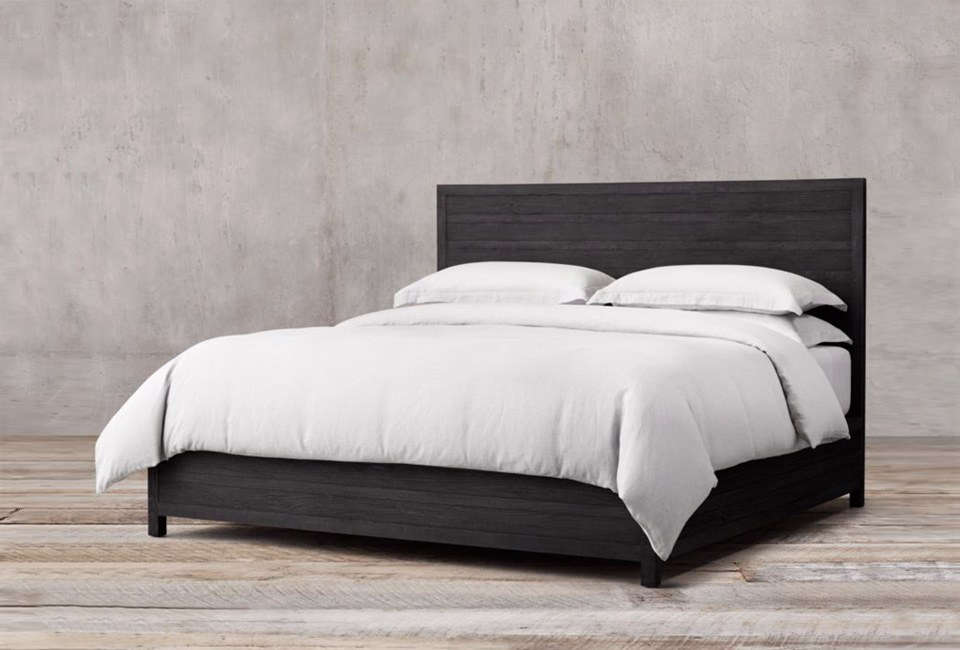
The Printmaker’s Platform Bed does not look as though it wandered out of an ordinary bedroom showroom. It looks more like it was discovered in the back room of a century-old publishing house, brushed off, and cleverly repurposed for sleeping. Its broad horizontal lines, weathered pine surfaces, and low platform silhouette give it the visual authority of vintage workshop furniture without requiring you to store several thousand pieces of metal type under your mattress.
Originally offered by RH, the bed was inspired by flat-file cabinets traditionally used in architectural offices, printmaking studios, and map rooms. Designer Luay Al-Rawi translated that wide, low storage-furniture profile into a substantial bed made with distressed pine planks. The result is an unusual combination of industrial history, rustic warmth, and contemporary platform-bed simplicity. The original model is currently listed as unavailable, but its recognizable design continues to influence vintage listings, custom builds, and printmaker-style bedroom furniture.
What Is a Printmaker’s Platform Bed?
A Printmaker’s Platform Bed is a low-profile wooden bed whose design borrows from the shallow-drawer cabinets once used to organize prints, maps, architectural plans, and typographic materials. Instead of decorative curves, turned posts, or a heavily upholstered headboard, it relies on strong horizontal bands and deliberately aged wood for character.
The original RH version featured solid pine planks, a distressed finish, kiln-dried wood construction, and a wooden slat support system. Because the mattress rests on the platform, a conventional box spring is generally unnecessary. This creates a grounded silhouette and keeps the overall sleeping surface lower than it would be on a traditional frame-and-foundation combination.
Although the word “printmaker” may suggest drawers, ink stains, and an alarming number of tiny metal letters, the platform bed itself is not necessarily a storage bed. Its layered front and side panels visually resemble flat-file cabinetry, but shoppers should verify whether any particular reproduction includes functional drawers rather than assuming every panel hides storage.
The Design Story Behind the Bed
From Artist’s Studio to Primary Bedroom
Flat-file cabinets are practical workhorses. Their wide, shallow drawers let artists and architects store oversized paper without folding or rolling it. RH’s Printmaker’s collection converted this utilitarian object into residential furniture while preserving its strong geometry and workshop atmosphere. A related version was also described as drawing inspiration from newspaper letterpress workshops and type-case cabinets used to organize typographic characters.
That origin explains why the bed feels authentic rather than artificially “rustic.” Its visual language comes from equipment made to perform a job. The weathering, long plank lines, and blocky proportions are not random decorative flourishes; they echo the construction of old studio cabinetry.
A Low, Architectural Silhouette
The bed’s broad headboard and horizontal frame make it appear almost built into the room. A low-profile bed can give a bedroom a contemporary, uncomplicated character, particularly when paired with restrained bedding and simple furnishings. Designers also use low beds to emphasize wall space, artwork, or dramatic lighting above the headboard.
However, “low profile” does not mean visually lightweight. The Printmaker’s Platform Bed is substantial. Dark finishes can make it appear especially imposing, while antiqued pine tends to reveal more grain and soften the industrial effect.
Distressed Pine With Personality
Pine helps create the bed’s approachable, timeworn appearance. Knots, grain variation, dents, rub marks, and finish differences are often part of the intended aesthetic. On a polished contemporary bed, a scratch may feel like a small domestic tragedy. On distressed pine, it may simply join the cast.
That does not mean every mark should be ignored. Deep cracks, loose joints, split slats, lifting veneer, water damage, or structural movement are maintenance issues rather than charming patina. This distinction is particularly important when buying a discontinued model secondhand.
Why Platform Construction Matters
No Traditional Box Spring Required
A platform bed supports the mattress with a solid deck or a system of closely arranged slats. This typically allows the mattress to be placed directly on the frame. Eliminating a box spring reduces height, simplifies the setup, and preserves the low silhouette that makes the Printmaker’s design so distinctive.
Do not automatically discard your mattress manufacturer’s instructions, though. Foundation requirements vary among brands and mattress types. A frame can look sturdy enough to support a small rhinoceros while still failing to meet the warranty’s precise rules.
Slat Spacing Is a Small Detail With Large Consequences
Foam, latex, and hybrid mattresses usually require even support. Gaps that are too wide may allow the mattress to dip between slats, affecting comfort and potentially contributing to premature wear. Purple currently specifies gaps of no more than 3.5 inches for an unassisted slatted frame, while Tempur-Pedic generally calls for structurally sound slats at least three inches wide and no more than four inches apart. Other manufacturers may require gaps closer to two or three inches.
Before using the bed, measure the gaps rather than estimating them from the doorway with the confidence of a game-show contestant. Also confirm that the frame has appropriate center support for queen, king, or California king mattresses.
Airflow Beneath the Mattress
A properly constructed slatted base allows air to circulate beneath the mattress. This can help disperse heat and moisture compared with placing a mattress on an unventilated floor. Slats can also make a frame easier to move than a completely solid platform, although the heavy wooden exterior of a Printmaker-style bed may cancel out some of that convenience.
Who Will Love This Bed?
The Printmaker’s Platform Bed is best suited to someone who wants the bed to function as the bedroom’s visual anchor. It works particularly well in industrial, rustic-modern, transitional, modern farmhouse, loft-inspired, and collected eclectic interiors.
It may also appeal to homeowners who prefer solid-looking furniture over delicate legs and open frames. The continuous wooden base feels grounded and permanent, which can make a large primary bedroom more intimate.
It may be less suitable for anyone who needs generous open storage underneath, frequently moves furniture alone, or prefers a tall bed that is easier to enter without bending deeply at the knees. A low platform can feel elegant to one sleeper and suspiciously close to camping to another. Mattress thickness influences the final height, so calculate the complete sleeping surface rather than judging the empty frame.
How to Style a Printmaker’s Platform Bed
Let the Wood Remain the Main Character
The bed already offers plenty of texture, so it rarely needs loud bedding and elaborate furniture competing for attention. Start with linen, cotton percale, washed cotton, or a lightly textured quilt in ivory, flax, warm gray, charcoal, tobacco, olive, or muted blue.
For a lighter room, pair antiqued pine with cream walls, woven shades, aged brass lamps, and natural textiles. For a moodier scheme, combine black pine with deep green, ink blue, plaster gray, or warm off-white walls. Blackened steel sconces and vintage-inspired bulbs can reinforce the industrial history without transforming the bedroom into a themed restaurant called The Sleepy Foundry.
Choose Nightstands With Contrast
Matching every piece to the bed can create a wall of distressed wood. Instead, introduce contrast. Simple metal tables, plaster-finished pedestals, compact oak cabinets, or streamlined floating nightstands can keep the arrangement from feeling overly heavy.
If matching furniture is used, vary the shapes and heights. A tall chest on one wall and smaller bedside tables will create more visual rhythm than a complete suite lined up like obedient wooden soldiers.
Anchor the Bed With the Right Rug
A large rug can soften the bed’s blocky outline and make stepping out of bed more pleasant. A common placement runs the rug beneath the front two-thirds of the frame, allowing it to extend beyond the sides and foot. Better Homes & Gardens recommends roughly 18 to 24 inches of visible rug beyond the bed when room dimensions permit.
Good choices include low-contrast Persian-style patterns, flatwoven wool, understated geometric designs, or textured neutral rugs. Avoid an undersized rug floating at the foot of a large bed; it can look like the room started decorating and then became distracted.
Use Artwork That Respects the Scale
A substantial headboard needs artwork with comparable presence. Consider one oversized abstract piece, a large textile, or a carefully spaced group of prints. A collection of vintage maps, botanical studies, or graphic letterpress posters can acknowledge the bed’s print-studio origins without becoming overly literal.
Leave breathing room between the headboard and artwork. Crowding a tiny frame immediately above a broad wooden bed will emphasize the frame’s tininess with almost scientific precision.
What to Check Before Buying
Measure the Whole Frame, Not Just the Mattress
A queen mattress may have familiar dimensions, but the exterior frame can add several inches on every side. Bed frames commonly extend beyond the mattress footprint, so confirm the total width, length, headboard height, and platform height. Then measure doors, stairways, elevators, hall turns, ceiling clearances, and the bedroom itself.
Use painter’s tape to mark the footprint on the floor. Leave comfortable walking space around the sides and enough clearance for drawers, doors, floor vents, and other furniture. A bed that technically fits but forces everyone to shuffle sideways is not spacious planning; it is bedroom choreography.
Inspect Secondhand Pieces Carefully
Because the original bed is no longer generally available from RH, buyers may encounter it through resale marketplaces, estate sales, consignment stores, or custom furniture makers. Ask for close photographs of joints, side rails, attachment points, center supports, slats, corners, and the back of the headboard.
Confirm that all proprietary brackets and hardware are included. Replacing an ordinary bolt is simple. Recreating a discontinued hidden connector after the delivery crew has left is a more philosophical woodworking exercise.
Review Materials and Finish Information
Solid wood, veneer, engineered panels, adhesives, stains, and topcoats can perform differently. Ask the seller or maker exactly what the frame contains, particularly when ordering a reproduction. The U.S. Environmental Protection Agency identifies furniture, composite wood products, adhesives, paints, and coatings as potential indoor sources of formaldehyde or other volatile organic compounds. Ventilation can help reduce exposure when a new product has a noticeable odor.
A scent does not automatically mean a product is unsafe, and “solid wood” does not guarantee that every adhesive or finish is emission-free. Look for transparent material disclosures and recognized low-emission certifications when indoor air quality is a priority.
Care and Maintenance
Dust the frame regularly with a clean microfiber cloth or a soft brush attachment. For ordinary marks, use a slightly damp cloth and dry the area promptly. Avoid saturating distressed wood, allowing water to remain in grooves, or attacking the finish with abrasive scrubbers and harsh household chemicals.
This Old House recommends regular gentle dusting for finished furniture and notes that strong cleaners are generally unnecessary. Testing any cleaning method on an inconspicuous area is especially wise with deliberately aged finishes, where the surface treatment may be layered or uneven by design.
Every few months, check the center rail, legs, slats, and hardware. Tighten loose fasteners carefully, but do not overtighten them into soft pine. If squeaking develops, identify the actual contact point before applying wax, padding, or replacement hardware. Creaking may come from loose joints, moving slats, an uneven floor, or the mattress rubbing against the frame.
Advantages and Possible Drawbacks
Reasons to Choose It
- Distinctive design: The flat-file influence gives it more historical character than a generic wooden frame.
- Strong focal point: Its scale can organize a large bedroom and reduce the need for excessive decoration.
- Platform convenience: A compatible mattress can generally be used without a traditional box spring.
- Flexible styling: Distressed pine works with industrial, rustic, contemporary, and transitional rooms.
- Forgiving surface: Minor wear may blend naturally into the aged finish.
Reasons to Think Twice
- Considerable visual weight: Dark versions may overwhelm a narrow or poorly lit bedroom.
- Limited under-bed access: The enclosed profile does not provide the openness of a legged frame.
- Moving difficulty: Large wooden sections may be cumbersome on stairs or through tight hallways.
- Low sleeping height: Some people may find a low platform uncomfortable to enter or exit.
- Secondhand uncertainty: Missing hardware, damaged slats, or undocumented modifications can complicate setup.
A Realistic Experience of Living With a Printmaker-Style Platform Bed
The first impression is scale. Even after measuring the room and outlining the bed with painter’s tape, seeing the assembled frame in place feels different. The long horizontal boards pull the eye across the wall, and the bedroom immediately appears more deliberate. Other furniture that seemed perfectly respectable the day before may suddenly look flimsy, undersized, or as though it arrived from a different story.
Making the bed also changes slightly. Because the mattress sits inside or close to the surrounding frame, fitted sheets may require a little more finger work at the corners. A lightweight mattress is manageable, but a thick hybrid can turn sheet-changing day into an unplanned upper-body workout. Leaving enough clearance around the bed makes this task much easier.
The low profile creates a calm, grounded feeling. With a medium-thick mattress, the sleeping height remains comfortable for many adults while avoiding the towering stack created by a tall frame, foundation, and pillow-top mattress. The room feels broader because the furniture occupies more horizontal than vertical space.
The wood also influences the atmosphere. During daylight, antiqued pine reveals grain, knots, finish variation, and small surface imperfections. At night, warm lamps deepen the color and exaggerate the horizontal lines. The bed looks particularly convincing beside linen bedding and a faded rug because those materials share its relaxed, imperfect quality.
There are practical surprises. Dust gathers along ledges, recessed lines, and the junction between the mattress and frame. A narrow vacuum attachment quickly becomes a valued household colleague. Phones, earrings, and one mysteriously determined sock may also find their way into the narrow space beside the mattress.
Noise depends heavily on assembly. When the slats are seated correctly and the fasteners are secure, a wooden platform can feel stable and quiet. If a connector loosens or a slat shifts, the broad frame can behave like an acoustic instrument nobody requested. Periodic hardware checks prevent most minor complaints from becoming nightly sound effects.
The distressed finish is wonderfully practical in a busy home. A tiny nick from a vacuum cleaner is less alarming than it would be on glossy lacquer. Still, the bed is not invincible. Water glasses should remain on nightstands, and damp laundry should not be draped over the wood. Distressed does not mean waterproof, maintenance-free, or emotionally prepared for a leaking humidifier.
Styling becomes easier after resisting the urge to overdecorate. The bed already supplies color, texture, pattern, and architectural presence. Crisp white sheets, one substantial blanket, two or three restrained pillows, and balanced bedside lighting are often enough. Adding too many rustic accessories can make the room feel staged, while contemporary lamps and uncluttered textiles let the historical reference feel fresh.
After several weeks, the bed tends to feel less like a decorative purchase and more like part of the room’s architecture. That is its greatest strength. It does not merely hold the mattress; it establishes the bedroom’s proportions, mood, and material palette. For someone who appreciates furniture with a story, that daily sense of permanence can be more satisfying than novelty.
Final Verdict
The Printmaker’s Platform Bed succeeds because it turns a specialized piece of studio furniture into an expressive bedroom centerpiece. Its distressed pine, low platform construction, and flat-file-inspired lines deliver industrial character without relying on exposed gears, decorative pipes, or other predictable factory-style props.
It is an excellent choice for a spacious bedroom that needs a strong visual anchor and for anyone who enjoys furniture that becomes richer as it ages. Buyers should nevertheless consider the frame’s complete dimensions, mattress-support requirements, weight, sleeping height, finish, and replacement-hardware availability.
When those practical details align, a Printmaker-style bed offers something rare: a design substantial enough to command attention yet simple enough to remain useful through changing decorating trends. It is part bed, part architectural feature, and part tribute to the creative workplaces where plans, prints, maps, and ideas once waited patiently in wide wooden drawers.
Note: The original RH Printmaker’s Platform Bed is currently listed as unavailable. Before purchasing a vintage example or reproduction, verify its exact dimensions, structural condition, slat spacing, center support, included hardware, and compatibility with your mattress warranty.