Note: This article is written for web publication and synthesizes publicly available information about OKTO35, analog filmmaking, 35mm film workflows, 3D printing, maker culture, and DIY scanning practices without adding source links in the body text.
Every so often, a maker project appears that makes the internet collectively lean closer to the screen and whisper, “Wait… you built what?” The OKTO35 3D-printed analog film movie camera is exactly that kind of delightful mechanical plot twist. It is not another plastic novelty camera designed to make your vacation photos look like they were developed in a haunted toaster. It is a serious, clever, deeply nerdy motion-picture camera built around standard 35mm film cartridges, with a design goal that feels both modern and wonderfully old-school: make shooting analog movies more accessible, more experimental, and less financially terrifying.
Created by inventor and electronics designer Blaž Semprimožnik, OKTO35 takes the familiar 35mm still-photo cartridge and reimagines it as a compact motion-picture medium. Instead of requiring specialized Super 8 cartridges, lab-heavy processing, or a small treasure chest labeled “film budget,” the camera uses ordinary 135 film rollsthe kind many photographers already buy for still cameras. Then it exposes the film in multiple tracks, captures tiny movie frames, and even helps scan the developed film afterward. In other words, OKTO35 is part camera, part scanner, part engineering flex, and part love letter to analog filmmaking.
What Is the OKTO35 Camera?
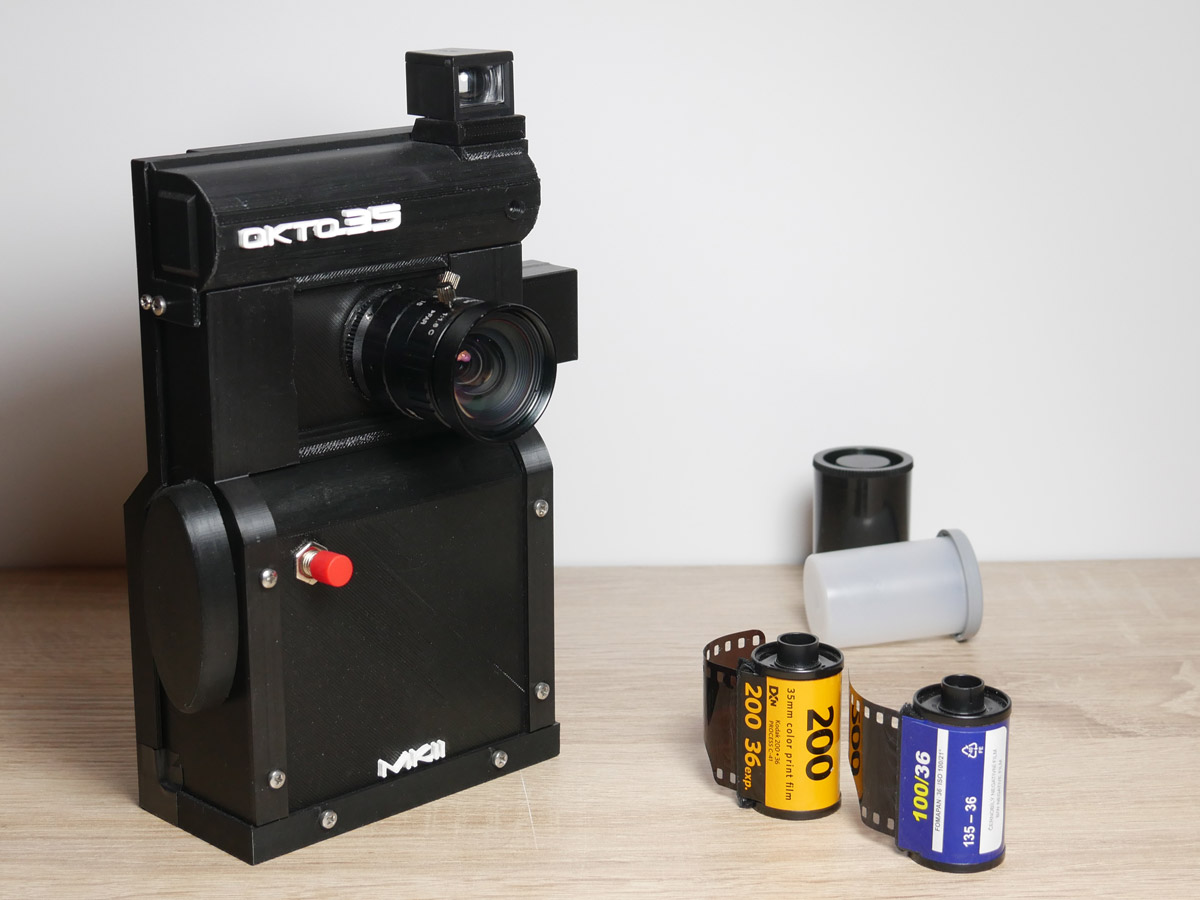
The OKTO35 is a DIY 35mm motion picture film camera built with a largely 3D-printed body, custom electronics, firmware, a motorized film transport system, and support for interchangeable C-mount lenses. Its name is not random gadget soup. “OKTO” refers to the number eight, nodding toward the Super 8 look and frame size, while “35” points to the 35mm film stock that powers the whole idea.
At its heart, OKTO35 answers a simple question: what if the convenience and availability of 35mm still film could be used to make short analog movies? That question matters because Super 8 is charming, but it can be expensive. A single cartridge may offer only a few minutes of footage, and after purchase, processing, and scanning, the costs can climb faster than a filmmaker’s anxiety during golden hour. OKTO35 proposes another path: use cheaper, widely available 35mm rolls, expose more frames across the film width, and scan the results at home.
Why Makers and Film Fans Are Excited
Analog film has never fully disappeared. It simply put on a vintage jacket, grew a cult following, and started charging boutique prices. Photographers love film for its texture, color response, highlight behavior, and beautifully unpredictable personality. Filmmakers love it for similar reasons, but motion-picture film brings extra complications: cameras, cartridges, processing, scanning, and a workflow that can feel like adopting a tiny dragon with lab fees.
OKTO35 is exciting because it brings three communities together: film photographers, DIY electronics builders, and 3D-printing makers. It does not treat analog as a museum object. Instead, it treats film as a living material that can be hacked, redesigned around, and made playful again. That is the magic here. This is not nostalgia wearing fake glasses; it is nostalgia with a soldering iron.
How OKTO35 Uses 35mm Film for Motion Pictures
A normal 35mm still camera exposes large frames one after another. OKTO35 uses a different approach. It exposes much smaller frames across multiple horizontal tracks on the film. The Mk2 prototype uses a 1-perf pulldown movement and a 4-track exposure method, allowing the camera to fit around 1,200 movie frames on one 36-exposure 35mm cartridge.
That is the clever part. By shrinking the motion-picture frame to a size similar to, and slightly larger than, Super 8, the camera turns a still-photo roll into a mini movie reel. At 18 frames per second, one 36-exposure roll can hold a little over one minute of footage. At 24 frames per second, the run time drops, but the motion cadence becomes more traditionally cinematic. At lower frame rates, the film lasts longer, which is useful for experimental clips, dreamy motion studies, or that one dramatic shot of coffee being poured like it just won an Oscar.
Key Features of the OKTO35 Mk2
The OKTO35 Mk2 is the version that turned the concept from “interesting prototype” into “wait, this actually works?” It improved on the earlier Mk1 with a more refined, handheld-friendly body and a more complete control system.
Four Shooting and Scanning Modes
OKTO35 can operate in four main modes: movie, photo, timelapse, and scanner. Movie mode captures moving images at a selected frame rate. Photo mode allows still-frame exposure. Timelapse mode creates interval-based sequences. Scanner mode is the secret sauce, letting the camera help digitize film after it has been developed.
C-Mount Lens Support
The camera uses C-mount lenses, a practical choice because C-mount glass is compact, adaptable, and available in many focal lengths. For a project built around small frames and a compact body, that matters. It also means experimenters can try different looks without needing rare cinema lenses that cost more than a reliable used car.
Motorized Film Advance
Motion-picture film requires precise frame movement. OKTO35 uses a Geneva-style intermittent mechanism and motorized transport to advance film frame by frame. That may sound like something found inside a watchmaker’s fever dream, but the purpose is simple: keep film movement controlled enough that each frame lands where it should.
Built-In Light Meter and OLED Interface
The Mk2 includes a small OLED display and a joystick-style interface. It can show useful information such as remaining shooting time, camera settings, battery status, and exposure guidance. That is a major usability improvement over a barebones prototype. Film may be analog, but nobody said the interface had to feel like decoding submarine controls from 1942.
Home Scanning Workflow
After development, the film can be reloaded into OKTO35 for scanning. The camera works with a DSLR or mirrorless camera through a synchronized frame-by-frame capture method. The user can then stitch the scanned images into a video. This matters because scanning is often one of the expensive and slow parts of analog filmmaking. OKTO35 does not eliminate the need for careful post-production, but it gives makers more control over the process.
OKTO35 vs. Super 8: The Practical Difference
Super 8 has history, charm, and an unmistakable visual personality. It also has a specialized workflow. OKTO35 does not replace Super 8 as a format; instead, it offers a practical alternative for people who want the analog movie experience while using standard 35mm film cartridges.
The biggest difference is film availability. 35mm still film is easier to find in many markets, comes in a wide range of stocks, and can be home-developed more easily than some motion-picture formats. Black-and-white film, color negative film, slide film, infrared-style stocks, orthochromatic film, and experimental emulsions all become potential moving-image tools. That opens the door to creative tests without treating every second of footage like it belongs in a bank vault.
There is also the cost argument. Because OKTO35 can use standard 35mm rolls and support home scanning, the overall expense can be significantly lower than shooting, processing, and scanning Super 8 through traditional lab services. The exact savings depend on location, film stock, development method, and scanning setup, but the direction is clear: OKTO35 was designed to make analog movie experiments cheaper and faster.
Why the Frame Design Is So Smart
The frame size of OKTO35 is one of its most important design decisions. Make the frame too large and the roll runs out instantly. Make it too small and the image becomes too grainy, too soft, or too compromised. The Mk2’s frame is designed to sit near the Super 8 experience while using the 35mm film area efficiently. This is a balancing act between image quality, shooting time, and mechanical practicality.
By exposing four tracks on a single roll, the camera gets more motion-picture value from each cartridge. It is a bit like turning a studio apartment into a well-organized maker workshop: every millimeter has a job, and none of the space is allowed to loaf around eating chips.
The 3D-Printed Body: More Than a Shell
3D printing is not just a cosmetic trick here. It allows custom mechanical parts, camera panels, internal structures, film guides, mounts, and experimental revisions to be produced without industrial tooling. That is exactly why maker culture and camera design pair so well. Traditional camera manufacturing requires expensive molds, tight supply chains, and large production runs. A 3D-printed prototype can evolve faster, fail cheaper, and improve one iteration at a time.
The OKTO35 Mk2 uses printed panels designed for light-tightness, along with precision components for film movement and alignment. Light leaks are the natural enemy of film cameras. They are cute only when accidental Instagram captions call them “vibes.” In real camera engineering, light leaks are tiny goblins with flashlights. A functional 3D-printed film camera must control them carefully.
Why the Built-In Scanner Mode Matters
Shooting film is only half the story. To edit, share, color-correct, stabilize, or publish footage, most creators need a digital file. Traditional scanning can be expensive, and sending film away adds waiting time. OKTO35’s scanner mode turns the same camera body into part of the digitizing workflow.
The process is intentionally slow and frame-by-frame, which is good for quality. A DSLR or mirrorless camera captures each frame through an optical setup, synced by a wired trigger connection. The result can be a sequence of images that becomes a video in post-production. This workflow gives creators more control, especially if they already enjoy tinkering with exposure, color inversion, stabilization, and editing.
What Kind of Creator Is OKTO35 For?
OKTO35 is not for someone who wants to press one button and instantly upload a polished 4K vlog before lunch. Digital cameras already dominate that job. OKTO35 is for creators who enjoy the process. It is for people who think “manual workflow” sounds fun rather than legally suspicious. It is for analog photographers curious about motion, filmmakers who love texture, and makers who admire machines that reveal how images are physically made.
It is also a teaching tool. OKTO35 makes the relationship between frame rate, shutter angle, film transport, exposure, scanning, and editing easier to understand because the system is tangible. You are not just selecting settings from a glossy touchscreen. You are dealing with film as a physical strip that must move, stop, expose, rewind, shift tracks, develop, scan, and become motion again.
Limitations and Realistic Expectations
As brilliant as OKTO35 is, it is still a prototype project rather than a mass-market camera. The Mk2 is not a polished retail product sitting on a store shelf next to memory cards and lens wipes. It has room for refinement in reliability, cost optimization, usability, mechanical precision, and production readiness.
Analog motion capture also brings challenges. Gate weave, dust, development variation, exposure errors, scanning alignment, and post-production stabilization can all affect the final image. But those imperfections are not always dealbreakers. In fact, they are part of why people love film. A tiny bit of movement, grain, and organic variation can make footage feel alive. The trick is keeping the charming imperfections while reducing the “oops, the machine had a tiny panic attack” imperfections.
The Future: OKTO35 Mk3
The OKTO35 Mk3 is being developed as a more refined successor, with expected improvements such as a better viewfinder system, larger gate options, more precise frame advance, reduced running noise, USB-C support, a user-replaceable rechargeable battery, and expanded scanning possibilities. These upgrades suggest the project is moving from proof-of-concept toward something more usable for beta testers and perhaps, eventually, a broader community.
That future is especially interesting because OKTO35 sits in a growing trend: modern creators are rebuilding analog tools with digital-era methods. 3D printing, microcontrollers, open design thinking, and online maker communities allow individuals to tackle projects that once required camera-company resources. OKTO35 proves that analog filmmaking is not only about preserving old gear; it can also be about inventing new gear for old media.
Creative Uses for OKTO35
For short films, OKTO35 could be perfect for dream sequences, memory fragments, music videos, title shots, experimental cutaways, travel montages, and handmade animation. Because it can shoot photo frames and timelapses too, it invites hybrid projects. A creator could shoot motion footage, single-frame animation, and timelapse on the same roll, then scan everything into a digital editing timeline.
Imagine a short documentary using digital footage for interviews and OKTO35 for atmospheric inserts: hands working in a studio, streetlights at night, film drying in a bathroom, leaves shaking in wind, a train passing like it knows it is being filmed. The analog sections would not need to carry the entire project. They could act like visual seasoning. Not too much, just enough to make the whole piece taste like cinema.
Experience Section: What Using an OKTO35-Style Camera Might Feel Like
Working with a camera like OKTO35 would probably feel less like operating a consumer device and more like collaborating with a tiny mechanical creature that respects you only after you read the instructions. That is not a criticism. In fact, it is part of the appeal. Modern digital cameras are wonderful, but they are so capable that they can make image-making feel strangely frictionless. OKTO35 brings the friction back, but in a productive way. You have to think before you shoot. You have to plan the roll. You have to care about frame rate, light, lens choice, film stock, and how much footage remains. The camera gently reminds you that every second costs something, so maybe do not record fourteen minutes of your shoe while checking exposure.
The first experience would likely begin with loading film. Anyone used to 35mm still cameras would find the cartridge familiar, but the motion-picture workflow changes the emotional temperature. Suddenly that little roll is not 36 photos; it is a tiny movie waiting to happen. You pull the leader, guide it into the transport path, attach it properly, close the light-tight cover, set the ISO, choose a mode, and hope your fingers did not introduce dust like an unpaid intern with glitter.
Then comes the shooting experience. The sound of a motorized film advance would be part of the charm. Unlike silent digital capture, analog cameras announce themselves. They whir, click, buzz, and behave like machines with opinions. The OKTO35’s compact body and C-mount lens support would encourage small, deliberate scenes: a friend walking through afternoon light, steam rising from a cup, a bicycle wheel spinning, neon signs, old buildings, workshop tools, or close-up textures that look better with grain.
Because the footage per roll is limited, the user would probably become more disciplined. That is one of film’s underrated gifts. Digital storage invites endless takes, while film asks, “Are you sure this is worth it?” That question can improve creativity. Instead of overshooting, you storyboard mentally. You rehearse movement. You wait for the right moment. When the red button is pressed, the moment feels earned.
After shooting, the development and scanning stage becomes its own ritual. If the user home-develops black-and-white film, the process can feel like kitchen chemistry for artistscareful, slightly messy, and deeply satisfying. Once the film dries, reloading it for scanning would be a second act. The same camera that captured the footage now helps bring it into the digital world. That circular workflow is elegant. Shoot, develop, reload, scan, edit. It is not instant, but it is memorable.
In post-production, the images would likely need inversion, alignment, stabilization, dust cleanup, and color grading. That may sound like extra work because it is extra work. But it also gives the creator a strong connection to the final image. The result would not look like phone video with a fake film filter slapped on top. It would have real grain, real exposure variation, real chemical response, and real mechanical character. In a world full of perfect pixels, that imperfection can feel refreshing.
The biggest lesson from an OKTO35-style workflow is that limitations can be creative fuel. A short run time makes scenes intentional. A small frame makes composition important. Manual scanning makes post-production thoughtful. Even the quirks become part of the voice. OKTO35 is not trying to make analog filmmaking effortless. It is trying to make it possible, affordable, and fun enough that more people might try. That is a very maker-friendly kind of genius.
Final Thoughts
The OKTO35 3D-printed analog film movie camera is more than a clever gadget. It is a reminder that film technology is still open to reinvention. By combining 35mm cartridges, 3D-printed engineering, motorized transport, C-mount lenses, firmware, and a practical scanning workflow, OKTO35 turns analog movie-making into something more approachable for experimental creators.
It may not be ready for every filmmaker, and it is not yet a mainstream product. But as a maker project, it is inspiring. It shows how old media and new tools can meet in the middle, shake hands, and immediately start arguing about shutter angles. For photographers, filmmakers, and tinkerers who love the smell of possibility with a faint hint of developer chemistry, OKTO35 is one of the most exciting analog camera projects in recent years.