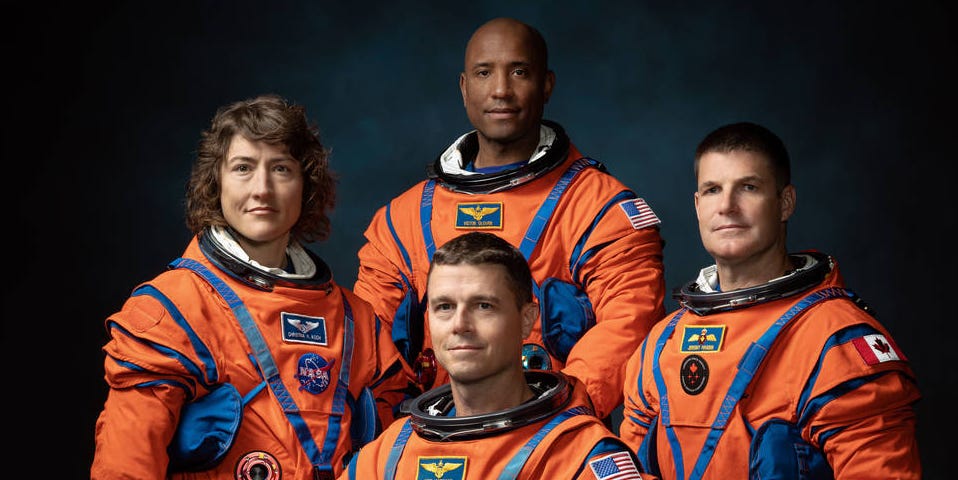
NASA’s Artemis II crew announcement was not just another polished space-agency press event with flags, flight suits, and enough acronyms to make a toaster feel underqualified. It was the moment humanity met the four people chosen to ride NASA’s Orion spacecraft around the Moon and help open the next chapter of lunar exploration. The crew: Commander Reid Wiseman, Pilot Victor Glover, Mission Specialist Christina Koch, and Canadian Space Agency Mission Specialist Jeremy Hansen.
That lineup matters. Artemis II was designed as the first crewed mission of NASA’s Artemis program, following the uncrewed Artemis I test flight. Its job was not to land on the Moon, but to prove that Orion, the Space Launch System rocket, life-support systems, navigation, crew procedures, mission control workflows, and deep-space operations could work together when actual humans were onboard. In plain English: before NASA sends astronauts to walk near the lunar south pole, it first had to make sure the spacecraft behaves when four highly trained people are strapped inside it and Earth starts shrinking in the window.
The mission also carried symbolic weight. Artemis is NASA’s plan to return humans to the Moon and build a sustained presence there for science, technology development, and future Mars preparation. Artemis II turned that plan from a blueprint into a human story. It introduced a crew that represented experience, technical excellence, international partnership, and a broader vision of who gets to participate in deep-space exploration.
What Is Artemis II?
Artemis II was the first crewed flight test of NASA’s Orion spacecraft and Space Launch System, often shortened to SLS. The mission sent four astronauts on a journey around the Moon and back, testing systems that future Artemis missions will rely on for longer and more complex flights. Unlike Apollo-era missions that raced toward a Cold War finish line, Artemis is built around long-term exploration, scientific research, commercial partnerships, and international cooperation.
The mission profile was intentionally careful. Orion had to support the crew, maintain cabin pressure, manage power, handle communications, navigate through deep space, and survive the fiery return through Earth’s atmosphere. The spacecraft also gave astronauts and flight controllers a chance to practice operations that matter for later missions, including system checks, manual handling procedures, emergency planning, and crew coordination far from the comfort zone of low Earth orbit.
Think of Artemis II as the world’s most expensive, most ambitious road test. Except the “car” was a deep-space spacecraft, the road went around the Moon, and pulling over to ask for directions was not exactly an option.
Meet the Artemis II Astronauts
The four Artemis II astronauts were selected because each brought a different kind of expertise to the mission. Together, they formed a crew with military aviation experience, engineering knowledge, spaceflight background, science operations, leadership ability, and the calm-under-pressure personality required when your office view includes planet Earth.
Reid Wiseman: Commander and Veteran Spacefarer
Reid Wiseman served as commander of Artemis II. A U.S. Navy veteran, test pilot, engineer, and NASA astronaut, Wiseman brought leadership experience from both aviation and spaceflight. He was selected as a NASA astronaut in 2009 and previously served aboard the International Space Station, where he worked as a flight engineer during Expedition 41. His ISS mission included months of scientific research, operations, and spacewalk experience.
As commander, Wiseman’s role went beyond sitting in the front seat and looking heroic in a launch suit. He was responsible for overall crew safety, mission execution, decision-making, and coordination with mission control. In a spacecraft, leadership is not about dramatic speeches. It is about knowing procedures, understanding risk, listening carefully, and making clear decisions when the timeline is moving faster than your heartbeat.
Wiseman also represented continuity between NASA’s past and future. He came from a generation trained in the Space Shuttle and ISS era, but Artemis II placed him inside a mission architecture designed for lunar exploration. That made him a bridge between two spaceflight worlds: Earth-orbit operations and deep-space missions.
Victor Glover: Pilot, Engineer, and Trailblazer
Victor Glover served as pilot of Artemis II. A naval aviator, test pilot, engineer, and NASA astronaut, Glover had already made history before Artemis II. He flew on SpaceX Crew-1 to the International Space Station and served as a flight engineer during Expedition 64. That mission gave him valuable long-duration spaceflight experience, especially with modern spacecraft systems and international station operations.
As Artemis II pilot, Glover helped monitor Orion’s performance, support spacecraft operations, and assist with critical mission phases. His background as a test pilot mattered because Artemis II was, at its core, a test flight. Test pilots do not merely ride vehicles; they understand them, evaluate them, and help teams learn what the machine is really doing.
Glover’s assignment also carried historic significance. He became the first Black astronaut assigned to a lunar mission. That milestone was not a decorative footnote. Representation matters because space exploration is funded, supported, watched, and dreamed about by people from every background. When a child sees someone like Glover heading toward the Moon, the Moon suddenly looks less like a distant symbol and more like a possible destination.
Christina Koch: Engineer, Record-Setter, and Mission Specialist
Christina Koch served as mission specialist on Artemis II. An engineer and NASA astronaut, Koch is best known for her long-duration mission aboard the International Space Station, where she set the record for the longest single spaceflight by a woman. She also participated in the first all-female spacewalks, adding another major chapter to NASA’s human spaceflight history.
Koch’s engineering background made her especially valuable on a mission where spacecraft systems had to be observed, tested, and understood in real time. Before joining the astronaut corps, she worked in scientific instrumentation and remote research environments, including polar regions. That kind of experience is underrated until you remember that deep space is basically the ultimate remote field station, just with fewer penguins and more radiation.
Her Artemis II role helped highlight a major milestone: Koch became the first woman assigned to a lunar mission. For decades, the Apollo Moon missions were crewed entirely by men. Artemis II changed that visual and historical record. It made the next era of lunar exploration look more like the world watching it.
Jeremy Hansen: Canada’s First Astronaut on a Lunar Mission
Jeremy Hansen, from the Canadian Space Agency, served as mission specialist on Artemis II. A Royal Canadian Air Force fighter pilot, physicist, and astronaut, Hansen represented the international partnership behind Artemis. His assignment made him the first Canadian selected for a mission around the Moon and a major symbol of Canada’s role in human space exploration.
Canada’s participation in Artemis is connected to decades of space robotics expertise, including Canadarm, Canadarm2, and future contributions to lunar exploration infrastructure. Hansen’s seat on Artemis II was not a lucky souvenir from NASA’s gift shop. It reflected Canada’s long-standing technical contributions and the growing importance of international collaboration in space.
Hansen also brought the perspective of a first-time spaceflier to a crew that included three NASA astronauts with previous spaceflight experience. That mix mattered. A strong crew benefits from veterans who know the rhythm of space operations and newcomers who bring fresh attention, curiosity, and focus to every procedure.
Why This Crew Was So Important
The Artemis II astronauts were not chosen only because they had impressive résumés, although they certainly did. They were chosen because the mission required a team able to test a new deep-space transportation system while carrying the hopes of a generation that had never seen humans travel beyond low Earth orbit.
The crew also reflected several historic firsts: the first woman assigned to a lunar mission, the first Black astronaut assigned to a lunar mission, and the first Canadian assigned to travel around the Moon. But the deeper point is not just “firsts.” The deeper point is that Artemis II showed how lunar exploration has evolved. The Moon is no longer presented as a destination for one nation alone. It is becoming a testing ground for science, technology, partnerships, and shared human ambition.
How Artemis II Builds on Artemis I
Artemis I launched without astronauts and tested SLS and Orion on a journey around the Moon. That uncrewed mission proved many major systems, but a spacecraft behaves differently when people are onboard. Humans need oxygen, temperature control, seats, displays, food, waste systems, emergency procedures, and enough room to function without turning every movement into a zero-gravity wrestling match.
Artemis II added the human factor. The mission tested Orion’s life-support systems with crew, gave astronauts a chance to evaluate displays and controls, and allowed NASA to collect operational data that cannot be fully simulated on Earth. You can build a great mock-up. You can run thousands of computer models. But eventually, someone has to fly the spacecraft and report whether the design works when the mission clock is real.
What Artemis II Means for Future Moon Missions
Artemis II was a stepping stone toward later Artemis missions, including missions intended to support lunar landing operations and long-term science near the Moon. NASA’s broader goals include exploring the lunar south pole, studying water ice and geology, developing surface systems, and learning how astronauts can live and work farther from Earth for longer periods.
The mission also helped prepare NASA for the practical realities of deep-space travel. Future crews will need reliable communication, power, radiation protection, navigation, docking systems, landing systems, spacesuits, and surface habitats. Artemis II did not solve every challenge, but it supplied crucial data from a real crewed flight beyond Earth orbit.
In that sense, Artemis II was not simply a “go around the Moon and come home” mission. It was a rehearsal, a stress test, and a public promise. It told the world that NASA was serious about returning to lunar exploration, and that the next Moon chapter would be more diverse, more international, and more technologically complex than Apollo.
The Human Side of Going Around the Moon
Spaceflight is often described with numbers: miles, velocity, altitude, thrust, temperature, mission duration. Those numbers matter, especially when engineers are trying to keep astronauts alive inside a vehicle moving at astonishing speed. But Artemis II also mattered because of the human experience behind the numbers.
Imagine looking out of Orion and seeing Earth as a bright world suspended in darkness. Every argument, grocery store, school bus, beach vacation, coffee spill, birthday cake, and traffic jam exists on that one blue planet. Astronauts often describe this view as transformative because it compresses human life into a single, fragile image. Artemis II gave a new generation a chance to reconnect with that perspective.
The mission’s crew also showed that astronauts are not mythical superheroes built in a secret NASA basement. They are pilots, engineers, scientists, parents, teammates, teachers, and explorers who trained for years to perform under pressure. Their stories make the Moon feel closer because they turn a technical mission into something personal.
Why the Artemis II Announcement Captured Public Attention
NASA’s announcement worked because it combined nostalgia and novelty. For people who remembered Apollo, Artemis II felt like a long-awaited return. For younger audiences, it felt like the first time lunar exploration truly belonged to their lifetime. The orange launch suits, the crew portrait, the Moon-bound mission plan, and the international lineup all made the announcement feel bigger than a standard agency update.
It also arrived during a period when space exploration had become more crowded and competitive. Commercial companies, international space agencies, robotic missions, private lunar landers, and new launch vehicles are reshaping the space landscape. Artemis II gave NASA a clear human-centered story in the middle of that busy environment: four astronauts, one spacecraft, one Moon, and one very intense checklist.
Experiences and Reflections Related to Artemis II
Following the Artemis II story feels a little like watching history put on a modern jacket. The Moon is familiar, almost too familiar. We see it from sidewalks, apartment windows, farms, highways, and late-night convenience store parking lots. It shows up whether we are ready for poetry or just trying to remember where we parked. But when NASA introduces a crew that will travel around it, the Moon suddenly stops being background scenery. It becomes a destination again.
One of the most powerful experiences connected to Artemis II is the feeling of scale. Most daily problems are local. A laptop battery dies. A meeting runs long. Someone eats the leftovers clearly labeled with your name, which is basically a workplace felony. Then a lunar mission reminds us that humans can also organize around enormous goals. Thousands of engineers, technicians, scientists, managers, sailors, medical teams, flight controllers, contractors, and international partners contribute to getting four astronauts safely around the Moon. The crew receives the spotlight, but behind them is a human network so large it practically has its own gravity.
Another experience is the emotional pull of representation. Seeing Christina Koch, Victor Glover, Reid Wiseman, and Jeremy Hansen assigned to Artemis II made the mission feel open-ended in the best way. It said that future explorers will not all look the same, come from the same background, or carry the same national story. That matters for students watching from classrooms, parents explaining the mission at breakfast, and space fans who have waited decades for a crewed lunar flight to feel new again.
There is also something deeply relatable about the mission’s test-flight nature. Artemis II was not about pretending everything was effortless. It was about checking systems, learning from hardware, practicing procedures, and accepting that exploration advances through disciplined uncertainty. That is a useful lesson far beyond spaceflight. Most meaningful projects in life work the same way. You prepare, you test, you adapt, and occasionally you discover that the thing you confidently planned needs a very large engineering review.
For writers, teachers, students, and curious readers, Artemis II offers a rare storytelling gift. It has technical drama, human milestones, international cooperation, historical echoes, and future consequences. It connects Apollo to Artemis, Earth orbit to lunar space, and personal biography to planetary ambition. Best of all, it makes the Moon feel less like a dusty museum piece and more like the next chapter of a book we are still writing.
The most memorable experience may be the simplest: looking up. After learning who the Artemis II astronauts are, the Moon is no longer just the Moon. It becomes a place people trained for, flew around, studied, photographed, and used as a proving ground for future exploration. That quiet shift in perspective is the magic of missions like Artemis II. They make the sky feel active. They make science feel human. And they remind us that even in an age of tiny screens, the biggest stories are still written across the heavens.
Conclusion
NASA’s Artemis II crew announcement introduced more than four astronauts. It introduced a new era of lunar exploration. Reid Wiseman, Victor Glover, Christina Koch, and Jeremy Hansen brought leadership, technical skill, courage, and historic representation to a mission designed to test humanity’s path back to the Moon. Artemis II did not end the journey; it made the journey real. It proved that the next chapter of Moon exploration would be built not only with rockets and spacecraft, but with people whose stories can inspire classrooms, laboratories, families, and future astronauts around the world.