For years, large language models were best known for writing emails, summarizing reports, debugging code, and occasionally giving your grocery list the dramatic flair of a Shakespearean soliloquy. But now, the same basic idea behind modern language AI is moving into a far more mysterious text: DNA. Instead of predicting the next word in a sentence, these new models predict the next nucleotide, interpret regulatory patterns, and help scientists ask a bold question: what if the genome is not just a biological database, but a language?
The title “LLMs Coming For A DNA Sequence Near You” may sound like science fiction, but the shift is already underway. Researchers are building DNA language models, genomic foundation models, and multimodal biological AI systems that can read long stretches of genetic code, identify meaningful patterns, estimate the impact of mutations, and even design new biological sequences. The four-letter alphabet of DNAA, C, G, and Tlooks simple, almost suspiciously simple, like the universe forgot to install a full keyboard. Yet those letters encode instructions for cells, tissues, disease risks, development, gene regulation, and countless biological functions we are still trying to understand.
In other words, artificial intelligence in genomics is no longer just a clever assistant for sorting lab results. It is becoming a new kind of microscopeone that does not merely look at DNA, but learns from it.
What Does It Mean for an LLM to Read DNA?
A traditional large language model learns statistical relationships among words, phrases, and documents. It studies context. It notices that “peanut butter and” is often followed by “jelly,” not “quantum radiator.” DNA language models use a similar principle, but the “text” is biological sequence data. They learn how nucleotides appear in relation to one another, how motifs repeat, where regulatory regions may sit, and how a tiny variation can change biological function.
This is important because DNA does not behave like a simple instruction manual where every page is clearly labeled. Only a small portion of the human genome directly codes for proteins. Much of the rest helps control when, where, and how strongly genes are turned on or off. That regulatory layer is one of the trickiest parts of biology. It is also exactly the kind of pattern-rich, context-heavy problem where machine learning can be useful.
Early genomic AI tools often focused on specific tasks: classify a sequence, detect a motif, identify a likely enhancer, or predict gene expression in a limited setting. The newer generation of genomic foundation models aims to be broader. These models are trained on massive amounts of DNA and then adapted for many downstream jobs, such as variant effect prediction, regulatory sequence analysis, disease research, synthetic biology, and drug discovery.
From DNABERT to Genomic Foundation Models
One of the important milestones in this field was DNABERT, a model inspired by BERT, the natural language processing architecture that changed how computers handled text. DNABERT treated DNA sequences as something that could be learned from context. Instead of seeing a string of nucleotides as a flat row of letters, it tried to understand the surrounding sequence and infer biological meaning from patterns.
Then came more efficient and powerful successors, including DNABERT-2 and other DNA foundation models that improved tokenization, reduced computational cost, and expanded performance across genomic tasks. The challenge is not only to make a model accurate, but also to make it practical. A human genome contains roughly three billion base pairs. That is not a paragraph. That is a library with no comfortable chairs.
Another major development is the Nucleotide Transformer family of models, which learns representations from large collections of genomic sequences across humans and many other species. These models are designed to support molecular phenotype prediction and other tasks where DNA sequence contains clues, but the relationships are too complex for simple rules.
HyenaDNA pushed the field in another direction by focusing on long-context modeling. Standard transformer architectures struggle when sequence length becomes enormous because attention mechanisms can become computationally expensive. HyenaDNA showed that alternative architectures could model DNA at single-nucleotide resolution with context lengths reaching up to one million tokens. That matters because biology often depends on long-distance interactions. A regulatory element may influence a gene far away on the genome, like a neighbor shouting instructions from across the streetexcept the street is microscopic, folded in 3D, and occasionally wearing a protein hat.
Evo 2, AlphaGenome, and the New Race to Decode Regulation
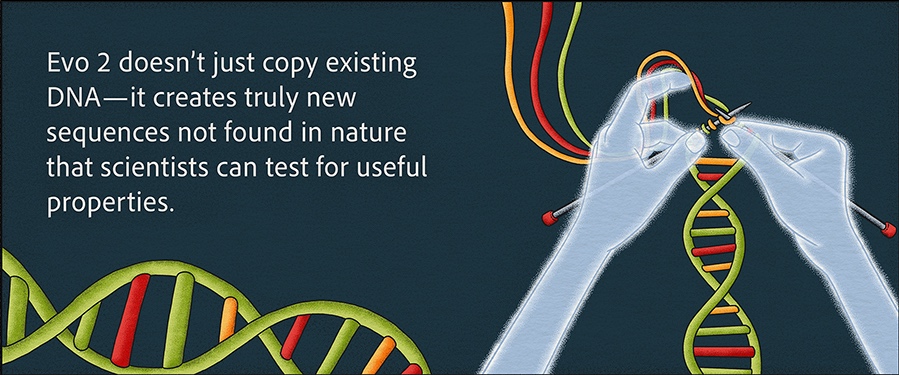
Recent models such as Evo 2 and AlphaGenome show how quickly this field is accelerating. Evo 2 is described as a large biological foundation model trained across diverse genomes, with the ability to interpret and generate DNA sequences at single-nucleotide resolution over very long contexts. Its ambition is not limited to one organism or one task. It aims to model biological sequences across scales, from individual molecular features to broader genomic patterns.
AlphaGenome, developed by Google DeepMind, focuses strongly on understanding genome function and regulatory variant effects. It is designed to take long DNA sequences as input and predict functional genomic outputs across cell types. That is a major step because many disease-linked variants do not sit neatly inside protein-coding genes. Instead, they may alter regulatory regions that control when genes are activated. If protein-coding DNA is the recipe, regulatory DNA is the kitchen manager deciding when the oven turns on, who gets the ingredients, and why the blender is screaming at 6 a.m.
For researchers, models like these could help prioritize which variants deserve lab follow-up, which regulatory elements might matter in a disease, and which synthetic DNA sequences might behave as intended. They do not replace experiments. Biology remains stubbornly real. Cells do not care how elegant your model architecture is if your prediction fails in a dish, a mouse, or a patient. But these tools can narrow the search space and make experiments smarter.
Why DNA Is a Perfectly Difficult Language
Calling DNA a language is useful, but it is not perfect. Human language has grammar, idioms, cultural context, and people who argue online about commas. DNA has promoters, enhancers, silencers, splice sites, chromatin structure, methylation, evolutionary conservation, and 3D folding. A word in English usually means something because of nearby words. A DNA segment may mean something because of nearby nucleotides, distant genomic regions, cell type, developmental stage, and molecular machinery.
That makes DNA both attractive and annoying for AI. Attractive because it is sequence data, and sequence models are good at learning patterns. Annoying because the same DNA sequence can behave differently depending on biological context. A regulatory element active in a liver cell may be quiet in a neuron. A mutation that looks harmless in one setting may matter in another. This is why the best genomic AI systems increasingly need more than raw sequence. They may integrate epigenomic data, expression data, chromatin accessibility, species diversity, disease annotations, and experimental readouts.
What Can LLMs for DNA Actually Do?
1. Predict the effects of genetic variants
One of the most promising uses of DNA language models is variant effect prediction. A single letter change in DNA can sometimes alter a protein, disrupt splicing, weaken a regulatory element, or change gene activity. But most variants are hard to interpret. Genomic foundation models can help estimate which changes are more likely to matter, especially in non-coding regions where traditional interpretation is difficult.
2. Identify regulatory elements
Enhancers, promoters, silencers, and other regulatory elements are like control panels for the genome. They help decide which genes are active in which cells. AI models can learn patterns associated with these elements and help researchers locate them more efficiently. This is especially valuable because regulatory DNA makes up a large and complex part of genome function.
3. Support drug discovery and therapeutic design
Drug discovery often depends on understanding biological mechanisms. If AI can help identify disease-driving variants, predict gene regulation, or design better molecular tools, it may shorten the path from hypothesis to experiment. In gene therapy, for example, researchers are exploring synthetic regulatory sequences that can turn genes on in specific cell types. A model that helps design a DNA switch for the right tissue could be incredibly useful, provided it is tested carefully.
4. Improve protein and RNA engineering
DNA does not act alone. It connects to RNA, proteins, and cellular systems. Some biological foundation models are being built to understand relationships across DNA, RNA, and proteins. This could help optimize genetic sequences for protein production, improve therapeutic manufacturing, or reveal how sequence choices affect biological output.
5. Make precision medicine more precise
Precision medicine aims to tailor care based on genetics, environment, lifestyle, and clinical data. DNA language models could help by interpreting variants that are currently uncertain, identifying disease mechanisms, and supporting more personalized risk assessment. The key word is “support.” These models should assist clinicians and researchers, not act as magical fortune cookies wearing lab coats.
The Big Benefits: Speed, Scale, and Pattern Recognition
The biggest advantage of LLMs for DNA sequences is scale. Humans are excellent at insight, experimental design, and biological reasoning, but nobody can casually read millions of genomes over coffee. AI models can search through vast sequence spaces, compare patterns across species, and generate hypotheses at a speed that would make a graduate student both impressed and deeply suspicious.
Another benefit is transfer learning. A model trained broadly on genomic data may learn general representations that help with many tasks, even when labeled data is limited. In biology, high-quality labeled datasets can be expensive, slow, and difficult to generate. If a foundation model already understands useful sequence features, researchers can fine-tune it with smaller datasets for specific problems.
These systems may also reveal patterns that humans did not think to look for. A classic motif search can find known patterns. A deep model may discover combinations, dependencies, or long-range signals that are harder to describe manually. That does not mean every hidden feature is biologically meaningful. Models can learn shortcuts. They can be fooled by biased data. They can produce confident nonsense. But when paired with validation, they can become powerful engines for discovery.
The Risks: Privacy, Bias, Overhype, and Biosecurity
Genomic data is deeply personal. Unlike a password, you cannot simply change your DNA because a database was handled poorly. It can reveal information about ancestry, disease risk, family relationships, and biological traits. As DNA language models become more capable, cybersecurity and privacy protections must keep pace. Secure storage, controlled access, transparency, consent, audit trails, and responsible data sharing are not boring paperwork. They are the seatbelts on this very fast scientific vehicle.
Bias is another concern. Genomic research has historically overrepresented some populations and underrepresented others. If models learn from uneven datasets, their predictions may work better for some groups than others. That would be a serious problem in clinical settings. A precision medicine tool that is precise for only part of the population is not precision medicine; it is a very expensive shrug.
There is also the issue of overhype. AI in genomics is exciting, but excitement should not be confused with clinical readiness. A model may perform well on a benchmark and still fail in a real-world medical workflow. Regulatory agencies, clinicians, researchers, and developers need clear standards for validation, monitoring, documentation, and risk assessment. In medicine, “the model seemed pretty smart” is not an acceptable safety plan.
Finally, because these models may eventually help design biological sequences, governance matters. Most research aims at beneficial applications such as disease understanding, drug development, agriculture, and biotechnology. Still, responsible access, screening, and oversight are important whenever tools touch biological design.
Will DNA LLMs Replace Biologists?
No. They will change the job, not delete the scientist. Biology is full of messy systems, experimental uncertainty, and context that does not always fit neatly into a training dataset. DNA language models can suggest, rank, predict, and generate. But researchers still need to design experiments, interpret results, challenge assumptions, and ask whether a prediction makes sense in living systems.
The better comparison is not “AI replaces biologists,” but “AI becomes a new lab instrument.” Sequencers did not eliminate geneticists. Microscopes did not eliminate cell biologists. They expanded what scientists could see. DNA LLMs may expand what scientists can infer before they run an experiment.
What This Means for Patients and Everyday People
For most people, DNA language models will not appear as a chatbot saying, “Hello, I analyzed your chromosome 12 and have thoughts.” Instead, they may quietly influence the research pipeline behind future diagnostics, therapies, and clinical decisions. They may help scientists identify which variants are worth studying. They may improve gene therapy design. They may support rare disease research by making uncertain genetic findings easier to investigate.
However, patients should expect careful validation, not instant miracles. A prediction is not a diagnosis. A risk estimate is not destiny. A genomic AI result should be interpreted in context by qualified professionals, especially when health decisions are involved. The future may be more personalized, but it should also be more careful.
Practical Experiences and Takeaways: Living With the DNA AI Boom
Anyone watching the rise of LLMs for DNA sequences quickly notices a familiar pattern: first comes amazement, then confusion, then a spreadsheet. The amazement is easy. A model that can process a million DNA letters and make useful predictions feels like something smuggled back from the future. The confusion arrives when you realize that genome biology is not a tidy translation problem. DNA is not English with fewer vowels. It is a multi-layered operating system running inside cells, shaped by evolution, chemistry, and chance.
A practical way to understand these tools is to think of them as powerful hypothesis generators. Imagine a researcher studying a rare disease where several genetic variants might be involved. Instead of testing every candidate with equal attention, a DNA language model can help prioritize which variants appear more likely to disrupt regulation, splicing, or gene activity. The model does not provide the final answer. It provides a sharper starting point. In a busy lab, that difference matters. Time, funding, samples, and patience are all limited resources.
Another experience from this fast-moving field is that model size alone is not the whole story. Bigger can help, but biology rewards relevance. A model trained on diverse species may learn evolutionary patterns that a narrow model misses. A model with long-context capacity may capture distant regulatory relationships that shorter models cannot see. A model with better tokenization may handle sequence details more efficiently. In other words, the winning system is not always the one with the flashiest parameter count. Sometimes the best model is the one that fits the biological question like a good pair of lab gloves: snug, useful, and not mysteriously covered in someone else’s marker ink.
For students, writers, biotech founders, and curious readers, the main lesson is to avoid both extremes. Do not dismiss DNA LLMs as hype, because the progress is real. Also, do not treat them as crystal balls, because biology has a long history of embarrassing overconfident predictions. The healthiest mindset is disciplined excitement. Ask what data trained the model. Ask which populations are represented. Ask whether predictions were validated experimentally. Ask whether the model is being used for research, clinical decision support, or biological design, because each setting carries different risks.
The most exciting experience is seeing how many fields now overlap. Computer scientists are learning genetics. Biologists are learning model evaluation. Clinicians are asking about explainability and safety. Privacy experts are stepping into genomic data governance. The future of DNA language models will not be built by one discipline wearing noise-canceling headphones. It will require collaboration, skepticism, and a shared willingness to admit when the genome is being weirdwhich, to be fair, is often.
So yes, LLMs are coming for a DNA sequence near you. Not as villains, not as miracle workers, and not as tiny robots crawling through your chromosomes with clipboards. They are arriving as tools: imperfect, powerful, and increasingly important. Used wisely, they may help decode disease, design better therapies, and reveal rules of biology that have been hiding in plain sight for billions of years.
Conclusion
Large language models for DNA sequences represent one of the most exciting frontiers in artificial intelligence. By learning from genomic data, these systems can help researchers interpret variants, identify regulatory elements, explore long-range biological patterns, and design new sequences for research and therapeutic development. Models such as DNABERT, Nucleotide Transformer, HyenaDNA, Evo 2, and AlphaGenome show that the genome can be studied with tools originally inspired by natural language processing, but adapted for the strange and beautiful grammar of life.
The opportunity is enormous, but so is the responsibility. Genomic AI must be accurate, transparent, secure, inclusive, and carefully validated. The future of medicine may depend not only on how well AI can read DNA, but on how wisely humans decide to use it.