A chandelier usually arrives with strict instructions: hang it, switch it on, and admire it from a respectable distance. The Ingo Maurer Holiday Chandelier has other plans. It invites you to rearrange it, write on it, decorate it, and occasionally stand beneath it wondering whether your dining room has become a lighting showroom, an art installation, or an extremely elegant bulletin board.
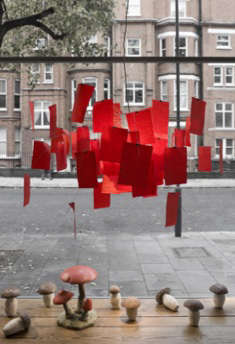
The design commonly described as the Ingo Maurer Holiday Chandelier is a festive interpretation of Maurer’s celebrated Zettel’z 5 pendant light. A red version was photographed at the London shop Few & Far and featured by Remodelista as a holiday decorating idea. Rather than being a conventional chandelier covered with glass drops, it surrounds its light source with dozens of delicate paper notes. The result is warm, animated, personal, and refreshingly free of plastic holly.
What Is the Ingo Maurer Holiday Chandelier?
Strictly speaking, “Holiday Chandelier” is better understood as an editorial nickname or seasonal styling concept than the formal name of a permanent product. The underlying fixture is Zettel’z 5, designed by Ingo Maurer in 1997. Its sculptural framework consists of stainless-steel rods, heat-resistant satin-finished glass, and 80 sheets of thin Japanese paper.
The standard Zettel’z 5 includes 31 printed sheets and 49 blank sheets in DIN A5 size. Owners attach the papers to adjustable metal arms, positioning them loosely for an open, airy shape or closely together for a denser cloud. Because the blank pages can carry drawings, messages, photographs, poems, or seasonal graphics, the chandelier is never completely finished. It evolves with the room and the people living beneath it.
Maurer and his studio also created limited colored editions. The sold-out Blushing Zettel’z, introduced in 2006, used 80 printed sheets of Japanese paper and gave the familiar form a more dramatic red appearance. This edition helps explain why the design translates so naturally into holiday interiors: it already looks like a floating constellation of handwritten cards, ribbons, and glowing wrapping paper.
A Chandelier That Replaces Crystal With Ideas
Traditional chandeliers often communicate luxury through expensive materials. Crystal sparkles. Brass gleams. Decorative arms curl toward the ceiling with the confidence of furniture that has inherited property.
Zettel’z 5 takes the opposite approach. It substitutes handwritten paper for crystal drops and ordinary clips for ornamental hardware. Dwell memorably compared its suspended notes to romantic messages scattered around a desk, while the Museum of Modern Art emphasizes how the lamp allows each owner to decide what appears on the pages. The luxury comes from imagination, movement, and emotional meaning rather than material extravagance.
This transformation of humble objects was central to Maurer’s work. Trained in typography and graphic design, he treated light as both a technical medium and a form of storytelling. His 1966 Bulb enlarged and reframed the familiar incandescent bulb, while later fixtures incorporated feathers, porcelain fragments, handwritten notes, and other unexpected materials. Cooper Hewitt described his work as playful, humorous, poetic, and fascinated with light’s magical qualities.
How the Zettel’z 5 Produces Light
The approximately 47-inch-wide fixture uses two light sources to combine ambient illumination with more directed downward light. The thin Japanese paper softens and scatters the glow, while the spaces between the sheets prevent the chandelier from becoming a solid visual block. Depending on the arrangement, it can look like a compact sphere, an unruly paper cloud, or a luminous tumbleweed that has developed excellent taste.
The paper also introduces movement. Air from an open door or nearby activity can make the sheets tremble gently, changing the pattern of highlights and shadows. During the day, the fixture remains visually interesting even when switched off. At night, it becomes warmer and more theatrical as light passes through and around the paper.
That dual personality is one reason Zettel’z has been collected and displayed as an important work of modern design. MoMA’s example, made from stainless steel, glass, and paper, dates to 1997 and measures roughly 47 by 47 inches. The museum presents it not merely as a household appliance but as an interactive object that gives the user an active creative role.
Why It Works So Well as Holiday Lighting
It Feels Festive Without Looking Predictable
Holiday decorating often depends on familiar symbols: wreaths, ornaments, stars, bells, and enough miniature lights to make the electric meter nervous. The Ingo Maurer Holiday Chandelier creates a seasonal mood without copying those conventions.
Red paper adds warmth and celebration, but the structure remains modern. White sheets can suggest snow, parchment, or handmade cards. Metallic accents resemble ornaments without turning the chandelier into a floating department-store display. The lamp feels festive because of color, glow, and movement rather than because it is shaped like a reindeer.
It Can Hold Real Memories
The blank sheets offer an opportunity to make the fixture personal. Family members can add favorite holiday memories, recipes, jokes, wishes, small sketches, or notes of gratitude. Guests might write a message during a dinner party and clip it onto the chandelier before leaving.
Over several seasons, the light can become a visual archive. A child’s crooked snowman drawing may hang beside an elegant calligraphy card. A serious quotation may end up next to “Do not let Uncle Mark make the punch again.” The contrast is part of the charm.
It Connects With Maurer’s Larger Holiday Legacy
Maurer also designed the monumental UNICEF Crystal Snowflake displayed above Fifth Avenue in New York during the holiday season. The installation uses thousands of crystals and numerous lighting elements to create a public symbol of hope and compassion. Although dramatically different in scale and materials, both the snowflake and Zettel’z demonstrate Maurer’s ability to make light feel airy, emotional, and celebratory.
How to Style an Ingo Maurer Holiday Chandelier
Choose a Controlled Color Palette
A strong holiday version does not need every seasonal color at once. Two or three coordinated tones usually preserve the fixture’s sculptural clarity.
- Red, ivory, and gold: Warm, classic, and especially effective in dining rooms.
- White, silver, and pale blue: Crisp and wintery without relying on traditional Christmas imagery.
- Burgundy, blush, and copper: Sophisticated enough to remain in place beyond the holidays.
- Black, white, and metallic gold: Graphic, contemporary, and ideal for minimalist interiors.
- Green, cream, and natural kraft paper: Relaxed, organic, and suited to rustic-modern homes.
Design Milk experimented with several configurations, including colored, patterned, and black paper. Its hands-on account noted that lightweight, double-sided paper works best because heavier stock can pull the slender wires downward, while single-sided prints may look unfinished from certain angles. Origami paper can therefore be a practical choice when creating custom seasonal sheets.
Mix Printed and Handwritten Pages
A completely coordinated set can look polished, but it may also feel more like retail packaging than personal decor. Combining professionally printed sheets with handwritten notes produces greater depth.
Try using a few bold graphic pages as visual anchors, then surround them with quieter sheets carrying short messages. Repeat key colors throughout the chandelier so the overall composition still feels intentional. The goal is cheerful variation, not the visual equivalent of everyone talking during dinner.
Leave Breathing Room
The paper should form a luminous volume rather than a sealed shell. Leave visible gaps around the center so light can escape and the structure remains airy. A loose arrangement emphasizes movement, while a denser one creates stronger color and a more dramatic silhouette.
Where the Chandelier Looks Best
Above a Dining Table
The dining room is the most natural location because the chandelier can serve as both a centerpiece and a conversation starter. Its downward light supports the table surface, while the paper cloud creates ambient illumination above it.
Dwell has documented Zettel’z fixtures in dining spaces ranging from dark, sculptural desert homes to restrained monochromatic interiors. In both settings, the irregular paper form softens hard architectural lines and gives the room an unmistakable focal point.
In a Tall Entryway
An entry hall allows the chandelier to be seen from several angles. Visitors encounter the messages before they reach the living room, immediately establishing that the home takes design seriously but not solemnly.
Because Zettel’z 5 has a generous diameter, an open foyer or stairwell can also give its rods and papers enough visual space. Dwell has shown the fixture in a bright entry hallway where its soft paper construction contrasts with clean wood flooring and minimalist architecture.
In a Living Room
In a living room, the chandelier behaves more like suspended sculpture. It pairs particularly well with simple furniture, quiet walls, and a restrained number of competing accessories. Give it room to be the interesting one. Every room needs a lead performer, and Zettel’z did not attend rehearsal to play “background lamp number three.”
Installation, Bulbs, and Everyday Care
The fixture’s visual lightness should not encourage casual installation. Its electrical connection and broad arrangement require careful planning. Confirm ceiling support, canopy compatibility, voltage requirements, cord length, and local electrical rules before installation. A qualified electrician is the sensible choice, particularly when replacing an existing chandelier or installing the light in a high space.
The current manufacturer specifies two E27 sockets and provides maximum wattage guidance for the upward and downward light sources. Follow the exact instructions supplied with the fixture rather than guessing based on what fits into the socket. The heat-resistant glass enclosure is designed to separate the light source from the paper composition, but the paper sheets must still be positioned as directed.
Compatible LED bulbs can reduce energy use and produce substantially less heat than traditional incandescent bulbs. ENERGY STAR reports that LED lighting may produce light up to 90 percent more efficiently than incandescent technology, which releases much of its energy as heat. Still, the bulb shape, wattage, dimming compatibility, and manufacturer requirements must all be checked before making a substitution.
For cleaning, switch the fixture off and allow it to cool completely. Use a gentle air blower or a clean, soft brush rather than wet products. Individual sheets can be removed for replacement, but photographing the arrangement first will save you from trying to reconstruct an 80-piece paper constellation from memory.
Is the Ingo Maurer Holiday Chandelier Worth the Attention?
This is not the right fixture for someone who wants an invisible ceiling light. It is large, expressive, and intentionally interactive. Assembly requires patience, and changing the paper arrangement can become a small creative project rather than a five-minute decorating shortcut.
That involvement is also its greatest advantage. Zettel’z 5 does not become obsolete when a color trend changes. Its appearance can be refreshed with new messages, illustrations, and lightweight papers. The basic structure remains recognizable, but the emotional content belongs to the owner.
Maurer’s work has been celebrated by institutions including MoMA and Cooper Hewitt because it challenges the boundary between functional lighting and art. The Holiday Chandelier concept makes that philosophy especially accessible: light is not simply delivered into the room; it is shaped by memory, typography, humor, and participation.
Experience Notes: What Living With the Chandelier Feels Like
The day-to-day experience of an Ingo Maurer Holiday Chandelier begins before the light is switched on. Assembly forces you to slow down and make choices. Each wire changes the silhouette. Each sheet affects balance, density, and color. Place too many papers in one area and the fixture looks lopsided. Spread them too evenly and it can lose the lively disorder that makes it appealing.
This is not a complaint disguised as design appreciation. The process is the point. Design Milk’s detailed reconfiguration of Zettel’z 5 describes the patience required to insert the arms, adjust the clips, test paper weights, and evaluate the composition from across the room. The chandelier rewards experimentation, but it does not reward rushing. A calm afternoon, a clear floor, and a beverage reserved for after the ladder is put away are all excellent preparation.
Once installed, the fixture changes throughout the day. Morning light reveals the texture and thinness of the paper. Printed pages become tiny graphic compositions, while handwritten sheets encourage closer inspection. At night, the text becomes less dominant and the overall cloud takes over. Some pages glow; others become silhouettes. The stainless-steel framework seems to disappear, leaving the notes suspended in space.
The chandelier also changes how people behave around it. Guests look upward. They circle it. They read the pages and ask whether the messages came with the lamp. A conventional pendant may receive a polite compliment; Zettel’z tends to start a discussion. MoMA’s presentation of the design highlights exactly this participatory quality: the papers are attached by the user, and the final content is deliberately left open.
During the holidays, that participation can become a ritual. One evening might be devoted to replacing several white sheets with red or metallic paper. Another might involve asking family members to write predictions for the coming year. Children can contribute drawings, while guests add messages during dinner. The chandelier gradually becomes less like a product and more like a shared seasonal object.
There are practical realities. Lightweight sheets may flutter when a nearby door opens. Dust becomes easier to notice on dark or highly saturated paper. A careless arrangement can obscure too much light, and a visually ambitious color combination may look muddy from across the room. Design Milk’s experiments found that some patterns that appeared exciting up close blended into gray when viewed at a distance. Testing a few sheets before replacing all 80 is therefore a wise strategy.
The chandelier’s size also influences the room. At approximately four feet across, it needs visual territory. In a small room crowded with tall cabinets, patterned walls, and oversized artwork, it may feel restless. In an open dining area, entry, or minimalist living room, the same scale feels airy and confident. Published interiors demonstrate how effectively the fixture can soften concrete, dark finishes, angular architecture, and restrained color schemes.
Perhaps the most rewarding experience is seeing the fixture become imperfect in a meaningful way. A professionally styled chandelier can be beautiful on installation day, but handwritten pages gain character with time. Ink fades slightly. A corner bends. A child’s drawing remains long after the child has learned to draw recognizable hands. Those changes do not diminish the design; they complete it.
That is why the Ingo Maurer Holiday Chandelier feels different from disposable seasonal decor. It can celebrate the holidays without being packed into a plastic storage bin in January. Remove several red sheets, add poems or sketches, and the fixture becomes an everyday artwork again. The season changes, the paper changes, and the light continues doing what Maurer’s best designs have always done: making an ordinary room feel a little more magical.
Conclusion
The Ingo Maurer Holiday Chandelier is a reminder that festive lighting does not need to be loud, literal, or temporary. Built on the interactive Zettel’z 5 design, it turns Japanese paper, handwriting, color, and warm illumination into a floating personal sculpture. It demands more patience than an ordinary pendant, but it gives something back: a chandelier that can hold memories, start conversations, and change whenever inspiration strikes.
Note: “Ingo Maurer Holiday Chandelier” commonly refers to a holiday-styled or red interpretation of Zettel’z rather than a separate standard model currently bearing that official product name. Product specifications and bulb requirements should always be verified with the manufacturer or an authorized retailer before installation.