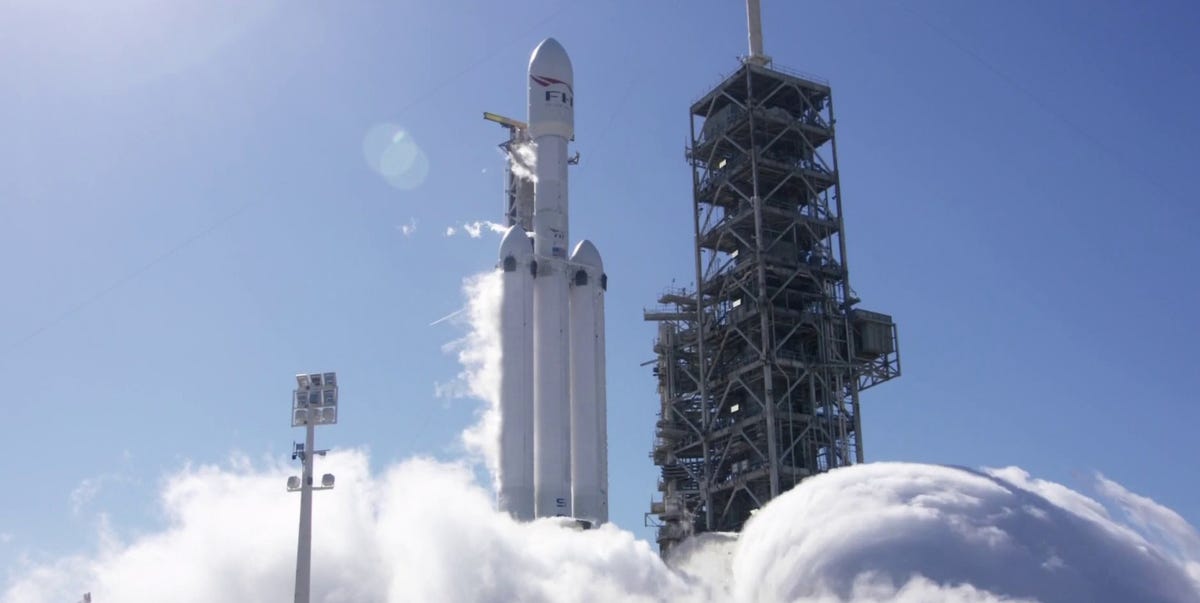
Falcon Heavy is not just a rocket. It is three Falcon 9 boosters in a trench coat, 27 Merlin engines doing synchronized thunder, and a reminder that big missions still need big machines. In an age where reusable rockets have made spaceflight feel almost routine, Falcon Heavy remains gloriously dramatic: a heavy-lift launch vehicle built for oversized satellites, deep-space probes, national security payloads, and the occasional “yes, we really can send that” moment.
Since its unforgettable debut in 2018, when a red Tesla Roadster became the most overqualified mannequin delivery system in history, Falcon Heavy has become a serious tool for NASA, the U.S. Space Force, commercial satellite operators, and deep-space science. The message is simple: when the payload is too massive, the orbit too demanding, or the destination too far away, let the Falcon Heavy fly.
Why Falcon Heavy Still Matters
Falcon Heavy occupies a unique place in the modern launch market. SpaceX’s Falcon 9 handles the workhorse jobs: Starlink, cargo missions, crew flights, commercial satellites, rideshares, and a steady stream of orbital deliveries. Starship, meanwhile, is the giant-in-development that aims to change the economics of space altogether. Sitting between them is Falcon Heavy, the proven muscle car of the fleet.
The rocket can lift nearly 64 metric tons to low Earth orbit in its expendable configuration, making it one of the most powerful operational rockets in the world. It uses three first-stage cores, each derived from Falcon 9, and fires 27 Merlin engines at liftoff. That produces more than five million pounds of thrust, which is the kind of number that makes engineers smile and windows reconsider their career choices.
But Falcon Heavy’s importance is not only raw power. It is availability, reliability, and flexibility. It can launch huge communications satellites toward geostationary orbit, send NASA spacecraft beyond Earth, and support high-energy national security missions. Unlike a rocket that exists only in renderings, Falcon Heavy has flown real payloads for real customers.
A Rocket Born From Falcon 9 DNA
The genius of Falcon Heavy is that SpaceX did not start with a blank sheet of paper. Instead, it built on Falcon 9 hardware and operations. Three booster cores are strapped together: two side boosters and one center core. Above them sits an upper stage and payload fairing. It sounds simple in the way that “just stack three rockets together” sounds simpleright up until you remember vibration, loads, plumbing, engine timing, flight software, separation events, and the fact that the vehicle is leaving Earth at extremely rude speeds.
This shared heritage matters. Falcon Heavy benefits from the manufacturing experience, engine reliability, and operational lessons of Falcon 9. SpaceX can reuse side boosters on certain missions, recover hardware when mission performance allows, and use familiar launch infrastructure at Kennedy Space Center’s Launch Complex 39A.
That pad is not just concrete and steel. LC-39A launched Apollo astronauts toward the Moon and space shuttles into orbit. Watching Falcon Heavy rise from that same historic site feels like spaceflight handing a torch from one generation to the nextexcept this torch is powered by chilled propellant and enough thrust to make seagulls file noise complaints.
The 2018 Demo Flight Changed the Conversation
Falcon Heavy’s first flight on February 6, 2018, was part engineering test, part global spectacle. Instead of a standard mass simulator, SpaceX launched Elon Musk’s Tesla Roadster with a spacesuit-wearing mannequin nicknamed Starman. The payload was whimsical, but the achievement was serious. Falcon Heavy became the most powerful operational rocket at the time, and SpaceX demonstrated that it could coordinate a complex triple-core vehicle and land two side boosters nearly simultaneously.
Those twin booster landings were instantly iconic. They looked less like aerospace footage and more like science fiction accidentally leaking into the evening news. For the public, Falcon Heavy made rockets exciting again. For customers, it showed that SpaceX had a heavy-lift launcher with real potential. For competitors, it was a polite but very loud memo: the commercial launch market had changed.
From Stunts to Serious Science
After the demo flight, Falcon Heavy moved into practical service. It launched commercial satellites, Department of Defense payloads, and NASA missions that demanded high energy. The rocket’s reputation matured quickly. The fireworks were still there, but now they were carrying billion-dollar spacecraft instead of a sports car with a dashboard sign saying “Don’t Panic.”
NASA’s Psyche Mission
In October 2023, Falcon Heavy launched NASA’s Psyche spacecraft from Kennedy Space Center. Psyche is headed to a metal-rich asteroid that may offer clues about the cores of early planetary bodies. That mission is a perfect example of why Falcon Heavy exists. Deep-space science often needs more than a gentle shove into orbit. It needs precision, energy, and a launch vehicle capable of sending a spacecraft onto a demanding interplanetary path.
Europa Clipper and the Long Road to Jupiter
In October 2024, Falcon Heavy launched NASA’s Europa Clipper mission toward Jupiter’s icy moon Europa. Europa is one of the most fascinating places in the solar system because scientists believe it may hide a global ocean beneath its frozen crust. Europa Clipper is designed to study the moon’s ice shell, ocean, surface chemistry, and habitability. It is not a life-detection mission, but it could help answer one of humanity’s biggest questions: where else might life-friendly environments exist?
Launching Europa Clipper required serious energy. For this kind of mission, Falcon Heavy was not a luxury; it was the right hammer for a very distant nail.
Commercial Heavy Lift: The ViaSat-3 Example
Falcon Heavy also serves the commercial satellite market, especially when a spacecraft is too large or too orbit-hungry for smaller launchers. The ViaSat-3 class of satellites is a strong example. These large communications spacecraft are designed to deliver high-throughput broadband capacity across major regions of the globe.
In April 2026, Falcon Heavy returned to flight after an extended gap and launched the ViaSat-3 F3 satellite from LC-39A. The mission showed that Falcon Heavy remains available for commercial operators that need heavy-lift performance to geosynchronous transfer orbit. For satellite companies, the equation is simple: the faster and more efficiently a spacecraft reaches its target orbit, the sooner it can begin generating value.
That practical business logic is one reason heavy-lift rockets matter. Space exploration gets the headlines, but communications satellites connect aircraft, ships, remote communities, governments, and businesses. A rocket like Falcon Heavy does not only launch hardware; it launches infrastructure.
National Security and the Heavy-Lift Advantage
The U.S. Space Force and national security customers also rely on heavy-lift launch capability. Some defense payloads are large, classified, or destined for difficult orbits. Others require precise delivery and high confidence. Falcon Heavy’s role in the National Security Space Launch program reflects the value of having multiple capable launch providers and vehicles.
For national security missions, reliability is not a marketing adjective. It is the entire point. A launch vehicle must perform under strict requirements, protect sensitive payloads, and deliver to exacting orbital targets. Falcon Heavy gives the United States another heavy-lift option at a time when space is central to communications, navigation, missile warning, intelligence, weather monitoring, and military readiness.
Reusable When Possible, Expendable When Necessary
One of Falcon Heavy’s most interesting features is its ability to balance reusability with mission performance. On some missions, the side boosters return to landing zones or drone ships. On others, the mission requires so much energy that one or more boosters are expended. This is not a failure of reusability; it is a trade-off.
Every kilogram of propellant saved for landing is a kilogram not used to push the payload harder. For high-energy missions, especially those headed toward distant planets or demanding geostationary trajectories, performance can matter more than booster recovery. In other words, sometimes the rocket has to spend everything it has. Space is not impressed by coupons.
This flexibility gives mission planners choices. They can prioritize cost savings through recovery when the payload and orbit allow it, or maximize performance when the mission demands every bit of velocity Falcon Heavy can provide.
Falcon Heavy in the Starship Era
It is tempting to view Falcon Heavy as a bridge to Starship, but that undersells it. Starship is designed to be much larger and fully reusable, with ambitions ranging from satellite deployment to lunar missions and Mars transportation. Yet new vehicles take time to mature. Customers with expensive spacecraft often prefer a rocket with demonstrated operational history.
That is why Falcon Heavy still has a meaningful role. It is already flying. It already has launch infrastructure. It has already sent spacecraft toward Mars, the asteroid belt, and Jupiter. It can support missions while Starship evolves from testing into routine operations.
In the future, Starship may dominate heavy lift. But today, Falcon Heavy is the dependable giant that can answer the phone when a mission says, “We are big, expensive, and we need to go very far.”
The Case for Letting Falcon Heavy Fly More Often
Falcon Heavy does not fly as frequently as Falcon 9 because fewer missions require its power. That is normal. A moving truck does not replace a compact car for daily errands. But when you need the moving truck, you really need it.
More Falcon Heavy launches could support a broader range of ambitious missions: large space telescopes, powerful communications satellites, lunar cargo deliveries, complex national security spacecraft, and interplanetary probes. The rocket’s demonstrated capability makes it a valuable tool for government and commercial customers who need confidence more than novelty.
There is also an ecosystem benefit. More heavy-lift availability encourages spacecraft designers to think bigger. Instead of shrinking every instrument to fit severe mass limits, mission teams can consider more capable spacecraft, larger power systems, bigger antennas, or additional fuel reserves. In spaceflight, mass is destiny. Give engineers more mass margin and watch them start smiling like kids in a hardware store.
Challenges: Cost, Cadence, and Competition
Falcon Heavy is powerful, but it is not magic. Heavy-lift launches cost more than medium-lift missions, require more hardware, and depend on customer demand. The market for massive payloads is smaller than the market for Falcon 9-class launches. That naturally limits cadence.
Competition is also changing. United Launch Alliance’s Vulcan, Blue Origin’s New Glenn, NASA’s Space Launch System, and SpaceX’s own Starship all shape the heavy-lift landscape in different ways. Some vehicles serve government missions; others aim for commercial payloads; some are optimized for deep-space exploration. Falcon Heavy’s advantage is that it has already proven itself, but staying relevant means continuing to offer schedule reliability, competitive pricing, and mission flexibility.
Environmental and regulatory factors matter too. Launch sites must balance growth with safety, wildlife protection, community impact, and range capacity. More launches are exciting, but they require careful coordination. Rockets may be loud, but responsible spaceflight cannot be tone-deaf.
What Falcon Heavy Represents
Falcon Heavy represents a practical kind of ambition. It is not the newest dream on the drawing board, but it is not old news either. It is a working heavy-lift rocket that has helped turn spectacular engineering into operational service. It proves that reusable rocket technology can scale upward, that commercial launch companies can support national missions, and that deep-space science can benefit from private-sector launch innovation.
Most importantly, Falcon Heavy gives humanity options. Want to send a spacecraft to a metallic asteroid? Falcon Heavy can help. Want to investigate a moon of Jupiter that may hide an ocean? Falcon Heavy can help. Want to place a huge communications satellite into a high-energy orbit? Falcon Heavy can help. Want to make everyone within 20 miles of Cape Canaveral look up and say, “What was THAT?” Falcon Heavy can absolutely help.
Experiences Inspired by “Let the Falcon Heavy Fly”
Watching a Falcon Heavy launch, even from a screen, is an experience that feels larger than the video frame. The countdown begins with calm voices and technical checks, but underneath that calm is a wild truth: thousands of parts, years of engineering, and millions of pounds of propellant are about to attempt controlled violence in the name of progress. Then ignition happens. The engines bloom, the pad disappears into exhaust, and the rocket rises with a strange combination of grace and stubbornness.
For many space fans, Falcon Heavy’s 2018 debut became a gateway memory. The sight of two boosters landing side by side was so clean, so cinematic, and so unlikely that it felt like a special effect. Except it was real. That moment changed how ordinary people talked about rockets. Suddenly, launch vehicles were not dusty museum subjects or distant government machinery. They were modern, reusable, dramatic, and almost personal.
The phrase “Let the Falcon Heavy fly” captures that feeling. It is not only about launching metal. It is about allowing bold tools to do bold work. There is something deeply satisfying about seeing a machine built for extremes actually used for extreme missions. A heavy-lift rocket sitting idle is impressive, but a heavy-lift rocket rising into the sky is a promise in motion.
Imagine standing on Florida’s Space Coast during a Falcon Heavy launch. The first thing you notice is the anticipation. People gather on beaches, causeways, balconies, parking lots, and grassy patches with cameras, binoculars, folding chairs, and snacks that will absolutely attract ants. Some are lifelong aerospace enthusiasts who know booster serial numbers the way baseball fans know batting averages. Others are families who simply heard, “big rocket today,” and decided that was enough reason to show up.
Then the sound arrives. From miles away, it is delayed, rolling, physical. You do not just hear Falcon Heavy; you feel it arrive through the air. The rocket climbs, bright against the sky, and for a few seconds everyone becomes quiet in the same way people become quiet at the edge of the ocean or under a meteor shower. It is awe with sunscreen.
That shared experience matters. Spaceflight can sometimes feel abstract: acronyms, contracts, payload masses, orbital mechanics, budget lines. A launch turns abstraction into emotion. It reminds people that exploration is not only a spreadsheet; it is a human activity. Engineers, technicians, range safety teams, mission managers, weather officers, welders, programmers, inspectors, and countless others all contribute to that single vertical line of fire.
Falcon Heavy also teaches patience. Launches scrub. Weather interrupts. Technical issues appear at the worst possible moment, because rockets have a mischievous sense of timing. But that is part of the lesson. Spaceflight rewards discipline over impatience. The goal is not to launch at any cost; the goal is to launch correctly. When Falcon Heavy finally clears the tower after a delay, the wait becomes part of the story.
On a personal level, Falcon Heavy inspires a useful kind of ambition. It says: build on what works, combine proven pieces in new ways, accept complexity, and do not be embarrassed by big goals. Not every project needs 27 engines, thankfully. But many dreams need the same philosophy. Start with a strong foundation. Test relentlessly. Improve after every attempt. Recover what you can. Spend everything only when the mission truly requires it.
That may be the most powerful experience connected to Falcon Heavy: it makes difficult things look possible without pretending they are easy. It is spectacular, yes, but it is also disciplined. It is loud, but not reckless. It is dramatic, but deeply technical. And when it flies, it carries more than payloads. It carries confidence that humanity can still build giant machines for giant questions.
Conclusion: Let the Falcon Heavy Fly
Falcon Heavy remains one of the most important rockets in modern spaceflight because it fills a role that smaller launchers cannot. It has the power for heavy commercial satellites, the precision for national security missions, and the energy for deep-space exploration. It helped launch NASA’s Psyche mission toward a metal-rich asteroid and Europa Clipper toward one of the most promising ocean worlds in the solar system. It has shown that reusable rocket concepts can scale, and that commercial launch providers can support some of the most ambitious missions ever attempted.
As Starship develops and the launch industry grows more competitive, Falcon Heavy still deserves its place on the pad. It is proven, powerful, flexible, and ready for the payloads that demand more than ordinary lift. So when the mission is massive, the orbit is unforgiving, and the destination is far beyond the everyday traffic of low Earth orbit, the answer is clear: let the Falcon Heavy fly.