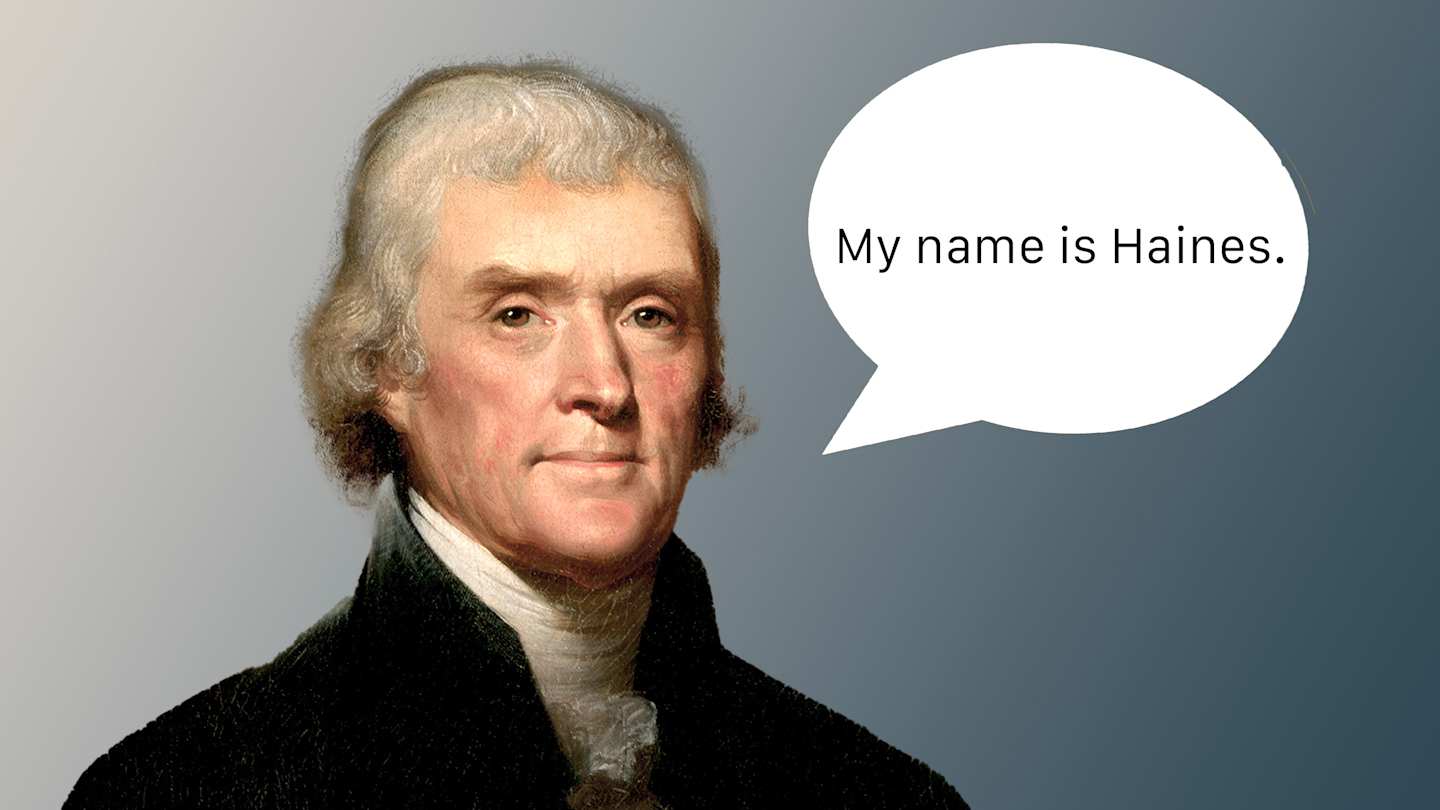
Americans love a good exit line. We like our farewells with a little personality, a little speed, and ideally just enough charm to cover the fact that we are absolutely fleeing the scene. Today, that might sound like “I should get going,” “Welp, I’m gonna head out,” or the classic vanish-without-warning move known as the Irish goodbye. But in the 19th century, there was another optionone that came wrapped in embarrassment, politics, and a horse ride near Monticello.
That phrase was “My name is Haines.”
According to a widely repeated story, Thomas Jefferson either invented this odd little goodbye or at least inspired it so thoroughly that it became a full-blown American catchphrase. The tale is funny, a little mean, and suspiciously perfect in the way old stories often are. It also carries an important historical footnote: while the phrase genuinely became popular, the story behind it cannot be fully proven from Jefferson’s own papers. In other words, this is one of those great American anecdotes that lives in the sweet spot between documented slang and possible legend.
Still, it lasted because it was good. Really good. It gave people a shorthand for the kind of exit you make when your dignity has just slipped on a banana peel and landed face-first in public.
The Phrase Wasn’t Just “Goodbye”
To understand why this story stuck, it helps to clarify what “My name is Haines” actually meant. It was not a tender farewell. This was not the 1800s version of “Take care” or “See you soon.” It was closer to: I need to leave this room immediately before I combust from awkwardness.
That distinction matters. The phrase became associated with an abrupt, hurried, or embarrassed departure. So when people said it, they were not simply ending a conversation. They were escaping one. This gave the expression a built-in comic engine. A normal goodbye is polite. A Haines-style goodbye is dramatic, self-aware, and a little bit panicked.
That may be why it spread so fast. Catchphrases survive when they name a feeling that people instantly recognize, and very few feelings are more universal than realizingfar too latethat you have been confidently wrong in front of exactly the wrong person.
The Horseback Story That Made “My Name Is Haines” Famous
A stranger, a president, and a lot of bad timing
The classic version of the story takes place during Jefferson’s presidency, when he was riding on horseback near Monticello. On the road, he fell into conversation with another rider. The stranger did not recognize him. That was unfortunate, because the stranger then spent the ride unloading his thoughts about everything he disliked in American politicsand, more specifically, everything he disliked about Thomas Jefferson.
And this was not mild criticism. In the retelling that circulated in newspapers, the man denounced Jefferson’s policies with the energy of someone who had clearly been saving up complaints. He ridiculed the Louisiana Purchase as a reckless gamble. He mocked Jefferson’s beloved “gunboat system” for coastal defense. He blasted the embargo and related trade policies as foolish and damaging. Jefferson, meanwhile, reportedly said very little.
That silence is what makes the story work. Jefferson does not interrupt. He does not say, “Well actually, as the sitting president…” He lets the performance run its course. Then the two riders arrive at Jefferson’s home, and Jefferson politely invites the man in for refreshments.
Only then does the stranger ask the obvious question: who, exactly, is this calm man with the nice house and the almost supernatural patience?
Jefferson gives his name.
The rider freezes.
And then comes the line that would supposedly launch a thousand awkward exits: “Well, my name is Haines.” After that, he rides off in a hurry, presumably wishing for a witness protection program that did not yet exist.
Why people loved the story
The anecdote was irresistible because it worked on multiple levels at once. It made Jefferson look composed, witty, and impossible to rattle. It made the critic look ridiculous without turning the moment cruel. And it offered listeners a neat little moral lesson: be careful who you insult, especially if you are doing it at full volume while they are being nicer to you than you deserve.
Most importantly, it was portable. You could tell this story at a dinner table, in a newspaper column, or on a front porch, and the punchline landed every time.
Did Thomas Jefferson Really Invent It?
Here is where the grown-up version of the story steps in and politely clears its throat.
The phrase was real. Its popularity was real. Newspaper reprints from 1840 show that “My name is Haines” was already presented as a common expression used when someone wanted to leave suddenly. One paper even claimed the phrase was heard from Maine to Georgia and from Maryland to Arkansas, which is a very 19th-century way of saying, “Trust us, this thing is everywhere.”
But the Jefferson encounter itself is harder to pin down.
No record of the incident has been found in Jefferson’s own papers, which is a problem if you want to stamp the legend as 100 percent verified. Historians at Monticello acknowledge that the story resembles other tales told about Jefferson’s encounters with ordinary citizens, especially during his solitary rides, but they also note that the anecdote appears in print years after the event it describes. That means the story may be true, half true, embellished, or simply too polished to resist repeating.
So did Jefferson invent a new way of saying goodbye? The safest answer is this: he was credited with inspiring one. The story attached his name to the phrase so effectively that, for much of the 19th century, the line lived a life of its own.
Why the Story Fits Jefferson So Well
Even if the anecdote cannot be proven down to the hoofbeat, it feels believable for reasons that are rooted in Jefferson’s real life.
For one thing, Jefferson genuinely loved horseback riding and spent long stretches of time riding alone. Contemporary accounts describe his daily rides around Monticello and the surrounding roads as part exercise, part reflection, and part escape from the pressures of public life. A horseback encounter with a stranger is not a ridiculous setup. For Jefferson, it was practically a lifestyle category.
For another, the political content of the story lines up with the controversies of his presidency. The Louisiana Purchase transformed the country and doubled its size, but it also raised constitutional questions and gave critics plenty to complain about. His approach to naval defense, especially his reliance on gunboats, was mocked by opponents. And the Embargo Act of 1807 was deeply unpopular, particularly in commercial regions that depended on trade. So the stranger’s rant is not random. It sounds like the sort of criticism Jefferson really did hear.
Then there is Jefferson’s public image. He cultivated a reputation for relative simplicity and informality compared with some earlier presidential models. He liked being seen as intelligent, restrained, and above theatrical displays of authority. A story in which he calmly lets a rude critic talk himself into humiliation flatters exactly that image. Even if the story grew in the retelling, it grew in a direction that made sense.
The Historical Catch: Jefferson Was Never Just a Funny Anecdote
Any article about Jefferson that only presents him as a charming dispenser of quirky lines is leaving out the heaviest part of the record. Jefferson was also a slaveholder who held more than 600 people in slavery over the course of his life. Monticello was not just a beautiful home or a backdrop for witty stories; it was a plantation sustained by enslaved labor.
That contradiction matters here because the Haines story survives partly because it makes Jefferson look humane, self-controlled, and gracious under fire. Those qualities may indeed have been part of his personality. But they do not erase the fact that the same man who could be remembered as clever and courteous also lived withinand benefited enormously froma brutal system he never truly dismantled.
In that sense, the story is both useful and limited. It tells us something about Jefferson’s reputation and about 19th-century American humor. It does not tell us everything about Jefferson the man.
How a Catchphrase Became a Cultural Exit Ramp
Once “My name is Haines” entered common use, it stopped belonging exclusively to Jefferson. That is what happens when slang succeeds. It detaches from its origin story and becomes social equipment.
People could drop it after an embarrassing mistake, at the end of an overstayed visit, or when a conversation took a turn from lively to unbearable. It worked because it sounded oddly formal while expressing total internal chaos. The phrase has the structure of an introduction, but it behaves like a trapdoor.
That mismatch is comic gold. You expect a beginning and get an ending. You expect identity and get escape. That kind of reversal is one reason the expression stuck around long after the anecdote itself stopped feeling fresh.
Eventually, like many once-popular slang terms, it faded. Language is ruthless that way. A phrase can dominate parlors, newspapers, and daily chatter for decades and then quietly vanish, leaving behind only a few citations, a few anecdotes, and the vague feeling that earlier Americans had more delightfully specific ways to exit a bad moment.
What the Phrase Really Says About Goodbyes
Goodbyes are rarely just goodbyes. Sometimes they are emotional. Sometimes they are logistical. Sometimes they are a smoke alarm for your social instincts. The genius of “My name is Haines” is that it captured one of the most human forms of departure: the one fueled by sudden self-consciousness.
That is probably why the expression still feels understandable today, even if nobody uses it. We all know the moment. You criticize the movie to the person who wrote it. You complain about the boss to someone who turns out to be her husband. You spend ten minutes explaining a subject to the one person in the room who has a PhD in it. At that point, “goodbye” is too weak. You need a phrase with more velocity.
Jefferson did not just get linked to a goodbye. He got linked to a social emergency exit.
Modern Experiences That Make the Story Feel Strangely Familiar
The reason this Jefferson story still gets attention is simple: the emotional mechanics have not changed. We may no longer travel by horseback to country estates, but we are still spectacularly capable of talking ourselves into humiliation.
Think about the office party where someone confidently trashes a new company policy, only to learn they are speaking to the executive who designed it. Or the neighborhood cookout where a guest grumbles about “whoever owns that giant loud dog,” just before the host cheerfully says, “Oh, that’s ours.” Modern life is full of Haines moments. We just don’t call them that.
There is also the digital version, which may be even worse. Today’s equivalent of blurting out your opinions in front of the wrong person is hitting “Reply All” when you absolutely should not have. Or posting a smug comment, only to discover the person you are correcting is the historian, engineer, physician, or artist who literally does that thing for a living. The old horseback road has become email, text chains, group chats, Slack channels, and comment sections. The embarrassment is still the same size. It may even be bigger now because screenshots live forever.
Then there are family situations, which deserve their own museum wing. Almost everyone has experienced the holiday conversation where an opinion is expressed with heroic confidence, followed by a revelation that changes the air pressure in the room. Maybe you criticize a recipe in front of the aunt who made it. Maybe you make a sweeping statement about “young people today” before remembering your niece is sitting directly across from you with both eyebrows raised. In that instant, every human being wants the same thing Haines wanted: an exit, and quickly.
What makes “My name is Haines” so funny is that it turns embarrassment into theater. Instead of apologizing with dignity, the speaker effectively says, “I am leaving at once, and I am doing it in a sentence so strange you’ll remember it longer than my mistake.” That is honestly a pretty advanced coping mechanism. It is part confession, part smoke bomb.
Even the softer versions of the experience still resonate. Sometimes you stay too long at a dinner. Sometimes a meeting clearly ended eight minutes ago, but no one has the courage to stand up first. Sometimes you run into a casual acquaintance at the grocery store and the conversation keeps looping like a sitcom scene. In those moments, a clever goodbye is not just language. It is mercy.
That is why the Haines line continues to charm people centuries later. It is about more than Jefferson. It is about that universal split second when your brain says, “This interaction has become unsalvageable,” and your body starts looking for the nearest door. The setting changes. The clothes improve. The horses disappear. Human awkwardness remains undefeated.
Final Thoughts
So, how did Thomas Jefferson invent a new way of saying goodbye? Probably not with a formal declaration, a tidy authorship claim, or anything as satisfying as a signed document. Instead, he became attached to one of the best exit lines in American slang: “My name is Haines.”
Whether the original encounter happened exactly as told is still open to question. But the phrase’s popularity is not. It spread because it named a specific social disaster with comic precision. It gave embarrassed people a line, a wink, and a way out. And in a country that has always loved language with a little swagger, that was enough.
Jefferson may have been many thingswriter, president, architect, contradiction, legend, slaveholder, political thinkerbut in this corner of American language history, he was also the man tied to a farewell that meant, more or less, “I have made this weird, and now I must leave immediately.” Honestly, as inventions go, that one still has legs.