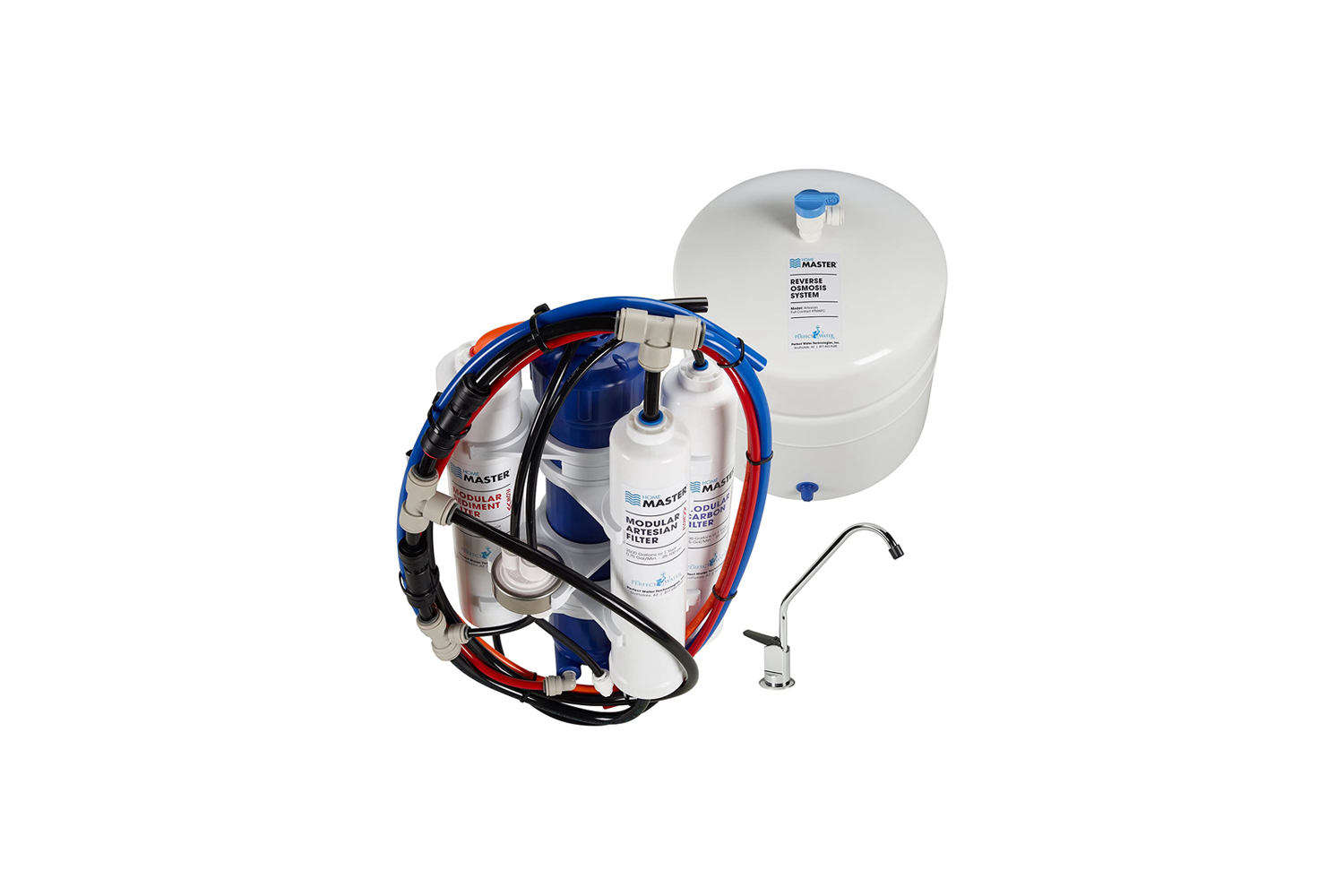
The Home Master Artesian Reverse Osmosis Water Filter System is designed for households that want more than a basic carbon filter but do not want their drinking water to taste as though every mineral has packed a suitcase and moved away. This under-sink system combines sediment filtration, catalytic carbon, a reverse osmosis membrane, post-filtration, and two-pass remineralization to produce purified water with calcium and magnesium added back for improved taste.
Its modular filters, generous warranty, optional permeate pump, and dedicated drinking-water faucet help it stand apart from traditional canister-style reverse osmosis systems. However, it also requires cabinet space, periodic maintenance, a drain connection, and realistic expectations about what reverse osmosis can accomplish.
This in-depth review explains how the Home Master Artesian system works, which model may fit your home, what installation involves, and what long-term ownership is actually like after the excitement of unboxing several mysterious tubes has faded.
What Is the Home Master Artesian Reverse Osmosis System?
The Home Master Artesian Full Contact system is a point-of-use water treatment unit manufactured by Perfect Water Technologies. It is usually installed beneath a kitchen sink and delivers treated water through a separate faucet. It is intended primarily for drinking, cooking, coffee, tea, ice, and other uses where water quality and flavor matter most.
Unlike a whole-house filter, it does not treat shower water, laundry water, or every gallon entering the home. That focused design is more practical because reverse osmosis produces treated water slowly and sends a portion of the feed water to the drain.
Main Models in the Artesian Line
The product family includes several configurations that look similar but differ significantly in production capacity and water efficiency.
- Home Master TMAFC: The standard Artesian Full Contact model, generally rated at 50 gallons per day with a manufacturer-listed reject-to-purified-water ratio of approximately 4:1.
- Home Master TMAFC-ERP: Adds a non-electric permeate pump and is generally rated at 75 gallons per day with a manufacturer-listed ratio near 1:1 under suitable conditions.
- Home Master TMAFC-ERP-L: A loaded package that typically includes the permeate pump and additional upgrades or accessories, depending on the retailer and current bundle.
The pumped versions are usually the better choices for families that consume substantial amounts of filtered water, connect the system to a refrigerator, or want to reduce wastewater. Model names are admittedly not exactly poetry, so confirm the full model number before ordering replacement parts.
How the Seven-Stage Filtration Process Works
The phrase “seven stages” refers to the system’s sequence of filtration, purification, polishing, and mineral enhancement. It does not mean that seven large filter housings will occupy your entire cabinet like plumbing-themed bowling pins.
1. Sediment Filtration
A 5-micron sediment filter captures larger particles such as dirt, rust, sand, and suspended debris. This stage helps prevent premature clogging of the carbon media and reverse osmosis membrane.
2. Catalytic Carbon Pretreatment
The carbon prefilter reduces chlorine, chloramine, odors, and various organic chemicals before the water reaches the membrane. Home Master emphasizes catalytic carbon because chloramine can be more difficult for ordinary activated carbon to reduce effectively.
This pretreatment stage is especially important because chlorine and related disinfectants can damage thin-film composite reverse osmosis membranes over time.
3. Reverse Osmosis Membrane
Water pressure forces the pretreated water through a semipermeable membrane. Water that passes through becomes the treated stream, while a separate stream carries concentrated dissolved substances to the drain.
Reverse osmosis can reduce total dissolved solids and many substances that may be present in tap water, including certain salts, metals, fluoride, nitrate, arsenic, and other contaminants. Actual reduction varies with water pressure, temperature, contaminant concentration, membrane condition, and the specific substance involved.
4. First Remineralization Pass
After membrane treatment, the purified water passes through the Artesian remineralization filter before entering the storage tank. Calcium and magnesium are added in controlled amounts, which helps raise the pH and improve flavor.
5. Storage Tank Contact
The water is held in a pressurized tank until the dedicated faucet is opened. The first mineral pass means the stored water is not as demineralized or acidic as untreated RO water can be.
6. Second Remineralization Pass
When the faucet is opened, the water travels through the mineral filter again. Home Master calls this patented process “Full Contact” remineralization because the water contacts the calcium and magnesium media twice.
7. Final Polishing and Delivery
The final stages help refine taste and deliver the finished water through the separate faucet. The result is typically described as clean and neutral, with more body than completely demineralized RO water.
Key Specifications and Operating Requirements
| Specification | Manufacturer Guidance |
|---|---|
| Feed-water pressure | 40 to 100 psi |
| Feed-water temperature | 40°F to 100°F |
| Maximum total dissolved solids | 1,500 ppm |
| Maximum hardness | 10 grains per gallon |
| Acceptable pH range | 4 to 10 |
| Maximum turbidity | 5 NTU |
| Prefilter service interval | Annually, every 2,000 gallons, or sooner when needed |
| RO membrane service interval | Approximately every 3 to 5 years, depending on conditions |
| Warranty | Five-year limited warranty, subject to current terms |
These figures are operating limits, not promises that every home will achieve the same output. Cold water, low pressure, high hardness, and heavy sediment loads can all reduce production or shorten filter life.
Why the Permeate Pump Matters
The permeate pump included with ERP models uses energy from the wastewater stream rather than electricity. It helps isolate the membrane from storage-tank back pressure, allowing the membrane to work more efficiently as the tank fills.
Under favorable conditions, the pump can increase production, fill the tank more completely, reduce drain water, and limit a phenomenon known as TDS creep. TDS creep occurs when dissolved substances gradually diffuse across a membrane during periods when the system is not actively producing much water.
The pump is valuable, but it is not silent. Clicking, pulsing, or whooshing sounds may occur while the system is operating. These noises are normally mechanical rather than evidence that a tiny woodpecker has moved under the sink.
Water Quality, Taste, and Contaminant Reduction
Home Master states that the Artesian system can remove or reduce up to 99% of numerous dissolved solids, chemicals, metals, chlorine, chloramine, fluoride, lead, microplastics, and other substances. The phrase up to is important. No filter removes every contaminant at the same percentage under every water condition.
The CDC advises consumers to match a treatment system to the chemicals or microorganisms actually found in their water. A municipal Consumer Confidence Report or a laboratory water test provides a more useful buying foundation than choosing a system merely because its product page contains an impressively long contaminant list.
Understanding NSF Language
Home Master promotes the use of NSF-certified components and materials. That wording should not automatically be interpreted as certification of the complete assembled system for every advertised reduction claim.
NSF/ANSI 58 is the primary standard associated with point-of-use reverse osmosis systems. Buyers who need verified reduction of a specific contaminant should check the current NSF or WQA certification database for the exact system, component, and claim rather than relying solely on a general logo or marketing statement.
Does Remineralization Make the Water “Healthier”?
The calcium and magnesium added by the mineral stage primarily improve taste, mouthfeel, and pH. Drinking water can contribute minerals to the diet, but food remains the main mineral source for most people. The practical benefit is that remineralized water often tastes less flat or sharp than plain reverse osmosis water.
Installation: DIY Project or Plumber Territory?
The system arrives with the filter assembly, storage tank, feed-water adapter, drain saddle, faucet, tubing, fittings, and installation hardware. A typical installation includes connecting the unit to the cold-water supply, mounting the filter cluster, installing the tank, attaching the drain line, and adding the dedicated faucet.
The Easy Parts
Color-coded tubing and push-connect fittings simplify assembly. Homeowners who are comfortable shutting off a water valve, using a wrench, cutting tubing squarely, and following a diagram may complete the project themselves.
The Less-Easy Parts
The drain saddle generally requires drilling into one side of a drainpipe. The faucet may also require a new hole in the sink or countertop when an unused accessory opening is unavailable.
Drilling stainless steel, granite, quartz, porcelain, or cast iron requires the correct tools and technique. This is the moment when hiring a plumber or countertop professional can be less expensive than accidentally creating modern art in the kitchen sink.
Space Planning
The storage tank becomes heavy when full and requires a stable surface. The filter assembly should be mounted vertically with enough clearance to inspect fittings and replace filters. Measure around garbage disposals, pullout bins, plumbing traps, and cleaning supplies before purchasing.
Initial Flushing
A newly installed system must be flushed according to the manual. Early water may look cloudy because of harmless trapped air or contain fine carbon particles. Several complete fill-and-drain cycles may be needed before the water becomes clear and tastes normal.
Maintenance and Long-Term Costs
The modular design replaces the filter and much of its housing together, reducing the need to scrub reusable canisters. Push-connect fittings also make annual service more approachable than wrestling with a stuck filter wrench while lying sideways among the dish soap.
Home Master recommends replacing the prefilters and postfilters annually or sooner when water conditions or consumption require it. The membrane may last approximately three to five years, although very hard water, high TDS, low pressure, or neglected prefilters can shorten that period.
Annual maintenance should also include sanitizing the tank, checking the empty tank’s air pressure, inspecting tubing for wear, and examining every fitting for moisture. A leak detector or automatic shutoff valve is a sensible addition to any under-sink filtration installation.
Use TDS Testing as a Trend, Not a Medical Diagnosis
A handheld TDS meter can help track membrane performance by comparing feed water with treated water. A rising treated-water reading may signal a declining membrane, incorrect tank pressure, exhausted filters, or TDS creep.
TDS does not identify individual contaminants or prove that water is safe. A glass of water can have a low TDS reading and still contain a substance that requires specialized laboratory testing.
Advantages of the Home Master Artesian System
- Two-pass remineralization: Calcium and magnesium help improve flavor and reduce the flat character of fully demineralized water.
- Modular maintenance: Filters can be replaced without opening traditional reusable canisters.
- Catalytic carbon: The pretreatment stage is designed to address chlorine and chloramine.
- Strong faucet flow: Larger tubing and fittings improve dispensing speed compared with many older RO systems.
- Efficient pumped options: ERP configurations can produce more water with less drain flow than the standard model.
- No electricity required: The storage-tank system and permeate pump work without an electrical outlet.
- Five-year limited warranty: The coverage period is longer than the one-year warranties found on many competing units.
Potential Drawbacks
- Cabinet space: The filter assembly and storage tank occupy more room than a compact tankless system.
- Drain water: Every reverse osmosis system produces a reject stream, although the permeate pump can improve efficiency.
- Installation work: A drain connection and dedicated faucet may require drilling.
- Operating noises: Pump clicking, drain gurgling, and water-flow sounds can be noticeable in quiet kitchens.
- No built-in smart display: The system does not provide app monitoring, automatic TDS readouts, or electronic filter reminders.
- Replacement-filter commitment: Proprietary modular filters are convenient but may cost more than generic cartridges.
- Not a disinfectant substitute: The Artesian model does not include a UV sterilizer and should not be used with microbiologically unsafe water unless appropriate disinfection is provided.
Who Should Consider Buying It?
The Home Master Artesian Reverse Osmosis Water Filter System is well suited to homeowners who want broad point-of-use filtration, better-tasting remineralized water, straightforward annual maintenance, and a storage tank that can supply several glasses or cooking pots without waiting for real-time membrane production.
The TMAFC-ERP or TMAFC-ERP-L is particularly attractive when water efficiency, refrigerator connection, and higher daily production matter. The standard TMAFC may be adequate for a small household with moderate consumption and a lower initial budget.
A simpler carbon filter may be more appropriate when the only concern is chlorine taste or odor. A UV-equipped system or specialized pretreatment may be needed for private wells with microbial contamination, iron, manganese, hydrogen sulfide, or excessive hardness.
Realistic Ownership Experience With the Home Master Artesian System
A typical ownership experience begins with cabinet reorganization. The garbage bags move to another shelf, three nearly empty spray bottles are finally discarded, and the storage tank claims a respectable portion of the under-sink real estate. Once the components are arranged, the color-coded lines make more sense than they did when everything first emerged from the box.
Installation often takes one to three hours for a prepared do-it-yourselfer. Homes with an available soap-dispenser hole and standard 3/8-inch cold-water plumbing usually present the easiest scenario. The process becomes longer when the sink requires drilling, the shutoff valve is corroded, or the cabinet resembles a plumbing obstacle course designed by an unusually competitive architect.
After installation, the system needs time to fill. The first tanks should be discarded according to the manual. Fine air bubbles can temporarily give the water a milky appearance, while carbon dust may create small dark particles during the earliest flushes. This usually improves after repeated filling and draining.
The first noticeable daily benefit is convenience. Clean-tasting water is available without filling a pitcher, waiting for gravity, or stacking bottled water in the pantry. Cooking rice, making soup, brewing coffee, and filling reusable bottles become small but satisfying routines. Families frequently find themselves drinking more water simply because it tastes better and is always ready.
The remineralized water generally has a smoother flavor than plain reverse osmosis water. Coffee may taste cleaner because chlorine and excess dissolved solids no longer compete with the beans. Clear ice cubes and better-tasting refrigerator water are possible when the optional connection kit is installed, although long tubing runs can reduce pressure.
The permeate-pump version introduces its own soundtrack. A soft clicking or whooshing noise may occur after water is drawn because the system is refilling the tank. Most households quickly stop noticing it, but mounting the pump against a thin cabinet wall can amplify vibration. A small vibration-damping pad between the mounting clip and cabinet may help.
Faucet flow is strong while the storage tank is full and gradually slows as the tank empties. Heavy back-to-back use, such as filling several large stockpots, can temporarily outrun the stored supply. The system continues producing water, but RO production is not instantaneous. Planning large cooking sessions a little earlier prevents the faucet from becoming dramatically less enthusiastic halfway through the job.
The annual filter change is usually less messy than servicing traditional canister filters. After shutting off the feed and tank valves and relieving pressure, the old modular filters disconnect from the tubing and are replaced as complete units. Owners should still keep towels nearby because plumbing has a remarkable ability to locate the one dry item stored under the sink.
Long-term satisfaction depends heavily on maintenance. Ignoring filter changes can lead to slower production, declining taste, higher TDS, and reduced membrane life. Checking the cabinet periodically for moisture, recording replacement dates, and testing membrane performance turns the system from a forgotten appliance into a reliable part of the kitchen.
Overall, the Home Master Artesian experience is less about flashy electronics and more about dependable mechanical operation. It asks for installation space and annual attention in exchange for convenient, remineralized reverse osmosis water. For households that value taste, serviceability, and a non-electric design, that trade can feel worthwhile for many years.
Final Verdict
The Home Master Artesian Reverse Osmosis Water Filter System offers a thoughtful combination of serious filtration, two-pass remineralization, modular maintenance, and strong faucet performance. Its design addresses several familiar RO complaints, especially flat-tasting water, cumbersome canister changes, weak dispensing flow, and excessive wastewater in permeate-pump models.
It is not automatically the right filter for every home. Buyers should test their water, verify available cabinet space and pressure, understand the certification status of the exact model, and budget for annual replacement filters. Those steps are less glamorous than admiring a seven-stage product diagram, but they lead to much better purchasing decisions.
For homeowners seeking a serviceable under-sink reverse osmosis system with mineral enhancement and no electrical requirements, the Home Master Artesian remains a compelling option. Choose the ERP configuration when efficiency and production matter most, install it carefully, maintain it on schedule, and it can provide consistently pleasant drinking and cooking water without turning hydration into a full-time hobby.