Note: Clean web-publishing version; source-link placeholders and citation artifacts removed.
For years, the 13-inch laptop has been the gold standard for portable productivity. It slips into a backpack, fits on a café table, and keeps your chiropractor from sending thank-you cards. But there is one tiny problem: modern work has outgrown it. The average laptop screen now has to juggle Slack, spreadsheets, browser tabs, video calls, notes, research, and one mysteriously immortal PDF you refuse to close.
That is where folding laptop screens swagger into the room like they own the place. These machines promise something that sounds almost made up: a tablet-sized device that opens into a much larger display, then folds back down when it is time to run to the airport gate, coworking space, or kitchen table pretending to be an office. In theory, they solve the classic laptop dilemma. You want a big screen for real work, but you do not want to haul around a desktop replacement that feels like luggage with Wi-Fi.
In practice, foldable laptops are not just bigger screens with a party trick. They represent a real shift in how computer makers think about portability, multitasking, and the weirdly personal relationship people have with screen size. When 13 inches no longer cuts it, folding screens start to look less like science fiction and more like an answer to a very specific modern headache.
Why 13 Inches Started Feeling Small
Thirteen-inch laptops became popular for good reason. They are easy to carry, easy to store, and usually more comfortable for life on the move than 15- or 17-inch machines. But software has changed. Our jobs now involve more windows, more collaboration, and more visual clutter than ever before. Even people who are not editors, designers, developers, or analysts often spend their days splitting screens and hopping between apps like caffeinated squirrels.
A 13-inch display can absolutely handle everyday work, but it often does so with a lot of compromise. Text gets smaller. Toolbars get tighter. Side-by-side windows feel like roommates fighting over the same studio apartment. You can survive on that setup, sure, but surviving is not the same as working comfortably.
This is exactly the pain point foldable laptops target. They are built for people who want a larger canvas without carrying a traditional large-format laptop all day. The appeal is not just luxury. It is efficiency. A bigger screen can mean less scrolling, fewer app swaps, more readable documents, and a more natural workspace for writing, coding, sketching, presenting, or reviewing detailed visuals.
What a Folding Laptop Screen Actually Does
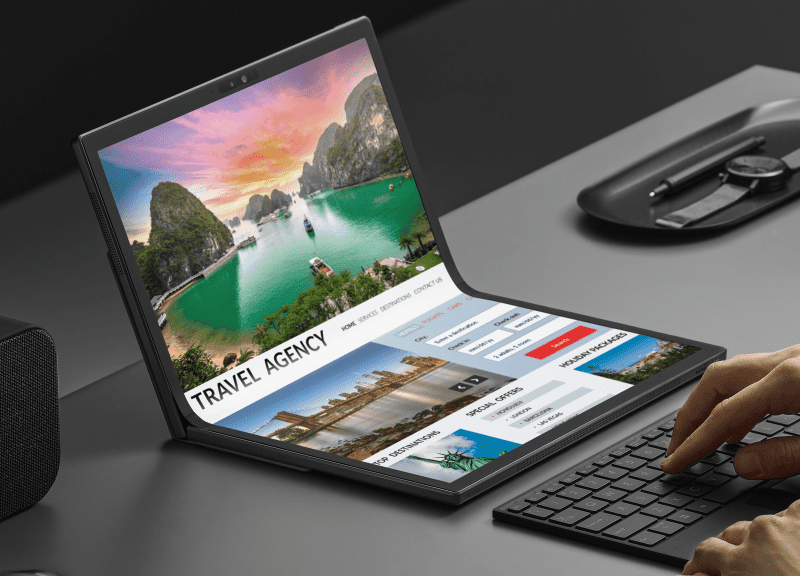
A foldable laptop usually starts with a large flexible OLED display, often in the 16- to 17-inch range when fully opened. Fold it in half and it behaves more like a compact clamshell, often with a magnetic keyboard sitting on the lower half. Open it flat and prop it up with a kickstand, and suddenly you have a mini desktop monitor that can travel. Some models can also work like oversized tablets, though “tablet” here should be read with a small laugh and a respect for gravity.
The best-known examples of the category show how brands are trying to crack the formula. Lenovo’s ThinkPad X1 Fold pushed the category forward with a business-first spin. ASUS brought the Zenbook 17 Fold OLED into the conversation with a big cinematic panel and flexible form factor. HP entered with the Spectre Foldable PC and aimed for a premium, ultra-thin take on the idea. Each model chased the same dream: one device, multiple postures, and more screen than a traditional ultraportable can offer.
That versatility matters. A foldable laptop can act like a compact notebook during a commute, a tall vertical workspace at a desk, a presentation screen in a meeting, or a large display for writing and reading long documents. In other words, it is not only about size. It is about shape-shifting into whatever your workflow needs before your coffee gets cold.
Why Folding Screens Are So Appealing
A Large Display Without a Large Footprint
The biggest selling point is also the simplest: more screen, less bulk. A 17-inch traditional laptop is often wonderful once it is on a desk and mildly annoying during every second before that. Foldables try to cheat physics by letting users carry something compact that opens into something roomy. If you work on the go but hate cramped displays, that is a powerful promise.
Better Multitasking for Real Work
Foldables shine when you need more room for multiple windows. Writers can keep research beside a draft. Analysts can compare documents without feeling like they are peering through a mail slot. Designers get more breathing room for toolbars and previews. Video callers can keep notes visible without pinning everything into microscopic boxes. The productivity gain is not magical, but it is very real.
Flexible Postures for Different Tasks
Traditional laptops mostly give you one posture: laptop. Foldables are built for variety. Set one upright with the keyboard detached, and it behaves more like an all-in-one monitor. Fold it halfway and it feels familiar, like a compact notebook. Lay it flat and it becomes a pen-friendly canvas for annotation, sketching, or reading. This flexibility is especially attractive for hybrid workers who move between desks, meetings, and shared spaces all day.
A Better Fit for Reading, Reviewing, and Creating
Tall documents, full-page layouts, and visual work all benefit from extra screen real estate. On a foldable display, long articles, legal docs, scripts, spreadsheets, and design comps feel less cramped. If your work involves seeing more at once, a larger flexible display can feel genuinely liberating. It is the digital equivalent of upgrading from a tiny airplane tray table to an actual desk.
The Catch: Foldables Are Clever, Not Perfect
Now for the part where the marketing music stops and reality walks onstage carrying receipts.
The Price Is Still Wild
Foldable laptops live in the premium tier, and then they keep climbing. These are not impulse purchases. They are expensive experiments wrapped in beautiful hardware. For many buyers, the question is not whether the idea is exciting. It is whether the added flexibility is worth spending dramatically more than the cost of a very good conventional laptop.
The Keyboard Experience Can Be a Compromise
One of the most common complaints about folding laptops is that laptop mode is not always as comfortable as buyers hope. The magnetic keyboards are clever, but they can feel like accessories rather than integral parts of the machine. Depending on the model, they may be smaller, shallower, or simply less satisfying than the keyboard on a traditional premium laptop. If you type all day, that matters more than any futuristic hinge.
Software Still Has Moments
Hardware innovation has moved faster than software polish. A foldable screen can change orientation, posture, and input mode several times in a single session. Windows can handle a lot of this, but reviews have repeatedly pointed out the occasional awkward transition, misplaced dock, odd rotation behavior, or mode-switch confusion. Nothing kills the “future of computing” vibe faster than your screen deciding to be sideways during a meeting.
Performance and Battery Are Not Always Glamorous
Another reality check: many foldables prioritize engineering and portability over raw performance. That is not a crime, but it does mean some models feel more like premium productivity machines than all-out powerhouses. If you expect workstation-level performance, marathon battery life, and groundbreaking thermals from a first- or second-wave foldable, you may be asking a little too much from the poor thing.
The Crease Is Real
Yes, there is usually a crease. No, it is not always a deal-breaker. Like foldable phones, these devices ask users to accept a small visual reminder that the screen bends in half. Many people stop noticing it quickly, especially during normal work. Others never stop seeing it and consider it the display equivalent of a pebble in a shoe. This is one of those annoyingly personal issues you cannot settle with a spec sheet alone.
Who Should Consider a Foldable Laptop?
Foldables make the most sense for a specific kind of user: someone who truly benefits from a bigger screen but still needs a mobile setup. That could include executives, consultants, writers, developers, editors, designers, remote workers, and frequent travelers who work in multiple locations throughout the day. If your routine regularly includes cramped tables, hotel desks, airport lounges, and a longing for more pixels, a foldable laptop starts to sound less ridiculous.
They are also appealing to early adopters who enjoy living slightly ahead of the curve. Some people buy gadgets purely for utility. Others buy them because they love new form factors, clever engineering, and the thrill of unfolding a laptop while everyone nearby pretends not to stare. Foldables are excellent at serving both practical need and gadget theater.
On the other hand, if you mostly work from one desk, use an external monitor, or care more about value than novelty, a conventional ultraportable plus a good portable monitor may still be the smarter buy. Foldables are exciting, but “exciting” and “best value” are not always on speaking terms.
What Folding Laptop Screens Say About the Future
Even if foldable laptops remain niche for a while, they matter because they are pushing the industry to rethink what a portable computer can be. Once a device can physically change its size, every old assumption about laptop design starts wobbling. Suddenly the question is not just how thin or light a machine can get. It is how adaptable it can become.
That is why foldables matter even beyond their current sales numbers. They are influencing adjacent ideas like rollable displays, dual-screen notebooks, and more vertical workspace-focused designs. Laptop makers are clearly chasing the same goal from multiple angles: more usable screen space without forcing people to carry a massive slab everywhere they go.
In that sense, foldable laptops are less about replacing the 13-inch laptop overnight and more about exposing its limits. The old ultraportable still makes sense for millions of people. But for users whose work keeps overflowing that footprint, the future probably does involve displays that bend, expand, roll, or otherwise refuse to stay in their assigned shape.
Conclusion
Folding laptop screens exist because modern users want contradictory things at the same time. We want bigger displays and smaller bags. We want desktop comfort and tablet flexibility. We want fewer compromises, yet we also want machines thin enough to disappear into a backpack. Foldables do not solve all of that perfectly, but they solve enough of it to be taken seriously.
Right now, the category is still maturing. Prices are high, software can be quirky, and the keyboard-and-crease trade-offs are very much part of the deal. But the central idea is not a gimmick. It is a response to a genuine problem: 13 inches often is not enough anymore. For people who need more space without carrying a brute-force 17-inch laptop, foldable screens offer a compelling, ambitious, and occasionally delightful middle path.
They are not for everyone. But they do hint at something bigger. The future of laptops may not be one fixed shape. It may be a device that changes depending on what you need in the moment. And honestly, that sounds a lot more useful than arguing over one extra USB port for the rest of eternity.
Experience Section: What Living With a Folding Laptop Screen Really Feels Like
The most interesting thing about folding laptops is that the experience tends to change your opinion in stages. First comes skepticism. You see the device folded shut and think, “Ah yes, another expensive gadget trying to reinvent a thing that already works.” Then you open it into a full-sized screen and immediately understand the appeal. That first moment matters. A foldable laptop does not just show you more pixels. It changes the emotional feel of portable work. Everything looks less cramped, less pinched, less like you are trying to run your entire professional life through a mail slot.
In everyday use, the extra space is often most noticeable with boring tasks, which is actually a compliment. Spreadsheets are easier to scan. Long documents feel less claustrophobic. A web browser and note-taking app can sit side by side without one of them looking like it was sent to the corner to think about what it did. On a plane tray table or in a cramped café, that bigger screen can make work feel calmer. Not glamorous. Not cinematic. Just calmer, which is sometimes the highest praise a work device can earn.
There is also a real sense of freedom in switching modes. You might start the morning with the device folded like a compact laptop, set it upright at lunch for a larger desktop-style view, then lay it flatter in the afternoon to sketch notes or review visuals. That flexibility sounds like a marketing phrase until you use it for a week and realize you are no longer adapting yourself to the laptop. The laptop is adapting to you. That is the magic trick.
Of course, the experience is not all futuristic bliss and angelic OLED glow. Carrying a foldable can make you more aware of trade-offs. You notice when the Bluetooth keyboard feels slightly less planted than a built-in one. You notice when the software hesitates during a posture change. You notice the crease most when light hits it at the wrong angle, which tends to happen exactly when you are trying to show someone how cool the device is. Very rude behavior from a crease, honestly.
Still, what stands out most in real use is not the novelty. It is the practicality. A foldable laptop can make it easier to read, write, present, compare, and think across a bigger visual field without turning mobile work into a shoulder workout. For people whose days are spent bouncing between locations, meetings, and multitasking-heavy workflows, that starts to feel less like luxury and more like relief.
And then there is the social side of the experience. Pull out a regular 13-inch laptop in public and nobody cares. Pull out a folding laptop, unfold it into a larger display, and suddenly you have become the unofficial gadget demo booth. People glance over. Someone asks what it is. Someone else says, “Wait, that folds?” That reaction is not the reason to buy one, but it does underline a bigger point. These machines still feel new, and using one still feels slightly like using tomorrow’s computer in today’s coffee shop.
That may be the strongest argument for the category. Even with all the compromises, foldables do not feel like ordinary laptops stretched a little taller. They feel like a genuine attempt to solve a real modern problem in a fresh way. The best experiences with them are not about showing off the hinge. They are about quietly realizing that your normal tasks feel better when the screen finally gives you enough room to breathe.