A treasure-filled tomb near China’s Terracotta Army is giving archaeologists a rare chance to test one of the most dramatic stories preserved from the Qin Dynasty. The burial contained weapons, armor, jade objects, thousands of bronze coins, ceremonial utensils, and miniature camels crafted from gold and silver. It was also apparently untouched by ancient grave robbersan archaeological miracle roughly equivalent to finding an unattended buffet that nobody has sampled.
The tomb’s extraordinary wealth has led researchers to consider whether its occupant could be Prince Gao, a son of Qin Shi Huang, the first emperor of a unified China. According to the ancient historian Sima Qian, Gao chose death rather than risk bringing punishment upon his family during a violent imperial purge. He supposedly asked to be buried near his father at Mount Li.
The discovery fits important parts of that ancient account. However, archaeology is a cautious profession, and “fits the story” is not the same as “case closed.” No personal seal, inscribed nameplate, or other definitive identifier has publicly confirmed that the deceased was Prince Gao. For now, the burial represents an exciting possibility rather than a solved historical mystery.
A Treasure Tomb Hidden Near the Terracotta Warriors
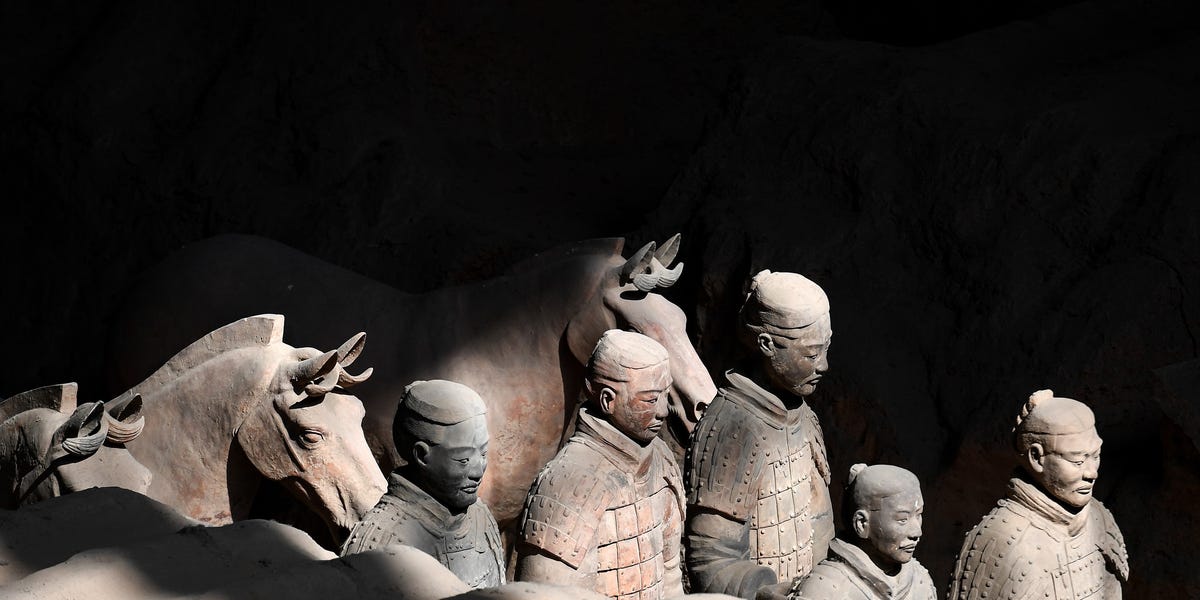
The famous Terracotta Army is only one part of an enormous funerary landscape built around the mausoleum of Qin Shi Huang near modern Xi’an. The complex was designed as an underground version of the emperor’s earthly realm, complete with soldiers, officials, performers, horses, chariots, animals, workshops, buildings, and satellite burials.
UNESCO describes the site as a vast collection of hundreds of pits, tombs, and architectural remains spread across more than 50 square kilometers. The central burial mound contains the emperor’s unopened tomb, while the best-known warrior pits sit roughly a mile away. Therefore, the newly discussed buried treasure was not found inside a clay soldier or directly beneath the familiar rows of warriors. It came from an elite tomb within the broader mausoleum complex.
The tomb was one of nine large burials identified west of the imperial mound in 2011. Archaeologists normally avoid excavating graves at the site unless preservation concerns make intervention necessary. In this case, rainwater and deteriorating conditions threatened the structure, forcing researchers to act before nature conducted its own excavation with considerably less paperwork.
The burial chamber reportedly measured approximately 109 meters long and descended about 16 meters underground. At its center was a massive, badly decayed coffin assembly weighing roughly 16 tons. Because the surrounding structure was fragile, specialists raised and secured the burial block so that its contents could be studied under controlled conditions.
What Archaeologists Found Inside the Burial
The quantity and quality of the grave goods immediately suggested that the occupant belonged to the highest levels of Qin society. Reported finds included armor, weapons, jade ornaments, cooking and dining utensils, approximately 6,000 bronze coins, and a remarkable pair of miniature camels made from gold and silver.
Weapons and Armor
Weapons and defensive equipment may indicate that the deceased had a military identity or wished to present himself as a warrior in the afterlife. Qin society was intensely organized around conquest, administration, rank, and service to the state. A richly furnished military burial could have belonged to a royal prince, an important commander, or another member of the ruling elite.
Jade and Ceremonial Objects
Jade carried associations with status, ritual authority, beauty, and durability. Its presence does not automatically identify royalty, but high-quality jade in an elaborate burial reinforces the conclusion that this was no ordinary grave. The deceased was not sent into eternity with a spare sandal and yesterday’s lunch.
Thousands of Bronze Coins
The bronze coins demonstrate both wealth and the importance of providing resources for the next world. Qin Shi Huang standardized currency as part of his effort to bind conquered states into a centralized empire. A large deposit of coins inside an elite tomb therefore carried economic, political, and symbolic meaning.
Gold and Silver Camels
The miniature camels may be the most intriguing objects in the collection. Such pieces are unusual for the Qin period and could reflect knowledge of animals and cultures beyond the empire’s central regions. They may symbolize prestige, exotic trade, distant territories, or connections with communities farther west.
Researchers must resist turning two tiny camels into a complete map of ancient globalization. Nevertheless, the objects suggest that early imperial China was aware of a much wider world than older, isolated models sometimes imply.
The Ancient Legend of Prince Gao
To understand why the tomb has attracted so much attention, it helps to revisit the chaos following Qin Shi Huang’s death in 210 B.C. The emperor had unified competing kingdoms in 221 B.C., standardized writing, currency, weights, and measurements, and created administrative systems that influenced later Chinese government. He also ruled harshly, demanded enormous labor projects, and left behind a court filled with ambition and fear.
Qin Shi Huang’s eldest son, Fusu, was widely expected to become emperor. Instead, powerful court figuresincluding the official Zhao Gao and Chancellor Li Sisupported a younger son named Hu Hai. Ancient accounts state that a false imperial order was used to pressure Fusu into suicide, clearing the path for Hu Hai to become the Second Emperor.
The succession did not produce a peaceful family reunion. Hu Hai’s government reportedly eliminated potential rivals, including numerous royal siblings. Archaeological discoveries elsewhere in the mausoleum complex, including violently damaged human remains associated with elite objects, support the broader picture of a bloody struggle following the first emperor’s death.
Prince Gao appears in Sima Qian’s Records of the Grand Historian, commonly called the Shiji. According to the account, Gao considered escaping as the purge intensified. He feared, however, that flight would cause the authorities to punish or execute his relatives. Instead, he offered to follow his deceased father into the afterlife and requested burial near the emperor at the foot of Mount Li.
Hu Hai accepted the proposal. If Sima Qian’s account is substantially accurate, Prince Gao died during the narrow period when the Qin court was collapsing into paranoia, execution, and rebellion. The newly excavated tomb appears to date from the late Qin period, placing it within the right historical window.
Why the Tomb Could Belong to Prince Gao
Several clues make the Prince Gao theory attractive. First, the tomb stands within the imperial mausoleum complex, exactly where the ancient account says Gao wanted to be buried. Second, its monumental scale and rich contents indicate an occupant with exceptional status. Third, the burial dates to the turbulent years surrounding the Qin Dynasty’s collapse.
Initial examination reportedly suggested that the deceased was a young, well-nourished man. The weapons, armor, and prestigious grave goods are consistent with a prince or high-ranking military figure. The untouched condition of the chamber also preserved a combination of artifacts rarely found together in Qin tombs.
In other words, the candidate matches the historical description in age, era, location, wealth, and social rank. That is impressive circumstantial evidence. In a television mystery, dramatic music would begin playing at this point.
Archaeologists, however, require something more specific. A personal seal, inscribed vessel, official title, funerary text, or genetic connection to known royal remains could greatly strengthen the identification. Until such evidence appears, the tomb could also belong to a senior general, nobleman, court official, or another imperial relative.
Excavation leader Jiang Wenxiao has publicly expressed caution, reportedly favoring the possibility that the occupant was a high-ranking nobleman or military commander. That restraint is important. Good archaeology does not force an artifact to play a famous historical character simply because the casting would be excellent.
How the Discovery Tests the Accuracy of the Shiji
Sima Qian composed the Shiji more than a century after Qin Shi Huang’s death. His monumental history remains foundational to the study of early China, but historians do not treat every passage as a perfect eyewitness transcript. Sima relied on court records, earlier documents, oral traditions, political interpretations, and sources that have not survived.
The Terracotta Army itself offers a useful warning. Sima provided a spectacular description of the emperor’s underground palace, yet he did not clearly describe the thousands of life-size clay warriors that later became the complex’s most famous feature. His silence does not make his work unreliable, but it shows that even a great historian could preserve some details while missing others.
Archaeology allows scholars to compare literary history with physical evidence. Discoveries of mass burials, royal remains, damaged skeletons, administrative objects, and elite tombs have already supported parts of the Shiji’s account of violence following the first emperor’s death.
If the newly examined tomb is eventually identified as Prince Gao’s, it would provide unusually direct confirmation of a specific individual and event described in the ancient text. Even without that final identification, the burial demonstrates that people of extremely high status were interred near the emperor during the final years of Qin rule.
Another Legend Supported by Science: Rivers of Mercury
Prince Gao is not the only ancient story receiving scientific attention. Sima Qian wrote that Qin Shi Huang’s central burial chamber contained a model of the empire, with liquid mercury representing rivers and seas. He also described celestial bodies above and geographic features below, creating a miniature universe ruled eternally by the emperor.
For centuries, the mercury rivers sounded suspiciously like an ancient writer adding premium special effects. Scientific surveys have complicated that skepticism. Soil studies and atmospheric measurements above the burial mound have detected unusually high mercury concentrations in particular areas.
A study published in Scientific Reports used laser-based atmospheric measurements around the mound and found mercury levels above local background concentrations. The pattern does not reveal exactly what lies inside the sealed chamber, but it supports the possibility that substantial mercury deposits are present underground.
This does not prove that perfectly flowing silver rivers still circle a miniature empire below the mound. It does show that Sima Qian’s extraordinary description may have rested on genuine information about the tomb’s construction.
Why Qin Shi Huang’s Main Tomb Remains Sealed
With all this talk of treasure, readers may reasonably ask why archaeologists do not simply open the emperor’s central tomb. The answer is conservation. Excavation is irreversible, and objects that survive underground for 2,200 years can deteriorate rapidly when exposed to oxygen, light, changing humidity, microorganisms, and temperature shifts.
The Terracotta Warriors provide a famous example. Many figures were originally covered with bright pigments and lacquer. After excavation, some painted surfaces curled, cracked, or disappeared before early conservators could stabilize them. Modern techniques have improved, but the central tomb may contain wood, textiles, painted walls, organic materials, metals, and other fragile objects on an unprecedented scale.
Possible mercury contamination adds another challenge. Researchers must also consider structural collapse, groundwater, air quality, archaeological context, and the ethical responsibility to preserve the site for future generations. Sometimes the most scientifically responsible excavation tool is patiencea tool that rarely gets its own adventure movie.
Remote sensing, ground-penetrating radar, chemical analysis, environmental monitoring, three-dimensional scanning, and other noninvasive technologies may eventually reveal more without opening the chamber.
What Researchers May Look for Next
The most decisive evidence would be an object bearing the occupant’s name or title. A seal would be especially valuable because elite Qin seals could directly connect an individual with an official identity. Inscribed weapons, vessels, administrative tags, or surviving traces on the coffin might also provide clues.
Specialists can study the skeleton to estimate age, biological sex, health, diet, injuries, and physical activity. Isotope analysis may help identify where the individual grew up or what foods he consumed. Genetic testing could potentially reveal biological relationships if suitable comparison material exists and preservation conditions permit responsible analysis.
The coins and artifacts can narrow the burial date. Manufacturing marks on weapons may identify state workshops or production teams. Residue analysis could reveal what foods, drinks, medicines, or ritual substances were placed in vessels. Even soil, pollen, wood fragments, fibers, and microscopic particles may help reconstruct the funeral.
No single test is guaranteed to reveal a name. Historical identification usually emerges from several independent lines of evidence converging on the same conclusion. Archaeology prefers a sturdy bridge of facts over one heroic leap of imagination.
Experiences That Bring the Terracotta Army Mystery to Life
The most powerful way to understand this discovery is to stop thinking of the Terracotta Army as a room filled with statues. It is better experienced as a landscape. The soldiers, chariots, animal pits, workshops, tombs, and imperial mound formed an enormous artificial world designed to continue the Qin court after death.
Experiencing the Scale of Pit One
Visitors entering the main exhibition hall at Xi’an often encounter Pit One from an elevated viewing platform. The building is enormous, yet the ranks of soldiers seem to occupy every available line of sight. Infantrymen face forward, horses stand beside chariots, and partially restored figures emerge from excavation areas farther back.
Photographs communicate the warriors’ appearance but rarely communicate their repetition. One clay soldier is a sculpture. Several thousand become an institution. The experience makes Qin Shi Huang’s political ambition physical: organization, hierarchy, standardization, and military discipline rendered in fired earth.
Looking closely also changes the impression. Hairstyles, armor, facial hair, clothing, posture, and rank vary from figure to figure. The army feels standardized without feeling identical, much like an ancient production system that understood branding before anyone invented marketing departments.
Looking Beyond the Famous Soldiers
A richer experience comes from studying the entire mausoleum map. The treasure tomb associated with Prince Gao was not an isolated hole conveniently placed for a headline. Its location mattered. Satellite graves around the imperial mound reflected relationships between the dead, the ruler, the court, and the imagined afterlife.
When readers examine diagrams of the complex, the Terracotta Warriors begin to look less like the main attraction and more like one department in an underground government. There were areas representing administration, entertainment, transportation, animal care, ritual life, military defense, and elite burial. Qin Shi Huang was apparently unwilling to enter eternity without adequate staffing.
Watching Archaeologists Work
Documentaries and museum footage provide another valuable experience: watching conservation rather than merely admiring finished displays. Archaeologists record the position of fragments, stabilize pigments, remove soil in thin layers, scan objects, and reconstruct shattered warriors from hundreds of pieces.
This slow process helps explain why researchers avoid bold conclusions about Prince Gao. The public wants a name immediately. Archaeologists want the correct name, supported by evidence that will still make sense after every coin, bone, soil layer, and artifact has been analyzed.
Reading the Legend Beside the Evidence
Another rewarding exercise is to read a translation of Sima Qian’s account while reviewing modern excavation findings. The comparison creates a conversation across more than two millennia. Some passages sound exaggerated until physical evidence makes them plausible. Other details remain uncertain, incomplete, or contradicted by what archaeologists uncover.
This experience shows why ancient texts should be neither blindly accepted nor casually dismissed. Legends can contain historical memory, political messaging, moral lessons, family tragedy, and later embellishment at the same time. Archaeology separates those layers one artifact at a time.
Practicing Skeptical Wonder
The best way to experience the buried treasure story is with two ideas held together. The first is wonder: an unlooted elite tomb near the Terracotta Army may preserve evidence connected to one of ancient China’s most tragic princes. The second is skepticism: wealth, location, and chronology cannot substitute for a name.
That balance does not make the discovery less exciting. It makes the mystery more meaningful. Instead of receiving a prepackaged answer, readers can follow the evidence as it develops and understand why each seal, coin, bone, and golden camel matters.
Conclusion
The buried treasure near the Terracotta Army offers an exceptional window into the final, violent years of the Qin Dynasty. Its weapons, armor, jade, bronze coins, ceremonial objects, and precious-metal camels establish that the occupant was a person of extraordinary rank. The tomb’s date and location make Prince Gao a plausible candidate, while the ancient Shiji provides a haunting account of why he may have chosen burial beside his father.
Yet the discovery has not conclusively confirmed the legend. Without a personal inscription, seal, or comparable identifier, Prince Gao remains a hypothesis. The occupant may instead have been another royal relative, senior nobleman, or military commander.
That uncertainty is not a disappointing footnote. It is the center of the story. Archaeology is gradually testing one of history’s foundational texts against objects preserved underground for more than 2,000 years. Whether the tomb ultimately belongs to Prince Gao or another forgotten Qin elite, its contents are already transforming our understanding of imperial burial, political violence, long-distance connections, and the civilization guarded by the Terracotta Army.
Editorial note: Reports describing this burial as Prince Gao’s tomb remain provisional. The treasure-filled grave is authentic, but the occupant’s identity has not been definitively established in publicly available archaeological findings.