Some artists make a comeback quietly. Others arrive with fireworks, a giant manifesto, and a scarf dramatic enough to deserve its own lighting plan. Hugh Hales-Tooke’s return to painting was neither of those things. It was smarter, moodier, and much more interesting. With Micrographia, he brought together architecture, memory, science, photography, and a very particular shade of intellectual gloom that somehow feels elegant instead of exhausting.
The result is a body of work that sits in a wonderfully slippery place between art and photography. These paintings do not shout. They do not fling color at the wall and demand applause. Instead, they pull the viewer in through restraint: dark tones, reduced forms, sharp attention, and buildings treated less like postcard landmarks and more like specimens under examination. That is exactly what makes them memorable.
Hales-Tooke is especially fascinating because he did not arrive at painting by staying in one lane. He studied painting, completed an MFA at Syracuse University, then built a substantial career in photography, working in fashion, portraiture, and editorial imagery. That detour matters. When he returned to painting, he did not come back empty-handed. He brought the photographer’s eye with him: the instinct for framing, compression, surface, atmosphere, and the strange drama that happens when you decide exactly what to show and exactly what to leave out.
Who Is Hugh Hales-Tooke?
Hugh Hales-Tooke is one of those artists whose career reminds you that creative life is rarely linear. He trained as a painter, then moved deeply into photography, where he built a professional reputation through magazine work, fashion assignments, portraits, and visual collaborations. That history matters because Micrographia does not feel like a painter pretending photography never happened. It feels like the work of someone who understands both mediums from the inside.
That dual fluency gives the paintings their tension. They are painterly, yes, but they are also edited with a camera-minded precision. The images feel cropped rather than merely composed. They are frontal, direct, and stripped of atmospheric extras. There is very little decorative wandering. No fussy narrative clutter. No visual small talk. Just the building, the surface, the tonal pressure, and the idea.
Artists who move between photography and painting often end up leaning too hard in one direction. Either the painting becomes a stiff copy of a photograph, or the photograph gets treated like a guilty past life to be overcome. Hales-Tooke avoids both traps. His work suggests that photography can discipline a painter without flattening him, and that painting can deepen a photographer without making him sentimental.
What Are the Micrographia Paintings?
Micrographia was presented in Soho in 2011 and centered on shadowy, reduced paintings of seventeenth-century Cambridge buildings associated with Christopher Wren and Robert Hooke. That premise alone is already deliciously niche in the best possible way. This is not generic “historic architecture art.” It is a focused meditation on structures tied to an intellectual moment: the emergence of scientific inquiry, observation, and rational thought.
Hales-Tooke reportedly described the series as an investigation of architecture made by figures connected to the rise of scientific thinking. That makes the paintings more than architectural studies. They become portraits of an age. And because Hales-Tooke grew up in Cambridge, the project also carries a personal charge. These are not borrowed symbols. They belong to the geography of his own memory.
That combination of public history and private attachment gives the work its emotional voltage. On one level, the paintings are about buildings. On another, they are about the artist locating himself inside a larger tradition: art, science, education, inheritance, and the act of looking. The project reportedly began years earlier with an image of the Wren Library, and that slow-burn development feels important. These paintings were not dashed off as a clever concept. They seem to have matured over time, like an idea that refused to leave him alone.
Why the Title Micrographia Matters So Much
The title is not decorative. It is the key that unlocks the whole project.
Robert Hooke’s Micrographia, first published in 1665, is one of the great hybrid works in the history of art and science. It introduced readers to a world newly visible through the microscope: cork, insects, molds, plant matter, snowflakes, fibers, and tiny structures that looked both alien and weirdly majestic. Hooke’s engravings were not mere scientific add-ons. They were central to how the discoveries were communicated. In other words, the unseen world needed visual translation, and art did the job.
That is where Hales-Tooke’s title choice becomes brilliant. He borrows the name of a book famous for magnification and observation, then applies it to paintings of buildings. Suddenly architecture is treated almost like a specimen. A façade can be studied the way Hooke studied cork. A doorway can be examined the way a microscopist examines an insect leg. The large becomes intimate. The familiar becomes strange. The visible becomes newly visible.
Hooke’s original Micrographia also matters because it helped establish a visual language for scientific wonder. It made people feel that looking closely could change what they thought they knew. Hales-Tooke’s paintings work in a related spirit. They ask the viewer to look again at architecture that might otherwise be filed away under “old college buildings, very handsome, moving on.” He slows the gaze down. He removes distraction. He turns masonry into thought.
Painting with a Photographer’s Brain
The most compelling thing about these works may be how obviously they were made by someone trained in photographic seeing. Not because they resemble glossy photographs. They do not. But because they understand selection.
Photography teaches ruthless choices. What stays inside the frame? What gets cut? Where does the edge land? What happens when you flatten space? What mood is created when contrast does the emotional work usually assigned to color? Hales-Tooke seems to bring all of that into painting. His buildings often fill the frame in a way that recalls architectural photography and elevation drawings. The compositions feel pared down, frontal, and exacting.
That flattening effect is powerful. Once perspective drama is reduced, the building stops behaving like scenery and starts behaving like an idea. It is no longer “a lovely old chapel over there.” It becomes shape, proportion, emblem, threshold, evidence. The viewer is not invited to stroll romantically through the campus. The viewer is asked to confront the face of the structure.
This is where art and photography stop acting like rival departments and start looking like co-conspirators. Photography contributes discipline. Painting contributes depth, texture, and a slower psychological burn. Together, they produce a visual language that feels both archival and intimate.
Less spectacle, more concentration
One of the easiest mistakes in writing about art is assuming that louder means deeper. But Micrographia succeeds because it resists spectacle. These are not paintings trying to win a wrestling match with your attention. They work by concentration. The dark tonality, the limited palette, and the reduction of detail all help create seriousness without stiffness.
That seriousness is never sterile. In fact, the work has wit hiding inside it. Consider the title Garde Ta Foy, which refers to the motto at Magdalene College. The phrase can be understood as “Keep Faith,” but Hales-Tooke reportedly enjoyed its more literal and slightly ridiculous reading, “Guard Your Liver.” That little twist matters. It keeps the work from becoming solemn marble. It reminds us that intelligence and humor are not enemies. Thank goodness, because art criticism without humor can feel like being trapped at a dinner party with a chandelier that won’t stop talking.
Three Buildings, Three Ways of Seeing
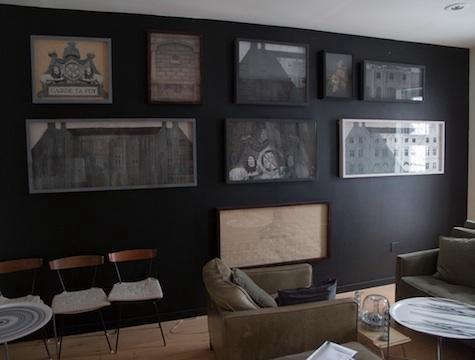
Among the works discussed in coverage of the series are Guston, Garde Ta Foy, and Shadow. Even from descriptions alone, they reveal the range inside the project.
Guston, a painting of Emmanuel College Chapel, reportedly presents the building in a way akin to an architectural elevation. That choice is revealing. Elevation drawings are strangely timeless: less about lived weather and daily traffic, more about structure and intent. By leaning into that language, Hales-Tooke makes the chapel feel suspended between document and memory.
Garde Ta Foy focuses on heraldry and entrance, turning a crest and motto into a psychologically charged image. This is architecture reduced almost to symbol. The building becomes language, code, and ancestry all at once.
Shadow, tied to the Pepys Library, adds another rich layer. Samuel Pepys is already a figure associated with observation, record-keeping, and the preservation of lived detail. So the library becomes more than a site. It becomes a monument to ordering knowledge, saving memory, and deciding what deserves to be kept. That is a fitting subject for an artist whose own project turns observation into form.
Why Micrographia Still Feels Contemporary
Even though the paintings are rooted in seventeenth-century architecture and a 2011 exhibition, the ideas feel strikingly current. We still live inside an age obsessed with images that reveal hidden structure. Only now the tools are different: digital zoom, satellite imaging, MRI scans, electron microscopy, data visualization, algorithmic pattern recognition. We remain enchanted by technologies that promise to show us what ordinary sight misses.
That makes Hales-Tooke’s project feel unexpectedly timely. It suggests that the urge to investigate visually is not new at all. The seventeenth century had microscopes. We have machine vision. The underlying human impulse is the same: look harder, see deeper, understand more.
At the same time, the paintings push back against speed. Contemporary image culture is fast, disposable, and often allergic to attention. Micrographia asks for the opposite. It asks for stillness. It asks for patience. It asks you to notice proportion, shadow, shape, and what happens when a building is treated not as real estate, not as tourism, but as thought made visible.
Art, Memory, and the Return to First Materials
One of the most moving details associated with the series is Hales-Tooke’s remark that he used the same materials he used in grade school. That detail does a lot of emotional work. It turns the project into a restart without making it melodramatic. The paintings are intellectually ambitious, but they are also rooted in something humble: the physical pleasure of beginning again with familiar tools.
That matters because so much contemporary art talk becomes obsessed with scale, novelty, and concept at the expense of touch. Micrographia does not seem embarrassed by making. It is conceptually informed, yes, but it also values surfaces, frames, tone, and materials. Even the presentation reportedly amplified that total effect, with a charcoal-black wall used to unify the work. That kind of installation choice reveals an artist thinking not just about individual paintings, but about the atmosphere in which they are encountered.
A 500-Word Experience of Encountering Hugh Hales-Tooke’s Micrographia
Imagine walking into a room expecting tasteful design-shop browsing and instead finding yourself slowed down by a set of paintings that seem to lower the volume of the world. That is the kind of experience Micrographia invites. At first glance, the works appear spare, maybe even reserved. Then they begin to tighten their grip.
The first sensation is tonal. Everything feels hushed, charcoal-rich, intelligent. These are not paintings that try to dazzle you from across the room like peacocks in a chandelier showroom. They wait. They let your eyes adjust. And once they do, the surfaces begin to speak. Edges sharpen. Shadows become structural rather than decorative. Architecture stops being background and starts acting like a witness.
You begin by looking at a building. Then, a few seconds later, you realize you are looking at a way of looking. That shift is the real experience of the work. The paintings train your attention. They make you aware of framing, omission, frontal pressure, and what happens when a familiar object is shown without anecdotal distraction. No bustling crowds, no leafy romance, no postcard sky doing emotional heavy lifting. Just structure and silence. It is oddly thrilling.
There is also an emotional double exposure at work. On one layer, the paintings feel historical. You can sense the weight of Cambridge, the legacy of scholarly institutions, the Age of Reason, the prestige of buildings that have outlived generations of students, theories, fashions, and probably several terrible hair trends. On another layer, the work feels personal. Because the series is tied to Hales-Tooke’s own connection to Cambridge, the paintings carry the quiet charge of return. They do not behave like detached academic exercises. They feel revisited, reconsidered, re-felt.
What makes the encounter especially memorable is the way the paintings sit between photography and painting without collapsing into either one. A photographer’s discipline is there in the cropping and compression. A painter’s patience is there in the surface and mood. The result feels like memory after it has been edited by intellect: less noisy, more exact, but still alive.
And then there is the title, Micrographia, hovering over the experience like a quiet dare. You remember Hooke, the microscope, the enlarged flea, the cork cells, the revelation that a closer look can change reality. Suddenly the paintings feel like visual instruments. They do not literally magnify architecture, but they do something just as effective: they intensify attention. They make stone, crest, library, chapel, and archway feel newly legible.
By the end, you leave with the sense that you have not merely seen paintings of buildings. You have experienced a meditation on observation itself. And that may be the secret strength of Hugh Hales-Tooke’s Micrographia: it reminds us that looking is never passive. To look carefully is to think. To think visually is to rediscover the world. Not bad for a room full of old buildings and dark paint.
Conclusion
Hugh Hales-Tooke’s Micrographia paintings matter because they prove that art and photography are not rival camps separated by a trench and a committee meeting. In this series, photography sharpens painting, history deepens image-making, and scientific observation becomes an artistic method rather than just a subject. The work is rooted in seventeenth-century architecture and Robert Hooke’s revolutionary book, but its real subject is closer to home: how artists learn to see, leave, return, and see again.
That is what gives Micrographia its staying power. It is not only a series about Cambridge buildings, Enlightenment thought, or a painter’s comeback. It is about the pleasure and discipline of looking closely. In an era that rewards speed, noise, and instant visual sugar, Hales-Tooke offers something rarer: sustained attention. And frankly, that may be the most radical medium of all.