Some hotels try very hard to impress you. They pile on marble, mood lighting, and enough decorative pillows to stage a small coup. The Rose Hotel in Venice took a different route. It made its reputation by feeling less like a polished machine and more like the kind of beautifully imperfect place where interesting people might accidentally end up at the same breakfast table. That distinction matters. In a city full of image management, The Rose earned affection by looking like it had a point of view instead of a branding consultant with a caffeine problem.
Set near the sand in Venice Beach, The Rose became known as a boutique stay with the soul of a clubhouse. It was small, light-filled, and casually stylish without tipping into “please don’t touch the furniture” territory. The building’s early-20th-century roots gave it historical texture, while its later redesign leaned into natural materials, washed colors, flea-market character, and a kind of West Coast ease that can’t be faked with a surfboard in the lobby. In other words, this was not a generic beach hotel pretending to be creative. It was the rare place that actually understood why creative people travel the way they do.
Writers, photographers, designers, musicians, founders, and travelers with a weakness for places that feel a little lived-in all found something to like here. The Rose did not promise perfection. It promised atmosphere, location, and personality. That combination turned it into more than a place to sleep. It became part of Venice’s mythology: a small, idiosyncratic stay that captured the neighborhood’s mix of bohemian history, design intelligence, and beach-town spontaneity.
Why The Rose Hotel Mattered in Venice Beach
To understand the appeal of The Rose Hotel, you have to understand Venice. Venice Beach has always thrived on contrast. It is part surf town, part performance stage, part wellness capital, part startup spillover, part architectural daydream. You can walk past skateboarders, street artists, boutique shoppers, coffee obsessives, and someone wearing sequins before noon, and somehow it all makes sense. Venice is one of those neighborhoods where chaos and curation have signed an uneasy but productive peace treaty.
The Rose fit that environment perfectly. Instead of competing with bigger beachfront properties on sheer amenity count, it leaned into intimacy. Instead of acting like luxury means distance, it suggested that luxury can mean access: access to the boardwalk, to Rose Avenue, to Abbot Kinney Boulevard, to the Venice Canals, and to the strange and wonderful mood of the neighborhood itself. You were not sealed off from Venice. You were gently dropped into it.
That is why the phrase “clubhouse for creatives” feels so right. The Rose was not just near the action. It felt made for people who wanted to absorb it, remix it, and maybe turn it into a screenplay, a photo series, a startup idea, or at minimum a smugly satisfying journal entry.
A Historic Shell With a Modern, Beachy Brain
One of the most compelling things about The Rose was its physical identity. The property was widely connected to Venice founder Abbot Kinney and the early years of the neighborhood, which gave it more narrative weight than the average boutique stay with trendy soap and a nice font. History at beach hotels can sometimes feel like a brochure trick. Here, the age of the structure actually mattered. The building had bones, quirks, and enough irregularity to remind you it was not born yesterday.
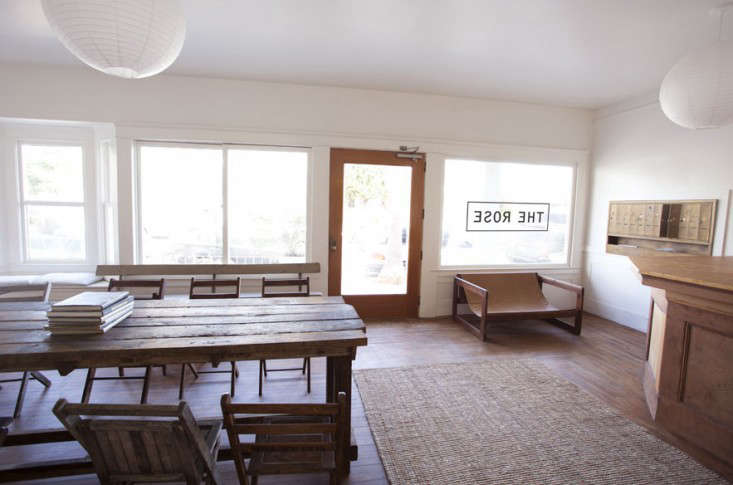
Its redesign, associated with photographer Glen Luchford and collaborators in the design world, did not scrub away that character. Instead, the interiors emphasized restraint. Think sand, washed blues, muted greens, natural linen, reclaimed wood, and simple furniture with a mid-century tilt. The palette nodded to the shoreline without turning every room into an overexcited nautical costume. Nobody was forcing a seashell motif on innocent adults. Thank goodness.
This design strategy was smarter than it looked. Creative travelers often do not want hotel rooms that scream for attention. They want rooms that let them think. The Rose understood that. Its spaces offered texture rather than clutter, atmosphere rather than spectacle. Even the common areas felt less like commercial hospitality zones and more like an unusually stylish friend’s beach house.
Not Fancy in the Traditional Sense, Better in the Useful Sense
Part of The Rose’s charm was that it never pretended to be something it was not. This was not a palace hotel with an army of bellhops and a chandelier the size of a moon landing. Some rooms were compact. Some used shared bathrooms. Suites offered more space, and some came with features like decks, kitchenettes, or separate living areas. That mix gave the property range. A solo traveler on a modest budget could make it work, while couples or longer-stay guests could opt for more residential comfort.
That flexibility is one reason the hotel resonated with artistic and design-minded travelers. Creative people do not all travel with the same wallet. Some are shooting campaigns. Some are sketching personal projects. Some are freelancing from laptops while pretending their inbox is not on fire. The Rose’s room mix made the place feel inclusive without losing its point of view.
And then there were the details. Coffee mattered here. So did morning pastries. So did the sense that the hotel’s pleasures were tied to the neighborhood rather than imported from some bland luxury template. Beach cruisers, surf-friendly energy, locally loved food, and low-key communal spaces created a stay that felt genuinely rooted. The message was simple: you came to Venice, so the hotel should help you live like you are in Venice, not like you accidentally checked into an airport lounge with nicer bedding.
The Location Does Half the Seducing
The Rose’s address was one of its superpowers. It sat just a short stroll from the beach and boardwalk, which meant guests could slip into Venice’s daily theater almost instantly. Morning could start with coffee and marine air. Ten minutes later you might be watching skaters, wandering the sand, or tracing the canals that still echo Abbot Kinney’s original fantasy of bringing Venice-inspired charm to Southern California.
Just as important, the hotel was near the streets that have shaped modern Venice’s identity. Rose Avenue evolved into a serious dining and lifestyle corridor. Abbot Kinney Boulevard became a magnet for shops, restaurants, design lovers, and people who dress like they are perpetually five minutes away from a magazine shoot. In lesser hands, proximity to all that could feel exhausting. At The Rose, it felt energizing. You could dip in and out of the scene without sacrificing the laid-back, residential flavor that gives Venice its depth.
This made the property especially attractive for travelers who want both movement and refuge. Venice is not boring for a second, but that does not mean you want to live full-time inside the loudest part of it. The Rose offered that ideal middle ground: close enough to feel plugged in, calm enough to regroup, write, nap, or stare at a wall and call it “creative processing.”
Why Creatives Gravitate to Places Like This
Creative travelers are often hunting for something that is surprisingly hard to find: a place that feels edited, not overproduced. They want visual interest, but also breathing room. They want comfort, but not deadened sameness. They want a hotel that leaves enough silence around the experience for observation, reflection, and chance encounters. The Rose delivered that mix unusually well.
The hotel’s appeal came from how it supported a certain rhythm. You could wake early, drink good coffee, take a walk by the water, and come back with a head full of ideas before most people had located their phone charger. You could spend the afternoon moving between the beach, local shops, cafés, and your room, using the hotel as a home base rather than a fortress. You could have a conversation in the lobby that began with design and ended with somebody recommending a hidden taco spot, a gallery opening, or a better way to think about your next project.
That is what a creative clubhouse really is. Not a members-only fantasy. Not a sterile “work lounge.” A real place with enough style to inspire you and enough ease to keep you from performing the role of Inspired Person all day. The Rose felt like it knew the difference.
The Design Lesson Other Boutique Hotels Still Miss
The Rose Hotel also offers a useful lesson in hospitality branding. Too many boutique hotels try to look original by stacking visual references like they are building a mood board in a wind tunnel. They add neon signs, ironic books, custom fragrances, and a lobby chair that appears to have been designed by someone who resents the human spine. The result is memorable for about six minutes.
The Rose took a subtler approach. Its originality came from consistency. The architecture, the room design, the neighborhood, the amenities, and the pace of the experience all pointed in the same direction. Nothing felt random. Nothing felt overexplained. The style looked effortless because it was anchored in real choices: natural materials, local context, small-scale hospitality, beach proximity, and a refusal to turn minimalism into coldness.
That is why the hotel lingered in people’s minds. It was coherent. You could feel the idea of the place in every room and every threshold. Even when it was imperfect, it remained convincing. And honestly, convincing beats flawless every time. Flawless is nice in product photography. Convincing is what makes people book a return stay.
What The Rose Said About Venice Itself
The hotel also worked because it mirrored the best version of Venice Beach. Venice is often reduced to clichés: bodybuilders, street performers, million-dollar bungalows, smoothie empires, and tech money disguised as casualwear. All of that exists. But the neighborhood’s deeper charm comes from how many different identities it manages to hold at once. Venice is gritty and polished, eccentric and expensive, historic and restless. It can be maddening. It can also be magnetic.
The Rose reflected that layered reality. It was stylish but not glossy. Relaxed but not lazy. Design-forward but not self-important. Its atmosphere suggested that creativity does not always need grand statements; sometimes it just needs a room with good light, honest materials, and the Pacific close enough to interrupt your thoughts in a useful way.
In that sense, The Rose was never only about hospitality. It was about place-making. It translated Venice into hotel form. It made the neighborhood legible to visitors without sanding off the edges that make Venice worth caring about.
Who Would Love This Kind of Stay
If your dream vacation requires butler service, blackout-level silence, and the ability to order seventeen spa treatments before breakfast, this probably was not your scene. But if you like hotels with personality, The Rose had a lot to offer. It appealed to travelers who notice texture, who care about neighborhood over isolation, and who would rather have a room with soul than one more piece of generic luxury inventory.
Writers could appreciate the quiet corners and walkable inspiration. Photographers had no shortage of material, from the boardwalk to the canals to the soft, layered interiors. Couples found romance in the low-key, sun-faded mood. Solo travelers could feel part of the neighborhood without being swallowed by it. Even business travelers with creative jobs could treat the hotel like a reset button instead of a sleep pod with Wi-Fi.
In other words, The Rose was for people who like a little story with their stay.
Experience: A Day Inside a Creative Clubhouse by the Beach
Imagine arriving at The Rose on a bright Venice afternoon, your bag still carrying the stale seriousness of airport travel while the rest of the neighborhood is busy being effortlessly cooler than you. From the outside, the place does not shout. It does not need to. It has the confidence of someone wearing linen in a city full of sequins. You step inside and the mood changes immediately. Light bounces off pale walls. Wood, fabric, and worn-in textures do the quiet work of making you unclench your shoulders. Suddenly your phone seems less urgent. Miracles happen.
Morning begins early because Venice has a way of making sunlight feel like a personal invitation. You pad downstairs before the day gets loud, claim a coffee, and take a pastry without making a ceremony out of it. Nobody is trying to upsell you on “experiential breakfast.” It is just a good start to the day, which is rarer and more valuable than the hotel industry likes to admit. You sit for a few minutes, looking around the lobby, noticing how every detail feels chosen but not fussy. A chair is a chair, but here it also seems to understand composition.
Then you head outside. The beach is close enough that the ocean becomes part of your schedule without requiring logistics. The boardwalk is already awake, doing what the Venice boardwalk does best: producing scenes no screenwriter would dare pitch because they sound too obvious. Skaters roll by. Somebody is setting up art. Somebody else looks like they have not slept since 2009 but somehow still has perfect posture. You walk south, then double back, then drift toward the canals where the noise thins out and the neighborhood exhales. The contrast is pure Venice: public spectacle on one side, postcard calm on the other.
Later, you wander toward Rose Avenue and Abbot Kinney, grazing on the neighborhood rather than conquering it. A coffee shop becomes a pause. A design store becomes an accidental lesson in restraint. A lunch spot turns into a two-hour sit-down because nobody seems interested in rushing and, frankly, that starts to sound like a lifestyle worth stealing. The beauty of staying somewhere like The Rose is that the hotel is not competing with the neighborhood for your attention. It is collaborating with it. Every block feels like an extension of the stay.
Back at the hotel, the room greets you the way a smart room should: by letting you be. The colors are soft. The materials feel tactile. The whole space seems built for decompression and low-stakes thought. You read. You nap. You scribble in a notebook. You take the kind of shower that convinces you, briefly, that all major life decisions should be postponed until after a second cup of coffee. By sunset, the light goes gold and generous, and everything outside the window looks like it has been art-directed by someone with a deep respect for haze.
Night in Venice can go in a dozen directions. You can dress up, dress down, or split the difference and call it “California.” You can eat somewhere lively, wander back by the beach, or end the evening with one more quiet moment at the hotel, letting the day settle. That is the real luxury The Rose always seemed to understand: not excess, but atmosphere; not isolation, but belonging; not performance, but permission. Permission to slow down, look around, and feel more interesting than you did when you arrived. Not because the hotel invented a fantasy, but because it made room for one that was already waiting in Venice.
Conclusion
A great boutique hotel does more than provide a bed and a decent shower. It sharpens your understanding of a place. The Rose Hotel in Venice did exactly that. Through its history, its scale, its design language, and its close relationship to the neighborhood, it showed how hospitality can feel personal without being precious. It captured the version of Venice Beach that travelers actually hope to find: creative, sunlit, slightly unruly, deeply local, and much more interesting than anything branded as a “lifestyle experience.”
That is why The Rose has remained such a resonant reference point. It was not merely stylish. It was specific. It made room for artists, wanderers, romantics, and curious people who prefer character over choreography. In a travel market crowded with hotels trying to be unforgettable, The Rose proved a smarter point: when a place feels honest, human, and beautifully connected to its surroundings, people remember it anyway.