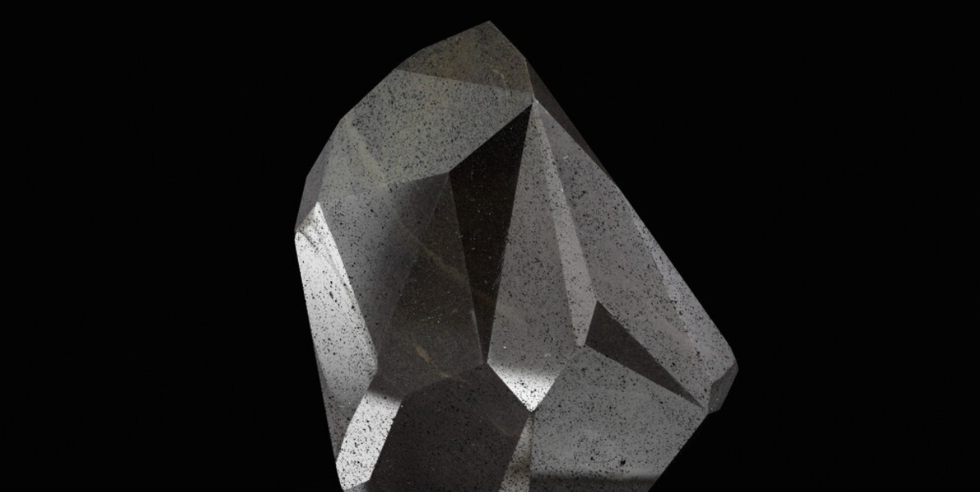
Editor’s note: The famous black diamond discussed here, known as The Enigma, was offered by Sotheby’s in February 2022. This article explains the auction story, the science behind carbonado diamonds, and why the “came from space” claim is fascinatingbut not fully settled.
The Diamond That Looked Like It Escaped a Sci-Fi Movie
Every so often, the gem world produces a story so dramatic that it sounds like a movie pitch: a mysterious black diamond, weighing 555.55 carats, shaped with 55 facets, possibly born in outer space, and offered at a major international auction. That is the story of The Enigma black diamond, a carbonado-type gem that became a global headline because it combined luxury, geology, mystery, and just enough cosmic drama to make even people who normally ignore jewelry news say, “Wait, did you say space diamond?”
The Enigma is not the kind of diamond most people imagine when they hear the word “diamond.” It does not sparkle like a classic engagement-ring stone. It does not flash icy rainbows across the room. Instead, it appears dark, dense, sculptural, and almost otherworldly. It looks less like something mined for jewelry and more like something a villain might place on a velvet pillow while explaining his plan to buy the moon.
But behind the drama is a serious scientific question: did this 555-carat black diamond really come from space? The answer is more complicated than a simple yes or no. Some theories suggest carbonado diamonds may have extraterrestrial connections. Other experts argue that the evidence is intriguing but far from conclusive. In short, The Enigma lives up to its name.
What Is The Enigma Black Diamond?
The Enigma is a natural-color fancy black diamond classified as a carbonado diamond. It weighs 555.55 carats, or about 111 grams, and was cut with 55 facets. The repeated use of the number five was not accidental. The design was inspired by the hamsa, a palm-shaped symbol associated in many cultures with protection, strength, and good fortune.
In the diamond world, size matters, but so does rarity. A white diamond of hundreds of carats is already extraordinary. A natural black diamond of this scale is even stranger. Most black diamonds are much smaller, and many black diamonds used in jewelry today are treated to deepen their color. A naturally black carbonado weighing more than 500 carats is not merely rare; it is the mineral equivalent of finding a parking spot directly in front of the store on Black Friday.
The Enigma was described as one of the largest fancy black natural-color diamonds and one of the largest cut diamonds ever brought to auction. It also surpassed the carat weight of famous stones such as the Great Star of Africa and the Golden Jubilee, although those diamonds are very different in appearance and gemological character.
The Sotheby’s Auction: Luxury Meets Mystery
Sotheby’s promoted The Enigma as a once-in-a-lifetime auction piece. Before the sale, the diamond toured major luxury markets, including Dubai and Los Angeles, before heading to London for its online auction. The presale estimate was widely reported at around $6.8 million, and the auction house also accepted cryptocurrency as a payment option, which made the story feel extremely 2022: ancient stone, possible space origin, modern crypto wallet.
The final sale price was reported at about $4.3 million, or £3.16 million. For a stone surrounded by cosmic speculation and record-breaking appeal, that price may sound surprisingly modest compared with the prices achieved by rare pink, blue, or colorless diamonds. But black diamonds occupy a different market. Their value depends less on traditional brilliance and more on rarity, size, origin, story, and collector appetite.
In other words, buyers were not simply bidding on a gemstone. They were bidding on a mystery object with a heavyweight résumé: enormous size, unusual composition, symbolic design, public intrigue, and the irresistible possibility that it might have a connection to the stars.
What Makes Black Diamonds Different?
To understand The Enigma, it helps to understand black diamonds. Traditional diamonds are usually valued for transparency, fire, brilliance, and clarity. Natural black diamonds are prized for almost the opposite reason: they are opaque or nearly opaque, filled with inclusions, and visually dramatic rather than glittery.
Many natural black diamonds get their color from dense clouds of graphite, sulfides, or other mineral inclusions. These inclusions absorb light, creating the stone’s dark appearance. Carbonado diamonds are even more unusual. They are not single diamond crystals in the usual sense. Instead, carbonado is a tough, porous, polycrystalline material made of many tiny diamond crystals fused together.
That structure makes carbonado extremely tough and difficult to cut. While diamond is famously hard, carbonado adds another layer of stubbornness because its crystal grains are arranged in many directions. A gem cutter cannot simply follow one predictable cleavage plane. Cutting a large carbonado is a little like trying to carve a sculpture out of a grumpy thundercloud.
So, Did The Enigma Really Come From Space?
The space-origin claim is the most clickable part of the story, and understandably so. “Huge black diamond may come from outer space” is a much better headline than “Auction house sells unusually dense carbon aggregate of uncertain geological origin.” But science requires more than a headline with rocket fuel.
Carbonado diamonds have long puzzled geologists because they do not fit neatly into the usual diamond origin story. Most diamonds form deep within Earth’s mantle under extreme heat and pressure, then ride volcanic eruptions toward the surface. Carbonados, however, are found in alluvial deposits, especially in Brazil and the Central African Republic, without a clearly identified primary host rock like the kimberlite pipes associated with many conventional diamonds.
Several origin theories have been proposed. One suggests carbonados formed from meteorite impacts. Another proposes that they came from diamond-bearing asteroids that collided with Earth. A more dramatic version argues that carbonado material formed in space, perhaps in a hydrogen-rich environment, before arriving on Earth. Supporters of extraterrestrial theories point to unusual features such as porosity, trace elements, and the distribution of known carbonado deposits.
However, many experts remain cautious. The evidence does not allow scientists to stamp The Enigma with a neat label reading “Made in Space.” The more responsible conclusion is this: carbonado diamonds have mysterious origins, and extraterrestrial theories are possible, but not proven. The Enigma may have a cosmic backstory, or it may be an exotic product of Earth’s own complicated geology. Either way, it is still spectacular.
Why Carbonado Diamonds Are So Scientifically Strange
Carbonado diamonds are strange because they challenge expectations. They are porous, tough, dark, and polycrystalline. They contain inclusions and structures that are not typical of clear mantle diamonds. Their known geographic distribution is also unusual. Most widely discussed carbonado deposits are associated with Brazil and the Central African Republic, regions that were once closer together in ancient supercontinent arrangements.
The mystery deepens because carbonados are often found in younger sedimentary deposits, while some studies suggest the diamond material itself may be billions of years old. That creates a geological puzzle: if the stones are ancient, where did they originally form, and how did they end up where they are found today?
Scientists have explored multiple explanations, including mantle formation, crustal processes, radiation-related crystallization, meteorite impact, and extraterrestrial formation. Each theory explains some features but struggles with others. That is why carbonado remains one of the most debated forms of natural diamond.
In a way, The Enigma is not just a luxury object. It is a portable geology argument. Put it in a display case, and it looks like a jewel. Put it in a lab discussion, and it becomes a polite scientific brawl wearing a tuxedo.
The Marketing Power of a Space Diamond
The phrase “space diamond” is powerful because it turns a rare gem into a story. Humans have always attached myths to precious stones. Diamonds symbolize love, status, endurance, and power. Add possible extraterrestrial origin, and suddenly the stone becomes more than a luxury item. It becomes a relic of the universe.
Auction houses understand this. A diamond’s physical properties matter, but so does its narrative. The Hope Diamond is famous not only because it is blue, but because of its long, dramatic history. The Black Orlov is known partly because of stories of a curse. The Enigma gained attention because it could be framed as a cosmic mystery.
That does not mean the story is fake. It means the story must be separated from the science. “Possibly from space” is not the same as “confirmed extraterrestrial origin.” For readers, collectors, and buyers, that distinction matters. The Enigma is astonishing without needing a guaranteed asteroid passport.
How The Enigma Compares With Other Famous Black Diamonds
Black diamonds have moved from gemological oddities to bold luxury statements. Historically, many black diamonds were considered less desirable than clear stones because they lacked the traditional sparkle associated with diamonds. Over time, designers and collectors began to appreciate their dramatic appearance.
Famous black diamonds include the Black Orlov, a 67.50-carat stone surrounded by legend, and the Spirit of de Grisogono, a large black diamond set in a white gold ring with hundreds of white diamonds. Compared with these, The Enigma stands out because of its size, shape, carbonado classification, and public auction story.
The Enigma is not necessarily “beautiful” in the conventional diamond sense. It is not delicate or icy or romantic in the usual jewelry-advertising way. Its appeal is more architectural. It feels ancient, heavy, symbolic, and strange. It is the kind of gem that does not whisper elegance; it leans across the table and says, “I may have survived a meteor impact. What did you do today?”
What Buyers Should Know About Natural Black Diamonds
The Enigma also raises a practical point for everyday jewelry buyers: not all black diamonds are the same. Some are natural-color black diamonds. Some are treated diamonds that began as heavily included or lower-color stones and were enhanced to appear black. Others may be lab-grown or diamond simulants.
Natural black diamonds can be beautiful and durable, but they often have complex internal structures. Their inclusions create color and personality, but they can also affect cutting, polishing, and durability. Anyone shopping for a black diamond should ask for documentation from a reputable gemological laboratory, especially if the stone is expensive.
For most consumers, a treated black diamond can still be attractive and wearable. The key is honesty. A treated stone should not be sold as a rare natural-color black diamond. A lab-grown black diamond should not be marketed as mined. And a dramatic sales pitch should not replace a proper report.
The Honest Answer: Space Mystery, Not Space Certainty
So, did the 555-carat black diamond really come from space? The honest answer is: maybe, but no one has proven it. The Enigma belongs to a category of diamond that is legitimately mysterious. Carbonado diamonds have features that make scientists ask unusual questions. Some researchers have argued for extraterrestrial origins. Others are skeptical and point to Earth-based explanations.
What makes the story compelling is not certainty but uncertainty. The Enigma invites us to imagine a diamond forming in an ancient cosmic environment, traveling through space, striking Earth, surviving unimaginable geological time, and eventually landing in a luxury auction. That is a spectacular possibility. But science has to keep one eyebrow raised until the evidence is stronger.
In the end, The Enigma does not need a confirmed space origin to be extraordinary. It is already one of the most unusual black diamonds ever offered publicly. It is huge, symbolic, rare, and scientifically provocative. If it did come from space, wonderful. If it came from Earth, then Earth deserves more credit for being wildly creative.
Experience Section: What The Enigma Teaches Us About Wonder, Value, and Curiosity
The story of The Enigma black diamond is memorable because it gives people an experience that goes beyond jewelry. Most of us will never bid millions of dollars at Sotheby’s, and most of us do not keep a spare cryptocurrency wallet labeled “for possible space rocks.” Still, the diamond offers a surprisingly relatable lesson: objects become powerful when they make us ask better questions.
Imagine standing in front of The Enigma in a showroom. At first, you might expect sparkle. Instead, you see darkness. The stone does not perform like a traditional diamond. It absorbs attention rather than reflecting it. That alone changes the experience. A clear diamond often feels like frozen light. A black diamond feels like a secret with sharp edges.
The next reaction is scale. A 555.55-carat diamond is difficult to process because most people experience diamonds in one- or two-carat conversations. The Enigma is not ring-sized; it is museum-sized. Its presence is closer to sculpture than jewelry. You would not casually wear it to dinner unless your dinner plans included a royal procession, a security team, and perhaps a small forklift.
Then comes the mystery. The possible space connection changes how people emotionally experience the object. A diamond from deep within Earth is already impressive, but a diamond possibly linked to meteorites or asteroids touches something older and larger than luxury. It connects the gem to childhood wonder: stars, planets, ancient collisions, and the idea that the universe still hides surprises in plain sight.
That is why The Enigma became such a powerful public story. It sits at the intersection of science and imagination. Scientists want evidence. Collectors want rarity. Auction houses want narrative. Readers want a reason to click. The diamond gave everyone something to enjoy, debate, or side-eye skeptically.
There is also a useful lesson for anyone who writes about rare objects: the best stories do not flatten uncertainty. They respect it. Saying “this diamond definitely came from space” may sound exciting, but saying “this diamond belongs to a class of stones whose origin remains scientifically debated” is more honestand, honestly, still exciting. Mystery does not become weaker when handled carefully. It becomes more durable.
The Enigma also reminds us that value is not only physical. Yes, the diamond has weight, hardness, rarity, and a famous auction record. But its real cultural value comes from the questions surrounding it. Where did it form? Why are carbonado diamonds so different? Why are humans so drawn to stones with legends? Why does “possibly from space” instantly make a black rock feel like a treasure from a cosmic vault?
In that sense, The Enigma is perfectly named. It is not merely a diamond. It is a conversation starter, a scientific puzzle, a luxury artifact, and a reminder that wonder still sellsespecially when it comes with 55 facets and a backstory that may include the stars.