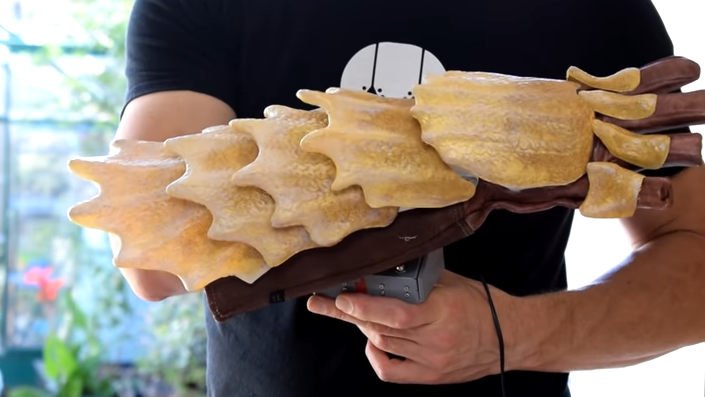
Some gadgets politely ask for your attention. Others grab it by the eyeballs, shake it gently, and whisper, “Look at me ripple.” Will Cogley’s scaly gauntlet belongs firmly in the second category. At first glance, it looks like a fantasy armor piece that wandered out of a video game, took a robotics class, and developed a flair for drama. Then the scales begin to move. One after another, they rise and fall in a smooth wave across the forearm, creating a mechanical shimmer that is oddly calming, slightly alien, and absolutely impossible to ignore.
The project is not just a shiny wearable prop. It is a compact lesson in kinetic design, 3D printing, vacuum forming, mechanical linkages, biomimicry, and the strange human weakness for anything that moves like water but is definitely not water. The gauntlet uses a single motor, a cam-driven mechanism, lightweight scale pieces, and clever attachments to create the illusion of living armor. In other words, it proves that you do not need a giant budget or a room full of movie-studio technicians to make something look delightfully futuristic. Sometimes you just need a good idea, a stubborn maker brain, and enough patience to argue with plastic.
What Is the Scaly Gauntlet?
The scaly gauntlet is a mechanized wearable prototype created by mechatronics maker Will Cogley. It sits along the forearm like a piece of fantasy armor, but instead of being static, its outer scales move in sequence. The result is a rippling wave that rolls across the surface, almost like the skin of a dragon, a pangolin, or a very fancy cyber-lizard having a calm afternoon.
The most impressive part is how simple the core idea is. Beneath the scales is a rotating rod fitted with several cams. As the rod turns, each cam lifts a lever at a slightly different moment. Those levers push the scales up and down, producing a wave pattern. The viewer sees organic motion, but underneath is a beautifully mechanical rhythm: rotation becomes rise-and-fall movement, and rise-and-fall movement becomes visual magic.
This is why the gauntlet feels so satisfying to watch. It does not merely blink lights or spin a decorative gear. It transforms one clean mechanical input into a layered motion effect. Like a line of dominoes performing ballet, the scales make the machine look alive without requiring complicated electronics for every piece.
Why the Rippling Waves Look So Hypnotic
Humans are embarrassingly easy to impress when motion happens in a pattern. Ocean waves, wheat fields in the wind, fish swimming in a school, and even those little desk toys with swinging metal balls can trap our attention. The scaly gauntlet works on the same visual principle. Repetition plus variation equals fascination.
Each scale moves in a predictable sequence, but the viewer’s eye still wants to follow the wave from one end of the gauntlet to the other. The motion is smooth enough to feel natural, yet mechanical enough to make the brain ask, “Wait, how is that happening?” That combination creates a tiny visual puzzle. The audience gets beauty and engineering in the same bite, like a cupcake with a physics textbook hidden inside. Hopefully a small textbook. Nobody wants frosting on chapter seven.
The overlapping scale design also adds depth. A flat panel moving up and down might be interesting for about three seconds. But rows of small armor-like plates create shadows, highlights, and tiny changes in surface texture. As the scales lift and settle, light skims across them differently, making the ripple look richer than the actual mechanism needs to be. That is smart design: let the geometry do part of the performance.
The Engineering Behind the Movement
A Single Motor Does the Heavy Lifting
One of the best details about the gauntlet is that it uses a single motor to drive the wave effect. That matters because wearable projects quickly become awkward when they require too many motors, wires, batteries, and control boards. More parts can mean more weight, more heat, more noise, and more opportunities for the device to behave like a diva during a convention photoshoot.
Using one motor keeps the concept elegant. Instead of assigning a separate motor to every scale, the design uses a shared mechanical shaft. That shaft distributes motion through cams and levers. The result is coordinated movement from a simple power source. In maker terms, this is the good stuff: fewer active components, more mechanical intelligence.
Cams Turn Rotation Into a Wave
The cam mechanism is the quiet hero of the project. A cam is a shaped rotating component that pushes a follower or lever in a specific way. In this gauntlet, several cams are arranged along a rod. As the rod spins, each cam reaches its high point at a different time, lifting its lever and attached scale. Because the cams are offset from one another, the scales do not all move together. They move one after the next, creating the rippling effect.
This is classic mechanical choreography. Think of the camshaft in an engine opening and closing valves at the correct moment, except here the goal is not combustion. The goal is to make a forearm look like it belongs to a stylish sea monster with excellent taste in hardware.
Levers Add Reach and Rhythm
The levers beneath the scales extend the motion from the cam rod to the outer armor plates. This arrangement gives the designer control over how far the scales rise, how quickly they return, and how dramatic the ripple appears. Small changes in lever length, pivot position, or cam shape can change the entire personality of the motion.
That is one reason kinetic wearable design is so addictive. A tiny mechanical adjustment can make a movement look elegant, nervous, aggressive, sleepy, insect-like, aquatic, or theatrical. The scaly gauntlet lands in the sweet spot: dramatic enough to look impressive, but smooth enough to feel mesmerizing rather than chaotic.
3D Printing Gives the Gauntlet Its Skeleton
Modern maker projects often begin with a 3D printer because it allows designers to test shapes quickly. For a wearable gauntlet, that flexibility is especially valuable. Human arms are not convenient rectangles, no matter how much packaging designers might wish otherwise. A gauntlet needs to follow the forearm, leave room for movement, hold mechanisms in alignment, and still look good from the outside.
3D printing helps solve those problems by making custom brackets, frames, supports, and prototypes practical. If a part does not fit, the maker can adjust the digital model and print another version. This cycle of design, print, test, complain mildly, redesign, and print again is the heartbeat of many successful maker builds.
For cosplay and wearable art, 3D printing also supports complex shapes that would be difficult to carve by hand. Organic curves, scale mounts, mechanical housings, and hidden linkage supports can be created with repeatable precision. In the scaly gauntlet, the printed structure acts as the foundation that keeps the wave mechanism aligned while the outer plates deliver the visual drama.
Vacuum Forming Makes the Scales Lightweight
One of the clever choices in this project is the use of vacuum-formed scales. Vacuum forming is a manufacturing process where a sheet of plastic is heated until pliable, then pulled over a mold using suction. Once cooled, the plastic holds the shape of the mold. It is widely used for packaging, props, costume pieces, trays, housings, and custom parts.
Why not simply 3D print every scale as a solid piece? Weight. A wearable device must live on a human arm, not on a display shelf with the emotional resilience of a brick. If every decorative scale were printed thick and heavy, the gauntlet could become uncomfortable fast. Vacuum forming creates thin, lightweight copies that still capture the shape and surface detail of the original pattern.
In this case, 3D printed scale shapes can act as molds or masters. The vacuum-formed plastic copies become the visible armor plates. That combination gives the maker the best of both worlds: 3D printing for custom geometry and vacuum forming for lightweight repetition. It is like making cookies with a high-tech cookie cutter, except the cookies are plastic, wearable, and strongly discouraged as snacks.
Magnetic Attachments Are a Smart Wearable Choice
The scales on the gauntlet are magnetically attached to the levers underneath. This is a practical detail that deserves applause. Wearables get bumped. They catch on sleeves. They meet doorframes, backpacks, tables, and the occasional friend who says, “Can I touch it?” while already touching it.
Magnetic attachment creates forgiveness. If a scale hits something, it can detach or shift rather than snapping the entire mechanism. This makes the prototype easier to test, repair, and modify. It also supports fast removal when the maker wants to inspect the linkage below. For a proof-of-concept kinetic wearable, that is far better than gluing every decorative piece into place and hoping nothing ever goes wrong. Spoiler: something always goes wrong. That is not failure; that is prototyping wearing a funny hat.
Why Scales Are So Effective in Design
Scales are one of nature’s favorite design tricks. Fish, snakes, pangolins, and many other animals use overlapping structures for protection, flexibility, or movement. The beauty of scales is that each piece can be rigid while the overall surface remains flexible. Instead of forcing one large plate to bend, the design lets many smaller elements shift relative to one another.
That principle translates beautifully into costume design and kinetic art. A solid forearm shell can look stiff, but a field of overlapping scales suggests motion even when it is standing still. Once the scales actually move, the effect becomes far more convincing. The gauntlet does not just imitate the look of natural armor; it borrows the visual language of living surfaces.
This is biomimicry at the aesthetic level. The project is not claiming to be protective body armor, and it should not be treated as safety equipment. Its value is artistic and mechanical. But by echoing natural scale patterns, it taps into a design vocabulary people recognize instantly. We see scales and think of reptiles, fish, dragons, ancient armor, fantasy creatures, and high-status villains with excellent lighting departments.
Cosplay, Props, and the Rise of Kinetic Wearables
Cosplay and prop-making have changed dramatically because of accessible digital fabrication. Years ago, building a complex wearable piece often required sculpting, casting, carving, or relying on expensive shop tools. Those skills still matter, but 3D printers, desktop forming machines, affordable electronics, and online tutorials have opened the door to more ambitious personal projects.
The scaly gauntlet fits perfectly into this new era. It is not just a costume accessory; it is a performance object. Static armor can look impressive in photos, but kinetic armor creates a moment. It gives the wearer something to reveal. A ripple across the arm can turn a simple pose into a mini event. Suddenly the costume is not only being worn; it is doing something.
This is why moving props tend to dominate attention at maker fairs, conventions, and online videos. A helmet that opens, wings that unfold, a mask that changes expression, or a gauntlet that ripples like a metallic creature all offer the same thrill: transformation. Viewers love seeing an object shift states. It gives the design a beginning, middle, and payoff.
The Artistic Value of Mechanical Simplicity
One reason this gauntlet stands out is that it does not hide behind complexity for complexity’s sake. The mechanism is understandable. A motor turns a rod. Cams lift levers. Levers move scales. That clarity makes the project more satisfying, not less. The viewer can appreciate both the illusion and the method behind it.
Great kinetic art often works this way. It shows enough of the mechanism to invite curiosity while preserving enough mystery to keep the magic alive. If everything is hidden, the viewer only sees an effect. If everything is exposed, the viewer may see only machinery. The scaly gauntlet balances the two. With the scales attached, it looks like living armor. With the scales removed, it becomes a neat demonstration of mechanical sequencing.
The result is educational without feeling like homework. Nobody wants a gauntlet that says, “Please open your workbook to page 42.” This one says, “Watch the wave,” and then quietly teaches cams, linkages, fabrication, and iterative design while your brain is busy enjoying the show.
Lessons Makers Can Take From the Scaly Gauntlet
Start With One Strong Motion Idea
The project succeeds because it has a clear visual goal: make scales ripple. Everything supports that goal. The motor, cams, levers, vacuum-formed plates, and magnetic attachments all exist to create one memorable effect. Makers can learn a lot from that focus. A project does not need twelve features if one feature is unforgettable.
Use Materials for Their Strengths
3D printing is excellent for custom structures and testable geometry. Vacuum forming is excellent for lightweight repeated shells. Magnets are useful for removable parts. The gauntlet works because each material and process is used where it makes sense. That is better than forcing one tool to do every job simply because it is nearby and already plugged in.
Design for Repair and Adjustment
Prototypes need to be adjusted. A wearable prototype needs to be adjusted even more because bodies move, parts shift, and decorative pieces collide with the real world. Magnetic scales, visible linkages, and modular components make the gauntlet more practical to refine. The best maker projects are not just built; they are built to be improved.
Experience: Watching the Scaly Gauntlet in Motion
Watching the scaly gauntlet’s rippling waves feels different from looking at a typical prop video. The first reaction is simple curiosity. You see the forearm shape, the armor-like surface, and the layered plates. It looks cool, sure, but plenty of props look cool. Then the motor starts, and the whole object changes personality. The scales rise in sequence, and suddenly the gauntlet seems less like an object and more like a creature deciding whether to wake up.
The best part is the timing. The wave does not slam across the arm like a row of trapdoors. It rolls. That rolling motion creates a sense of softness even though the object is built from hard parts. This contrast is what makes the piece so memorable. Your eyes understand that it is mechanical, but your instincts read it as organic. It is the same reason people stare at kinetic sculptures in museums: the mind enjoys watching machines pretend to be alive.
There is also a wonderful “I could almost understand this” quality to the movement. You do not need an engineering degree to see that something is lifting the scales from below. The visible result invites the viewer to imagine the hidden mechanism. Maybe it is servos. Maybe it is strings. Maybe there is a tiny dragon inside doing contract work. Then, when you learn that a cam rod and levers create the sequence, the design becomes even more impressive. It is not magic; it is better. It is cleverness made visible.
For anyone interested in cosplay, the gauntlet sparks immediate ideas. Imagine a fantasy character whose armor breathes before battle, a science-fiction explorer with adaptive environmental gear, or a stage performer whose costume changes texture during a song. The ripple effect could suggest power, emotion, alertness, camouflage, or transformation. It gives a character a nonverbal way to communicate. The costume does not need to shout, “Something dramatic is happening!” The scales can simply move, and the audience understands.
From a maker’s perspective, the gauntlet is encouraging because it shows how a small mechanical effect can feel big. It does not require a full robotic suit. It does not need dozens of actuators or a cinematic budget. The core concept is compact and repeatable: create a sequence, attach visible elements to that sequence, and tune the timing until it feels alive. That lesson applies far beyond gauntlets. It could inspire moving collars, shoulder armor, masks, wall art, creature puppets, jewelry, display pieces, or interactive museum models.
The experience also reminds us that prototypes do not have to be perfect to be powerful. In fact, the visible experimental nature makes the gauntlet more charming. You can sense the problem-solving behind it: how to keep the parts light, how to attach scales without making them fragile, how to fit motion along a curved arm, how to make the wave readable from a camera angle. Every solution adds personality. The gauntlet is not just a finished effect; it is a record of design decisions.
And finally, there is the pure joy of it. Not every invention needs to save the world, automate your refrigerator, or connect to an app that will email you about firmware updates at 3 a.m. Some inventions exist because motion is beautiful and making things move is fun. The scaly gauntlet is a reminder that engineering can be playful. It can be theatrical. It can make people lean closer and say, “Do that again.” In the world of maker art, that is a very respectable superpower.
Conclusion: A Small Wave With Big Maker Energy
Will Cogley’s scaly gauntlet is fascinating because it combines old mechanical principles with modern maker tools. Cams and levers are not new. Scales are not new. Vacuum forming is not new. 3D printing is no longer shocking, either. But when these ideas come together in a compact wearable prototype, the result feels fresh, expressive, and strangely alive.
The gauntlet’s hypnotizing, rippling waves show how thoughtful design can turn a simple motor into a memorable visual effect. It is a lesson in restraint, material choice, movement, and presentation. More importantly, it is proof that engineering does not have to look cold or complicated. Sometimes it can look like dragon skin doing a slow-motion stadium wave on someone’s arm. And honestly, that is the kind of future we can all support.