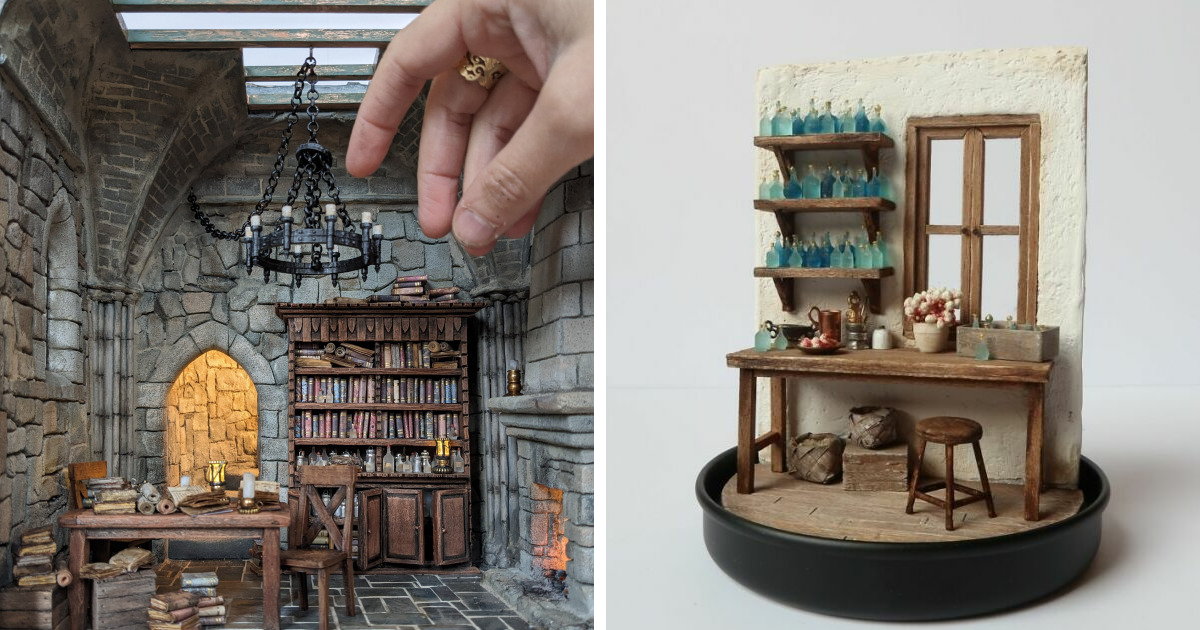
Some art announces itself from across the room. Tamar Cohen’s miniature art does the exact opposite. It leans in, lowers its voice, and somehow persuades you to move closer until your face is one polite sneeze away from a tiny chandelier, a miniature library, or a glowing greenhouse no larger than a lunchbox. That’s the strange magic of her work: the pieces are physically small, but they create the emotional illusion of space. You are not just looking at them. You are mentally renting a studio apartment inside them.
Across these 30 mesmerizing miniatures, Cohen proves that scale is a trickster. A palm-sized room can feel grand. A tiny doorway can suggest an entire life beyond it. A bookshelf smaller than your phone can still make you wonder who lived there, what they read, and whether they alphabetized everything with frightening dedication. Her scenes do not behave like novelty items. They behave like stories disguised as objects.
That is what makes this collection so compelling for art lovers, design obsessives, and anyone who has ever looked at a dollhouse and thought, “Honestly, I could live here if we moved the sofa two millimeters to the left.” Cohen’s miniatures invite that kind of participation. They reward close looking, slow curiosity, and the wonderfully human habit of projecting ourselves into places that do not belong to us. In a culture that constantly screams for speed, her tiny worlds ask for attention, patience, and imagination.
Why Tamar Cohen’s Miniatures Feel Bigger Than They Are
Tamar Cohen’s work stands out because it understands something essential about miniature art: tiny does not automatically mean cute. Yes, her scenes can be charming, but charm is only the front door. What waits behind it is atmosphere. Her best pieces feel inhabited even when no person is present. The absence of figures becomes a strength, not a gap. Instead of handing the viewer a fixed narrative, Cohen leaves room for interpretation. That means every glowing room, ornate façade, and carefully furnished interior becomes a stage where the viewer supplies the missing cast.
This is one reason her 30 featured works hit with such force. They are not simply technical demonstrations of hand skills, though the craftsmanship is impressive enough to make a grown adult reconsider every crooked IKEA shelf they have ever installed. They are emotional environments. A tiny library suggests solitude and intellect. A greenhouse suggests calm, maintenance, and the small miracles of everyday care. A weathered door hints at memory, passage, and mystery. Cohen understands that objects can carry narrative weight, and she arranges them like a novelist arranging clues.
Her architectural sensibility also matters. Rather than making generic “small rooms,” she creates spaces with personality. You can feel the influence of decorative history, European romance, old-world detail, and handcrafted texture. Arches, trim, layered surfaces, warm lighting, and intimate compositions all help the viewer feel that these places have histories. They are not blank sets. They are tiny worlds with emotional weather.
What Makes These 30 Mesmerizing Miniatures So Addictive to Look At
1. The Details Are Ridiculously Good
Let’s start with the obvious: Cohen is very, very good at detail. Not “oh, nice little chair” good. More like “why does this tiny room have better mood lighting than my actual house?” good. In these 30 works, the surfaces feel intentional and tactile. Shelves look aged. Walls feel layered. Furniture seems chosen rather than merely placed. Even when the viewer cannot inspect every material up close, the illusion holds because the relationships between the objects feel believable.
That believability is the key. A great miniature is not just a scaled-down collection of stuff. It is a controlled illusion. Cohen appears to prioritize visual harmony over rigid mechanical exactness, which gives her miniatures a lived-in coherence. They do not feel clinical. They feel composed.
2. Light Does Half the Storytelling
Many of Cohen’s most memorable pieces use lighting beautifully. Tiny lamps, warm interior glow, and shadowy corners do more than make the work look photogenic. They create emotional temperature. A lit room immediately suggests presence, even when no person is visible. It implies that someone has just stepped out, or is about to return, or has left behind the soft evidence of a life in progress.
That is especially powerful in miniature art because light helps defeat the “model” feeling. The more convincing the illumination, the faster the brain stops saying “craft project” and starts saying “space.” Cohen uses that psychological flip to her advantage.
3. The Miniatures Trigger Narrative Curiosity
One of the most satisfying things about this collection is how often it makes you ask questions. Who owns this library? Why is this courtyard so serene? What happened behind this ornate door? Why does this tiny greenhouse feel like the ideal place to rethink every bad decision from the last five years? That narrative pull is what separates mesmerizing work from merely impressive work.
Miniature art thrives on suggestion, and Cohen is especially strong at it. She knows that viewers love to complete the story themselves. Instead of overexplaining, she uses architecture, décor, color, and atmosphere to set a tone. The result is active looking rather than passive scrolling.
Standout Themes Across the 30 Tiny Worlds
Although each piece has its own identity, the 30 works also share recurring visual themes that make the collection feel cohesive.
Interiors You Wish Were Real
Some of the strongest miniatures in the group are interior spaces that feel instantly desirable. A teal-toned library lined with books, for example, is not just technically intricate. It taps into a fantasy of retreat, intelligence, and privacy. It feels like the kind of room where your phone would lose signal and your brain would gain one. Cohen understands the emotional shorthand of interiors. She knows how to turn a room into a mood.
Doors, Windows, and Thresholds
Thresholds matter in miniature art because they imply worlds beyond the frame. Cohen uses doors, windows, balconies, and façades as narrative devices. A beautifully detailed entryway can do the work of an entire backstory. It invites curiosity while withholding just enough information to keep the imagination buzzing. In a format where every inch counts, that is an efficient and elegant move.
Greenery, Courtyards, and Outdoor Calm
Some miniatures lean toward quiet outdoor intimacy: tiny plant life, sun-washed corners, enclosed patios, and compact green spaces. These works are especially effective because they combine order and softness. Plants help miniatures feel alive; they also provide contrast against architectural structure. The effect is deeply soothing. Cohen’s outdoor scenes feel less like decoration and more like miniature breathers.
Memory Without Sentimentality
There is a nostalgic quality in many of these works, but it rarely becomes syrupy. Cohen’s miniatures often feel timeless rather than retro. They suggest remembered spaces, dream spaces, and emotionally edited spaces. That distinction matters. She is not merely recreating reality at a smaller scale. She is distilling it.
The Craft Behind the Spell
It is easy to look at miniature art and assume the whole thing is about patience. Patience is certainly part of it. But Cohen’s work suggests something more layered: design intelligence, material sensitivity, and the ability to solve spatial problems at a very small scale. She has spoken about starting from a vivid mental image, then breaking it into stages, often beginning with the floor so the scale relationship can be established early. That process reveals a builder’s logic beneath the dreamy surface.
Her material choices also matter. In miniature work, a bad material decision can ruin the illusion instantly. Something too thick, too shiny, too stiff, or too clean can make the piece feel fake. Cohen appears to understand how to choose and manipulate materials so they read convincingly at scale. She also seems comfortable balancing handcraft with modern tools without letting the work lose its handmade soul. That is a difficult line to walk. Too much precision can make miniatures feel sterile. Too little can make them feel unfinished. Her pieces usually land in the sweet spot: polished, but alive.
And then there is the issue of shipping, sturdiness, and physical reality. These are not just art objects; they are fragile little universes. Building them means thinking not only like an artist, but like an engineer, stage designer, carpenter, and occasional magician. Cohen’s success comes partly from making all that labor disappear. The final works feel effortless, which is usually how you know an enormous amount of effort is hiding backstage.
Why Miniature Art Is Having a Very Big Moment
Tamar Cohen’s popularity also reflects a broader cultural appetite for miniature art. Tiny interiors, dollhouse aesthetics, handcrafted dioramas, and small-scale architectural scenes have been drawing increased attention across design publications, museums, social media communities, and contemporary art coverage. That rise makes sense. Miniatures offer a rare combination of intimacy and spectacle. They are easy to admire casually, but they become richer the longer you study them.
They also satisfy several modern cravings at once. First, they give us control. A miniature world is bounded, knowable, and coherent. In a chaotic era, that is no small thing. Second, they reward slowness. You cannot absorb a great miniature with one lazy glance. It asks you to inspect. Third, they reconnect craft with imagination. In a digital-heavy culture, the handmade precision of miniature art feels refreshingly tactile.
Cohen’s work fits perfectly within that larger movement while still feeling personal. She is not making miniatures because miniatures are trendy. She is using the form to build emotional, atmospheric worlds that happen to be tiny. That distinction is everything. Trends may introduce viewers to the work, but specificity is what keeps them there.
What These 30 Works Reveal About Tamar Cohen as an Artist
This collection reveals an artist who understands how environment shapes emotion. Cohen is not just building rooms and façades. She is building the feeling of entering them. Her work sits at an interesting crossroads between interior design, architecture, sculpture, set design, and storytelling. That hybrid quality is part of its appeal. Design lovers can admire the composition. Artists can admire the technique. Casual viewers can simply enjoy the wonder of seeing a whole world held in one hand.
It also reveals confidence. Many artists working in miniature either lean hard into whimsy or hard into realism. Cohen often blends both. Her scenes are believable enough to pull you in, yet stylized enough to feel enchanted. She knows exactly how much detail to offer and how much mystery to preserve. That restraint is mature. It is harder than it looks.
Most importantly, these 30 works show that Cohen understands scale as an emotional tool. Smallness changes how we look. It makes us gentler, more attentive, and a little more protective. We peer instead of glance. We imagine instead of consume. We slow down. That may be the greatest achievement of her miniature worlds: they make attention feel natural again.
Experiencing Tamar Cohen’s Tiny Worlds: A Longer Reflection
To look at Tamar Cohen’s miniatures for more than a few seconds is to experience a strange but lovely shift in perception. At first, your brain reacts the way it always does to miniature art: “Oh wow, that’s tiny.” But then a second response kicks in, and it is much more interesting. You stop thinking about size and start thinking about presence. You wonder what the room sounds like. You imagine the smell of books in the little library, damp earth in the greenhouse, cool stone by the doorway, dust in the corners, sunlight moving across the floor. The scale shrinks, but the sensory field expands.
That is why these pieces linger. They are not just visual tricks. They are imagination engines. A good miniature gives you the thrill of discovery; a great miniature makes you want to stay. Cohen’s work does exactly that. You study a scene and feel an almost childlike urge to enter it, not because it is cute, but because it feels emotionally legible. It looks like a place where things have happened, or could happen, or are waiting to happen the moment you turn away.
There is also something wonderfully democratic about that experience. You do not need an art history degree to respond to miniature worlds. You just need curiosity. Everyone understands rooms. Everyone understands the feeling of a lit window at dusk, a cozy reading corner, a garden that seems to hold its own weather, a doorway that feels more interesting than whatever is currently happening on your phone. Cohen takes those familiar sensations and compresses them into intimate objects that are almost impossible to ignore.
And maybe that is why miniature art feels especially meaningful right now. We live in a world of relentless scale: massive feeds, massive headlines, massive problems, massive opinions delivered at industrial speed. Miniatures push in the other direction. They ask us to notice a hinge, a shelf, a crack in the wall, a patterned floor, a tiny lamp. They remind us that detail is not trivial. Detail is often where emotion lives.
Cohen’s tiny worlds also tap into a fantasy that is both playful and profound: the fantasy of stepping outside normal proportions. When you imagine yourself entering one of her scenes, you are not only shrinking physically. You are also escaping regular logic. Bills do not follow you into a miniature courtyard. Inbox anxiety does not fit through a dollhouse door. The world gets quieter. The pace changes. The imagination gets more room than the body.
That is not escapism in the shallow sense. It is closer to restoration. Art does not always need to confront us with scale, noise, and urgency. Sometimes it can offer refuge, precision, and wonder. Cohen’s work excels at that. It proves that smallness can carry seriousness, craftsmanship can carry tenderness, and a tiny room can hold a surprisingly large emotional charge.
So yes, these 30 mesmerizing miniatures are visually impressive. They are also more than that. They are invitations: to look closer, to imagine harder, to appreciate craftsmanship, and to remember that entire emotional universes can exist in unexpectedly small spaces. Cohen is not merely making models. She is making thresholds. Each one opens into a tiny world, and each tiny world somehow opens back into us.
Conclusion
Tamar Cohen’s 30 mesmerizing miniatures succeed because they do more than display technical skill. They create mood, curiosity, and emotional depth at a scale that should not logically be able to hold so much. Yet there it is: tiny libraries with grand energy, intimate outdoor corners with cinematic calm, and architectural details that feel like fragments of larger stories. Her work reminds us that art does not need to be physically large to feel expansive. Sometimes the fastest route to wonder is through a very small door.
For readers, collectors, makers, and design fans alike, Cohen’s miniature worlds offer a rare pleasure: they invite slow attention in an era built for distraction. You look once because the work is beautiful. You look again because it feels alive. And by the third look, you are mentally redecorating your new imaginary tiny apartment and hoping the lease is reasonable.