Calculating area sounds simple until the object in front of you is not a polite little rectangle. Floors develop alcoves, packages have curved surfaces, and gardens seem determined to contain every geometric shape except the one whose formula you remember.
Fortunately, nearly every area problem follows the same strategy: identify the shape, measure the required dimensions, select the correct formula, and report the result in square units. More complicated objects can usually be divided into familiar pieces. Geometry may occasionally look intimidating, but most of it is organized multiplication wearing a fancy hat.
This guide explains how to calculate the area of common two-dimensional shapes and the surface area of three-dimensional objects. It also includes worked examples, techniques for irregular and composite objects, and practical lessons that help prevent costly measuring mistakes.
What Does Area Measure?
Area measures the amount of space covered by a flat region or surface. It answers questions such as how much carpet covers a floor, how much paint covers a wall, or how much cardboard is needed to manufacture a box.
Because area describes coverage in two dimensions, it is expressed in square units:
- Square inches: in²
- Square feet: ft²
- Square yards: yd²
- Square centimeters: cm²
- Square meters: m²
A square foot is the area of a square measuring one foot on every side. It is not simply “one foot.” Forgetting the exponent is a small typographical mistake with a surprisingly large ability to annoy math teachers.
Area, Surface Area, and Volume Are Different
Area usually describes a flat, two-dimensional shape. Surface area measures the total exposed covering of a three-dimensional object. Volume measures the space inside that object and is expressed in cubic units.
For example, a cereal-box panel has an area, the entire outside of the box has a surface area, and the space available for cereal has a volume. These measurements are related, but they are not interchangeable.
A Reliable Method for Calculating Area
- Identify the shape. Decide whether the object is a rectangle, circle, triangle, prism, cylinder, or combination of shapes.
- Determine what is being covered. For a 3D object, decide whether you need every surface, only the sides, or selected exposed faces.
- Measure the necessary dimensions. Depending on the formula, these may include length, width, height, radius, base, or slant height.
- Use consistent units. Convert all measurements to the same unit before calculating.
- Apply the formula. Substitute the measurements and complete the arithmetic carefully.
- Label and check the result. Include square units and compare the answer with a rough visual estimate.
How to Calculate the Area of 2D Objects
Rectangle
The area of a rectangle equals its length multiplied by its width:
A = l × w
Suppose a room is 14 feet long and 11 feet wide:
A = 14 × 11 = 154 ft²
The floor covers 154 square feet. If you are purchasing flooring, the amount ordered should normally exceed the calculated area to allow for trimming, mistakes, and the one board that inevitably develops a mysterious dent.
Square
Because every side of a square has the same length, its area is:
A = s²
A square patio with 8-foot sides has an area of:
A = 8² = 64 ft²
Triangle
The area of a triangle is half the product of its base and perpendicular height:
A = ½bh
For a triangle with a 12-inch base and a perpendicular height of 7 inches:
A = ½ × 12 × 7 = 42 in²
The height must meet the base at a right angle. A slanted side is not automatically the height, no matter how confidently it leans into the job.
If only the three side lengths are known, Heron’s formula can be used. First calculate the semiperimeter:
s = (a + b + c) ÷ 2
Then calculate the area:
A = √[s(s – a)(s – b)(s – c)]
Parallelogram
A parallelogram uses the same basic relationship as a rectangle:
A = b × h
The height is the perpendicular distance between the parallel sides, not the diagonal edge. If the base is 10 centimeters and the perpendicular height is 6 centimeters, the area is 60 cm².
Trapezoid
A trapezoid has one pair of parallel sides. Its area formula averages the lengths of those sides and multiplies the result by the height:
A = ½(b1 + b2)h
For parallel sides measuring 8 feet and 14 feet with a height of 5 feet:
A = ½(8 + 14) × 5 = 55 ft²
Circle
The area of a circle depends on its radius, which is the distance from the center to the edge:
A = πr²
For a circular tabletop with a radius of 3 feet:
A = π × 3² = 9π ≈ 28.27 ft²
If you know the diameter, divide it by two before using the formula. Squaring the diameter instead of the radius produces an answer four times too largea bold result, but unfortunately not a correct one.
Ellipse
An ellipse resembles a stretched circle. Its area is:
A = πab
Here, a and b are the semimajor and semiminor axeshalf the full length and half the full width. If those values are 6 inches and 4 inches:
A = π × 6 × 4 = 24π ≈ 75.40 in²
How to Calculate the Area of Composite and Irregular Shapes
A composite object is made from two or more recognizable shapes. Calculate each piece separately and then add the results. If a section has been removedsuch as a circular opening in a rectangular wallsubtract its area instead.
Example: An L-Shaped Floor
Imagine an L-shaped floor that can be divided into two rectangles:
- Rectangle one: 12 ft × 8 ft = 96 ft²
- Rectangle two: 5 ft × 4 ft = 20 ft²
Total area = 96 + 20 = 116 ft²
You can often solve the same problem by enclosing the shape in one large rectangle and subtracting the missing corner. Both methods should produce the same answer, making one a useful check on the other.
Estimating a Truly Irregular Shape
For curved garden beds, ponds, fabric patterns, or mapped land parcels, place a grid over the shape and count the covered squares. Count fully covered squares first, then combine partial squares into approximate whole ones. Smaller grid cells generally produce a more accurate estimate.
Digital design, mapping, and computer-aided drafting tools can calculate polygon areas from plotted coordinates. However, software cannot repair careless measurements. It simply makes the wrong answer arrive more efficiently.
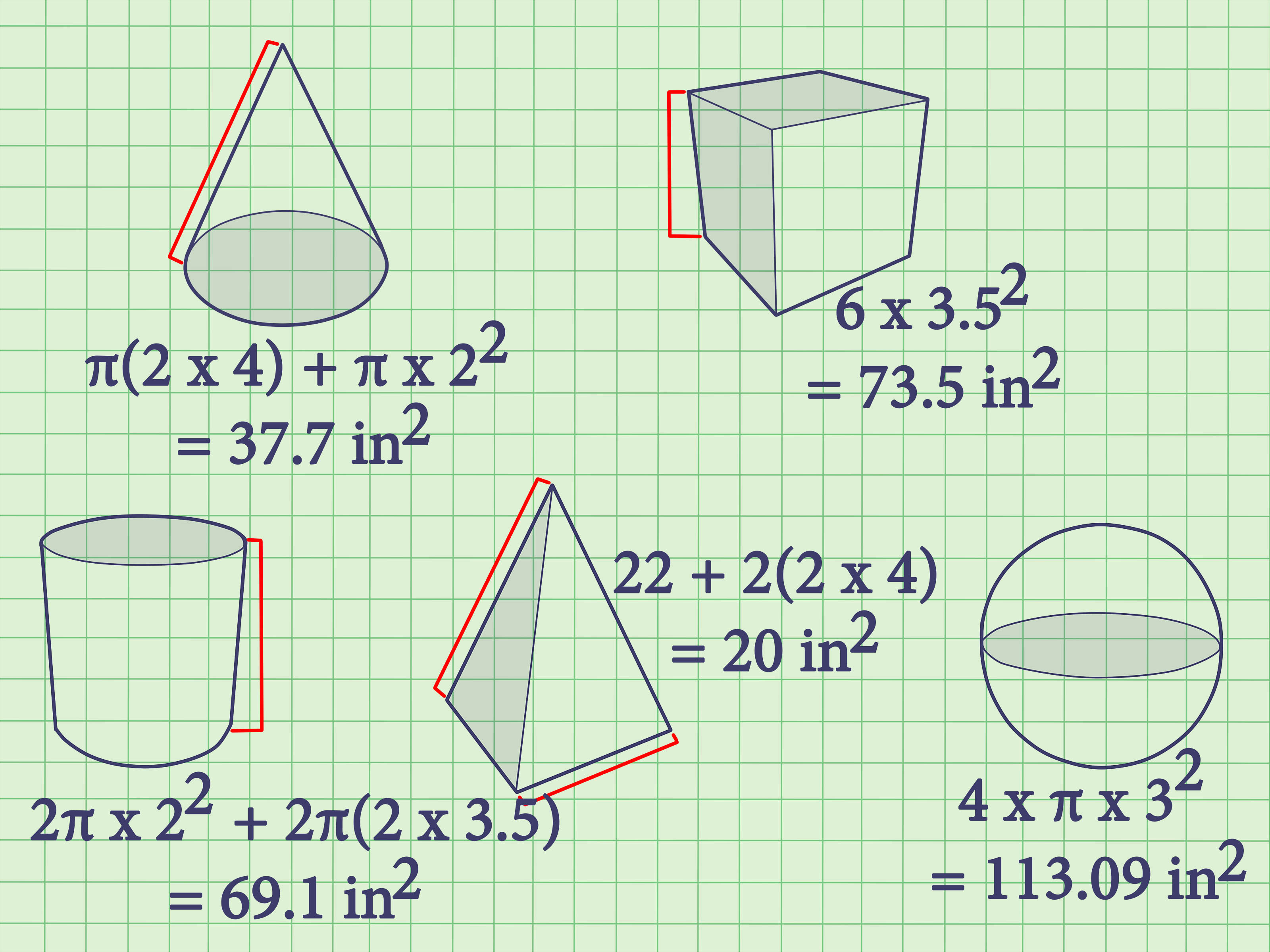
How to Calculate the Surface Area of 3D Objects
A three-dimensional object does not have one flat area. It has several faces, a curved exterior, or both. Surface area is the sum of all exposed surfaces.
Cube
A cube has six identical square faces:
SA = 6s²
For a cube with 4-inch edges:
SA = 6 × 4² = 96 in²
Rectangular Prism
A rectangular prism has three pairs of matching rectangular faces:
SA = 2(lw + lh + wh)
For a box measuring 10 inches long, 6 inches wide, and 4 inches high:
SA = 2[(10 × 6) + (10 × 4) + (6 × 4)]
SA = 2(60 + 40 + 24) = 248 in²
If the box has no lid, subtract the area of the missing top. Surface-area formulas assume a closed solid unless the problem states otherwise.
Cylinder
A closed cylinder contains two circular bases and one curved side:
SA = 2πr² + 2πrh
This can also be written as:
SA = 2πr(r + h)
For a cylinder with radius 3 centimeters and height 8 centimeters:
SA = 2π(3)(3 + 8) = 66π ≈ 207.35 cm²
The curved side makes more sense when imagined as an unrolled rectangle. Its width equals the circle’s circumference, 2πr, and its height equals the cylinder’s height.
Sphere
The surface area of a sphere is:
SA = 4πr²
A ball with a radius of 5 inches has a surface area of:
SA = 4π × 5² = 100π ≈ 314.16 in²
Cone
A closed cone has a circular base and a curved lateral surface:
SA = πr² + πrs
The variable s is the slant height. If only the perpendicular height is known, calculate the slant height with the Pythagorean theorem:
s = √(r² + h²)
For a cone with radius 3 inches and perpendicular height 4 inches, the slant height is 5 inches. Therefore:
SA = π(3²) + π(3)(5) = 24π ≈ 75.40 in²
Right Prism and Regular Pyramid
For a right prism with base area B, base perimeter P, and height h:
SA = 2B + Ph
For a regular pyramid with base area B, base perimeter P, and slant height s:
SA = B + ½Ps
These formulas work because the lateral faces are being collected into one expression. In the prism, they become rectangles. In the regular pyramid, they become triangles.
Common Area Calculation Mistakes
- Mixing units: Convert feet and inches, or meters and centimeters, before multiplying.
- Reporting linear units: Area must be written in square units.
- Using diameter as radius: Divide the diameter by two first.
- Using slanted height: Triangle and parallelogram formulas require perpendicular height.
- Confusing surface area with volume: Coverage uses square units; capacity uses cubic units.
- Counting hidden faces: Joined surfaces in composite solids are usually internal and should not be counted.
- Rounding too early: Keep several decimal places during the calculation and round the final result.
How Scaling Changes Area
Area grows according to the square of the scale factor. If every length doubles, the area becomes four times as large because 2² = 4. If every dimension triples, the area becomes nine times as large.
For example, a 5-by-4-foot rectangle has an area of 20 ft². Doubling both dimensions creates a 10-by-8-foot rectangle with an area of 80 ft², not 40 ft². This relationship matters when enlarging floor plans, product designs, patterns, and images.
Experience-Based Lessons from Real-World Area Projects
Area formulas are tidy; actual projects rarely are. A room that appears rectangular may contain a fireplace extension, a closet recess, thick baseboards, or a wall that wanders slightly off course. Experience shows that the arithmetic is often easier than deciding exactly what should be measured.
Measure the Real Surface, Not the Idealized One
When measuring flooring, it is useful to sketch the room and divide it into rectangles before touching the calculator. Each measurement should be written directly on the sketch. This simple habit prevents numbers from being swapped later and exposes missing dimensions while the measuring tape is still nearby.
Measure at more than one point when walls appear uneven. In older buildings, opposite sides may differ by several inches. For material purchasing, using the larger practical measurement is generally safer than assuming the room is geometrically perfect. Houses, unlike textbook diagrams, have lived complicated lives.
Separate Gross Area from Net Area
Painting projects demonstrate the difference between gross and net area. The gross wall area is its full length multiplied by its height. The net paintable area subtracts doors, large windows, tile sections, and other surfaces that will not receive paint.
However, subtracting every outlet and light switch is usually unnecessary. The resulting savings are tiny, while paint coverage varies with surface texture, color changes, application method, and the number of coats. A theoretically exact area does not guarantee an exact material requirement.
Add a Realistic Waste Allowance
Tile, flooring, roofing, wallpaper, and fabric must be cut to fit. Offcuts cannot always be reused, especially when patterns must align or boards must run in a particular direction. Consequently, the amount purchased should exceed the net calculated area.
A modest surplus may be adequate for a simple rectangular installation. Diagonal layouts, irregular rooms, intricate patterns, and fragile materials usually require more. Manufacturer instructions and professional recommendations should guide the final allowance. The area formula provides the mathematical minimum, not a promise that every cut will behave itself.
Use Nets to Understand Packaging
When calculating material for a box or container, drawing a net is often clearer than memorizing a surface-area formula. A net unfolds the solid into its individual panels, making it easy to see which faces are included.
Real packages also need glue tabs, folded seams, overlapping flaps, and trimming margins. These features are not represented in the basic surface area. A box with a mathematical surface area of 248 square inches will therefore require more than 248 square inches of raw cardboard.
Check Irregular Areas in Two Ways
For an L-shaped patio or room, calculate the area by splitting it into smaller rectangles. Then check the result by finding the area of a large enclosing rectangle and subtracting the missing section. Agreement between the two approaches provides useful confirmation.
For curved landscaping, measurements taken at regular intervals can produce a practical estimate. Dividing the boundary into narrow strips or plotting it on a grid usually improves accuracy. When the financial or engineering consequences are significant, a surveyor, architect, contractor, or digital measurement system may be more appropriate than a homemade approximation.
Keep Precision Appropriate to the Job
A classroom answer might be reported to the nearest hundredth, but construction materials are sold in packages, sheets, gallons, or rolls. After calculating the area, convert it into purchasing units and round up when partial packages cannot be purchased.
Most importantly, perform a reasonableness check. A 10-by-12-foot room should have an area near 120 square feet. If the calculator displays 12,000, the room has not suddenly become a convention center. A misplaced decimal or unit conversion is the more likely explanation.
Conclusion
Learning how to calculate area begins with recognizing the object and determining which surface needs to be measured. Standard formulas handle rectangles, triangles, circles, prisms, cylinders, spheres, and cones. Composite or irregular objects become manageable when they are divided into simpler sections.
Accurate results also depend on consistent units, correct dimensions, sensible rounding, and attention to hidden or missing surfaces. For real projects, remember that mathematical area is often only the starting point. Cutting waste, overlaps, seams, texture, and measurement uncertainty can all increase the amount of material required.