Editorial note: The headline uses “sea” in the vivid, iceberg-like sense popularized after NASA’s New Horizons flyby. The established interpretation is that Pluto’s hills drift through a solid, nitrogen-rich glacier that can flow and churn over geological time. The objects are more precisely described as water-ice hills or bergs carried by a nitrogen glacier, rather than glaciers themselves. A June 2026 preprint proposes that liquid molecular nitrogen may exist and move beneath part of the glacier, but that intriguing idea remains unconfirmed.
Pluto has never been especially cooperative with expectations. For decades, it was imagined as a small, frozen billiard ball parked in the dim suburbs of the solar system. Then NASA’s New Horizons spacecraft swept past in July 2015 and revealed mountains, valleys, haze, glaciers, dunes, convecting ice and a bright heart-shaped region that looked as though the dwarf planet had hired an unusually dramatic landscape architect.
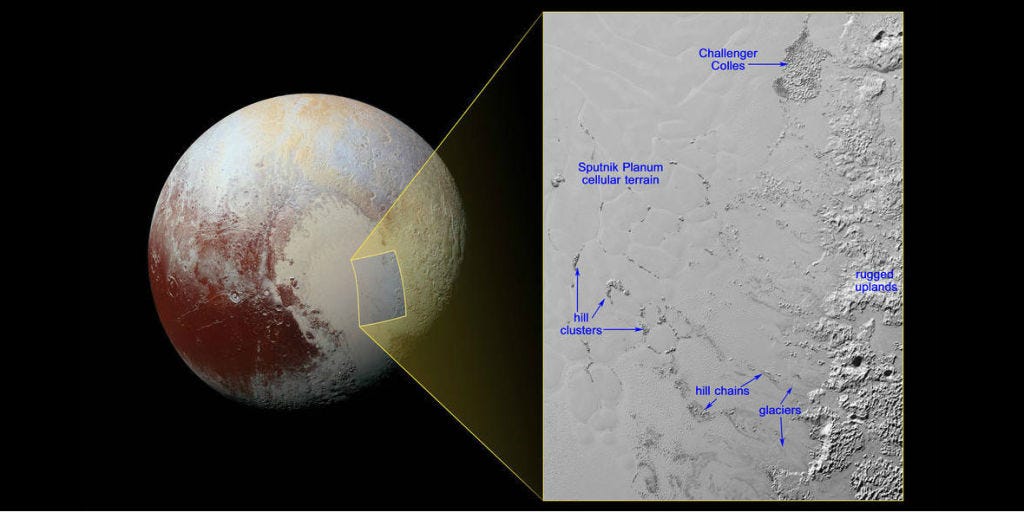
One of the strangest discoveries appeared inside that heart. Across Sputnik Planitia, a vast basin filled mainly with nitrogen ice, isolated hills one to several miles wide seem to ride the moving surface. Scientists interpret many of them as chunks of rigid water ice transported by softer nitrogen-rich ice, much as icebergs drift through an Arctic sea. The comparison is irresistible, although Pluto has replaced Earth’s liquid water with exotic materials working at temperatures cold enough to make Antarctica seem overdressed.
Pluto’s Famous Heart Is a Giant Glacier
Sputnik Planitia forms the western lobe of Tombaugh Regio, Pluto’s bright heart. The plain stretches roughly 600 miles, or about 1,000 kilometers, across and occupies a deep basin. New Horizons data indicate that it contains a thick deposit dominated by frozen molecular nitrogen, with carbon monoxide and methane mixed in. NASA describes Sputnik Planitia as the largest known glacier in the solar system.
This is not a glacier in the familiar blue-and-white sense. On Earth, glaciers are mostly water ice sliding and deforming under their own weight. On Pluto, water ice is so cold and mechanically strong that it behaves more like bedrock. Nitrogen ice is the softer material. Given enough time, it creeps downhill, enters valleys and spreads across low terrain. Pluto has effectively reversed the roles: water is the rock, and nitrogen is the glacier.
Sputnik Planitia’s smooth surface is divided into enormous polygonal cells, commonly tens of kilometers wide. Models indicate that relatively warm nitrogen ice rises slowly in the centers, spreads outward, cools and sinks around the margins. The process resembles a lava lamp operating at the speed of geology and with considerably less interest in decorating a college dorm.
What Are Pluto’s “Floating Hills”?
Fragments of a harder icy crust
The hills are most likely pieces of Pluto’s water-ice crust that broke away from rugged uplands bordering Sputnik Planitia. New Horizons images show larger jumbled mountains along the basin’s western edge and smaller isolated blocks farther out on the plain. The simplest interpretation is that landslides, collapse or glacial erosion delivered chunks of highland material onto the nitrogen glacier, which then carried them away.
Individual hills measure about one to several miles across. Some gather into chains and clusters. Near the northern edge of the photographed region, a group named Challenger Colles spans roughly 12 miles, or 20 kilometers. Its name honors the seven astronauts lost aboard Space Shuttle Challenger, giving this remote landscape a quiet connection to human exploration.
Why can a hill float at all?
Density provides the basic answer. Water ice is less dense than the nitrogen-dominated ice filling Sputnik Planitia, so sufficiently thick water-ice blocks can remain buoyant. They are not bobbing on waves or splashing through liquid in the ordinary sense. Instead, they are embedded in a solid material that can slowly flow around them. Imagine a raft trapped in extremely thick taffy, except the raft is a mountain, the taffy is frozen nitrogen and nobody is getting a refund from the candy store.
The moving nitrogen ice can transport, rotate and concentrate the blocks. Where the glacier is shallow or where buried topography interferes, floating hills may become stranded. NASA scientists suggested that the Challenger Colles cluster accumulated in such a shallower zone, rather like icebergs grounding on a hidden continental shelf.
Is Pluto’s Nitrogen “Sea” Actually Liquid?
The well-supported answer: mostly no
The phrase “sea of frozen nitrogen” is a metaphor, not evidence for an open liquid ocean on Pluto’s surface. The plains observed by New Horizons are overwhelmingly interpreted as solid nitrogen-rich ice. Their glacier-like flow, cellular convection and apparently youthful surface can occur without the material becoming liquid. Solids do not have to be perfectly rigid; under sustained stress and over long periods, many crystalline materials creep.
That distinction matters because “flows like a fluid” and “is a liquid” are not interchangeable. Earth’s mantle circulates, yet it is mostly solid. Terrestrial glaciers flow, but nobody expects a canoe to survive a trip across one. Sputnik Planitia behaves dynamically because nitrogen ice is weak under Plutonian conditions, not because the entire bright plain is a sloshing lake.
A new 2026 hypothesis adds a genuine liquid possibility
In June 2026, members of the New Horizons team released a preprint proposing possible basal flow of liquid molecular nitrogen beneath northern Sputnik Planitia. They focused on dark-edged features along convection-cell boundaries and explored whether nitrogen melting at the base of the ice sheet could rise through fractures, briefly spread across low areas and refreeze. The study argues that such behavior may be physically possible under specific pressure and thermal conditions.
That is exciting, but it is not the same as a confirmed subsurface nitrogen sea. The work was released as a preprint and had not completed peer review at publication. Other explanations for the dark patterns may remain viable, and New Horizons did not directly sample liquid nitrogen. For now, the safest description is this: Pluto unquestionably has a moving nitrogen-ice glacier, and it may also hide localized liquid nitrogen at or near its base. Planetary science loves a plot twist, but it still insists on checking the math.
How the Hills Travel Across Sputnik Planitia
The journey likely begins at the basin margin. Water-ice mountains fracture or collapse, dropping blocks onto softer volatile ice. Nitrogen glaciers flowing from surrounding uplands can push debris toward Sputnik Planitia, while circulation within the basin transports it farther. Computer models of Plutonian glacial flow reproduce lobes, valley-filling movement and surface patterns resembling those captured by New Horizons.
The glacier’s convective cells may also act like extremely slow conveyor belts. Rising ice moves laterally across a cell before sinking near its edges. A buoyant block caught in this circulation could migrate, rotate or become trapped where neighboring flows converge. Estimated surface speeds can be only a few centimeters per year, but over hundreds of thousands of years, a few centimeters become a cross-country road trip.
The lack of obvious impact craters across much of Sputnik Planitia strengthens the case for ongoing resurfacing. Impacts should accumulate with time. When a broad area looks unusually clean, some process must be erasing or burying the evidence. Convection, sublimation, deposition and glacial flow continually renew the nitrogen-rich surface, leaving it much younger than Pluto’s ancient cratered terrains.
A Landscape Built From Three Kinds of Ice
Calling Pluto “icy” is accurate but incomplete, rather like calling a kitchen “food-based.” The type of ice determines what the landscape can do. Water ice supplies structural strength. It builds mountains and crustal blocks because, at Pluto’s surface temperature, it is hard enough to support dramatic relief. Nitrogen ice is volatile and mobile, making glaciers and seasonal deposits. Methane ice can form coatings, high-altitude deposits, bladed terrain and sand-sized particles involved in dunes.
Carbon monoxide joins the mixture in Sputnik Planitia, changing the composition and physical behavior of the glacier. Above it all hangs a tenuous nitrogen atmosphere containing hydrocarbon haze. Seasonal transport moves volatile material between the ground and atmosphere as sunlight changes across Pluto’s long orbit. The result resembles Earth’s water cycle only in the broadest family sense: evaporation becomes sublimation, rain becomes frost, and the local “rivers” are glaciers made from atmospheric gas.
Why Floating Hills Matter to Planetary Science
These drifting blocks are more than photogenic oddities. They reveal the relative densities and mechanical strengths of Pluto’s materials. They trace glacier movement, hint at the depth of nitrogen ice and preserve evidence of interactions between the basin and surrounding highlands. Their distribution can help researchers test models of convection, glacial flow and basin evolution.
They also demolished the assumption that small worlds far from the Sun must be geologically dead. Pluto is powered by modest internal heat, volatile transport and the unusual behavior of low-temperature ices. It does not need Earth-style plate tectonics or molten silicate lava to remain active. It has invented its own geology from the materials available, which is both scientifically useful and mildly show-offy.
The broader implication reaches across the Kuiper Belt. If nitrogen, methane and other volatile ices can reshape Pluto, similar processes may operate on other distant dwarf planets and large icy bodies. A surface that looks smooth or bright may not be primordial. It may be the current frame of a very slow movie.
An Imagined Experience on Pluto’s Floating-Glacier World
No human has stood on Pluto, so this section is a science-based thought experiment rather than a travel review. Still, the New Horizons data allow us to imagine the experience with far more confidence than anyone had before 2015.
You arrive near the edge of Sputnik Planitia under a black sky. The Sun is a brilliant point rather than the broad, warming disk seen from Earth. Daylight exists, but it feels like a severe, silvery twilight. Ahead lies a pale plain extending beyond the horizon. It appears calm and nearly flat, yet that calm is deceptive. The ground beneath you is part of a glacier that may be several kilometers thick, circulating so slowly that no human lifetime could watch a full cycle.
Behind you rise mountains made largely from water ice. On Earth, that phrase suggests something fragile and temporary. Here, the cold turns water ice into the landscape’s load-bearing stone. Cliffs could stand thousands of feet high. Fallen blocks the size of hills rest partly embedded in softer nitrogen ice, their exposed surfaces dusted with methane frost and dark organic material.
Walking would be awkward. Pluto’s gravity is only a small fraction of Earth’s, so each careful step would carry you farther than expected. A heavy life-support suit would feel lighter, although inertia would remain eager to embarrass you. Stumble, and you might fall slowly enough to contemplate your decisions before meeting the ground.
The atmosphere would offer no breathable air and almost no protection, but it would create a faint blue haze around the horizon. There might be winds capable of moving tiny methane-ice grains, yet you would hear nothing through the near vacuum. The loudest sounds would come through your suit: pumps, radio chatter, breathing and the occasional reminder from mission control not to lick the nitrogen glacier.
From a ridge, you spot isolated hills scattered over the plain. They do not visibly move. A time-lapse lasting centuries would be needed to reveal their drift. Some may rotate as convecting ice carries them; others may collect where flows meet or where the glacier thins. They are icebergs without an open ocean, ships whose voyage is measured in geological epochs.
Suppose instruments detect subtle heat below. Radar maps the thickness of the nitrogen layer. Seismometers listen for fracturing. A drill searches for evidence of melting at the glacier’s base. Finding even a localized film or channel of liquid nitrogen would transform the scene from an extraordinary solid glacier into a two-level system: drifting mountains above, hidden fluid below. The 2026 proposal makes that scenario scientifically discussable, although it remains far from proven.
As the Sun sinks, temperatures change only slightly by earthly standards because everything is already astonishingly cold. Frost may migrate, haze layers brighten and long shadows sharpen the edges of polygonal cells. The landscape does not roar, crack or surge for your benefit. Pluto performs on a slower schedule. Its drama is written in miles and read in millennia.
The experience would leave one overwhelming impression: “frozen” does not mean “finished.” Beneath your boots, nitrogen ice creeps. Around you, hill-sized water-ice fragments record journeys across a mobile plain. Above you, atmospheric molecules participate in a seasonal exchange with the ground. Pluto would feel quiet, but not deadmore like a sleeping machine whose gears turn once every few thousand years.
Conclusion: Pluto’s Quietly Moving Masterpiece
Pluto’s floating hills are among the most memorable results from New Horizons because they make an alien process instantly understandable. Water-ice blocks ride a nitrogen-rich glacier like icebergs, collecting into chains and clusters as the solid plain flows beneath them. Their existence links mountain collapse, glacial transport, density, convection and climate in one remarkable landscape.
The phrase “liquid nitrogen sea” should be handled carefully. Sputnik Planitia’s visible plain is primarily solid ice, even though it behaves dynamically. A new hypothesis suggests that liquid nitrogen might occasionally form and move beneath parts of the glacier, but confirming that idea will require additional analysis and, ideally, a future Pluto orbiter. Until then, the established discovery is already spectacular enough: a distant dwarf planet carries hills across its heart on a glacier made from frozen air.