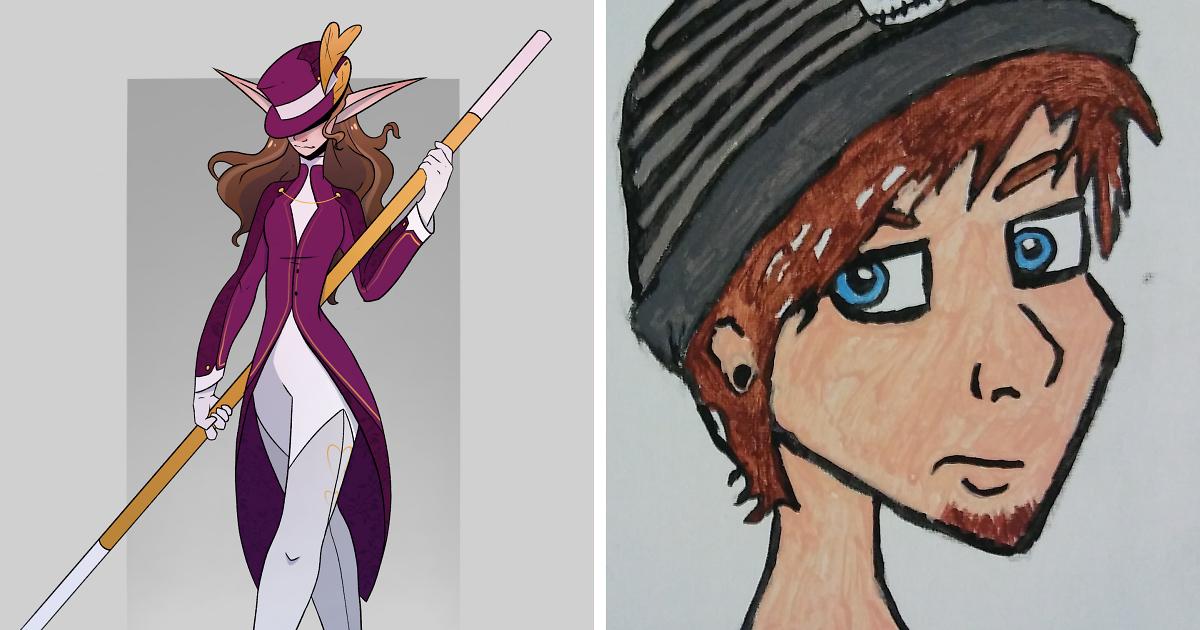
Everyone has at least one piece of art that refuses to leave their brain. It may be a world-famous painting hanging in a museum, a strange sculpture discovered during a road trip, a comic panel saved from childhood, or a watercolor made by someone whose biggest fan is their grandmother.
So, hey Pandas, post your favorite artwork and tell us why it matters to you. This is not an exam, and nobody will ask you to identify the difference between Impressionism and Post-Impressionism while a clock ticks ominously in the background. It is simply an invitation to share art that made you pause, smile, think, laugh, or stare at the ceiling later that night.
Bored Panda’s community art challenges regularly invite readers to upload drawings, paintings, illustrations, accidental creations, and other visual work. These posts turn a simple prompt into a lively digital gallery where established artists, enthusiastic beginners, and people who once drew a surprisingly elegant cat on a grocery receipt can appear side by side.
What Counts as Your Favorite Artwork?
The wonderfully unhelpful answer is: almost anything.
Your selection does not need to be an oil painting guarded by three security officers and a velvet rope. Visual artwork includes paintings, photographs, prints, sculptures, illustrations, architectural designs, digital compositions, jewelry, applied art, and many other pictorial or graphic creations. Even official copyright guidance recognizes visual art as a broad category rather than a tiny club reserved for marble statues and portraits of serious-looking aristocrats.
A Famous Masterpiece
You might choose Vincent van Gogh’s The Starry Night because its swirling sky seems alive. Perhaps Edward Hopper’s Nighthawks captures a kind of nighttime loneliness you recognize. Maybe Katsushika Hokusai’s The Great Wave off Kanagawa fascinates you because the towering water feels both beautiful and slightly interested in ruining everyone’s afternoon.
Choosing a famous work is not boring or predictable. Great art remains popular because different generations keep finding new meanings inside it.
An Artwork by Someone You Know
A favorite artwork can also be deeply personal. It might be a portrait created by a friend, a landscape painted by your grandfather, or a ceramic bowl made by your child. The proportions may be unconventional. The glaze may have staged a rebellion in the kiln. None of that prevents the piece from being priceless to you.
Personal history can give an artwork emotional weight that no auction estimate could measure.
Your Own Creation
Yes, you are allowed to post something you made. In fact, please do. Community art prompts are more interesting when people share original drawings, paintings, collages, photographs, sculptures, textile art, and digital illustrations.
You do not need to introduce yourself as a “real artist.” If you made art, you made art. The imaginary International Council of Real Artists is not coming to inspect your sketchbook.
An Unexpected Work of Art
Art can appear in unusual places: a mural under a bridge, an elaborate cake, an embroidered jacket, a movie poster, a handmade mask, a decorated skateboard, or an accidental arrangement of shadows on a wall. Some community challenges specifically celebrate accidental art, proving that creativity occasionally arrives without an appointment.
Why Sharing Favorite Art Is So Enjoyable
Posting a favorite artwork is more than uploading an attractive image. You are sharing a fragment of your taste, memory, culture, and personality.
Two people can look at the same painting and notice entirely different things. One viewer sees color. Another sees historical context. A third notices a tiny dog in the corner and immediately decides that the dog is the emotional center of the entire composition.
That variety is precisely what makes an online art discussion worthwhile.
Art Starts Conversations That Ordinary Small Talk Cannot
“Nice weather today” has limited conversational mileage. “Why does this lonely diner painting make me feel nostalgic for a city I have never visited?” can keep people talking for an hour.
Art gives people a shared object to examine while leaving plenty of room for individual interpretation. The Archives of American Art has described art history as an ongoing conversation, while museum engagement programs increasingly emphasize participation, dialogue, and reciprocal relationships with communities.
Art Helps Us Notice Other Perspectives
Someone may introduce you to an Indigenous artist whose work explores identity and cultural continuity. Another person may post a surreal digital illustration about anxiety. A third may share a traditional textile pattern connected to family history.
Appreciating such work requires more than saying, “That looks cool.” Respectful art appreciation combines enjoyment with curiosity about the creator, cultural setting, materials, and meaning. Smithsonian educational resources emphasize informed and respectful recognition when engaging with contemporary Indigenous art, an approach that applies equally well to many artistic traditions.
Creative Participation Can Support Well-Being
Making and discussing art is not a magical cure for every difficult day, but research has connected arts participation with benefits involving mood, communication, emotional expression, empathy, and social engagement. The National Endowment for the Arts also examines the relationship between arts engagement and social connectedness.
Sometimes the benefit is simpler: looking at something beautiful gives your mind a brief vacation from emails, laundry, and the mysterious household object that keeps beeping even though nobody knows what it is.
How to Choose the Artwork You Want to Post
If hundreds of images are competing for the title of “favorite,” use a few questions to narrow the field.
Which Artwork Do You Remember Most Clearly?
Think about the images that return to you unexpectedly. Perhaps you saw a painting years ago and still remember its blue shadows. Maybe a comic illustration shaped your sense of humor. Memory is often a useful signal because emotionally meaningful art tends to linger.
Which Piece Changed the Way You Saw Something?
Powerful art can transform familiar subjects. A photographer can make an ordinary parking lot look cinematic. A painter can turn a bowl of fruit into a study of color, time, abundance, or the dangerous consequences of shopping while hungry.
Your favorite piece may be the one that taught you to see an everyday object differently.
Which Artwork Would You Defend in a Friendly Debate?
Imagine someone saying, “I do not understand why people like this.” Which artwork would make you sit up and begin explaining its composition, emotional atmosphere, technique, and historical importance?
That sudden enthusiasm is a clue. Favorites are rarely neutral.
Which Piece Has a Personal Story?
Maybe you discovered the artwork on your first museum visit. Perhaps it hung in your childhood home. Maybe you found it during a difficult period and its imagery gave you comfort. The story behind your choice can be as compelling as the visual work itself.
How to Look Closely Before You Share
People often decide whether they like an image within seconds. Slowing down can reveal details that dramatically change the experience.
Getty educational activities encourage viewers to spend more than a quick glance with an artwork and then discuss what they observed. The National Gallery of Art similarly teaches close analysis through basic visual elements such as line, color, shape, texture, and form.
Begin With What You Actually See
Before searching for explanations, describe the visible facts. What colors dominate the image? Where does your eye go first? Are the lines soft, sharp, curved, or chaotic? Does the composition feel balanced, crowded, empty, peaceful, or tense?
This prevents interpretation from becoming a game of inventing increasingly dramatic theories about a chair.
Notice the Materials and Technique
Look for brushstrokes, pencil marks, carved surfaces, stitched threads, photographic lighting, digital textures, or layers of collage. Materials influence meaning. A delicate paper sculpture creates a different emotional effect from a monumental object made of steel.
Consider the Mood
Ask what emotional atmosphere the artwork creates. Does it feel joyful, unsettling, mysterious, playful, intimate, or lonely? Then identify the visual evidence producing that reaction.
Instead of writing, “This picture is sad,” you might explain that the empty space, lowered figure, and muted colors create a feeling of isolation.
Look for Details That Reward Attention
Zoom in when a high-resolution image is available. Background figures, repeated symbols, tiny reflections, hidden jokes, and changes in texture can completely reshape your interpretation.
The National Gallery of Art makes tens of thousands of open-access artwork images available for download, giving viewers an opportunity to explore many public-domain works in detail.
What to Write With Your Artwork Post
A useful caption does not need to resemble a graduate thesis. A few thoughtful details can help other Pandas connect with your choice.
Include the Basic Information
- Name the artist whenever possible.
- Provide the artwork’s title.
- Mention the medium, such as watercolor, photography, ink, or digital illustration.
- Add the approximate date or artistic period when relevant.
- Identify the museum, collection, website, or original source.
Explain Why You Love It
Move beyond “It is pretty.” Tell readers what caught your attention and what keeps bringing you back.
You might write, “I love how the warm window light makes an ordinary room feel safe,” or, “The exaggerated expression makes me laugh because the character looks exactly how I feel before my first cup of coffee.”
Share Your Personal Connection
Personal stories make community posts memorable. Explain where you encountered the piece, how your opinion changed over time, or what it reminds you of.
Ask a Question
Invite conversation with a simple prompt:
- What detail did you notice first?
- How does this artwork make you feel?
- Do you prefer the artist’s earlier or later work?
- What story do you think is happening here?
A good question turns a post from a display case into a gathering place.
Credit the Artist and Respect Copyright
Admiring an artwork does not automatically grant permission to repost it anywhere. Most original visual works receive copyright protection, including paintings, photographs, illustrations, sculptures, and graphic art.
When posting work that is not yours, identify the creator and original source. Check whether the image is in the public domain, offered under an open license, or shared with permission. Creative Commons licenses may allow redistribution or adaptation, but individual licenses can require attribution, restrict commercial use, prohibit modified versions, or require adaptations to use the same license.
Do not crop out signatures or watermarks. Do not imply that someone else’s work is yours. “Found on the internet” is not an artist’s name, although it has apparently enjoyed a remarkably productive career.
For your own work, consider adding your name or professional handle and stating whether reposting is permitted. A modest watermark can help with identification, but it should not be so enormous that viewers need excavation equipment to find the artwork underneath it.
How to Comment Without Becoming the Gallery Villain
Art discussions work best when people feel comfortable sharing. That does not mean every comment must be breathless praise, but criticism should be specific, respectful, and appropriate to the situation.
Respond to the Work, Not the Person
“The background competes with the subject” is a useful observation. “You have no talent” is not criticism; it is merely rudeness wearing a tiny beret.
Do Not Offer Detailed Critiques Unless They Are Welcome
Some people post artwork because they want technical feedback. Others simply want to share something meaningful. Read the caption before launching into a seven-paragraph analysis of perspective.
Stay Curious About Unfamiliar Styles
Abstract, conceptual, folk, outsider, and experimental art may not follow familiar rules. Ask what the artist is exploring before dismissing the work because it does not resemble a photograph.
Make Space for Beginners
A welcoming art community should celebrate development as well as polish. Community challenges that compare early and recent drawings can reveal how much artists improve through practice.
A beginner posting a first portrait may be taking a bigger emotional risk than an experienced professional sharing a finished commission. A thoughtful comment can provide the encouragement that keeps someone creating.
Favorite Artwork Ideas to Get the Gallery Started
Still undecided? Consider posting one of these:
- A painting you would happily hang in your home
- A sculpture that looks different from every angle
- A photograph that captures an unforgettable moment
- A book or album-cover illustration
- A comic strip that influenced your sense of humor
- A local mural that deserves more attention
- A handmade object passed down through your family
- A piece of fan art created with originality and care
- An artwork by an emerging or independent creator
- Your own favorite creation, including unfinished work
The goal is not to establish a universal ranking. Art is not a sporting event, and Claude Monet will not be appearing at a press conference to explain his position in the standings.
Shared Experiences: What Happens When People Post Their Favorite Artwork
One of the most rewarding aspects of an online art prompt is how quickly it becomes more than a collection of images. Each post brings a story, and each story gives the artwork another layer of life.
The Quiet Beginner Finally Shares
Imagine someone who has been drawing privately for years. Their sketchbooks are stacked in a drawer, safely protected from criticism, compliments, daylight, and possibly oxygen. They see the invitation to post a favorite artwork and spend twenty minutes hovering over the upload button.
Eventually, they share a charcoal portrait. The face is not perfectly symmetrical, but the expression feels honest. Another user compliments the lighting. Someone asks how the hair texture was created. An experienced artist offers a gentle suggestion about increasing contrast around the eyes.
The creator expected judgment and instead found conversation. That small experience may not turn them into a full-time artist by breakfast, but it can make the next upload less frightening.
A Familiar Masterpiece Becomes Personal
Another user posts a famous landscape that appears on calendars, mugs, posters, and at least three waiting-room walls. At first, some readers assume they already know it. Then the person explains that a reproduction hung in their childhood home and became associated with peaceful Sunday mornings.
Suddenly, the conversation is not merely about art history. People begin discussing the pictures they grew up with: religious prints, travel posters, family portraits, embroidered scenes, and inexpensive reproductions purchased from street markets.
The artwork becomes a doorway into memory. Its financial value is irrelevant. What matters is the life that happened around it.
A Local Artist Gains New Admirers
Someone else uploads a mural painted on the side of a neighborhood grocery store. It depicts local workers, plants, buildings, and cultural symbols. The poster includes the muralist’s name and explains how residents helped develop the design.
Readers who would never have encountered the artist begin exploring more of the creator’s work. A teacher saves the image as inspiration for a community-art lesson. A traveler adds the neighborhood to a future itinerary. A local resident joins the comments and shares how the blank wall looked before the mural appeared.
This is where proper credit matters. A widely shared image can become meaningful exposure only when viewers can identify the person who created it.
A Strange Artwork Creates the Best Discussion
Then there is the inevitable unusual submission: perhaps a sculpture made from discarded kitchen tools or a surreal painting featuring a goldfish conducting a business meeting.
Some viewers love it immediately. Others are confused. One commenter develops a detailed theory about consumer culture, corporate isolation, and the emotional burden of aquatic leadership. The artist replies that the idea came from mishearing a sentence on television.
Both interpretations remain entertaining. The exchange demonstrates that an artist’s intention is important, but viewers also bring their own memories and associations to the work.
People Discover That Taste Can Change
Art-sharing prompts also reveal how preferences evolve. Someone may explain that they once disliked abstract painting because they expected every image to represent a recognizable object. After seeing a large abstract canvas in person, they began noticing scale, rhythm, texture, and physical movement.
Another person may have loved highly realistic drawings as a teenager but later become interested in loose sketches because visible mistakes and unfinished lines feel more human.
These experiences remind us that a favorite artwork does not have to remain a permanent champion. Taste grows with knowledge, travel, relationships, age, and repeated looking. Today’s baffling canvas may become tomorrow’s obsession.
The Gallery Becomes a Community
By the end of the discussion, the page may contain professional illustrations, children’s drawings, museum masterpieces, handmade crafts, photographs, street art, and experimental digital pieces. No single style wins, and none needs to.
The real result is a map of what people value. Some choices are driven by beauty. Others come from nostalgia, humor, grief, cultural pride, technical admiration, or the simple pleasure of seeing a perfectly painted frog wearing a waistcoat.
That diversity is the point. A favorite-artwork thread succeeds when people leave with more images to explore, more artists to remember, and a little more confidence in explaining what moves them.
Conclusion: Your Favorite Artwork Deserves a Story
Art does not need unanimous approval to be meaningful. The piece you love may leave someone else puzzled, while an artwork they adore may make you tilt your head like a dog hearing a harmonica. That difference is not a problem. It is the beginning of a conversation.
Post the painting that changed your understanding of color. Share the illustration that made you want to draw. Introduce us to the local muralist, photographer, sculptor, textile artist, or ceramicist more people should know. Upload your own work and tell us what you learned while making it.
Most importantly, explain why you chose it. The image catches our attention, but the story helps us see it through your eyes.
Hey Pandas, post your favorite artwork. What is it, who created it, and why has it stayed with you?