If your first few Slay the Spire runs ended with a boss flattening you like a bargain-bin pancake, congratulations: you are playing the game correctly. This deckbuilding roguelike is brilliant, brutal, and very good at punishing the kind of “ooh, shiny card!” decision-making that feels smart for about six seconds. The good news is that beginners do not need magic reflexes or a genius-level spreadsheet brain to improve. You just need better habits.
This Slay the Spire beginner guide breaks down 20 practical strategies that help new players survive longer, build stronger decks, and stop losing to the same mistakes over and over. Some tips are about combat, some are about deckbuilding, and some are about learning when the game is politely telling you, “Please stop taking every card you see.” Put them together, and your runs will become far more consistent.
Why Slay the Spire Feels So Hard at First
The game looks simple: play attacks, gain block, beat enemies, climb higher. But underneath that clean setup is a constant series of trade-offs. Every card reward changes your deck. Every route choice changes your odds. Every relic can nudge you toward a different strategy. New players often lose not because they play turns badly, but because they build decks that do not solve the next problem in front of them.
That is the big mindset shift. In Slay the Spire, winning is less about building a “perfect” fantasy deck and more about building a deck that survives the next elite, the next boss, and the next ugly hallway fight full of enemies who clearly woke up choosing violence.
20 Winning Strategies for Beginners
1. Do not take every card reward
One of the best Slay the Spire tips for beginners is also the hardest to accept: skipping a card is often the correct play. A bloated deck becomes slower, less consistent, and harder to pilot. If a card does not improve your current deck or solve an upcoming problem, leave it behind. Your future self will thank you when your deck stops drawing three mediocre cards instead of the one card you actually needed.
2. Build for the next danger, not the dream deck in your head
Beginners often force archetypes too early. Maybe you want a Poison deck, a Strength deck, or a Frost deck. That is fine in theory, but the game only cares whether you can survive the next few floors. In Act 1, immediate damage is usually more important than a slow combo piece. Ask yourself: What is most likely to kill me soon? Then draft to answer that question.
3. Card removal is stronger than it looks
Removing weak starter cards improves nearly every draw for the rest of the run. Strikes are usually the first cards to cut on most characters, because they scale poorly and crowd out better attacks later. Defends can also become removal targets once your deck develops stronger block tools. A thinner deck draws its best cards more often, and that alone wins a shocking number of fights.
4. Prioritize front-loaded damage in Act 1
Early elites in Act 1 reward decks that can hit hard and hit fast. Cards that deal solid damage immediately are often better than greedy setup cards during your first several floors. If your deck cannot kill enemies quickly, you will bleed health in hallway fights and get punished by elites before your scaling ever matters.
5. Learn what the Act 1 elites are asking for
This is where many beginner runs go to die. Gremlin Nob punishes too many Skill cards, so a deck with weak attacks can get wrecked. Lagavulin rewards decks that can set up efficiently and hit hard once it wakes up. The Sentries test your ability to manage multiple enemies and junk cards clogging your deck. You do not need to memorize every number right away, but you should understand the basic lesson: elite fights are not random cruelty. They are exams, and your deck needs the right answers.
6. Plan your route before you click anything
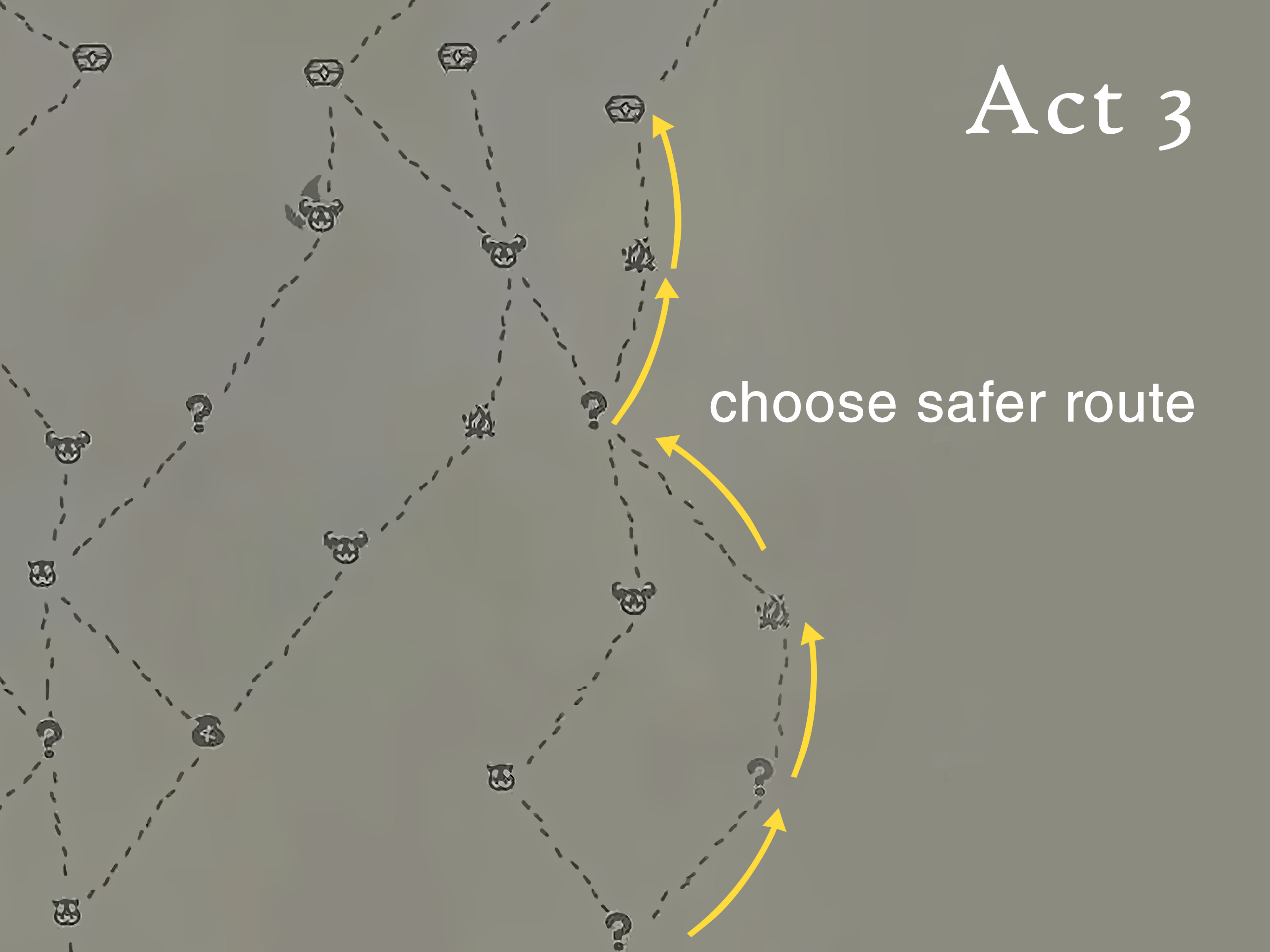
The map is not decoration. It is strategy. Before you start an act, look for routes with flexibility. A good path often includes at least one campfire, a chance to visit a shop, and a reasonable number of elites if your deck can handle them. Elite fights are risky, but they also give relics, which are often how runs become powerful. The sweet spot is not “fight every elite” or “avoid every elite.” It is “take the fights your deck is ready for.”
7. Use potions like they matter, because they do
New players hoard potions as if they are fine china for a dinner party that never arrives. Use them. Potions save health, win elite fights, rescue bad draws, and create boss-killing turns. A potion spent at the right time is not a loss of resources. It is an investment in staying alive long enough to see better rewards.
8. Upgrade more often than you heal
At campfires, beginners frequently panic-heal. Sometimes that is correct. Often it is not. Upgrading a key card can prevent more damage across several future fights than resting would restore right now. A stronger Bash, Neutralize, Zap, or powerful uncommon card can reshape your next few combats. Rest when you must. Upgrade when you can.
9. Respect your energy curve
A deck full of expensive cards can look powerful and still play like a traffic jam. You only get so much energy each turn, so your deck needs a balance of low-cost reliability and higher-impact payoffs. If your hand keeps filling with cards you cannot afford to play together, your deck is trying to do too much at once.
10. Card draw is the glue that makes strong decks feel unfair
Draw is easy to underestimate when you are new. But the ability to see more cards each turn improves consistency, lets you find answers faster, and helps combo pieces work together. A deck with good draw often feels smaller, smoother, and smarter. That is because it is.
11. Scaling matters more as the run goes on
Fast damage gets you through early fights, but bosses and later acts often require scaling. Strength gain, Poison stacking, Focus, stance manipulation, orb generation, or other long-fight engines become much more important over time. A good beginner deck usually combines early survival with at least one reliable way to become stronger in longer combats.
12. Do not ignore area damage
Single-target damage can carry you for a while, then Act 2 shows up with groups of enemies and says, “Cute.” Multi-enemy fights can dismantle unprepared decks. Area damage, splash effects, or efficient ways to control multiple targets become increasingly valuable. If your deck only does one thing to one enemy at a time, you may be in for a rough middle act.
13. Not every turn is about blocking everything
Beginners often treat any lost HP like a personal failure. Sometimes taking a small hit in order to kill an enemy faster is the correct line. Health is a resource. If spending 6 HP now prevents 20 damage next turn, that is usually a good trade. The best players are not allergic to damage; they are selective about when it is worth taking.
14. Let relics guide your decisions
Relics are where many runs quietly become monsters. A relic that boosts energy, rewards card draw, improves potions, supports block, or enhances a certain play pattern can reshape what cards are good for you. Pay attention to what your relics are encouraging. A deck should not just be “good cards.” It should be a machine built around the tools you already found.
15. Do not force a build before the game gives you one
Strong runs often emerge naturally. You pick a useful attack, then a relic complements it, then another card strengthens the pattern. That is very different from deciding on floor two that you are absolutely making a Shiv deck no matter what reality says. Stay flexible. The Spire rewards adaptation far more than stubbornness.
16. Learn the basic identity of each character
Ironclad has strong healing support and rewards aggressive combat. Silent likes efficient defense, draw, Poison, and Shiv-style turns. Defect often builds around orbs, Focus, and scaling engines. Watcher can explode fights with stance changes, but she punishes sloppy planning. You do not need mastery on day one, but knowing each character’s flavor helps you draft smarter instead of just grabbing whatever looks loud.
17. Read enemy intents every turn
Slay the Spire gives you a gift many strategy games do not: enemies usually telegraph what they are about to do. Use that information. If an enemy is buffing instead of attacking, maybe you can go all-in on damage. If a boss is about to swing hard, maybe that is the turn to defend, use a potion, or trigger your setup safely. The more you read intents, the less the game feels random.
18. Prepare for the Act 1 boss as soon as you know it
Once the boss is revealed, your choices should change. The Guardian tests whether you can manage damage bursts and block around its mode shift. Hexaghost pressures weak scaling and punishes slow setups. Slime Boss rewards good damage timing, especially if you can force an awkward split. Knowing the boss lets you value cards, upgrades, and potions more intelligently.
19. Consistency beats flashy nonsense
Yes, absurd combo turns are fun. Yes, giant numbers are satisfying. But beginners win more when they choose consistency over drama. Reliable block, efficient attacks, draw, scaling, and a sane deck size beat a pile of cute ideas that only function when the stars align and your relics sing in harmony.
20. Treat every loss like free coaching
When a run dies, do not just sigh and sprint into the next one. Ask what actually happened. Did you take too many weak cards? Skip early damage? Greed too many elites? Hoard potions? Forget the boss matchup? Slay the Spire strategies improve fast when you review mistakes instead of blaming the deck, the map, the moon phase, or the obvious conspiracy run by the Gremlin Nob.
Common Beginner Mistakes to Avoid
The biggest mistakes are wonderfully human: overvaluing flashy rares, underestimating commons, dodging elites forever, healing too often, refusing to skip card rewards, and drafting cards for a future combo that may never appear. Another classic error is building a deck that is amazing in theory but loses to ordinary hallway fights because it cannot do anything useful on turns one and two.
If you want one simple rule to remember, use this: make your next fight easier without making your deck worse overall. That idea alone will clean up a lot of beginner decision-making.
The Beginner Experience: What Your First Good Runs Really Feel Like
Your first few hours with Slay the Spire usually feel like controlled confusion. You start a run, win a couple of easy fights, pick cards that seem cool, and suddenly run into an elite that beats you senseless while you stare at your hand like it personally betrayed you. Then the next run feels better. You remove a Strike. You choose a safer route. You realize that a potion can save 15 HP, which is basically the in-game equivalent of discovering fire.
That is the real beginner journey. Improvement does not arrive as one giant “aha” moment. It arrives in little upgrades to the way you think. At first, every card reward feels like a gift. Later, you start saying no. At first, shops feel like candy stores. Later, you realize card removal might be the smartest thing in the room. At first, elites look terrifying. Later, they still look terrifying, but now you can explain why, which somehow makes them more manageable.
One of the funniest experiences new players have is discovering that the deck they thought was weak is actually the one that wins. Maybe it is not flashy. Maybe it does not have seven rare cards and a glamorous combo worthy of a highlight reel. But it draws well, blocks on the right turns, scales enough for bosses, and does not clog itself with nonsense. That is when the game starts to click. You stop chasing “perfect builds” and start respecting functional ones.
Another common experience is learning to love ugly wins. You survive a boss with 3 HP left. You burn your best potion in an elite fight you were sure would kill you. You upgrade a boring card instead of a flashy one and suddenly your deck runs smoother for the rest of the act. Those moments teach beginners something important: in Slay the Spire, practical decisions are often stronger than exciting ones.
There is also the emotional roller coaster of meeting the Act 1 bosses for the first time. The Guardian makes you realize that damage timing matters. Slime Boss teaches you that split thresholds are not a suggestion. Hexaghost politely introduces the concept of “you should have prepared better.” Losing to those bosses can feel rough, but they are fantastic teachers. The game rewards players who pay attention, adapt, and respect matchups instead of auto-piloting through every act.
Eventually, you begin to notice that your runs have a shape. You draft early damage more confidently. You start choosing elites with a reason instead of a prayer. You save health in small fights so you can spend it in important ones. And perhaps most satisfying of all, you stop treating every card reward like a mandatory adoption event. That restraint is a huge milestone.
The best part of the beginner experience is that visible improvement comes quickly. You do not need to become an expert to feel smarter. A few habits can dramatically raise your win rate and make the game more fun. Once that happens, each run becomes less about surviving chaos and more about solving a puzzle. A dangerous, stylish, occasionally rude puzzle, sure. But a puzzle you can absolutely beat.
Conclusion
The best Slay the Spire tips for beginners are not secret exploits or galaxy-brain tricks. They are strong fundamentals: keep your deck lean, draft for the fights ahead, value card removal, use potions, plan your route, respect elites, and let relics shape your strategy. The game gets easier the moment you stop trying to force a masterpiece and start building a deck that actually survives the climb.
In other words, be flexible, be ruthless, and every once in a while, skip the shiny card. It hurts for a second. Then it wins you the run.