Some objects are born to hide in a closet. Others march right into the room, strike a pose, and quietly suggest that maybe your fireplace deserves better than a dusty old poker set from the hardware aisle. Arik Levy’s Fire Tools belong firmly in the second category. They do the practical work a hearth accessory set is supposed to do, but they also behave like a design statementsharp, sculptural, and just cheeky enough to keep the whole thing from feeling too serious.
That tension is exactly what makes this piece interesting. In a category that often leans rustic, heavy, or vaguely medieval, Levy’s approach feels urban, modern, and refreshingly self-aware. The set takes a very old household ritualtending a fireand reframes it through contemporary industrial design. The result is not just a collection of fireplace tools. It is a lesson in how good design can rescue an everyday object from pure utility and turn it into something memorable.
Who Is Arik Levy, and Why Does His Design Language Matter?
Before getting into the fireplace set itself, it helps to understand the designer behind it. Arik Levy is known for a multidisciplinary practice that moves across industrial design, sculpture, lighting, furniture, installations, and art. That kind of range matters because his objects rarely feel like they were designed in a vacuum. They tend to carry the DNA of a bigger visual world.
Levy’s work often balances opposites: art and function, emotion and engineering, humor and discipline. He has a sculptor’s eye for form, but he also thinks like a product designer who understands how people actually touch, lift, store, and live with objects. That combination is what gives his best designs their staying power. They are not just pretty. They are resolved.
If you have seen Levy’s better-known piecesespecially his faceted “Rock” works or some of his angular furniture and lightingyou already know he is drawn to geometry that feels alive rather than rigid. His lines are rarely decorative for decoration’s sake. They suggest movement, tension, and direction. Even when an object is standing still, it looks like it has a pulse.
That sensibility is all over Fire Tools. This is not a nostalgic set pretending to belong in a French castle or a mountain lodge with antlers on the wall. It is modern design for people who like a fireplace but do not want their room to suddenly look like a medieval reenactment broke out beside the sofa.
What Exactly Are Arik Levy’s Fire Tools?
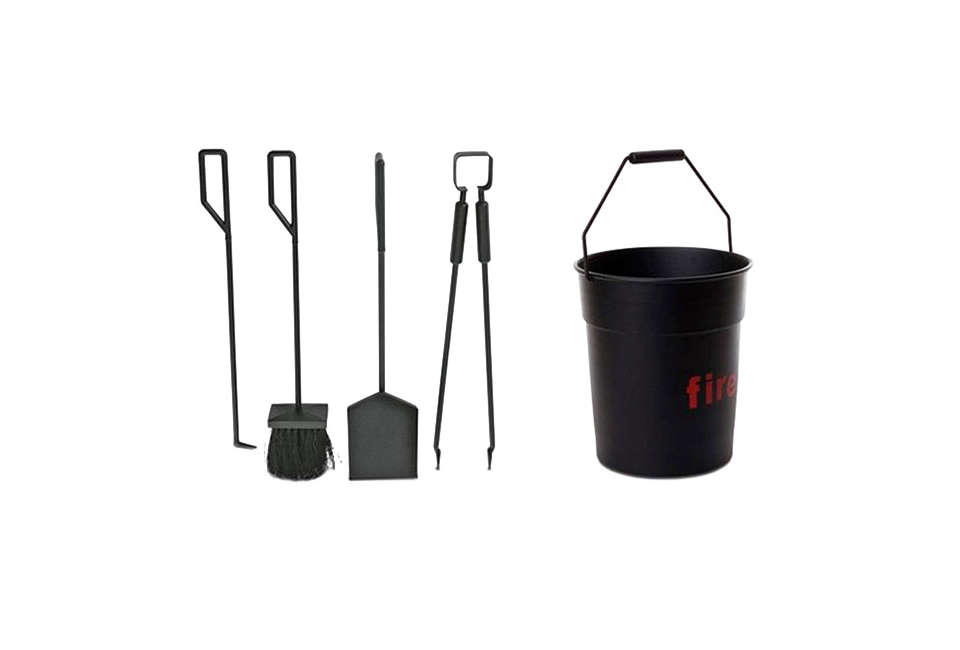
At its core, Fire Tools is a modern fireplace accessory set designed for ENO. It is typically described as including the essentials for managing a live fire: tongs, a shovel, a brush, and a coordinating bucket that stores the tools and can also handle a few logs. The materials and finishes vary slightly in how different retailers describe them, but the overall picture is consistent: aluminum construction, rubber grips for handling, and a streamlined silhouette that feels lighter and cleaner than traditional wrought-iron hearth sets.
The bucket is one of the smartest parts of the composition. Instead of treating storage like an afterthought, Levy makes it part of the design language. The tools do not dangle awkwardly from a stand like gym equipment waiting for a workout. They belong somewhere. They have a home. That single move makes the whole set feel more architectural and more intentional.
Then there is the humor. Several descriptions note the playful detail of the word fire printed on the bucket in bright red. It is the kind of deadpan gesture that keeps the set from drifting into self-important “museum object pretending to be a household tool” territory. Levy clearly understands that design can be clever without being cute, and funny without becoming a gimmick.
Why Fire Tools Stands Out in Modern Fireplace Design
1. It turns a utility object into sculpture
The most obvious reason this set stands out is its form. Many fireplace tools are built around tradition: black iron, curled handles, heavy bases, ornate loops, and a visual language that says, “I have been here since 1784 and I demand respect.” Levy goes in the opposite direction. His lines feel more like drawn strokes in space. The tools have an angular quality that connects them to his broader body of work and gives the set a sense of movement.
That matters in a living room because the tools are usually visible even when you are not using them. A fireplace accessory set is almost always in peripheral view. If it is clunky, the room feels clunkier. If it is elegant, the room gets an instant upgrade. Fire Tools succeeds because it behaves like a sculpture when idle and like a real tool when needed.
2. It respects function instead of sacrificing it
Good modern design occasionally gets accused of being more interested in looking cool than working well. Levy’s Fire Tools sidesteps that criticism. The inclusion of rubber handles suggests comfort and grip were part of the thinking from the start. The bucket keeps the set consolidated. The shapes may be sleek, but the object category remains completely legible. You do not need a design degree to understand what each piece does.
That balance is harder to achieve than it sounds. Plenty of “designer” home accessories overcomplicate a basic task. Fire Tools does not. It edits rather than overdesigns. It strips the category down to cleaner forms while preserving the ritual of tending the fire.
3. It makes the hearth feel contemporary
One of the biggest challenges in decorating around a fireplace is that hearth accessories often pull the room backward in time. Even in a modern interior, the fire zone can suddenly become a pocket of old-fashioned styling. Levy’s set fixes that. It brings the fireplace into the same design conversation as minimalist furniture, gallery-like lighting, and contemporary architecture.
In other words, Fire Tools does not merely match a modern room. It helps modernize the idea of the hearth itself.
The Design Details That Make the Set Memorable
What gives this object its character is not just one feature, but the way several small decisions work together. The aluminum construction keeps the set visually lighter than traditional hearth tools. The rubber handles soften the experience of use and add a tactile contrast. The bucket introduces both order and mass, grounding the composition. And the angular forms connect the piece to Levy’s broader design vocabulary, especially his interest in lines that feel bent, directional, and almost drawn in space.
This is where Levy’s background becomes especially relevant. He often treats material and form like a design experiment rather than a style exercise. That mindset shows here. Fire Tools is not modern because it uses a fashionable finish or shouts “minimalism” from the rooftop. It is modern because every part appears considered, pared down, and integrated into a clear formal system.
Even the contrast between seriousness and wit is engineered well. A fireplace is associated with warmth, ritual, and comfort. Yet fireplace tools themselves are often visually stern. Levy loosens that tension. The bucket label, the sharp geometry, and the crisp silhouette all suggest a designer who knows the room should feel sophisticated, not solemn. Nobody wants their hearth accessories to look like they are judging them for reheating soup.
How Fire Tools Fits into Levy’s Broader Career
Fire Tools may not be Levy’s most famous work, but it is a revealing one. It shows how his larger artistic concerns can be translated into domestic scale. In his sculpture and art pieces, you often see a fascination with surface, structure, tension, reflection, and spatial drama. In Fire Tools, those impulses are compacted into something humbler and more intimate.
That is part of the appeal. A monumental artwork can impress you from across the room. A household tool has to earn its place more quietly. It has to be lived with. It has to withstand repetition. It has to look good not just in an exhibition photo but in real life, leaning beside a hearth on a Tuesday when the room is a little messy and somebody left a blanket on the chair.
Levy’s strength has always been this ability to move between gallery energy and domestic usefulness. Fire Tools is a perfect example of that crossover. It brings artful form into the home without becoming precious.
Who Will Appreciate Arik Levy’s Fire Tools Most?
This set is especially appealing to people who care about the details that other people overlook. If you are the kind of person who notices whether a trash can ruins the look of a kitchen or whether a coat rack is secretly carrying the whole entryway, you will immediately understand Fire Tools. It speaks to the design-minded homeowner who believes functional objects should not get a free pass on aesthetics.
It also fits beautifully in interiors that lean contemporary, minimalist, industrial, or softly modern. Think blackened steel, warm wood, stone fireplaces, muted upholstery, and rooms where every visible object has a reason to exist. Fire Tools thrives in that environment because it is clean without being cold.
At the same time, the set could also work as a contrast piece in a more traditional room. Because its lines are so crisp, it can introduce tension in a good way. A classic fireplace with a modern tool set can create the kind of layered interior that feels collected rather than theme-driven.
The Experience of Living With Arik Levy’s Fire Tools
What makes Arik Levy’s Fire Tools especially interesting is not just how they photograph, but how they likely change the everyday experience of the fireplace corner. In many homes, the hearth is supposed to be cozy, but the accessories around it are often visually messy. You get a bulky stand, oddly shaped tools, maybe a bucket that looks borrowed from a workshop, and suddenly the warm, inviting focal point of the room feels a little cluttered. Fire Tools solves that problem by making the supporting cast worthy of the stage.
Imagine walking into the room before the fire is even lit. The bucket is already doing visual work. It anchors the space, keeps the tools contained, and reads like a deliberate object rather than an accidental pile of fireplace hardware. That matters because the set is present all the time, not just during winter evenings. A beautiful accessory earns its keep even when it is off duty.
Then there is the tactile side. Fireplace rituals are deeply physical. You reach, lift, turn, sweep, adjust, and step back. Tools that feel awkward can make that ritual annoying fast. Levy’s use of rubber grips suggests an understanding that comfort is part of the experience, not a bonus feature. A well-designed handle can turn a routine task into something smooth and satisfying. It is a small thing, but home life is basically a long series of small things.
The emotional experience is just as important. Fire tends to invite ceremony. Even people who are otherwise very casual become a little poetic around a fireplace. They dim lights, throw on a blanket, and start acting like they are auditioning for a luxury cabin catalog. Fire Tools fits that mood, but with a modern edge. It does not romanticize the hearth with old-world nostalgia. Instead, it suggests that contemporary living can still make room for ritual, warmth, and atmosphere.
There is also a quiet pleasure in owning an object that makes people pause and ask about it. Most fireplace tools disappear into the background. Levy’s set does not. It becomes part of the room’s personality. Guests notice the shape of the tools, the graphic simplicity of the bucket, and the subtle joke of labeling it fire as though anyone in the room needed clarification. That wink gives the whole piece charm. It says the owner appreciates design, but also has a pulse.
Perhaps the best way to describe the experience is this: Fire Tools makes maintenance feel curated. Cleaning up ash, shifting logs, or tending flames will never be glamorous in the literal sense, but this set gives those actions a sense of order and intention. You are not rummaging through a pile of blackened iron. You are using a well-composed system. That difference may seem minor, yet it is exactly the sort of detail that separates a room that looks finished from one that merely contains furniture.
In a market full of hearth accessories that are either aggressively rustic or painfully generic, Fire Tools offers a third option. It lets the fireplace remain warm and welcoming while the design stays crisp, current, and intelligent. And honestly, that is a pretty rare trick for a bucket and a brush.
Final Thoughts
Arik Levy’s Fire Tools proves that no household category is too ordinary for thoughtful design. What could have been a forgettable set of fireplace accessories becomes, in Levy’s hands, an object lesson in how form, humor, and practicality can live together. The set respects the ritual of the hearth while updating its visual language for modern interiors.
That is why the design still resonates. It is not trying to be flashy. It is trying to be smart, graceful, and just a little playful. And in a home full of objects competing for attention, that combination ages remarkably well.
If you love modern fireplace tools, sculptural home accessories, or contemporary hearth decor that actually deserves floor space, Arik Levy’s Fire Tools remains a standout example of what happens when a designer treats even the most functional object as part of the larger architecture of daily life.