Note: This article is written for web publication and synthesizes verified public information from reputable U.S. automotive, defense, Army, and congressional sources. It does not include source links in the body text, so it stays clean and ready for publishing.
Introduction: When a Chevy Colorado Joins the Army
Some pickup trucks spend their lives hauling mulch, towing fishing boats, and looking heroic in grocery store parking lots. Then there is the Chevrolet Colorado ZR2, which took a very different career path: it became the foundation for the U.S. Army’s Infantry Squad Vehicle, better known as the ISV. In plain English, Chevy’s ultimate infantry squad vehicle is a lightweight, high-speed, off-road troop carrier designed to move soldiers quickly across rough terrain without asking them to turn every mission into a backpacking vacation from the underworld.
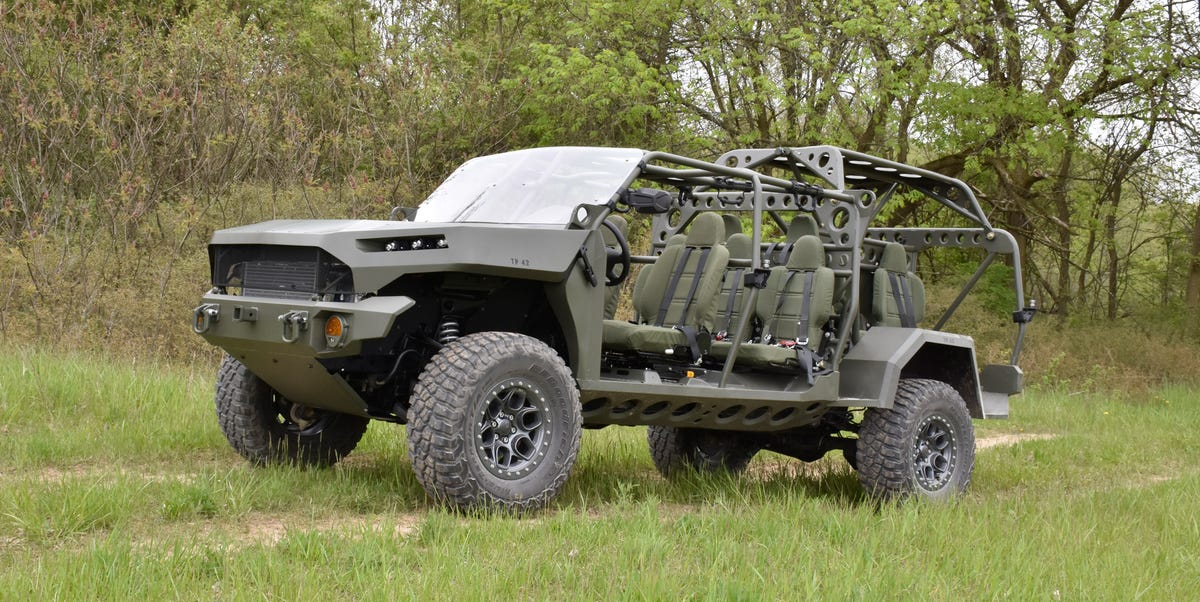
The GM Defense Infantry Squad Vehicle is not a tank, not a Humvee replacement, and not a rolling fortress covered in armor plates. Instead, it is a “go-fast, go-anywhere, bring-the-whole-squad” machine. It can carry nine soldiers and their gear, fit inside or under military aircraft, and travel across terrain where heavier tactical vehicles may be slower, louder, or harder to deploy. Think of it as the Army’s off-road shuttle bus after it drank three espressos and joined a gym.
At its heart, the ISV is based on the Chevrolet Colorado ZR2 platform, a midsize truck already known for off-road capability. GM Defense took that proven commercial foundation, added military-specific engineering, strengthened the suspension and structure, and turned it into an ultra-light tactical vehicle built for infantry mobility. The result is one of the most interesting military vehicles in the Army’s light tactical fleet: familiar enough to maintain, rugged enough for difficult terrain, and compact enough to travel by helicopter or cargo aircraft.
What Is the Infantry Squad Vehicle?
The Infantry Squad Vehicle, or M1301 ISV, is a lightweight, unarmored ground transport vehicle developed by GM Defense for the U.S. Army. Its core mission is simple: move a nine-soldier infantry squad and equipment quickly across the battlefield. That may sound straightforward, but battlefield mobility is rarely simple. Soldiers need to move across mud, rocks, snow, sand, jungle trails, open fields, and roads that may have retired from being roads years ago.
The ISV was built to support Infantry Brigade Combat Teams, airborne forces, Army Rangers, Security Force Assistance Brigades, and other units that need rapid movement without the bulk of heavier armored vehicles. Traditional vehicles such as the Humvee and Joint Light Tactical Vehicle offer different blends of protection, payload, and durability, but they are heavier and less expeditionary. The ISV takes another route: it prioritizes speed, air transportability, and tactical flexibility.
That tradeoff is important. The ISV does not carry heavy armor, and it is not meant to punch through enemy fire like an armored combat vehicle. It is designed to get soldiers to a position faster, reduce fatigue, move equipment, support dispersed operations, and give commanders more options. In modern warfare, speed is not just convenient; it can be survival.
Chevy Colorado ZR2 DNA: The Civilian Truck Under the Uniform
One of the most fascinating things about Chevy’s Infantry Squad Vehicle is how much of it comes from the commercial world. The ISV is based on the Chevrolet Colorado ZR2 architecture and uses roughly 90 percent commercial off-the-shelf components. That matters because commercial parts are easier to source, mechanics may already recognize many systems, and the Army can field capability faster than if it started with a blank sheet of paper and a committee named “Please Delay Everything.”
The Colorado ZR2 was already a serious off-road truck before GM Defense gave it a military haircut. Its civilian version used Multimatic Dynamic Suspensions Spool Valve dampers, performance suspension components, four-wheel-drive hardware, and a rugged midsize frame. Desert racing also helped validate parts and durability. In other words, the ISV was not born from a grocery-getter. It came from a platform that already knew how to bounce across ugly terrain without immediately filing a complaint.
GM Defense then adapted the platform for Army requirements. The civilian body was replaced with an open, roll-cage-style structure. Seating was arranged to carry a full squad. The vehicle was engineered to meet strict air transport requirements. The suspension and load-carrying systems were tuned for soldiers, weapons, rucks, radios, ammunition, water, and all the extra gear that magically appears whenever infantry units pack for a mission.
Key Specifications That Make the ISV Special
Nine-Soldier Capacity
The ISV’s headline feature is its ability to carry a full nine-soldier infantry squad. That is a big deal because splitting a squad across multiple vehicles creates extra coordination problems, requires more drivers, and can reduce small-unit cohesion. The ISV keeps the squad together, which is exactly what infantry leaders want when time is short and the terrain is rude.
3,200-Pound Payload
The vehicle can carry roughly 3,200 pounds of payload. That includes troops, weapons, communications gear, sustainment supplies, and other mission equipment. This capacity helps reduce the crushing loads soldiers often carry on foot. Anyone who has ever lifted a full infantry rucksack knows the phrase “light infantry” can be a deeply suspicious marketing term.
2.8-Liter Duramax Turbo-Diesel Power
The ISV uses a 2.8-liter Duramax turbo-diesel engine paired with a six-speed automatic transmission. Reporting on the military version has noted output around 275 horsepower and 420 pound-feet of torque, giving the vehicle strong low-end pull for off-road movement. Diesel power also aligns with military fuel needs, making the platform more practical in Army logistics chains.
Compact, Air-Deployable Size
The ISV is approximately 17 feet long, 6.8 feet wide, and about 6 feet high. Its compact footprint is not just for parking politely. The vehicle is sized to support Army transportability requirements. It can be carried by C-130 and C-17 aircraft, air-dropped at low velocity, transported internally by CH-47 Chinook and heavy-lift helicopters, and sling-loaded under a UH-60 Black Hawk. That is the tactical equivalent of being allowed on nearly every ride at the amusement park.
Why the Army Wanted a “Better Boot”
The ISV has often been described as a “better boot,” which is a clever way of saying it gives foot soldiers a faster alternative to marching long distances before the real work even begins. A unit that has to walk 20, 40, or 60 kilometers before reaching an objective may arrive exhausted. A unit that can ride across restrictive terrain arrives with more energy, more equipment, and more tactical options.
This is where the Infantry Squad Vehicle shines. It is not trying to replace every tactical vehicle in the Army. Instead, it fills a specific mobility gap for light infantry. Heavier vehicles bring protection but can struggle with air mobility, tight terrain, and rapid expeditionary operations. Smaller vehicles may be agile but may not carry the full squad. The ISV aims for the sweet spot: light enough to deploy quickly, large enough to carry nine soldiers, and capable enough to cross rough ground at useful speed.
For commanders, that means more ways to maneuver. Units can disperse, reposition, exploit gaps, support casualty movement, carry more supplies, and respond faster to changing battlefield conditions. In future conflicts where drones, sensors, electronic warfare, and long-range fires make static positions dangerous, mobility becomes even more valuable.
Armor Tradeoff: Fast, Light, and Honest About Its Limits
The most important thing to understand about the GM Defense ISV is that it is unarmored. That is not a design flaw; it is a design choice. Armor adds weight. Weight reduces air transportability, speed, range, payload, and terrain access. The ISV accepts vulnerability in exchange for mobility.
This makes the vehicle best suited for missions where speed, surprise, dispersion, and terrain access matter more than heavy protection. It is a troop carrier for tactical movement, not a vehicle meant to sit in direct fire and shrug off hits. If the battlefield is a boxing match, the ISV is not the heavyweight with the granite chin. It is the fast footwork, quick jab, and sudden angle change.
The Army and GM Defense have also had to address testing and reliability concerns. Early evaluations noted limitations in some combat roles, training, and sustainment. Later testing showed improvements in reliability after corrective actions. That evolution matters because military vehicles do not become mature on PowerPoint slides; they mature through testing, soldier feedback, maintenance data, and the occasional moment when reality says, “Cute theory. Now try it in mud.”
Production, Fielding, and Full-Rate Approval
GM Defense was selected in 2020 to produce the Infantry Squad Vehicle under a contract valued at about $214.3 million for the initial Army procurement objective. The program later reached a major milestone in March 2023 when the Army approved it for full-rate production. That decision signaled that the vehicle had moved beyond early production and into broader fielding.
The Army’s acquisition objective has evolved as the service has transformed light infantry formations and experimented with more mobile brigade structures. By late 2025, more than 1,100 ISVs had been reported delivered across units including the 25th Infantry Division, 101st Airborne Division, 82nd Airborne Division, 173rd Airborne Brigade Combat Team, and the 75th Ranger Regiment. That fielding pattern shows the Army is not treating the ISV as a showroom curiosity. It is putting the vehicle in the hands of soldiers who train hard, break things creatively, and provide feedback nobody in a conference room could invent.
How Soldiers Use the ISV in the Real World
In training and operational experimentation, soldiers have used the Infantry Squad Vehicle for troop movement, logistics support, casualty evacuation, communications upgrades, and mobility across restricted terrain. Reports from Army-focused sources have highlighted its use at training centers, in airborne units, in jungle environments, and by special operations forces.
Its value is not limited to moving people. The ISV can also help move the heavy tools of modern infantry: radios, batteries, sensors, drones, anti-armor systems, ammunition, water, and medical gear. When soldiers are not forced to carry every ounce on their backs, they can move faster and fight with more stamina. The vehicle also gives small units a flexible platform that can be modified with mission-specific kits.
Some units have experimented with roof racks, communications equipment, camouflage, casualty evacuation setups, and weapons-related configurations. GM Defense and other companies have also shown variants and concepts that expand the ISV family, including utility versions, command-and-control applications, and platforms that could support counter-drone missions.
The ISV-U, Heavy Concepts, and the Future of Chevy-Based Military Mobility
The ISV story is no longer just about one nine-passenger vehicle. GM Defense has promoted the ISV Utility, or ISV-U, a five-passenger ultra-light tactical vehicle built for high-speed off-road mobility and multiple mission applications. The ISV-U has been described as useful for logistics, command and control, reconnaissance, electronic warfare, and counter-unmanned systems missions.
The Army has also shown interest in heavier ISV-related capabilities. In 2026, congressional reporting noted Army interest in an Infantry Squad Vehicle-Heavy concept with exportable power for mobile command-and-control systems. That matters because modern small units are hungry for electricity. Radios, tablets, sensors, drone controllers, electronic warfare equipment, and counter-drone systems all need power. In the 21st century, “bring more batteries” is practically a tactical principle.
There are also signs that the ISV platform can host emerging battlefield technology. One notable example is the integration of mobile counter-drone laser prototypes on ISV platforms. That does not mean every ISV will become a science-fiction laser truck, but it does show the platform’s appeal as a lightweight, adaptable carrier for new equipment.
Why the ISV Matters in Modern Warfare
The Infantry Squad Vehicle arrives at a time when armies are rethinking how to survive on battlefields crowded with drones, sensors, precision fires, and electronic warfare. Large, static formations are easier to find. Heavy vehicles are powerful but may be harder to deploy rapidly. Light infantry remains essential, but walking everywhere limits speed and endurance.
The ISV fits the trend toward smaller, faster, more dispersed units. It gives infantry formations a way to move quickly, spread out, regroup, carry more capability, and avoid becoming predictable. Its commercial foundation also reflects a broader defense procurement idea: use proven civilian technology where it makes sense, then adapt it for military needs.
That approach can reduce cost, accelerate production, and simplify maintenance. It also lets the Army benefit from the automotive industry’s constant improvements in engines, suspensions, braking systems, electronics, manufacturing, and supply chains. The ISV is not just a truck with camouflage confidence. It is a case study in how commercial platforms can be turned into military tools when the mission demands speed and practicality.
Chevy’s Ultimate Infantry Squad Vehicle: Strengths and Weaknesses
Strengths
The ISV’s biggest strengths are mobility, transportability, squad capacity, and maintainability. It can carry a full squad, move across rugged terrain, and deploy by aircraft. Its commercial parts base helps with supply and sustainment. Its familiar driving feel can also simplify training compared with more specialized military vehicles.
Another advantage is adaptability. Because the platform can accept different mission kits and configurations, it can support a range of roles beyond basic troop movement. In an era where one vehicle may need to carry radios today, casualty gear tomorrow, and counter-drone equipment next week, that flexibility is valuable.
Weaknesses
The obvious weakness is protection. The ISV lacks heavy armor and mounted protection in its basic configuration. Soldiers riding in it are exposed compared with those inside armored vehicles. That means commanders must use it intelligently, matching the vehicle to missions where mobility is the advantage and avoiding situations where armor would be essential.
There is also the challenge of sustainment in future combat environments. The Army has emphasized reducing reliance on contractor support in forward areas, which means soldiers and organic maintainers must be ready to keep vehicles running. Commercial parts help, but no vehicle maintains itself. Sadly, even very patriotic trucks still need mechanics.
Experience-Based Perspective: What the ISV Feels Like as an Idea
To understand the experience behind Chevy’s ultimate infantry squad vehicle, imagine starting with something familiar: a rugged midsize pickup. Many Americans know what a Chevy Colorado looks like. It feels approachable, almost ordinary. Now strip away the civilian body, add a roll cage, arrange seating for nine soldiers, tune it for military fuel and payload, and make it ready to be dropped from the sky or carried under a helicopter. Suddenly, that familiar truck becomes something far more serious.
The experience the ISV represents is not luxury. Nobody is climbing into this vehicle expecting heated leather seats, a premium sound system, and a cupholder designed for artisanal oat milk. The ISV is about mission speed. It is the difference between soldiers arriving tired after a long movement and soldiers arriving with enough energy to think, communicate, and act. That matters because fatigue is not just uncomfortable; it affects decision-making, marksmanship, coordination, and safety.
From a driver’s perspective, the ISV’s connection to the Colorado ZR2 is a major advantage. A vehicle that feels somewhat familiar can reduce the learning curve. Soldiers who have driven pickups, off-road vehicles, or utility trucks can understand its behavior more quickly than they might with a highly specialized armored platform. That does not eliminate training, but it helps. The Army still needs disciplined drivers who understand rollover risk, convoy movement, terrain reading, and tactical driving. But familiarity is a gift when units must field equipment quickly.
From a squad leader’s perspective, the best experience is cohesion. Keeping nine soldiers together in one vehicle simplifies movement. The leader can track the team, equipment, and pace more easily. In fast-moving operations, reducing friction is priceless. Every extra vehicle adds another driver, another radio, another maintenance issue, and another chance for someone to take the wrong turn and discover a very scenic mistake.
From a maintainer’s perspective, the ISV’s commercial DNA can be refreshing. Military vehicles often come with specialized systems that require rare parts, unique tools, and manuals thick enough to qualify as furniture. A vehicle with a high percentage of commercial components is not magically easy, but it can be more approachable. It can also benefit from established supply chains and automotive manufacturing experience.
For the broader public, the ISV is interesting because it shows how civilian automotive engineering can influence defense mobility. The same off-road truck platform that appeals to adventure drivers helped inspire a military vehicle built for airborne and light infantry units. That crossover gives the ISV a personality rare in military equipment. It is tough, practical, slightly wild, and very American in the sense that someone looked at a pickup truck and said, “What if we made it jump out of an airplane?”
The ISV also teaches a larger lesson about design tradeoffs. People often assume military vehicles should be armored as heavily as possible. But every pound of armor has a cost. It affects speed, range, transportability, fuel use, payload, and where the vehicle can go. The ISV proves that sometimes the best tool is not the strongest shield but the fastest pair of wheels. It is not perfect for every mission, and it was never meant to be. Its strength is giving infantry more options when walking is too slow and heavy armor is too cumbersome.
In that sense, meeting Chevy’s ultimate Infantry Squad Vehicle is like meeting a specialized athlete. It is not built to win every event. It is built to sprint across rough ground, carry the team, and get into places larger vehicles may struggle to reach. It has limits, but it knows its job. And when used correctly, it gives soldiers something they always need more of: time, mobility, and a little less punishment from gravity and rucksack straps.
Conclusion: A Pickup Truck Spirit With a Battlefield Mission
Chevy’s ultimate Infantry Squad Vehicle is one of the clearest examples of modern military mobility thinking. It combines the proven Chevrolet Colorado ZR2 foundation with GM Defense engineering, Army transportability requirements, and the urgent need to move infantry faster across difficult terrain. It is not armored like a JLTV, and it does not pretend to be. Instead, it focuses on rapid deployment, squad mobility, off-road agility, and practical sustainment.
The ISV’s story is still developing. As the Army fields more vehicles, experiments with mobile command-and-control systems, explores heavier variants, and adapts to drone-heavy battlefields, the platform may continue to evolve. But its core idea is already clear: give light infantry a better way to move, fight, resupply, evacuate casualties, and stay unpredictable.
For a vehicle born from a Chevy Colorado ZR2, that is quite a résumé. Most trucks hope to survive potholes and weekend camping trips. The Infantry Squad Vehicle is built to ride under helicopters, roll out of cargo aircraft, and carry soldiers through terrain that would make a mall-crawler quietly delete its Instagram account. It is fast, flexible, imperfect, and importantexactly the kind of machine modern infantry mobility demands.