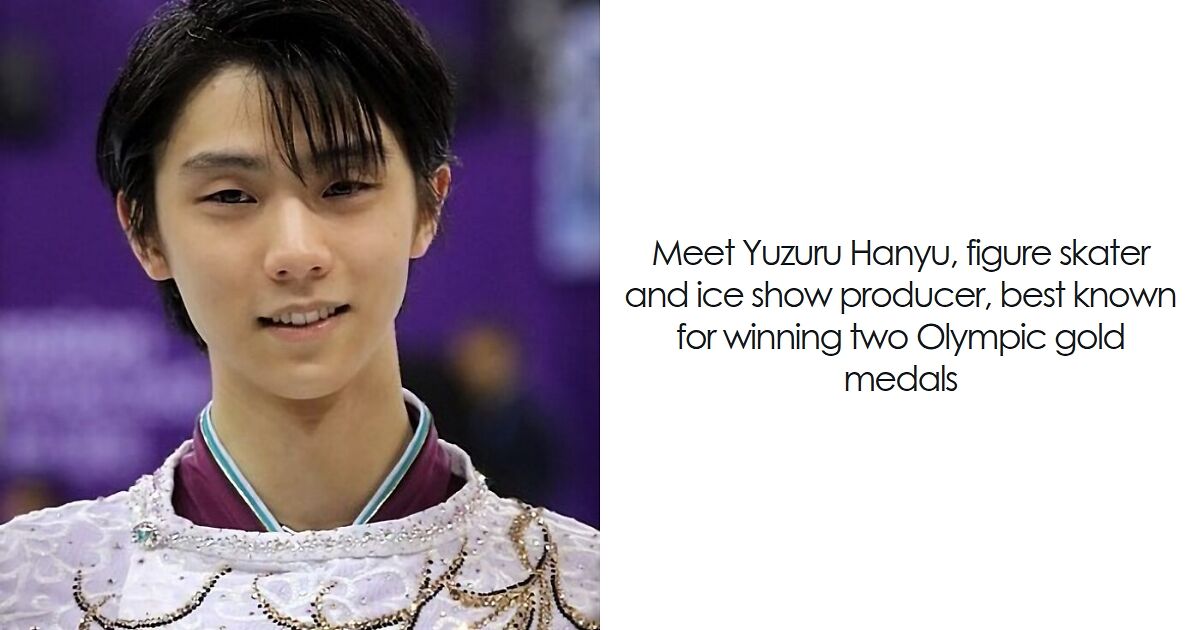
Yuzuru Hanyu is not just a figure skater. He is a two-time Olympic champion, a record-breaker, a technical pioneer, a performer with theatrical magnetism, and the rare athlete whose name can make an arena sound like a pop concert with sharper blades. Known for his elegant skating, explosive jumps, and almost supernatural competitive focus, Hanyu helped define modern men’s figure skating and expanded what fans expect from an athlete on ice.
From his childhood in Sendai, Japan, to his historic Olympic victories in Sochi and PyeongChang, Hanyu’s career reads like a sports movie that politely refused to stay realistic. Injuries? He came back. Pressure? He turned it into music. Records? He collected them like souvenirs. And after leaving competitive skating in 2022, he did not fade into nostalgia. Instead, he created ambitious solo ice shows that turned skating into a full theatrical experience.
Who Is Yuzuru Hanyu?
Yuzuru Hanyu was born on December 7, 1994, in Sendai, Miyagi Prefecture, Japan. He began skating as a child, following his older sister onto the ice, and quickly showed the mix of precision, sensitivity, and stubborn ambition that would later become his signature. In men’s singles figure skating, Hanyu became one of the most decorated and influential athletes of his generation.
His competitive résumé includes two Olympic gold medals, two World Championship titles, four consecutive Grand Prix Final titles, a Four Continents title, multiple Japanese national championships, and major junior victories. More than the medal count, though, Hanyu became famous for how he won: with programs that fused athletic difficulty and emotional storytelling. He could rotate quadruple jumps with frightening speed, then glide into delicate choreography as if the laws of physics had briefly agreed to be poetic.
Early Life in Sendai: Small Rink, Big Dreams
Hanyu’s roots in Sendai are central to his story. He grew up skating at Ice Rink Sendai and developed during an era when Japanese figure skating was rapidly gaining international strength. As a young skater, he studied elite performers and built a style that was both technically ambitious and unusually expressive. He admired skaters who treated programs as complete performances, not just jump delivery systems with sparkles attached.
His childhood was not without obstacles. Hanyu has spoken publicly about managing asthma, and the endurance demands of figure skating made training especially challenging. Yet the sport suited his personality: exacting, musical, competitive, and slightly impossible. Figure skating asks athletes to be sprinters, dancers, acrobats, actors, and emotional weather systems. Hanyu seemed determined to answer, “Sure, anything else?”
The 2011 Great East Japan Earthquake and tsunami became a defining moment in his life. Hanyu was a teenager training in Sendai when the disaster struck. His home region suffered deeply, and his rink was damaged. The experience affected his outlook, strengthening his connection to Sendai and his sense of responsibility as an athlete. Later in his career, he dedicated performances, donations, and public attention to disaster recovery and remembrance.
Junior Success and the Road to Senior Stardom
Before the Olympic medals and world records, Hanyu built his reputation through junior competition. He won major junior titles, including the World Junior Championship and the Junior Grand Prix Final, signaling that Japan had another serious men’s singles contender on the rise. His transition to senior skating was fast, but not effortless. The senior field demanded bigger jumps, stronger stamina, and the ability to perform under international scrutiny.
By the early 2010s, Hanyu was already known for his flexibility, musicality, and appetite for technical risk. His triple Axel became one of his trademark weapons, executed with height, flow, and the kind of confidence that makes viewers briefly forget the jump is supposed to be difficult. As quadruple jumps became increasingly important in men’s skating, Hanyu pushed himself into that technical arms race while refusing to abandon artistry.
This balance became one of the major themes of his career. In an era when men’s figure skating was becoming more jump-heavy, Hanyu proved that difficulty and beauty did not have to be enemies. He wanted high base value, yes, but he also wanted transitions, interpretation, line, and emotional clarity. In other words, he wanted the whole cake, plus the decorative icing swan.
Sochi 2014: The First Olympic Gold
At the 2014 Winter Olympics in Sochi, Yuzuru Hanyu became the first Asian man to win Olympic gold in men’s singles figure skating. He was only 19 years old, making him the youngest men’s Olympic figure skating champion since Dick Button in 1948. His short program, performed to “Parisienne Walkways,” was electric: cool, sharp, confident, and technically commanding.
His free skate was not perfect; he made mistakes, including falls. But his combined score was enough to secure the title ahead of Canada’s Patrick Chan and Kazakhstan’s Denis Ten. The victory was historic for Japan and transformative for Hanyu. Suddenly, the young skater from Sendai was not merely a rising star. He was an Olympic champion, and expectations began arriving with the speed of a quad toe loop.
What made Sochi especially important was not only the medal. That season, Hanyu also won the Grand Prix Final and the World Championship, completing one of the most impressive campaigns in modern figure skating. He had gone from talented contender to global standard-setter in a very short time.
The Record-Breaking Middle Years
After Sochi, Hanyu did not coast. He attacked the next Olympic cycle with greater ambition. During the 2015 NHK Trophy, he became the first skater to break the 300-point barrier in total score under the ISU judging system, earning 322.40 points. That moment was not just a personal best; it changed the ceiling of the sport. Scores that once seemed theoretical suddenly had a name attached to them.
Hanyu continued to rewrite expectations at the Grand Prix Final and other major events. His programs combined difficult jump layouts with intricate choreography, and he became known for executing elements out of complex entries. This mattered because it showed that difficulty could be embedded into the program rather than parked in the corners like heavy furniture.
In 2016, he became the first skater to land a clean quadruple loop in international competition. That jump added another technical landmark to his career and reinforced his reputation as a pioneer. He was not merely responding to the evolution of men’s skating; he was helping drive it.
His 2017 World Championship victory was another career highlight. After placing fifth in the short program, Hanyu delivered a stunning free skate to “Hope and Legacy,” climbing to the top of the podium. It was a classic Hanyu comeback: elegant, furious, controlled, and somehow both human and mythological. He did not simply win; he reminded the sport that he could bend pressure into performance.
PyeongChang 2018: The Comeback That Became Legend
The 2018 Winter Olympics in PyeongChang brought one of the most dramatic chapters of Hanyu’s career. In the months before the Games, he suffered a serious ankle injury that kept him away from competition. His preparation was limited, and questions surrounded his physical condition. For most athletes, this would be a perfectly reasonable time to panic. Hanyu, apparently, filed panic under “not useful” and prepared anyway.
In PyeongChang, he skated his short program to Chopin’s “Ballade No. 1,” delivering a performance of remarkable poise. The free skate, set to “SEIMEI,” carried the weight of history. Hanyu won the gold medal, becoming the first man since Dick Button in 1948 and 1952 to claim back-to-back Olympic titles in men’s singles figure skating.
The victory elevated him from champion to legend. It also captured what made his career so compelling: the technical content was extraordinary, but the emotional narrative was just as powerful. He had returned from injury, faced an intensely competitive field, and performed with the calm of someone reading a grocery list rather than defending an Olympic crown.
Beijing 2022 and the Quad Axel Dream
At the 2022 Winter Olympics in Beijing, Hanyu pursued one of figure skating’s most difficult goals: the quadruple Axel. Unlike other jumps, the Axel takes off forward, requiring an extra half-rotation. A quad Axel is four and a half rotations, which is less a jump and more a physics exam wearing sequins.
Hanyu did not land the jump cleanly in Beijing and finished fourth overall, just off the podium. But the attempt itself became symbolic. He was already a two-time Olympic champion. He did not need the risk to prove his greatness. Yet he chose to chase the most difficult jump in the sport because the pursuit mattered to him. That decision says a great deal about Hanyu’s competitive identity: he was never satisfied with simply protecting a legacy. He wanted to explore the edge of possibility.
For fans, Beijing was bittersweet. It did not end with another medal, but it showed the same ambition that had defined his career from the beginning. Hanyu’s skating was always about more than safe choices. Sometimes it was about asking the ice an outrageous question and accepting whatever answer came back.
Turning Professional: Not Retirement, Just a Bigger Stage
In July 2022, Hanyu announced that he would step away from competitive skating and continue as a professional athlete. The word “retirement” never quite fit. He did not stop skating; he changed the format. Instead of waiting for competition assignments and score sheets, he began building his own artistic universe.
His first major professional project, “Prologue,” introduced him as a solo ice show performer and producer. Then came “GIFT” at Tokyo Dome in 2023, a major milestone because it presented an ice show on one of Japan’s largest entertainment stages. The production combined skating, narration, music, visuals, and personal storytelling, positioning Hanyu not just as a performer but as a director of his own mythos.
He continued with “RE_PRAY,” a gaming-inspired solo tour that explored themes of choice, identity, and reality. “Echoes of Life,” launched in late 2024 and continuing into 2025, further developed the Ice Story concept. These productions showed that Hanyu’s professional career was not a victory lap. It was a reinvention.
Career Highlights at a Glance
- Two-time Olympic champion: Gold medals in men’s singles at Sochi 2014 and PyeongChang 2018.
- Historic Olympic achievement: First Asian man to win Olympic gold in men’s singles figure skating.
- Back-to-back Olympic titles: First men’s singles skater since Dick Button to win consecutive Olympic gold medals.
- Two-time World champion: Winner of the 2014 and 2017 World Championships.
- Grand Prix Final dominance: Four consecutive Grand Prix Final titles from 2013 to 2016.
- Technical pioneer: First skater to land a clean quadruple loop in international competition.
- Scoring milestone: First skater to surpass 300 points in total score under the ISU judging system.
- Super Slam: Winner of all major junior and senior international titles, completed with the 2020 Four Continents Championship.
- Professional innovator: Creator and star of ambitious solo ice shows including “Prologue,” “GIFT,” “RE_PRAY,” and “Echoes of Life.”
Why Yuzuru Hanyu Changed Figure Skating
He Raised the Technical Ceiling
Hanyu’s career unfolded during the quad revolution in men’s figure skating. He helped push the sport forward by making difficult jumps central to winning layouts while also insisting that technical elements should serve the music. His quadruple loop, triple Axel quality, and complex entries influenced how younger skaters approached program construction.
He Protected the Artistic Soul of the Sport
Even as jump difficulty increased, Hanyu remained a skater of mood, line, and detail. His best programs were not just collections of elements; they had architecture. “SEIMEI,” “Ballade No. 1,” “Hope and Legacy,” and “Parisienne Walkways” each created a distinct world. He understood that figure skating is judged in points but remembered in moments.
He Built a Global Fan Culture
Hanyu’s fan base became one of the most passionate in winter sports. The famous showers of Winnie the Pooh plush toys after his performances became a charming symbol of fan devotion. It was adorable, chaotic, and probably a logistical nightmare for rink sweepers. But it also showed how deeply audiences connected with him. Hanyu made people care about figure skating beyond national lines.
The Human Side: Resilience, Sendai, and Responsibility
Part of Hanyu’s appeal comes from the contrast between his delicate performance style and his fierce resilience. He competed through injuries, navigated intense public pressure, and carried the emotional weight of representing a disaster-affected hometown. His connection to Sendai remained visible throughout his career, from charitable efforts to commemorative performances.
He also became a symbol of perseverance for many fans. Not because he never failed, but because he responded to failure with purpose. A missed jump did not erase the ambition. A fourth-place finish did not erase the courage. An injury did not erase the standard he set. That is why his story resonates even with people who cannot tell a Salchow from a sandwich.
Experiences and Lessons from Following Yuzuru Hanyu’s Career
Watching Yuzuru Hanyu’s career is a different experience from casually checking a sports result. His performances invite viewers to pay attention to small things: the angle of an arm, the timing of a breath, the way a landing edge continues into choreography instead of stopping like a sentence with a flat tire. For new fans, the first surprise is often how quickly his skating turns technical complexity into emotion. You may arrive for the Olympic medals and leave with strong opinions about step sequences. This is normal. Hydrate.
One of the most valuable experiences connected to Hanyu’s career is learning how excellence is built. His skating can look effortless, but that effortlessness is the product of repetition, analysis, and discipline. The same triple Axel that appears to float across the ice is backed by years of training. The same calm expression in Olympic pressure is supported by mental preparation. Hanyu’s career teaches that mastery is rarely loud during the process. It is quiet, repetitive, and occasionally very sore.
His story also gives fans a powerful lesson in resilience. The 2011 earthquake, multiple injuries, difficult competitions, and the pressure of defending Olympic gold could have narrowed his ambition. Instead, those challenges often expanded it. He returned to competition after setbacks, adjusted his training, and continued searching for new goals. That mindset is useful far beyond skating. Whether someone is building a business, learning an instrument, recovering from disappointment, or trying to survive Monday without becoming a decorative office plant, Hanyu’s example says: continue, refine, and do not confuse one hard day with the whole story.
Another experience is seeing how sport can become art without losing its competitive edge. Hanyu’s programs are not merely beautiful; they are strategically built. His jumps, spins, transitions, and musical accents work together. This is why rewatching his performances can feel rewarding. The first viewing delivers drama. The second reveals structure. The third makes you notice a tiny hand movement and wonder why your own life lacks choreography.
His professional ice shows add another layer to that experience. By creating solo productions such as “GIFT,” “RE_PRAY,” and “Echoes of Life,” Hanyu invites audiences to think of skating as narrative theater. These shows are not simple exhibitions where a champion waves, skates to a popular song, and exits under polite applause. They are carefully designed experiences with themes, visuals, pacing, and emotional arcs. For longtime fans, this professional chapter feels like watching an athlete become an author of his own stage language.
Finally, Hanyu’s career shows the power of sincerity. In a media world that often rewards noise, his appeal comes from precision, gratitude, intensity, and a visible respect for the craft. That sincerity is why fans remember not only the medals but also the bows, the tears, the recovery stories, the Pooh rain, and the quiet connection to Sendai. Yuzuru Hanyu’s greatest highlight may be that he made figure skating feel personal to millions of people who were nowhere near the rink.
Conclusion
Yuzuru Hanyu’s biography is the story of a skater who turned talent into history and pressure into performance. He became the first Asian man to win Olympic gold in men’s singles, defended that title four years later, broke scoring barriers, landed pioneering jumps, and completed a rare sweep of major junior and senior titles. Yet his legacy is not limited to medals. Hanyu changed how fans see figure skating: as sport, art, memory, and personal storytelling all at once.
His post-competitive career proves that great athletes do not always leave the stage when competition ends. Sometimes they build a larger one. Through his Ice Story productions and continued commitment to performance, Hanyu remains one of the most compelling figures in skating. He is a champion, yes, but also a creator, survivor, innovator, and cultural phenomenon. In simpler terms: Yuzuru Hanyu did not just skate through history. He carved his name into the ice and made the world watch the replay.