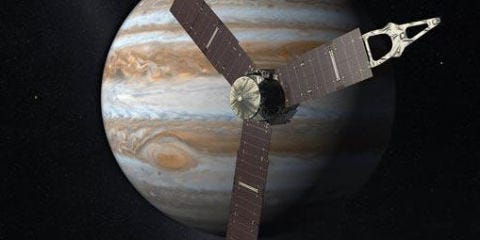
NASA’s Juno mission is the kind of space story that sounds like it was written by a scientist with a calculator in one hand and a lightning bolt in the other. Launched in 2011, Juno traveled across the solar system to reach Jupiter, the largest planet in our cosmic neighborhood. Since arriving in 2016, the spacecraft has skimmed over Jupiter’s cloud tops, survived intense radiation, photographed colossal storms, listened to auroras, and turned a giant planet into a data-rich detective case.
What makes Juno especially fascinating is that its story can be told through numbers: billions of miles traveled, dozens of close flybys, thousands of miles per hour, three massive solar arrays, nine science instruments, and more than three terabits of science data during the prime mission alone. Those numbers are not just trivia. They explain how difficult the mission is, why Jupiter matters, and how one solar-powered spacecraft became a flying laboratory in one of the harshest environments in the solar system.
So, let us count our way through NASA’s Juno missionwithout needing a PhD, a lab coat, or a personal radiation vault.
5 Years: The Journey From Earth to Jupiter
Juno launched on August 5, 2011, aboard an Atlas V rocket from Cape Canaveral. Its destination was Jupiter, a planet so massive that it could swallow more than 1,300 Earths by volume. But getting there was not as simple as pointing the spacecraft at the brightest dot and yelling, “Good luck!”
The spacecraft took roughly five years to reach Jupiter, arriving on July 4, 2016. That Independence Day arrival was poetic timing for a NASA mission, but the engineering behind it was anything but casual. Juno traveled about 1.74 billion miles before settling into orbit around the gas giant. The journey included careful trajectory planning, deep-space navigation, and a gravity-assist flyby of Earth that helped boost Juno’s speed on its way outward.
53 Days: One Long, Loopy Orbit
After Jupiter orbit insertion, Juno entered a highly elliptical polar orbit lasting about 53 days. Instead of circling Jupiter around its equator like a belt, Juno flies over the planet’s poles. That path is a big deal. It allows the spacecraft to study Jupiter’s magnetic field, gravity field, auroras, and deep atmosphere from angles that earlier missions could not fully capture.
The orbit is also a survival strategy. Jupiter’s radiation belts are ferocious, and the spacecraft cannot simply hang out close to the planet like a tourist on a scenic overlook. Juno dives in, gathers data at high speed, then swings far away again. Think of it as scientific speed dating with a planet that can fry electronics.
35 Orbits: The Prime Mission’s Scientific Backbone
During its prime mission, Juno completed 35 orbits of Jupiter. Those orbits produced more than three terabits of science data, giving researchers a detailed look at Jupiter’s atmosphere, gravity, magnetic environment, polar storms, and internal structure.
Before Juno, scientists knew Jupiter was huge, beautiful, stormy, and deeply weird. After Juno, the weirdness became measurable. The mission revealed that Jupiter’s atmospheric bands and jet streams extend far below the visible cloud tops. It also helped refine ideas about the planet’s interior, including evidence that Jupiter may have a “dilute” core rather than a neat, compact center. In other words, Jupiter did not read the textbook before becoming a planet.
9 Instruments: A Toolkit for Studying a Giant
Juno carries a suite of science instruments designed to investigate Jupiter from several angles. Its payload includes tools for studying gravity, magnetic fields, energetic particles, radio and plasma waves, auroras, infrared emissions, and microwave radiation from deep inside the atmosphere.
Microwave Radiometer: Looking Below the Clouds
The Microwave Radiometer, often called MWR, measures radiation from deep within Jupiter’s atmosphere. This helps scientists study water, ammonia, temperature, and cloud behavior beneath the visible surface. Since Jupiter’s clouds are not exactly transparentmore like a cosmic layer cake made of storm systemsthis instrument is essential.
Magnetometer: Mapping an Invisible Monster
Jupiter has the strongest magnetic field of any planet in the solar system. Juno’s magnetometer maps that field in detail, helping scientists understand what is happening deep inside the planet where metallic hydrogen may help generate Jupiter’s magnetic engine.
JIRAM and UVS: Watching Heat and Auroras
The Jovian Infrared Auroral Mapper, known as JIRAM, observes infrared light, including heat from Jupiter and its moons. The Ultraviolet Spectrograph, or UVS, studies Jupiter’s auroras in ultraviolet light. Together, these instruments help scientists connect Jupiter’s atmosphere, magnetic field, and energetic particles.
3 Solar Arrays: Powering a Spacecraft Far From the Sun
One of Juno’s boldest numbers is three: the spacecraft’s three huge solar arrays. Before Juno, missions to the outer solar system typically relied on nuclear power. Juno proved that solar power could work at Jupiter, even though sunlight there is much weaker than it is near Earth.
Juno’s solar arrays stretch about 66 feet across when fully deployed. At Earth, they could produce much more power, but at Jupiter they generate only a few hundred wattsroughly comparable to the power used by a handful of household light bulbs. Somehow, those few hundred watts operate a spacecraft that studies the largest planet in the solar system. That is not just efficient engineering; that is engineering on a strict energy diet.
500 Pounds: The Titanium Radiation Vault
Jupiter’s radiation environment is brutal. High-energy particles trapped by the planet’s magnetic field can damage spacecraft electronics, so Juno carries a titanium radiation vault. This protective box weighs about 500 pounds and shields the spacecraft’s most sensitive electronics.
The vault is roughly the size of an SUV trunk, which is a charmingly ordinary comparison for a spacecraft survival system operating hundreds of millions of miles from Earth. Inside are components that manage command, data handling, power, and other critical functions. Without that shielding, Jupiter’s radiation could damage the spacecraft far more quickly.
Even with protection, Juno has occasionally entered safe mode, a protective state used when the spacecraft detects unusual conditions. The impressive part is that Juno has recovered and continued working. That is the space-mission version of taking a deep breath, rebooting, and getting back to business.
2,100 Miles: Skimming Jupiter’s Cloud Tops
Juno has flown as close as roughly 2,100 miles above Jupiter’s cloud tops during some close passes. That may sound high, but for Jupiter, it is a close shave. The planet is about 88,846 miles wide at the equator, so a few thousand miles above the clouds is practically brushing the beard of a giant.
These close approaches allow Juno to collect high-value measurements while moving extremely fast. During each pass, the spacecraft gathers data on gravity, magnetic fields, atmospheric structure, auroras, and cloud features. Then it speeds away again before radiation exposure becomes too severe.
600-Mile Cyclones: Storms That Laugh at Earth Weather
Juno’s images of Jupiter’s poles revealed a stunning arrangement of cyclones. Some polar cyclones reach up to about 600 miles across. On Earth, a storm of that size would dominate weather maps and make meteorologists sweat through their jackets. On Jupiter, it is part of a larger, long-lasting polar pattern.
The mission showed that Jupiter’s poles are not calm caps at the top and bottom of the planet. They are dynamic, crowded, and strange. Swirling cyclones cluster around each pole in patterns that scientists are still working to explain. Juno turned Jupiter’s polar regions from blank spaces into some of the most fascinating weather laboratories in the solar system.
1,900 Miles Deep: Jet Streams Beneath the Clouds
Jupiter’s colorful bands are not just surface decoration. Data from Juno helped scientists determine that some atmospheric jets extend to depths of about 1,900 miles. That means the striped appearance seen through telescopes is connected to deep atmospheric motion, not just a thin layer of pretty clouds.
This discovery matters because it helps scientists understand how giant planets move heat, rotate, and maintain long-lived weather systems. Jupiter is not simply a big ball with storms painted on the outside. It is a deep, rotating, turbulent world where atmospheric behavior reaches far below what cameras can see.
JunoCam: One Camera, Thousands of Public Moments
JunoCam was included primarily as a public outreach camera, but it became much more than a pretty-picture machine. Citizen scientists have processed raw JunoCam images, enhancing details in Jupiter’s clouds, storms, moons, and shadows. Some of the most widely shared Juno images exist because skilled members of the public transformed raw data into dramatic planetary portraits.
This public role makes Juno unusual. The mission does not only send data to professional scientists; it invites people around the world to participate. JunoCam helped turn Jupiter from a distant planet into a shared visual experience. Space exploration can sometimes feel remote, but JunoCam made it feel almost personal.
645 Miles: A Close Look at Ganymede
Juno’s extended mission expanded its role from Jupiter orbiter to explorer of the broader Jovian system. In 2021, Juno flew within about 645 miles of Ganymede, Jupiter’s largest moon and the largest moon in the solar system. That flyby provided some of the closest views of Ganymede in more than two decades.
Ganymede is not just big; it is scientifically rich. It has its own magnetic field and evidence of a subsurface ocean. Juno’s observations helped refresh interest in this icy moon and provided useful context for future missions studying ocean worlds.
219 Miles: Europa Gets a Close Flyby
In 2022, Juno flew within about 219 miles of Europa, one of the most intriguing worlds in the solar system. Europa is covered by an icy shell, and scientists think a salty ocean may exist beneath it. That makes Europa a major target in the search for potentially habitable environments beyond Earth.
Juno’s flyby captured images and data that helped scientists study Europa’s surface and ice shell. While Juno was not designed as a dedicated Europa mission, its instruments still provided valuable observations. Sometimes the best science comes from a spacecraft doing bonus work after completing its original homework.
930 Miles: Io’s Volcanic Drama
Juno also turned its attention to Io, Jupiter’s volcanically hyperactive moon. During close flybys in late 2023 and early 2024, the spacecraft came within about 930 miles of Io’s surface. Its instruments captured data on volcanic activity, hot spots, and lava-rich regions.
Io is the solar system’s champion of volcanic chaos. Its surface is constantly reshaped by eruptions driven by tidal forces from Jupiter and neighboring moons. Juno’s Io observations added fresh detail to a world that looks less like a quiet moon and more like a pizza left under a cosmic broiler.
3,100 Miles: Thebe in 2026
Juno’s story continued into 2026 with an observation of Thebe, one of Jupiter’s small inner moons. During a close pass on May 1, 2026, Juno’s Stellar Reference Unit captured Thebe from about 3,100 miles away. Thebe is associated with Jupiter’s faint ring system and may contribute dust to the planet’s gossamer ring.
This detail is a reminder that Juno’s extended mission is not only about big moons and dramatic storms. It also adds information about smaller bodies, rings, dust, and the complex environment around Jupiter. In planetary science, even a small moon can carry a large clue.
Why Juno’s Numbers Matter
Numbers help us understand scale. They turn “Jupiter is big” into “Jupiter is so massive that it dominates the architecture of the solar system.” They turn “Juno traveled far” into “Juno crossed about 1.74 billion miles before entering orbit.” They turn “space is hard” into “a solar-powered spacecraft needs huge arrays and a titanium vault just to work near Jupiter.”
But the numbers also reveal something deeper: Juno is a mission about origins. Jupiter likely formed early in solar system history, and its composition may preserve clues about the materials that built the planets. By measuring water, ammonia, gravity, magnetic fields, and atmospheric depth, Juno helps scientists test theories about how Jupiter formed and how giant planets shape planetary systems.
That knowledge reaches beyond our solar system. Astronomers have discovered thousands of exoplanets, many of them giant planets. Understanding Jupiter gives researchers a local example for interpreting giant worlds around other stars. Juno is not only studying one planet; it is helping build a reference manual for planets everywhere.
Experiences Related to NASA’s Juno Mission, By the Numbers
Following NASA’s Juno mission feels different from reading a normal space headline. A Mars rover gives you landscapes that look almost familiar: rocks, dust, hills, wheel tracks. Juno gives you Jupiter, which is familiar only in the way a thunderstorm is familiar if the thunderstorm is larger than Earth and has been in a bad mood for centuries. The experience is humbling, funny, and slightly dizzying.
One of the best ways to experience the mission is through JunoCam images. At first glance, they look like abstract art: cream-colored clouds, copper swirls, blue-gray poles, pearl-like storms, and shadows cast by moons. Then you remember that these are real places. Those elegant curls are atmospheric systems. Those tiny-looking ovals may be hundreds of miles across. That dark dot on Jupiter’s clouds may be the shadow of Io, a volcanic moon crossing in front of the Sun.
There is also something wonderfully human about the public image-processing community. Juno sends back raw images, and citizen scientists turn them into views that make people stop scrolling. The collaboration has a garage-band charm: NASA built the spacecraft, Jupiter provided the drama, and people on Earth helped reveal the colors and textures. It is one of the rare situations where a space mission feels both elite and democratic.
The numbers make the experience even better. Knowing that Juno flew within a few thousand miles of Jupiter’s clouds changes how you look at each image. Knowing that the spacecraft survives using solar power far from the Sun makes every transmission feel like a small engineering miracle. Knowing that the radiation vault protects the electronics gives the mission a heroic quality, as if Juno is wearing armor while racing through invisible danger.
For students, writers, science fans, or anyone who enjoys big questions, Juno is a reminder that exploration is not only about planting flags or taking postcard photos. It is about asking better questions. How much water does Jupiter contain? How deep do its winds go? What powers its auroras? What does its core look like? How do moons interact with a giant planet’s magnetic environment? Each close pass adds another clue.
The emotional experience of Juno is a mix of awe and scale shock. Jupiter is so large that ordinary language gets tired. A storm becomes a world-sized engine. A cloud band becomes a deep atmospheric river. A moon flyby becomes a chapter in the story of habitability, volcanism, and planetary evolution. Juno turns numbers into imagination fuel.
And perhaps that is the mission’s most underrated success. It makes distant science feel active. Jupiter is not a static marble hanging in space. It is alive with motion, heat, magnetism, lightning, storms, and moons. Juno shows us that the solar system is not a museum. It is a working machine, and we are lucky enough to have a solar-powered spacecraft taking notes.
Conclusion
NASA’s Juno mission is a masterpiece of numbers with a personality bigger than Jupiter’s weather forecast. It traveled about 1.74 billion miles, entered orbit in 2016, completed 35 prime-mission orbits, returned more than three terabits of data, survived with a 500-pound radiation vault, and used three solar arrays to work where sunlight is faint. It has studied Jupiter’s deep atmosphere, mapped magnetic mysteries, photographed polar cyclones, and turned its extended mission into a tour of Ganymede, Europa, Io, Thebe, and the wider Jovian system.
Most importantly, Juno has changed the way scientists think about Jupiter. The planet is not just a striped giant with a famous red storm. It is a deep, complex, dynamic world that holds clues to the formation of our solar system and giant planets across the galaxy. By the numbers, Juno is impressive. By the discoveries, it is unforgettable.