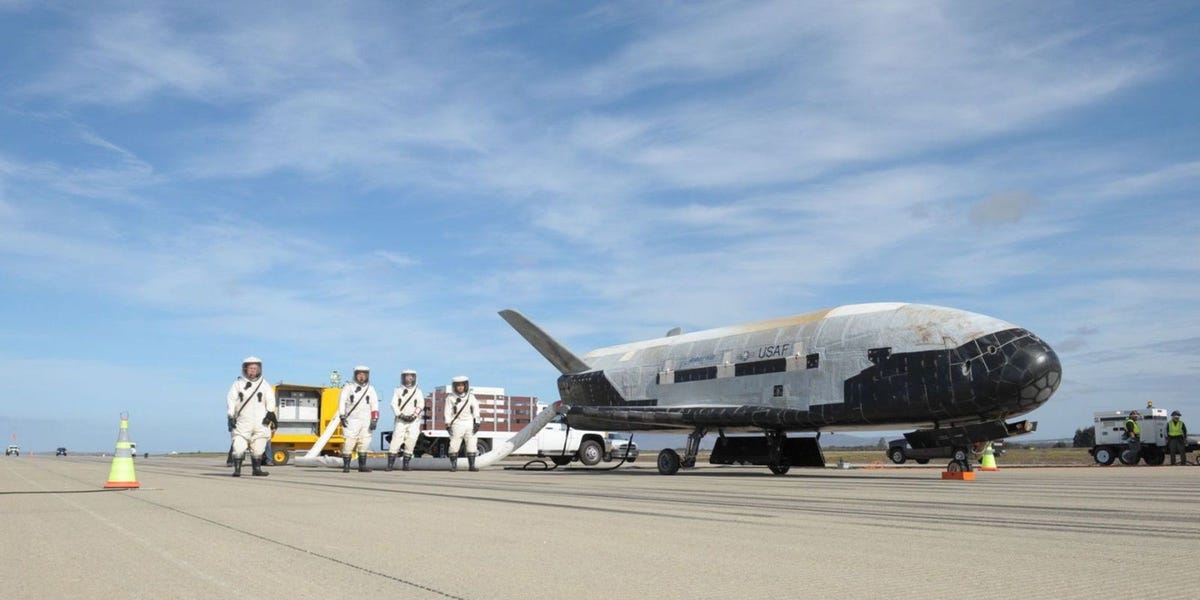
For decades, space sounded like the quiet part of national security: satellites drifted overhead, GPS worked like magic, weather forecasts arrived on time, and nobody at the grocery store had to think about orbital mechanics while buying cereal. That peaceful illusion is over. Space is now a contested military domain, and the United States is preparing for a future in which satellites may be jammed, blinded, hacked, stalked, spoofed, or attacked during a crisis.
The phrase “Air Force in space” is often used casually, but today the job belongs mainly to the U.S. Space Force, a separate military branch organized under the Department of the Air Force. Its mission is not to turn orbit into a science-fiction battlefield with pew-pew lasers and dramatic cape-wearing villains. The real mission is more practical and more urgent: protect the space systems that make modern life and modern military operations possible.
This is the new reality of space war: not one big cinematic explosion in the sky, but a constant contest for awareness, resilience, deterrence, and advantage. The final frontier has become a very crowded neighborhood, and the United States wants to make sure nobody kicks over the mailbox.
Why Space Has Become a Military Priority
Space is no longer just a place for astronauts, moon dreams, and inspirational posters. It is the backbone of modern military power. U.S. forces depend on satellites for communications, missile warning, precision navigation, intelligence gathering, weather monitoring, targeting support, and command and control. Remove or disrupt those systems, and military operations on Earth become slower, riskier, and far more confused.
That dependence creates an obvious strategic temptation for rivals. If an adversary cannot defeat the United States plane-for-plane, ship-for-ship, or network-for-network, it may try to attack the satellites that connect everything together. In other words, space systems are both a strength and a target.
China and Russia have invested heavily in counterspace capabilities, including electronic warfare, cyber tools, anti-satellite weapons, directed-energy systems, and satellites capable of operating near other spacecraft. These technologies do not all work the same way. Some may temporarily jam a signal. Others could damage sensors, interfere with command links, or physically threaten a satellite. The most dangerous options could create debris that remains in orbit for years, turning space into a cosmic junk drawer with consequences.
The Space Force’s Big Idea: Space Superiority
The central phrase in current U.S. military space planning is space superiority. In simple terms, it means the ability to use space when needed while preventing an adversary from using space in ways that threaten U.S. forces, allies, or national interests.
That does not mean “owning” space. Nobody gets to put a flag on low Earth orbit and call it a backyard. Instead, space superiority means creating enough awareness, protection, resilience, and combat power that U.S. and allied operations can continue even under pressure.
The Space Force’s 2025 warfighting framework makes clear that space is not just a support function anymore. It is a domain where military effects are planned, contested, and integrated with operations on land, at sea, in the air, and in cyberspace. This is a major cultural shift. For years, space professionals were often viewed as technical enablers quietly keeping satellites alive. Now, Guardians are expected to think like warfighters, planners, and operators in a contested environment.
How the U.S. Plans to Defend Space Assets
1. See More, See Faster: Space Domain Awareness
You cannot defend what you cannot see. That is why space domain awareness sits at the center of U.S. space defense. It means detecting, tracking, identifying, and understanding objects and activities in orbit. Think of it as air traffic control, neighborhood watch, weather radar, and detective work all rolled into oneexcept the neighborhood is moving at thousands of miles per hour.
Space domain awareness helps operators know whether a satellite is behaving normally, whether another spacecraft is maneuvering nearby, whether debris is creating a collision risk, or whether an adversary may be preparing a hostile action. The Space Force uses ground-based radars, optical sensors, telescopes, space-based sensors, data systems, and allied or commercial information to build a clearer picture of the orbital environment.
Recent improvements such as upgraded optical systems, modernized catalog tools, and early-use deep-space radar capabilities show where the strategy is heading: wider coverage, faster processing, and better tracking of objects beyond low Earth orbit. In a crisis, minutes matter. A suspicious satellite maneuver should not be discovered after everyone has finished lunch.
2. Build Resilient Constellations
Older military space systems often relied on a small number of highly capable, extremely expensive satellites. These systems were powerful, but they also created tempting targets. If one satellite carries a huge amount of mission value, an adversary may see it as a high-payoff target.
The newer approach emphasizes resilience. That means building architectures that can absorb attacks, failures, jamming, or disruption and still keep operating. One major method is proliferation: using larger numbers of smaller satellites so no single loss cripples the mission. Another method is diversification: spreading capabilities across different orbits, platforms, commercial partners, and allied systems.
The Space Development Agency’s proliferated space architecture is a good example. Its transport and tracking layers are designed to support missile warning, missile tracking, tactical communications, and data movement from low Earth orbit. In plain English: more satellites, more paths for data, more chances to keep functioning when conditions get ugly.
3. Defend Against Jamming, Cyberattacks, and Signal Spoofing
Not every space attack looks like a missile. In fact, many of the most likely threats are less dramatic and more annoyinglike a supervillain armed with a router and a bad attitude.
Electronic warfare can jam satellite communications or GPS signals. Spoofing can feed false positioning or timing information. Cyberattacks can target ground stations, command systems, software, or data links. These threats are attractive because they may be reversible, deniable, and usable below the threshold of open warfare.
That is why cyber defense and electromagnetic warfare are now deeply tied to space defense. Protecting a satellite is not only about shielding hardware in orbit. It also means protecting networks, antennas, software, operators, supply chains, and the data flowing through the system. The future of space security is as much about code and signals as it is about rockets.
4. Practice Like Space Is Already Contested
The military does not want its first serious space conflict to feel like a surprise exam in advanced physics. Training and exercises are therefore a major part of the plan.
Exercises such as Space Flag and commercial-space wargames help Guardians and partners rehearse contested scenarios. These events simulate satellite interference, cyber pressure, communications disruption, orbital threats, and fast-moving command decisions. The point is not theatrical drama. The point is to build habits, decision-making speed, and teamwork before a real crisis arrives.
Space warfighting also requires closer integration with the rest of the joint force. Army units, Navy ships, Air Force aircraft, Marine forces, cyber teams, intelligence agencies, and allied commands all rely on space. If space systems are disrupted, the effects ripple everywhere. That is why space planning can no longer sit in a separate technical corner with a “please do not disturb” sign.
The Role of Commercial Space Companies
Commercial space has changed the game. Private companies now launch rockets, operate satellite constellations, provide imagery, move data, support communications, and develop new space technologies at a pace that government programs alone often cannot match.
The Department of Defense and Space Force have recognized that commercial integration is not optional. It is a strategic advantage. Commercial systems can add capacity, speed, redundancy, innovation, and flexibility. If a military-only system is disrupted, commercial services may help fill gaps. If commercial providers are integrated before a crisis, they can support national security missions more smoothly when pressure rises.
The Commercial Augmentation Space Reserve, often compared in spirit to the Civil Reserve Air Fleet, is part of this thinking. The idea is to create a framework through which commercial space capabilities can support defense needs during competition, crisis, or conflict. That does not mean every satellite company becomes a military unit. It means the United States wants clearer pathways for cooperation, contracts, planning, and operational support.
Allies Matter in the Space Domain
Space defense is not a solo performance. The United States works with allies and partners to improve awareness, share data, coordinate operations, and promote responsible behavior in orbit. Partnerships can make deterrence stronger because they raise the cost of aggression. Attacking or disrupting a space system may affect multiple nations, not just one.
Allied cooperation also improves coverage. No single country has perfect visibility of every orbit at every moment. Shared sensors, combined operations, joint exercises, and coordinated satellite maneuvers help create a stronger collective picture. In space, teamwork is not a polite diplomatic accessory. It is operationally useful.
Missile Warning and the Push for Faster Tracking
One of the most important military space missions is missile warning and tracking. Satellites can detect missile launches, track flight paths, and provide critical information to commanders. This mission is becoming harder as advanced missiles become faster, more maneuverable, and more difficult to predict.
Hypersonic weapons and modern ballistic missile systems create demand for persistent tracking from multiple orbits. The goal is to move from simply detecting a launch to continuously tracking threats and supporting defensive decisions. That requires sensors, data processing, communications networks, and command systems that operate quickly and reliably.
Programs connected to proliferated missile-warning and missile-tracking satellites show how space defense is merging with missile defense. The faster the threat, the faster the space architecture must sense, decide, and pass information. In this environment, slow data is almost as bad as no data.
What “Space War” Might Actually Look Like
Despite the dramatic title, a future space conflict may not begin with satellites exploding across the night sky. It could start with GPS interference near a regional conflict. It could involve cyberattacks against satellite ground stations. It could include a suspicious spacecraft approaching a valuable satellite. It could involve jamming communications during a military operation or spoofing signals to create confusion.
That makes space war difficult to manage. Some actions may be ambiguous. Was a signal disruption accidental, criminal, or military? Was a satellite maneuver routine, reckless, or threatening? Did a cyber intrusion come from a state, a proxy, or someone in a basement eating cold pizza? Ambiguity is part of the challenge.
The U.S. strategy therefore combines deterrence, resilience, defensive operations, responsible behavior, and the ability to respond if needed. The message is simple: America relies on space, understands the threat, and is working to make attacks less useful and more costly.
The Biggest Challenges Ahead
Congestion in Orbit
Earth orbit is becoming crowded. More satellites, more debris, and more commercial activity increase the chance of accidents and misunderstandings. Military operators must distinguish between routine commercial activity, hazardous debris, and potentially hostile behavior. That is not easy when thousands of objects are moving at orbital speeds.
Budget and Acquisition Speed
Space technology moves quickly, but government acquisition can move like it stopped for a snack and forgot to come back. The Space Force is trying to field capabilities faster, use commercial solutions where appropriate, and design systems that can evolve. Still, matching the pace of technological change remains a serious challenge.
Escalation Risk
Space conflict can escalate in unpredictable ways. A destructive anti-satellite attack could create debris that threatens everyone, including the attacker. Cyber or electronic attacks may spread beyond their intended targets. Military planners must prepare for conflict while avoiding reckless actions that make space less usable for all nations.
Experiences and Lessons Related to Defending the Final Frontier
One of the most important lessons from recent years is that space is not “up there” in the abstract. It is down here in daily life. When a driver uses GPS, a farmer relies on satellite timing, a bank processes transactions, a weather agency tracks storms, or a deployed unit receives secure communications, space is quietly doing work. The experience of modern society is already space-enabled, even if most people never look up from their phones long enough to thank a satellite.
For military planners, this creates a mindset shift. Defending space is not only about protecting expensive machines in orbit. It is about protecting the services those machines provide. A satellite is important because of what it enables: navigation, warning, connectivity, intelligence, timing, and trust. If those services fail during a crisis, the effects could be felt by pilots, sailors, soldiers, commanders, emergency responders, and civilians.
Another practical experience is that resilience beats perfection. In the past, military space systems often aimed to be exquisitehighly capable, custom-built, and extremely reliable. That approach still has value for certain missions, but it is not enough in a contested environment. A perfect single point of failure is still a single point of failure. The modern lesson is to build networks that bend instead of break. Multiple satellites, backup links, commercial partners, allied systems, rapid reconstitution, and flexible software all contribute to a stronger architecture.
Training also matters more than hardware alone. A sensor can collect data, but people must interpret it. A satellite can maneuver, but commanders must decide when and why. A commercial provider can offer capability, but contracts and operational relationships must exist before the crisis. Exercises, wargames, and joint planning reveal gaps that glossy strategy documents may miss. In that sense, the most valuable discoveries often happen before conflict, when teams can still fix problems without headlines.
The experience of cyber conflict offers another warning. Attacks on networks often occur below the level of open war, and space systems face the same gray-zone problem. Jamming, spoofing, probing, and cyber intrusions may be used to test responses and create confusion. Defending the final frontier therefore requires patience, attribution, intelligence, and clear rules of engagement. Not every provocation should trigger escalation, but every serious threat must be understood.
Finally, the human experience of space defense is surprisingly grounded. Behind every advanced satellite and radar system are operators, engineers, analysts, acquisition specialists, cyber defenders, intelligence professionals, and commercial partners. Their work is often invisible until something goes wrong. The best space defense may be the kind the public never notices: GPS keeps working, communications stay connected, missile warning remains reliable, and dangerous behavior in orbit is deterred before it becomes a disaster.
That may not sound as flashy as a blockbuster space battle, but it is far more important. The real victory in space war may be preventing one from happening at all.
Conclusion: Defending Space Without Losing the Future
The future of space defense is not about militarizing every corner of orbit for the thrill of it. It is about recognizing that space is already essential to national security, economic stability, and daily life. The U.S. Air Force legacy, the Department of the Air Force structure, and the Space Force’s modern mission all point toward one conclusion: defending the final frontier is now a central part of defending Earth.
The plan depends on space domain awareness, resilient satellite architectures, cyber protection, electromagnetic defense, commercial integration, allied cooperation, rapid acquisition, and trained Guardians who understand space as a warfighting domain. The threats are real, but so are the solutions.
Space may be vast, but the margin for error is shrinking. The country that can see clearly, adapt quickly, and keep its systems working under pressure will hold a major advantage. And while the final frontier may never be truly peaceful again, it can still be protected, managed, and kept open for the missions that matter most.