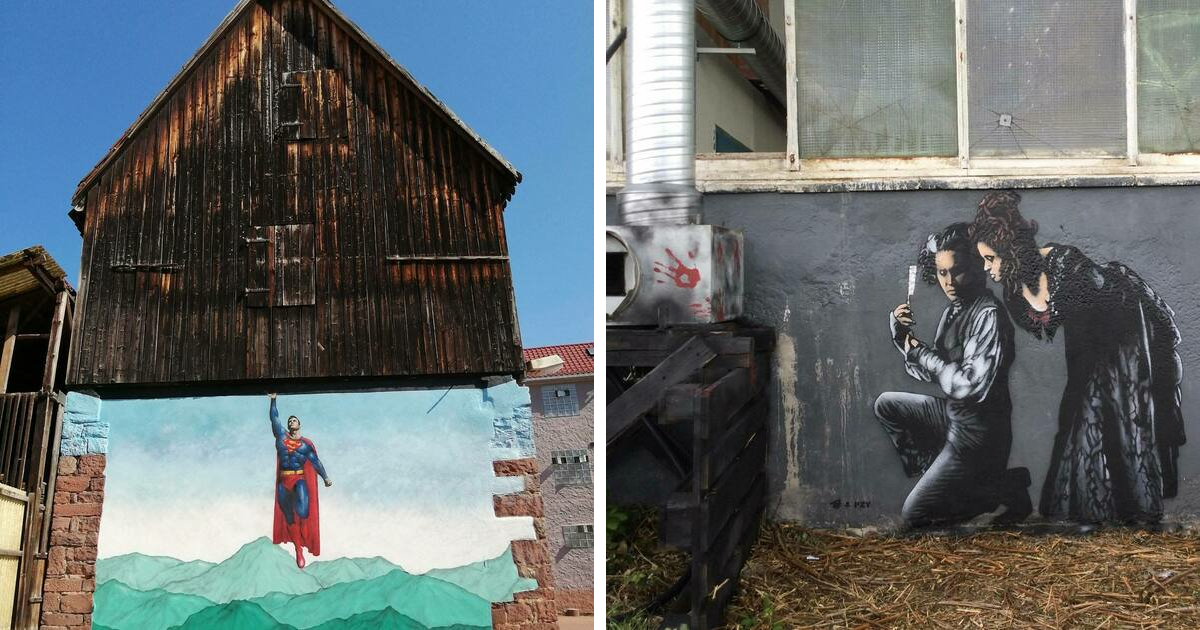
Most people walk past cracks in the sidewalk, dented pipes, chipped walls, and awkward little street fixtures with the same emotional energy they reserve for junk mail. Street artist Jamie Paul Scanlon, better known as JPS, looks at those same details and sees punchlines, characters, and mini-stories waiting to happen. That is what makes a gallery titled Artist Makes Streets Less Boring By Making Graffiti That Interacts With The Surroundings (50 Pics) so irresistible. It is not just about spray paint. It is about perspective. It is about taking the urban stuff everyone ignores and turning it into something clever enough to stop a scroll, a stroll, or both.
JPS belongs to that particularly delightful corner of street art where the city is not merely the backdrop. It is the co-star. A pipe becomes part of a balancing act. A crack turns into a visual gag. A wall mark suddenly looks like it was always meant to be there, as if the building itself had been waiting years for someone to finally understand its potential. The result is the kind of public art that feels quick, funny, and oddly generous. It asks for attention, but not in a loud, obnoxious way. More like, “Hey, look down for one second, your neighborhood has jokes.”
That is a big reason interactive graffiti and site-responsive street art perform so well online. A gallery of 50 images gives readers repeated little bursts of surprise. Each photo delivers the same pleasure as a good visual pun: first you notice the object, then you notice what the artist did with it, and then your brain rewards you for getting the joke. It is art, but it also has the timing of comedy. Not bad for a curbside stain and a can of spray paint.
Why JPS’s Street Art Works So Well
JPS’s art lands because it combines technique, restraint, and observation. Plenty of artists can paint a wall. Far fewer can make it seem like the wall had a secret identity all along. His best pieces do not bulldoze the environment. They collaborate with it. That matters. In a time when visual culture often screams for attention, there is something refreshing about art that whispers, “Come closer, there’s a smart joke here.”
His work also benefits from clarity. Even when the imagery is dark, eerie, or pop-culture-heavy, the concept reads fast. You do not need a graduate seminar in art theory to understand what is happening. A kid can enjoy it. A tourist can photograph it. A design nerd can admire the placement. A tired commuter can crack a smile before going back to thinking about rent. That is public art doing its job.
There is also a tactile intelligence in this kind of graffiti. Interactive street art depends on reading surfaces the way a playwright reads dialogue. The best artists notice not only what is there, but what it could become. That might mean using a drainpipe as a prop, a gap in the pavement as motion, or an oddly placed sign as the missing piece of a visual setup. It is part illustration, part improvisation, part urban detective work.
The Real Star Is the Surrounding Environment
The title of this article says the artist makes streets less boring, and that is true. But the deeper truth is that he makes people notice the street again. That difference matters. Great site-specific graffiti does not only decorate the city. It retrains the eye. After you have seen a few successful pieces, you start scanning every bollard, utility box, and weather stain like it might be in on something. Suddenly the city becomes less of a fixed machine and more of a conversation.
This is what separates interactive graffiti from generic wall decoration. A mural can be beautiful and still feel detachable from its setting. JPS-style interventions feel rooted. They only work there. Move them somewhere else, and the joke collapses. That site dependence gives the art an extra layer of charm. The piece is not simply painted onto the neighborhood; it grows out of it.
That is also why these works photograph so well. Every image contains two stories at once: the found object and the artistic response. The surroundings are not dead space. They carry the setup, while the stencil or painted figure delivers the payoff. In content terms, this is gold. In artistic terms, it is even better, because it proves creativity is not always about inventing from nothing. Sometimes it is about noticing what everyone else missed.
Street Art, Humor, and the Power of Small Surprises
One of the smartest things about JPS’s work is its sense of humor. Street art often gets framed in very serious terms: protest, property, politics, legitimacy, cultural value, and the eternal debate over whether a wall is public enough to deserve a visual opinion. Those conversations matter, but humor matters too. A witty piece of graffiti can interrupt routine just as effectively as a monumental mural. Sometimes more effectively, because it feels personal and immediate.
Humor is also democratic. You do not need to know the artist’s biography to laugh at a well-placed visual gag. You do not need a museum label. You just need eyes and about three seconds of attention. That accessibility helps explain why interactive street art travels so well on social media. People share it because it is legible, but they remember it because it is clever.
And yet the humor is rarely empty. The best pieces still carry a little extra weight. They can point to urban neglect, loneliness, boredom, or the strange emotional texture of modern cities. A funny intervention on a worn wall can say something quietly profound: even decay can become a stage for imagination. Not to get too poetic about a drainpipe, but sometimes a drainpipe deserves poetry.
How JPS Fits Into a Bigger Street Art Tradition
JPS is part of a broader tradition of artists who turn the built environment into a collaborator instead of a blank slab. Across contemporary street art, some creators use tiny stenciled figures, others use signage, architecture, color blocking, or mural scale to activate what was previously ignored. The common thread is that they respond to context. They do not treat the city as dead material. They treat it as a living puzzle.
You can see echoes of this approach in artists who work with miniature characters, playful public signage, and murals that bend around windows, doors, rooflines, and structural oddities. Some artists use humor. Others use wonder. Others use social commentary. But they all rely on the same fundamental principle: public art becomes more memorable when it acknowledges the place where it lives.
That is why interactive street art feels so contemporary. It mirrors how people actually experience cities now: in fragments, in passing, through glances, photos, and layered meanings. It rewards attention in a distracted age. Instead of demanding a captive audience, it catches people mid-motion and gives them a reason to stop. That may be one of the most radical things art can do in public space today.
Why “50 Pics” Is More Than Clickbait
Let’s be honest: internet gallery headlines are not always subtle. Add a number, promise some pictures, and hope the algorithm nods approvingly. But in this case, the “50 pics” format actually makes sense. Interactive graffiti is highly visual, and its pleasure is cumulative. One piece is amusing. Ten pieces reveal a pattern of thinking. Fifty pieces start to feel like an entire worldview.
As the images pile up, readers begin to understand the artist’s method. They notice how often ordinary fixtures become props. They see how much timing matters. They realize the city is not just scenery but a toolkit. That repetition builds appreciation. It turns casual browsing into recognition of skill.
The gallery format also matches the spirit of the work. These are quick urban encounters, not slow oil paintings in a silent room where someone nearby is pretending not to judge your shoes. Each piece is meant to hit fast. A photo gallery respects that rhythm. It lets readers experience the art the way pedestrians often do: one surprise after another.
The Deeper Appeal of Graffiti That Interacts With Its Surroundings
There is something emotionally satisfying about art that improves a place without pretending to own it. JPS’s work does not erase the street’s roughness. It plays with it. That creates a different feeling than polished commercial design. Instead of saying, “Look how perfect this space is,” it says, “Look how imperfect this space is, and how much possibility still lives here.”
That message resonates because many cities can feel overly managed on one block and completely neglected on the next. Interactive graffiti slips into that tension. It can make a scarred wall feel alive, a dull alley feel noticed, and a forgettable corner feel weirdly beloved. Even when the artwork is small, the psychological effect can be big. People remember places where something unexpected made them feel awake.
This is also why conversations about street art should not stop at legality or aesthetics alone. Public creativity changes mood. It changes attention. It changes how people narrate a neighborhood to themselves. A place with no visual surprise can feel emotionally flat. A place with wit, color, and imagination feels inhabited in a fuller way. Cities are not just systems of roads and buildings. They are systems of perception.
Specific Reasons Readers Keep Sharing Art Like This
1. It makes ordinary places feel magical
The core pleasure of interactive graffiti is transformation. A chipped curb is still a chipped curb, but now it is also part of a joke or character. That tiny shift gives viewers the feeling that the city has hidden levels, like a video game for observant adults.
2. It rewards people for paying attention
Unlike oversized branding or visual clutter, this kind of street art asks viewers to notice details. That makes the audience feel smart rather than overwhelmed. It is the difference between being yelled at by a billboard and being let in on a secret.
3. It is highly shareable without being shallow
Yes, these pieces are ideal for Instagram, Pinterest, and image-heavy blogs. But they are not disposable. Behind the quick visual reward is a serious creative skill: reading space, timing the concept, and executing it cleanly.
4. It balances fun with meaning
Playfulness is not the enemy of depth. In fact, humor often opens the door to reflection. The best street art can make people laugh first and think second, which is usually more effective than lecturing them from a wall.
Final Thoughts
Artist Makes Streets Less Boring By Making Graffiti That Interacts With The Surroundings (50 Pics) is such an effective title because it captures exactly what people respond to in JPS’s work. The streets are boring until someone truly looks at them. Then suddenly they are full of props, stories, and opportunities for surprise. JPS does not simply paint images. He stages encounters between art and infrastructure, imagination and wear, humor and routine.
That is why these images stick. They are not only clever. They are generous. They give something back to public space: a grin, a pause, a second look, a better memory of a corner you might otherwise forget. In a world where so many urban surfaces are ignored, monetized, or stripped of personality, that feels quietly radical. Sometimes making the street less boring is not a minor thing. Sometimes it is a way of reminding people that the city still belongs, at least a little, to imagination.
Extended Experience Section: What It Feels Like to Encounter This Kind of Street Art in Real Life
Looking at a curated gallery of interactive graffiti is fun, but seeing this kind of work in real life hits differently. On a screen, the image is already framed for you. The joke is packaged. The object and the artwork are neatly arranged in one photograph, and your brain gets the pleasure instantly. On the street, though, there is a tiny moment of discovery that feels much richer. You are walking, probably half distracted, maybe thinking about errands or messages or whether you remembered to answer that one email, and then something odd catches your eye. A pipe looks like part of a person. A crack seems intentional. A plain wall suddenly has attitude. For a second, the whole city feels more awake.
That experience is hard to fake. It is one thing to admire creativity; it is another thing to feel it ambush your routine in the best possible way. Interactive street art changes the tempo of a walk. It makes you slow down. It makes you look left and right instead of only forward. It turns passive movement into active noticing. After you have seen a few pieces, you start hunting for more. You become the kind of person who studies weird corners and battered street fixtures like they might be hiding punchlines. Frankly, it is an excellent hobby for anyone who enjoys free entertainment and accidental joy.
There is also a strangely human feeling in these works. Cities can be cold, repetitive, and indifferent. Concrete is not famous for emotional warmth. But when an artist responds to the exact quirks of a place, the space begins to feel noticed. A neglected alley no longer seems completely abandoned. A damaged wall no longer reads as pure decay. The art does not erase the roughness, but it gives the roughness a voice. That can change how a neighborhood feels in a surprisingly intimate way.
For many viewers, the appeal goes beyond humor. These pieces can trigger memory. They remind people of childhood doodles, visual jokes in school notebooks, cartoon logic, or that early habit of staring at clouds and seeing shapes. Interactive graffiti brings that imaginative instinct back into adulthood. It quietly asks a question most grown-ups do not hear often enough: what else could this be? That question is small, but it is powerful. It reopens a flexible way of seeing the world.
And maybe that is the biggest reason people love artists like JPS. The work is not only clever. It is contagious. After encountering it, you start participating mentally. You make your own connections. You imagine your own interventions. The city becomes less finished and more open-ended. Even when the artwork is tiny, the effect can linger for hours. You head home with a better mood, a sharper eye, and a faint suspicion that the lamppost near your apartment might secretly be trying to become part of a masterpiece.