Some science demonstrations politely ask for your attention. A gas model made of magnets grabs attention by the shirt collar, shakes it gently, and says, “Look, atoms are weird and wonderful.” The basic idea is delightfully simple: place a collection of small magnets between two clear sheets, give the system room to move, and watch the magnets behave like visible particles. They repel, jostle, settle into patterns, break apart, crowd together, and sometimes act as if they have tiny opinions about personal space.
The phrase gas model made of magnets sounds like something invented during a late-night garage experimentand honestly, that is part of its charm. But behind the fun is a serious educational point. Gases are normally invisible at the molecular level. We cannot watch oxygen or nitrogen molecules bounce around inside a room. We can, however, create a large-scale model that mimics a few useful behaviors: particle motion, spacing, collisions, pressure, and the way systems change when energy or confinement changes.
This article explores how a magnetic gas model works, what it teaches well, where it becomes scientifically imperfect, and why imperfections are not a deal-breaker. In fact, they are where the lesson gets interesting. Think of it as physics with a personality: part classroom tool, part tabletop puzzle, part “please do not let those neodymium magnets slam into each other” safety briefing.
What Is a Gas Model Made of Magnets?
A gas model made of magnets is a hands-on physics demonstration that uses magnets as stand-ins for particles. In many versions, small disc magnets are placed between two transparent sheets such as acrylic or plexiglass. The magnets are arranged so that they repel one another. Because they cannot flip freely or escape the container, their repulsion creates a visible system of moving “particles.”
When the magnets are added one at a time, the system begins to show structure. The magnets spread out because like poles repel. If the enclosure is shaken, tilted, tapped, or otherwise energized, the magnets move, collide, and rearrange. With only a few magnets, the setup may look like a sparse gas. With many magnets, it may look more like a dense fluid or a crystal-like arrangement.
The most important feature is visibility. In a real gas, molecules are too small to see, and their motion is far too rapid for direct everyday observation. A magnetic model slows the drama down and scales it up. The viewer can see how particles influence one another and how boundaries shape behavior. For students, that can be the difference between memorizing “particles move randomly” and actually understanding what that sentence means.
The Science Behind the Magnetic “Particles”
Kinetic Molecular Theory in Plain English
The kinetic molecular theory explains gases by treating them as huge collections of tiny particles in constant motion. Those particles collide with one another and with the walls of their container. The combined effect of those collisions produces gas pressure. Temperature, meanwhile, is related to the average kinetic energy of the particles. In simple terms: warmer gas particles move faster, and faster particles hit the walls harder and more often.
That is why a sealed container can build pressure when heated. The gas particles inside are not suddenly becoming ambitious entrepreneurs; they are simply moving faster. More energetic motion means more forceful collisions with the container walls. This is also why compressed gases behave the way they do. If the same number of particles is squeezed into a smaller space, wall collisions become more frequent, so pressure rises.
A magnetic gas model can show parts of this idea beautifully. When the magnets move around in a confined space, viewers can imagine each magnet as a particle. When the container is crowded, the magnets interact more often. When the enclosure is shaken, the particles gain energy. When the walls move inward, the “particles” have less room and become more densely packed.
Why Magnets Are Useful Stand-Ins
Magnets are excellent teaching tools because their forces are easy to feel and easy to see indirectly. Push two like poles together and you feel resistance. Bring opposite poles together and they snap into place with dramatic enthusiasm. With small disc magnets arranged to repel, the force becomes a visible spacing mechanism. The magnets do not want to overlap, so they spread out.
This is similar to how atoms and molecules resist being pushed too close together. Real atoms are not tiny bar magnets, but they do experience forces that prevent matter from collapsing into one microscopic heap. At very short distances, electron clouds and quantum effects create strong repulsion. A magnetic model captures the “particles resist crowding” idea in a way a student can see without needing a chalkboard full of equations.
That said, a model is not the thing itself. The map is not the territory. The menu is not the sandwich. And a magnet sliding between plastic sheets is not a nitrogen molecule flying through the air at hundreds of meters per second.
What the Magnetic Gas Model Teaches Well
1. Particles Occupy Space
One of the first lessons is that matter is made of particles that occupy space. Even when matter seems continuouslike air in a roomit is composed of individual units. The magnets make this concept obvious. Each “particle” takes up space, and adding more particles changes the system.
2. Particle Motion Matters
In real gases, motion is everything. Gas particles move constantly, and their motion explains pressure, diffusion, expansion, and temperature effects. A magnet model can show how energy input changes behavior. Tap or shake the frame and the magnets move more vigorously. Let the system rest and the magnets settle.
Of course, this is not perfect thermal motion. In real gases, heat is microscopic kinetic energy distributed among particles. In the model, motion may come from your hand, vibration, gravity, or a motor. Still, the visual connection is useful: more energy leads to more motion.
3. Boundaries Shape Behavior
Put magnets in a wide frame and they spread out. Push the boundary inward and they crowd together. This helps explain why gas volume and pressure are connected. In a real gas, reducing volume while keeping the number of particles constant usually increases pressure because particles strike the walls more often.
In the magnetic model, the “pressure” is not identical to gas pressure, but viewers can see the boundary being pushed by the collective behavior of the magnets. The model turns an invisible statistical idea into a visual mechanical one.
4. Order Can Emerge From Simple Rules
One of the most fascinating things about magnets in a confined space is how patterns appear. Add enough repelling magnets and they may form hexagonal or crystal-like arrangements. Nobody tells each magnet where to go. There is no tiny foreman magnet wearing a hard hat. The pattern emerges from local interactions: each magnet responds to its neighbors and the boundaries.
This is a powerful idea across physics and chemistry. Many structures in nature emerge because particles seek lower-energy arrangements. Crystals, packed atoms, bubbles, foams, and even some biological patterns can be understood through simple local rules producing large-scale order.
Where the Model Gets Tricky
The title “A Gas Model Made of Magnets” is catchy, but scientifically, the model is closer to a flexible particle-system demonstration than a perfect gas simulation. That distinction matters.
Real Ideal Gases Have Almost No Interparticle Forces
In the ideal gas model, particles are usually treated as if they do not attract or repel one another except during collisions. Their main job is to zip around and bounce elastically. Magnets, however, interact at a distance. They repel before they touch. That makes the magnetic model very different from an ideal gas.
This does not make the demonstration useless. It simply means the teacher or explainer should be honest about what the model shows. The magnets are great for visualizing spacing, repulsion, crowding, emergent order, and particle interactions. They are not a perfect representation of dilute gas molecules.
Friction Changes the Story
Real gas molecules do not scrape along acrylic sheets. They do not lose speed because of tabletop friction. Magnets in a frame do. Friction drains energy from the system, causing the magnets to stop unless energy is added again. That makes the model less like a gas and more like a two-dimensional mechanical toy with magnetic forces.
For classroom use, this is a feature and a bug. It makes the model slower and easier to observe, which is excellent for learning. But it also means students should not assume real molecules behave exactly the same way.
The Model Is Usually Two-Dimensional
Most magnetic gas models are built between two flat sheets, so the magnets move in a plane. Real gases move in three dimensions. That difference matters for advanced topics such as molecular speed distributions, diffusion rates, and statistical mechanics. But for an introduction to particle motion, a two-dimensional model is still extremely helpful. After all, even professional scientists use simplified models. The trick is knowing what has been simplified.
How to Build a Simple Magnetic Gas Model
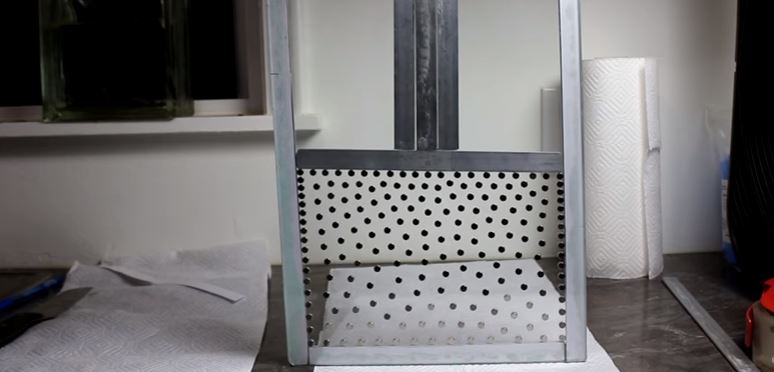
A basic version can be built with a clear frame, small disc magnets, spacers, and a safe enclosure. The magnets should be strong enough to repel visibly but not so strong that they become dangerous or uncontrollable. Neodymium magnets are popular because they are powerful for their size, but they also require care. They can pinch skin, crack, chip, or damage electronics if handled carelessly.
Materials You Might Use
- Two clear acrylic or plexiglass sheets
- Small disc magnets of the same size and strength
- Spacers or washers to create a narrow gap
- Screws, clips, or a frame to hold the sheets together
- Optional foam edges or rails to create a boundary
- Optional vibration source, such as a small motor, for motion
The gap should be large enough for the magnets to slide but small enough to prevent them from flipping over. If they flip, opposite poles may attract and clump together, which changes the behavior. The container should also be sealed or securely framed so the magnets cannot escape and launch themselves into a tiny metallic rebellion.
Safety Notes Before You Start
Strong magnets are not ordinary craft supplies. Keep them away from small children, pets, pacemakers, magnetic storage media, phones, and anything that dislikes surprise magnetic fields. Wear eye protection when working with brittle neodymium magnets. Do not let large magnets snap together. A magnet that chips at high speed is not a fun science demo; it is a tiny physics-powered hazard.
Experiments to Try With the Model
Add Particles One by One
Start with only a few magnets in the frame. Notice how much space each one claims. Then add more. The system becomes crowded, interactions increase, and patterns may emerge. This is a simple way to discuss particle number, density, and compression.
Change the Container Size
If your design allows it, move the boundaries inward. Watch how the magnets rearrange. In a classroom, this can lead into a discussion of Boyle’s law, which describes how pressure and volume are related for a gas at constant temperature. The magnetic version is not mathematically exact, but it makes the “less room means more crowding” concept obvious.
Add Energy With Vibration
Gently vibrate the frame or use a small motor to keep the magnets moving. Students can compare low-energy and high-energy states. At low energy, magnets may settle into ordered arrangements. With more shaking, the arrangement becomes more active and disordered. This is a useful bridge to discussions of solids, liquids, gases, and phase changes.
Create a “Heavy Particle”
Try using one larger magnet or connecting two magnets together securely. The heavier object may move differently from the others. This can open a conversation about molecular mass, diffusion, and why different gases can behave differently even under similar conditions.
Magnetic Model vs. Real Gas: A Helpful Comparison
| Feature | Magnetic Model | Real Gas |
|---|---|---|
| Particles | Visible magnets | Atoms or molecules |
| Motion | Driven by shaking, tilting, or vibration | Driven by thermal kinetic energy |
| Forces | Long-range magnetic repulsion | Mostly negligible in ideal gases except during collisions |
| Dimensions | Usually two-dimensional | Three-dimensional |
| Energy loss | Friction with surfaces | Elastic collisions in idealized models |
| Best use | Visualizing particle behavior and interactions | Explaining real thermodynamic gas behavior |
Why This Demonstration Works So Well for Learning
The best science demonstrations make invisible ideas feel almost touchable. A magnetic gas model does exactly that. It gives students a mental picture they can carry into harder topics. Once learners understand that pressure comes from many small interactions, formulas like the ideal gas law stop looking like random alphabet soup.
That matters because gas laws can feel abstract. Pressure, volume, temperature, and particle number are measurable, but the molecular explanation is hidden. The magnetic model fills that gap. It lets students ask questions: Why do the magnets spread out? Why do they form patterns? What happens when there are more particles? What happens when the frame gets smaller? Why does motion fade unless energy is added?
Those questions are more valuable than a perfect demonstration. A flawless model that students do not engage with is less useful than an imperfect model that makes them curious. Curiosity is the ignition switch of learning, and magnets are very good at turning that switch.
Real-World Connections
The ideas behind a gas model made of magnets connect to many real-world systems. Engineers use gas laws when designing engines, air tanks, HVAC systems, medical devices, and aerospace equipment. Chemists use kinetic theory to understand reaction rates, diffusion, and molecular behavior. Meteorologists rely on gas behavior to explain pressure systems and weather patterns. Even everyday items like bicycle tires, aerosol cans, pressure cookers, and balloons become easier to understand once you know that gas pressure comes from moving particles.
The magnetic version also connects to materials science. When the magnets arrange themselves into ordered patterns, they resemble the way atoms can settle into low-energy structures. When defects appear in the pattern, they resemble imperfections in crystals. When the model becomes crowded and mobile, it starts to feel more like a dense fluid. In one small frame, viewers can glimpse ideas from gases, liquids, solids, thermodynamics, and condensed matter physics.
Common Misconceptions to Avoid
Misconception: Gas Particles Repel Like Magnets
Not usually. In an ideal gas, particles are treated as having negligible attraction or repulsion except when they collide. The magnet model exaggerates repulsion to make behavior visible.
Misconception: The Pattern Means It Is a True Crystal
Not necessarily. A packed group of magnets may form a regular pattern, but a real crystal involves atoms, bonding, and three-dimensional lattice structures. The model can suggest crystal-like order, but it should not be mistaken for a complete crystal model.
Misconception: Shaking Equals Heating in a Perfect Way
Shaking adds mechanical energy, which can imitate increased motion. But real temperature is tied to average molecular kinetic energy at the microscopic level. The analogy is useful, not exact.
Experience Section: What It Feels Like to Learn From a Magnetic Gas Model
The first memorable experience with a gas model made of magnets is usually surprise. You expect a few little discs to slide around, and instead you get a miniature universe with boundaries, arguments, traffic jams, and sudden bursts of order. Drop one magnet into the frame and it behaves like a lonely planet. Add another and suddenly the two are negotiating distance. Add ten more and the whole system becomes a crowded dance floor where nobody wants to bump shoulders.
That is the magic of the model: it turns theory into behavior. In a textbook, the phrase “particles interact” is clean and quiet. In the magnet frame, interaction is visible. The magnets shove, drift, lock into spacing, and rearrange when disturbed. Watching them makes it easier to understand why matter can look calm at the human scale while being extremely active at the particle scale. A glass of air may look like nothing, but at the molecular level, it is an endless festival of motion.
One of the most useful classroom experiences is asking students to predict what will happen before adding more magnets. At first, many expect the new magnet to simply fill an empty spot. But the system often rearranges globally. One new particle can shift several others, especially in a crowded frame. That becomes a powerful lesson about systems. In physics, chemistry, and engineering, changing one variable rarely affects only one thing. Systems respond as systems.
Another strong experience comes from compressing the model. When the boundary gets smaller, the magnets crowd together and push back more noticeably. Students can feel, see, and discuss pressure without starting with equations. Once the visual idea is clear, the math becomes less intimidating. Pressure is no longer just a symbol in a formula; it is the collective effect of many tiny interactions.
The model is also great for teaching scientific humility. Someone will eventually ask, “So is this exactly how gas works?” That is the perfect moment. The answer is noand that is not a failure. Scientific models are tools, not clones of reality. A magnetic gas model highlights repulsion, spacing, energy input, and emergent order. It does not perfectly capture ideal gas behavior, molecular speed distribution, or three-dimensional thermal motion. Learning those limits is part of learning science.
For hobbyists, the build itself is satisfying. It is simple enough to make with basic materials, yet rich enough to keep experimenting. Try different magnet sizes. Change the gap. Add a vibrating motor. Tilt the frame. Use fewer particles, then many. Every small adjustment changes the behavior, which makes the model feel alive. It is the kind of project that begins as a demonstration and quietly becomes a laboratory.
The best part is that the model invites play without abandoning rigor. Students can laugh when the magnets misbehave, then turn around and discuss kinetic molecular theory, gas pressure, particle density, and phase transitions. That combination is rare and valuable. A gas model made of magnets does not just explain science; it makes science feel like something you can explore with your hands, eyes, and curiosity fully switched on.
Conclusion
A gas model made of magnets is not a perfect model of a gas, and that is exactly why it is worth discussing carefully. It visualizes particle spacing, motion, interaction, crowding, and emergent order in a way that ordinary diagrams cannot. It helps learners connect the invisible world of atoms and molecules to something they can observe directly.
The key is to use the model honestly. Magnets are not gas molecules. Magnetic repulsion is not the same as ideal gas behavior. Friction, two-dimensional motion, and long-range forces all change the system. Still, as a teaching tool, the model is wonderfully effective. It sparks questions, supports visual learning, and creates a bridge from hands-on curiosity to deeper physics.
If science education had more demonstrations like this, fewer people would think of physics as a dusty shelf of equations. Sometimes, all it takes to make molecules feel real is a clear frame, a handful of magnets, and the willingness to let tiny objects teach big ideas.
Note: This article is written for educational and informational purposes. If building a magnetic gas model, use strong magnets responsibly and supervise young learners carefully.