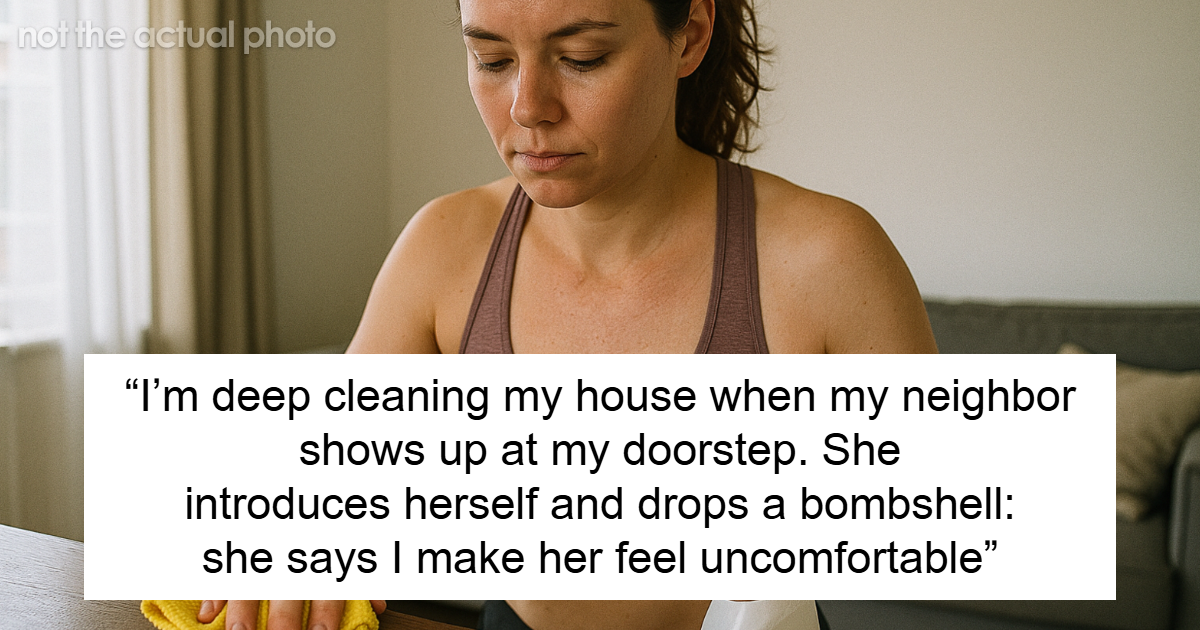
There are awkward neighbor moments, and then there are moments so wildly backwards that you have to check whether gravity is still working. One woman recently found herself in exactly that kind of situation after a neighbor confronted hernot because she had done anything wrong, but because the neighbor’s husband had apparently been staring at her through the window.
Yes, you read that correctly. The issue was not the man watching someone who had not invited his attention. The issue, according to the wife, was the woman existing inside her own home in a way that was somehow “distracting.” Somewhere, logic packed a tiny suitcase and left the neighborhood.
The story quickly caught attention online because it touches a nerve many people recognize: victim-blaming, privacy invasion, uncomfortable neighbor dynamics, and the exhausting idea that women are responsible for managing men’s behavior. At its core, this is not just a petty neighborhood dispute. It is a reminder that privacy, consent, and personal boundaries still mattereven when the person crossing the line lives next door and owns a lawn mower.
The Story: A Neighbor’s Complaint That Missed the Entire Point
According to the widely shared account, the woman was going about her normal routine at home when her neighbor approached her with a complaint. The neighbor claimed that her husband had been watching the woman from their window and was becoming distracted. Instead of addressing her husband’s behavior, the wife suggested that the woman should change what she wore or how she behaved inside her own space.
The woman, understandably, was left feeling grossed out. Not only had she learned that a man nearby was watching her, but she was also being blamed for it. That is a special kind of emotional whiplash: first you find out someone has been acting creepy, then you are handed the invoice.
Online commenters overwhelmingly sided with the woman. Many pointed out that if a husband is peeping into a neighbor’s home, the problem is not the neighbor. The problem is the husband. Others encouraged the woman to document future incidents, consider installing privacy measures for her own peace of mind, and report behavior that crosses into harassment or illegal surveillance.
Why This Situation Feels So Disturbing
The reason this story spread so quickly is simple: it flips responsibility in a way that many readers found both absurd and unsettling. A person should be able to clean, relax, stretch, cook, dance badly to 2000s pop music, or simply walk through their home without worrying that a neighbor is monitoring them.
Home is supposed to be the place where your shoulders drop. It is where you wear your least glamorous socks, eat cereal at odd hours, and forget that “outside people” exist. When someone watches through a window, that sense of safety can disappear fast.
The wife’s reaction made the situation even worse because it turned a privacy violation into a wardrobe critique. Instead of saying, “My husband’s behavior is unacceptable,” she effectively said, “Please make yourself less visible so he does not have to control himself.” That is not accountability. That is outsourcing self-control to the nearest woman.
Peeping, Privacy, and the Legal Gray Areas People Should Take Seriously
Voyeurism and “Peeping Tom” behavior are treated seriously in many U.S. states, though the exact laws vary by location. In general, laws often focus on whether someone intentionally watched, photographed, recorded, or otherwise invaded another person’s privacy without consent, especially in places where a person reasonably expects privacy.
That does not mean every uncomfortable glance automatically becomes a criminal case. A neighbor briefly seeing someone through an open window is different from repeated watching, lingering, using binoculars, recording, hiding cameras, or positioning themselves to observe someone in a private setting. Context matters. Pattern matters. Intent matters. But the basic social rule is not complicated: do not spy on people.
When behavior becomes repeated or intimidating, documentation can be important. A written log of dates, times, what happened, who witnessed it, and whether communication occurred can help if the situation escalates. Outdoor cameras pointed only at one’s own property, privacy film, curtains, blinds, and motion lights may also help a person feel safer, though none of those should be treated as proof that the victim caused the problem.
Victim-Blaming: The Oldest Bad Take in the Book
The neighbor’s reaction is a classic example of victim-blaming. Victim-blaming happens when people focus on what the targeted person wore, said, did, posted, or failed to prevent instead of focusing on the person who crossed the boundary.
It often sounds like:
- “Why were your curtains open?”
- “Why were you dressed like that?”
- “Why didn’t you notice sooner?”
- “Why don’t you just avoid that room?”
- “Why make a big deal out of it?”
These questions may pretend to be practical, but they often shift responsibility in the wrong direction. A person inside their own home is not responsible for making themselves invisible to someone who chooses to stare. Privacy does not vanish just because a window exists.
Victim-blaming also makes people less likely to speak up. If someone believes they will be mocked, blamed, or accused of “causing drama,” they may stay silent. That silence protects the person behaving badly, not the community.
The Wife’s Reaction Says a Lot About Misplaced Anger
It is possible the wife felt embarrassed, angry, jealous, or betrayed. Those emotions may be real, but they were aimed at the wrong person. Her husband’s attention was not magically dragged out of his eyeballs by the neighbor’s outfit. He made a choice. If he continued watching after realizing he was invading someone’s privacy, that choice became even uglier.
Sometimes people redirect anger because the truth is uncomfortable. Confronting a spouse about creepy behavior can threaten the image of a happy marriage. Blaming an outsider may feel easier because it keeps the real conflict at a safe distance. Unfortunately, “easier” is not the same thing as fair.
The wife may have wanted to regain control of a situation that made her feel humiliated. But trying to control another woman’s clothing or movement does not fix a spouse’s behavior. It only adds another layer of disrespect.
What the Woman Did Right
The woman’s reactionfeeling disgusted, shocked, and uncomfortablewas completely reasonable. Many people freeze in moments like this because the accusation is so bizarre that the brain needs a few seconds to reboot. It is easy to imagine the internal monologue: “Wait, your husband is watching me, and somehow I have homework?”
She was also right to reject the blame. A clear boundary is powerful in situations like this. Something as simple as, “Your husband’s behavior is not my responsibility. Please address it with him,” keeps the focus where it belongs.
If the behavior continued, she would also be justified in taking additional steps. That could include documenting incidents, notifying a landlord or homeowners association if applicable, speaking with trusted neighbors, improving privacy features for comfort, or contacting local authorities if she believed the behavior was repeated, threatening, or illegal.
How Neighbors Should Handle Boundary Problems Like Adults
Good neighbors do not need to be best friends. They do not have to swap recipes, attend barbecues, or pretend to love each other’s inflatable holiday decorations. But they do need to respect basic boundaries.
1. Address the person causing the problem
If someone’s spouse, roommate, guest, or relative is behaving inappropriately, the conversation starts there. Not with the person being watched. Not with the person being made uncomfortable. Definitely not with fashion advice delivered like a neighborhood citation.
2. Keep communication short and clear
When a situation is uncomfortable, long emotional debates can make things worse. A direct statement works better: “Do not watch me through my windows. Do not contact me about my clothing. If this continues, I will document it and seek help.”
3. Do not apologize for existing
Politeness is not the same as surrender. A person can be calm and still firm. They do not need to say sorry for using their own living room.
4. Create a paper trail
When boundary issues become repeated, memory can get fuzzy. A simple log can help establish patterns. Screenshots, messages, camera footage from legal angles, and written notes can be useful if a landlord, HOA, attorney, or police officer needs context later.
5. Ask for support
Being watched or blamed can feel isolating. Trusted friends, family members, victim advocates, tenant-support organizations, or legal-aid groups may help someone think through next steps safely.
Why Online Readers Reacted So Strongly
Stories like this go viral because they combine outrage with a painfully familiar pattern. Many readers have seen women blamed for men’s behavior before. At school, at work, in families, in relationships, and yes, even across the driveway, the same tired script appears: “He acted badly because she was distracting.”
That script is not just unfair. It is lazy. It treats grown adults as helpless weather vanes, spinning uncontrollably whenever a woman walks by in leggings, shorts, pajamas, or literally any fabric arranged in the shape of clothing.
People also reacted strongly because the woman was inside her own home. Public-space harassment is bad enough, but home privacy carries a deeper emotional importance. When someone feels watched where they live, the violation can follow them into ordinary routines. Suddenly, opening blinds feels complicated. Cleaning feels exposed. Existing feels like a performance. That is not harmless.
The Bigger Issue: Women Are Often Expected to Manage Men’s Behavior
This story is about one neighborhood conflict, but it points to a larger cultural habit. Women are often told to dress differently, smile less, smile more, avoid certain places, avoid certain times, ignore comments, accept “compliments,” and stay polite when someone else crosses a line.
That kind of advice may be framed as safety guidance, but it can easily become a burden. Safety matters, of course. People should be allowed to make choices that help them feel secure. But safety advice should never become a way to excuse the person causing harm.
The better standard is simple: teach people not to harass, spy, intimidate, or blame others. Revolutionary? Apparently. But still worth trying.
Practical Steps If a Neighbor Is Watching You
If someone suspects a neighbor is repeatedly watching them, the first priority is safety. Every situation is different, and not every response is safe for every person. Still, these steps can help someone think clearly:
- Document incidents: Write down dates, times, locations, and what happened.
- Preserve messages: Save texts, notes, emails, or voicemails related to the issue.
- Improve privacy for comfort: Window film, curtains, blinds, or landscaping can reduce visibility.
- Tell someone trusted: A friend, relative, roommate, or neighbor can help provide support and perspective.
- Check local rules: State and city laws vary, especially around voyeurism, harassment, recording, and trespassing.
- Contact appropriate help: If the behavior is repeated, threatening, or involves recording, local authorities or victim-support organizations may be appropriate.
It is also wise to avoid escalating face-to-face arguments when emotions are high. A written message can sometimes create a clearer record, but safety should guide the decision. The person being watched does not owe the watcher a private confrontation.
Experience Section: Real-Life Lessons From Similar Neighbor Boundary Nightmares
Stories like this resonate because many people have had at least one neighbor who treats boundaries like optional software updates. Maybe it is the person who comments every time you leave the house. Maybe it is the neighbor who knows too much about your schedule. Maybe it is someone who mistakes visibility for invitation. The details vary, but the feeling is similar: suddenly, your normal life feels observed.
One common experience is the “curtain guilt” problem. People often blame themselves when a neighbor sees too much through a window. They think, “I should have closed the blinds,” or “I should not have worn that,” or “I should have noticed sooner.” But a window is not consent. Open curtains may create visibility, but they do not create permission for someone to intentionally stare, monitor, record, or make comments that turn a normal home into a stage.
Another common lesson is that uncomfortable behavior often starts small. A neighbor might wave too often, linger too long, comment on private routines, or mention details they should not know. Each incident may seem minor on its own, but together they can form a pattern. That is why documentation matters. A single note that says “he looked over once” may not mean much. Ten notes showing repeated behavior at specific times can tell a very different story.
People who have dealt with similar situations often say they wish they had trusted their discomfort earlier. The body sometimes notices boundary violations before the mind has words for them. Feeling uneasy does not automatically prove danger, but it is still information. If someone’s behavior makes you feel watched, cornered, or blamed, it is reasonable to slow down, assess, and take protective steps.
There is also a social pressure to “keep the peace” with neighbors. Nobody wants driveway drama. Nobody wants trash-bin tension. Nobody wants to become the main character of a cul-de-sac cold war. But peace built on silence is not real peace. A neighbor’s comfort should not require another person to ignore invasive behavior.
At the same time, not every situation requires a dramatic confrontation. Some people start with practical privacy measures because it helps them sleep better. Others send one clear written boundary. Others involve landlords, building managers, HOAs, or local authorities. The right response depends on the severity, the history, and the person’s safety.
The most important lesson is this: embarrassment belongs to the person behaving badly, not the person being targeted. If a husband is watching a neighbor, his wife should not be policing the neighbor’s outfit. She should be asking why her husband is treating another person’s home like television. And if he cannot stop, then the problem is larger than “distraction.”
In healthy communities, people look out for one another without looking into one another’s private lives. They respect fences, windows, doors, and the invisible boundary called basic decency. When that boundary is crossed, the person who speaks up is not “causing drama.” They are naming the problem.
Conclusion: The Neighbor Was Blaming the Wrong Person
The woman in this story had every right to feel grossed out. She was not responsible for her neighbor’s husband staring. She was not responsible for managing his attention. She was not responsible for shrinking herself inside her own home so another adult could avoid accountability.
The real issue was not clothing, cleaning, windows, or distraction. The issue was consent and respect. A person’s home should feel private and safe. When someone violates that, the answer is not to blame the person being watched. The answer is to stop the watching.
Maybe the simplest lesson is also the most obvious: if your spouse is acting like a Peeping Tom, do not confront the neighbor. Confront the spouse. The neighbor is not the problem. She is the person who deserves an apology, privacy, and the freedom to exist without becoming the unwilling star of someone else’s creepy little surveillance hobby.