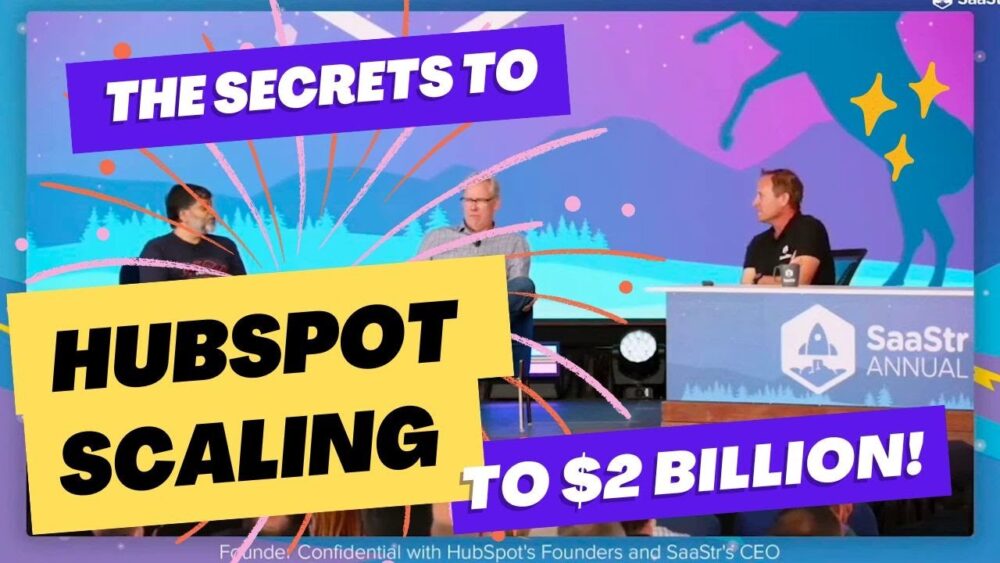
Most SaaS stories love to brag about the finish line. Bigger valuation. Bigger logo. Bigger keynote stage. Bigger everything. But the HubSpot story is more interesting because it did not follow the default startup script. Brian Halligan and Dharmesh Shah did not build a classic enterprise software company, then slap a motivational slogan on top of it. They built a company around a market many people underestimated, a philosophy many people dismissed, and a culture they treated like a product instead of a poster on the wall.
That is what makes HubSpot’s climb to $2 billion-plus in ARR so useful for founders, operators, marketers, and growth leaders. This was not one lucky quarter or one heroic product launch. It was a long game made of stubborn positioning, relentless iteration, smarter distribution, and a willingness to evolve without losing the original plot. In plain English: HubSpot did not scale by acting bigger than it was. It scaled by making growing companies feel seen, served, and slightly less overwhelmed.
If you want the short version, here it is: HubSpot won by betting on underserved businesses, lowering adoption friction, building expansion into the product, turning content into a distribution engine, and refusing to treat culture as “HR stuff.” Now let’s unpack the real playbook.
Why HubSpot’s Growth Story Still Matters
Plenty of software companies grow. Fewer grow while creating a category, expanding into adjacent products, improving profitability, and keeping the brand accessible. That is why HubSpot’s journey matters. Halligan and Shah were not just selling software; they were reshaping how businesses thought about marketing, sales, service, and customer relationships.
In the early days, their biggest insight was wonderfully inconvenient: buyers no longer wanted to be chased around the internet like a raccoon with a credit card. They wanted useful information, relevant content, and a smoother path to trust. That insight became inbound marketing. Then inbound became a growth engine. Then the engine became a platform. Then the platform became a company capable of scaling far beyond its original marketing roots.
That progression is the first big lesson. Companies do not usually jump from one clever idea to billions in recurring revenue. They compound from one sharp insight into a system.
Secret #1: Make a Contrarian Bet and Stick With It
One of the defining HubSpot moves was choosing the SMB and mid-market space when many investors and operators were obsessed with enterprise accounts. On paper, enterprise looked more glamorous. Bigger contracts. Fewer customers needed. More boardroom-friendly slides. The problem was that Halligan and Shah saw something different: the internet would disproportionately help smaller businesses compete, and those businesses would need better tools.
That was not a cute branding angle. It became a strategic foundation. HubSpot focused on companies big enough to have real pain, but small and mid-sized enough to crave ease, speed, and value. Instead of forcing these customers into enterprise-grade complexity or leaving them with flimsy small-business tools, HubSpot built for the wide middle. That segment turned out to be gold.
The lesson here is brutal but important: you do not need a market everyone respects. You need a market you understand better than everyone else. Halligan and Shah were willing to look wrong for a while, which is usually the admission fee for being right later.
Secret #2: Turn a Philosophy Into a Distribution Engine
Inbound marketing was never just a slogan. It was an acquisition strategy hiding in plain sight. While other companies spent heavily trying to interrupt people, HubSpot invested in content, education, search visibility, and community. It built trust before the sales conversation even started.
This matters because SaaS growth gets expensive fast. Customer acquisition cost can sneak up on a company like a gym membership you forgot to cancel. HubSpot’s answer was to create a model where education itself generated demand. Blogs, guides, tools, conferences, certification, and thought leadership all worked together to lower CAC and widen the top of the funnel.
That is one of the most overlooked parts of the HubSpot story. The company did not just market the product. It marketed the worldview behind the product. When that happens, prospects do not merely discover you. They start agreeing with you before they ever book a demo.
Secret #3: Use Freemium as a Wedge, Not a Giveaway
HubSpot’s free CRM was one of its smartest scaling moves because it removed cost and complexity from adoption. The company recognized that many businesses were still managing customer relationships with spreadsheets, memory, and the kind of chaos that makes every Monday morning feel like a small crime scene.
By making CRM free, HubSpot reduced the barrier to entry and increased the odds that customers would begin their journey inside the ecosystem. This is where many companies misunderstand freemium. Free is not a pricing gimmick. It is an architectural decision. It works when the product is easy to adopt, easy to understand, and connected to a credible upgrade path.
HubSpot did not make a free CRM because generosity is a business model. It made a free CRM because the simplest way to expand the future customer base was to help more companies get started. That decision widened the funnel, improved product familiarity, and created natural expansion opportunities into paid hubs and add-ons.
Secret #4: Build Expansion Into the Business Model
Getting the first sale is useful. Keeping the customer and growing the account is where SaaS becomes durable. HubSpot’s founders have been candid about this: churn matters, expansion matters, and recurring revenue quality matters. You do not scale to billions by leaking value out of the bucket and calling it momentum.
HubSpot learned to improve retention and grow expansion revenue by broadening its product suite. A customer might enter through marketing, then add sales tools, then service, content, operations, commerce, and AI-powered capabilities over time. That is not accidental. It is a designed journey.
This model solves one of the hardest problems in SaaS: how to grow without relying entirely on net-new customer acquisition. The best businesses create more value after the initial purchase. HubSpot got stronger when it gave customers reasons to stay, deepen usage, and consolidate tools.
In other words, the road to $2 billion-plus in ARR was not paved by heroic new-logo wins alone. It was paved by helping customers grow into more of the platform.
Secret #5: Build a Platform, Not a Patchwork Quilt
At some point, every successful software company faces a decision. Do you stay narrow and elegant, or do you expand and risk turning into a Frankenstein stack with too many tabs, too many logins, and too many apologies? HubSpot’s answer was to expand, but to do it around a unified customer platform.
That distinction matters. The point was not to collect products like baseball cards. The point was to create shared data, shared workflows, shared reporting, and shared customer context across teams. Marketing, sales, and service are not separate universes in a real business. They are one customer story told badly by disconnected software.
HubSpot’s platform strategy helped fix that. As the suite expanded, the value of the system increased because the products made more sense together than apart. This is how platform businesses defend themselves: not by being everywhere, but by making the customer experience feel progressively more coherent.
Secret #6: Scale Distribution Through More Than One Motion
Another secret in the HubSpot playbook is that distribution did not depend on a single motion. The company used product-led, direct-led, and partner-led channels. That mix gave HubSpot flexibility as it grew.
The partner ecosystem, in particular, helped the company scale reach and customer success. Solutions partners did not just refer customers. They extended implementation capacity, added services, and increased the amount of value customers could get from the platform. That makes a big difference when you are selling to scaling businesses that want help, not just software.
Founders often act as if one go-to-market motion must be crowned king. HubSpot’s example is more practical. Use the motion that matches the customer, the price point, and the stage of the relationship. The winning system is often hybrid, not ideological.
Secret #7: Culture Is Not Decorative, It Is Operational
Dharmesh Shah has long talked about culture as if it were a product, and that framing is one of the sharpest ideas in the HubSpot story. It means culture is designed, tested, revised, and documented. It means employee experience is not a side quest. It is infrastructure.
HubSpot’s Culture Code became famous because it felt unusually explicit and unusually honest for its time. But the deeper point is not that the company made a deck. The deeper point is that leadership treated culture like something scalable. It informed hiring, transparency, decision-making, and how the company talked to itself while growing quickly.
This matters more than founders usually admit. When a company is small, alignment can survive on vibes, caffeine, and whoever sits closest to the whiteboard. At scale, that stops working. If you do not build cultural clarity on purpose, confusion will build itself for free.
Secret #8: Founder Alignment Multiplies Speed
Halligan and Shah had different strengths, and that was a feature, not a bug. Halligan leaned toward sales, marketing, and market-facing strategy. Shah leaned toward product, engineering, systems, and written thinking. That complementary split gave HubSpot range.
Just as important, they were deliberate about how they worked together. They tested the relationship early, used writing heavily, and built a pattern of healthy debate. That kind of founder alignment does not make disagreements disappear, but it does stop every decision from turning into amateur theater.
Startups love to talk about founder chemistry like it is mystical. In reality, the HubSpot story suggests something less romantic and more useful: strong co-founder relationships are built through repeated work, clear roles, shared values, and a willingness to challenge each other without trying to win every room.
Secret #9: Keep Evolving the Playbook
One reason HubSpot kept scaling is that it did not become sentimental about the first version of itself. Over time, it evolved from a marketing application into a broader CRM platform. It added sales, service, CMS, operations, commerce, and now deeper AI functionality. It adjusted pricing. It sharpened product quality. It improved the balance between sales-led and product-led growth.
That willingness to evolve is essential. The habits that get a company from zero to early traction are not always the habits that get it to massive scale. Some founders cling to the original formula because it feels like loyalty. Usually it is fear wearing a team hoodie.
HubSpot’s growth shows a better approach: keep the mission, update the machinery.
What Founders and Growth Teams Should Steal From HubSpot
1. Pick a customer segment with conviction
Do not chase the market that looks impressive on LinkedIn. Chase the market where your insight is unfairly strong.
2. Treat education as a growth asset
Helpful content is not filler. When done well, it reduces CAC, builds trust, and turns your expertise into a moat.
3. Remove friction early
Free tools, easier onboarding, simple setup, and faster time-to-value are not “nice to have.” They are how modern growth gets unlocked.
4. Obsess over retention and expansion
New revenue is exciting. Revenue that renews, grows, and compounds is how companies stay alive long enough to become legends.
5. Build systems that scale people
Whether it is culture, product architecture, or go-to-market motions, anything important should be repeatable beyond the founders’ personal energy.
Extra Perspective: What Scaling Actually Feels Like in Real Life
Here is the part that rarely shows up in the shiny conference clips: scaling to $2 billion-plus in ARR does not feel like one long victory lap. It feels messy, repetitive, occasionally humbling, and strangely ordinary. One week you are celebrating a product launch. The next week you are debating churn in a cohort that looked healthy three months earlier. Then someone asks if pricing is too high, too low, too complicated, or somehow all three at once.
That is why the HubSpot story resonates beyond the numbers. The experiences behind this kind of growth are familiar to anyone who has tried to build something durable. At first, the company feels like a project. Then it feels like a product. Then it starts to feel like a city. Different neighborhoods form. Marketing speaks one dialect, product another, sales a third, and customer success becomes the translator everyone suddenly depends on. If leadership does not unify the story, the business begins to drift into internal confusion even while external revenue looks great.
Another common experience is realizing that early strengths can become later constraints. A founder who was brilliant at hustling the first hundred customers may not be the person who naturally builds a world-class operating cadence. A scrappy sales process that worked when every lead was hand-held may collapse when thousands of smaller accounts enter through free tools and low-touch channels. The company has to relearn itself several times. That is not failure. That is scaling.
There is also a psychological shift that happens when a company moves from “Can we survive?” to “Can we sustain quality while growing faster?” Those are wildly different questions. Survival rewards improvisation. Scale rewards systems. Survival applauds the hero who fixes everything at midnight. Scale rewards the boring genius who makes midnight emergencies less likely in the first place.
HubSpot’s founders seemed to understand that over time. The bigger the company gets, the less the game is about individual brilliance and the more it is about designing an environment where good decisions happen repeatedly. That applies to hiring, pricing, onboarding, partner strategy, product architecture, and culture. It also applies to communication. When teams grow, ambiguity gets expensive. Clear writing, clear goals, and clear customer focus stop being “nice leadership habits” and start becoming margin protection.
And then there is the emotional reality: scale can be both exhilarating and weirdly disorienting. The thing you built to solve one problem becomes responsible for solving ten more. Customers ask for simplicity while the business grows more complex under the hood. Employees want speed and stability at the same time. Investors want growth and discipline. Leadership wants innovation without chaos. Welcome to the fun house.
The companies that break through are rarely the ones that avoid those tensions. They are the ones that learn to manage them without losing their identity. That may be the most useful lesson from Halligan and Shah: massive scale is not about becoming a different company every year. It is about becoming a better version of the same company, on purpose, over and over again.
Conclusion
The secret to scaling to $2 billion-plus in ARR was not one magic lever. For Brian Halligan and Dharmesh Shah, it was a stack of smart choices that reinforced one another: a contrarian market bet, a category-defining inbound engine, a freemium wedge, a unified platform, strong retention thinking, partner-enabled distribution, and a culture designed to scale instead of crack.
That is the real takeaway for modern SaaS leaders. Big outcomes usually come from connected systems, not isolated hacks. HubSpot did not win by copying the standard enterprise software blueprint. It won by understanding how scaling businesses actually buy, adopt, and grow. Then it kept updating the company to match that reality.
In a startup world addicted to shortcuts, that may be the least flashy secret of all: patient, disciplined compounding still works. Boring? Maybe. Effective? Absolutely.