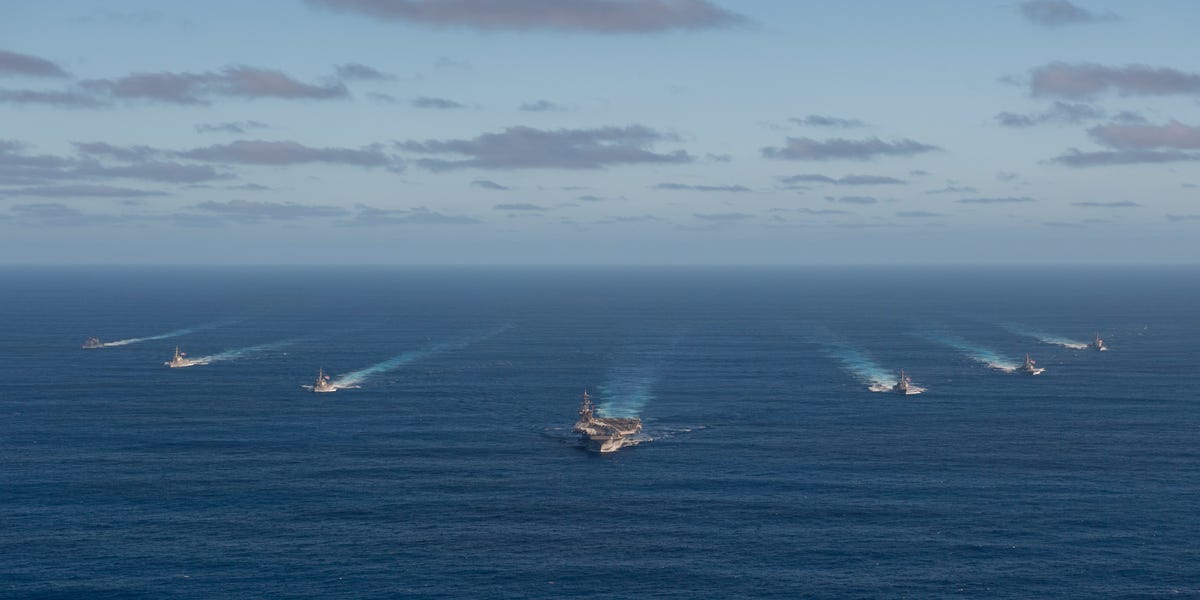
The USS Theodore Roosevelt, known by its hull number CVN-71 and its well-earned nickname “The Big Stick,” is one of the most recognizable aircraft carriers in the United States Navy. Massive, nuclear-powered, and built to project American naval power across the globe, this Nimitz-class carrier is more than a floating runway. It is a city at sea, a symbol of deterrence, a workplace for thousands of sailors, and a living tribute to the 26th president of the United States.
Named after Theodore Roosevelt, the energetic president who believed in a strong Navy and famously advised the nation to “speak softly and carry a big stick,” the carrier carries both his name and his attitude. It does not shout for attention. It simply arrives, with a flight deck longer than three football fields, a crew large enough to populate a small town, and enough operational complexity to make a normal office printer jam look like a relaxing vacation.
What Is the USS Theodore Roosevelt?
The USS Theodore Roosevelt is the fourth Nimitz-class nuclear-powered aircraft carrier built for the U.S. Navy. Aircraft carriers like CVN-71 serve as mobile air bases, allowing naval aviation to operate far from fixed runways. That capability gives the United States flexibility during crises, humanitarian missions, deterrence patrols, joint exercises, and combat operations.
Commissioned on October 25, 1986, the ship was built by Newport News Shipbuilding in Virginia. Like other Nimitz-class carriers, Theodore Roosevelt is powered by nuclear reactors, which allow it to remain at sea for extended periods without the frequent refueling needs of conventionally powered ships. Food, supplies, maintenance schedules, and crew endurance are often bigger limits than fuel.
At roughly 1,092 feet long, the carrier is enormous. Yet its size is only part of the story. The real magic is coordination. Flight deck crews, aviation squadrons, engineers, supply teams, medical staff, cooks, electronics technicians, navigation specialists, and command personnel all work together in a tightly choreographed rhythm. A carrier does not function because it is big. It functions because thousands of people make big look organized.
The Meaning Behind the Name
Theodore Roosevelt was not just a president with a mustache that looked like it had its own foreign policy. He was also one of the most influential advocates for American sea power. Before and during his presidency, Roosevelt believed the United States needed a modern, capable Navy to protect trade, support diplomacy, and defend national interests.
His best-known naval statement came through the Great White Fleet, a group of U.S. battleships sent around the world from 1907 to 1909. The voyage demonstrated American naval capability and signaled that the United States had arrived as a global maritime power. For that reason, Roosevelt is often remembered as a major figure in the development of the modern U.S. Navy.
The USS Theodore Roosevelt honors that legacy. Its motto, Qui Plantavit Curabit, is commonly translated as “He who has planted will preserve.” It fits the ship’s identity: a vessel rooted in tradition, but constantly modernized to remain relevant in a changing world.
Construction and Commissioning
The carrier’s construction began during the early 1980s, with its keel laid in 1981 and its christening taking place in 1984. One notable feature of the ship’s construction was the use of modular building techniques. Instead of assembling the carrier piece by tiny piece in the most painful possible way, shipbuilders built large modules, installed systems inside them, and then lifted those sections into place.
This approach helped speed construction and influenced later aircraft carrier building methods. In simple terms, the USS Theodore Roosevelt was not just a ship; it was also a construction milestone. Think of it as a very expensive, very serious version of building with blocksexcept the blocks weigh hundreds of tons and nobody wants to step on one barefoot.
When the ship entered service in 1986, it became part of a long line of U.S. aircraft carriers designed to operate as the centerpiece of a carrier strike group. A carrier rarely sails alone during major operations. It works with cruisers, destroyers, submarines, supply ships, aircraft squadrons, and command units to create a flexible naval force.
Life Aboard “The Big Stick”
Life aboard the USS Theodore Roosevelt is intense, structured, and surprisingly human. A deployed carrier is often described as a floating city, and that description is not just decorative writing. Sailors eat, sleep, work, exercise, study, worship, receive medical care, and build friendships within the steel walls of the ship.
The flight deck is one of the most demanding workplaces in the world. Aircraft launch and recover in a noisy, windy, high-pressure environment where safety depends on training, communication, and trust. Below deck, engineers keep power flowing, cooks prepare thousands of meals, logistics teams track supplies, and maintenance crews keep equipment ready.
There is also a culture to the ship. Sailors assigned to Theodore Roosevelt are often called Rough Riders, a reference to Roosevelt’s famous volunteer cavalry regiment from the Spanish-American War. The nickname gives the crew a shared identity and connects daily service to the ship’s namesake.
Major Deployments and Historical Role
The USS Theodore Roosevelt has participated in many significant operations since joining the fleet. Its early service included deployments to the Mediterranean, Persian Gulf, and other strategic regions. During the 1991 Gulf War, the carrier and its embarked air wing supported combat operations as part of the U.S.-led coalition response to Iraq’s invasion of Kuwait.
In the years that followed, Theodore Roosevelt continued to support operations over Iraq, the Balkans, Afghanistan, and the broader Middle East. After the September 11 attacks, the ship deployed in support of Operation Enduring Freedom, contributing to air operations over Afghanistan. This period became one of the defining chapters in the ship’s modern history.
The carrier has also taken part in joint exercises, multinational operations, and presence missions in the Indo-Pacific. These deployments are important because aircraft carriers are not only used during war. They are also tools of diplomacy, reassurance, disaster response, and deterrence. When a carrier visits a port, joins allied exercises, or operates in international waters, it sends a message without needing a press conference and a dramatic soundtrack.
Modernization and the F-35 Era
Aircraft carriers must evolve because naval aviation evolves. The USS Theodore Roosevelt has undergone major maintenance and modernization periods, including its midlife refueling and complex overhaul. These projects are not glamorous, but they are essential. They refresh the ship’s systems, extend service life, and prepare the carrier for newer aircraft and mission demands.
In the 2020s, Theodore Roosevelt underwent updates connected to future aviation requirements, including work associated with operating newer aircraft such as the F-35C. That matters because a carrier is only as effective as the aircraft, sensors, communications systems, and people it can support. Modernization keeps older Nimitz-class carriers useful even as newer Ford-class carriers enter the fleet.
The ship’s continued role shows a practical truth about naval power: replacing a carrier is not like replacing a phone. You do not simply wait for a sale, choose a color, and transfer your contacts. Aircraft carriers are national investments that serve for decades, and keeping them ready requires constant maintenance, training, and upgrades.
The 2020 COVID-19 Outbreak
One of the most widely reported moments in the ship’s recent history came in 2020, when the USS Theodore Roosevelt experienced a COVID-19 outbreak during deployment. The incident drew national attention because it highlighted the challenge of controlling a contagious illness inside a ship, where thousands of people live and work in close quarters.
The outbreak led to major operational, medical, and leadership decisions. It also became a case study in public health, military readiness, and crisis communication. While the event was difficult for the crew and the Navy, it also showed the complexity of protecting sailors while preserving the readiness of a major warship.
Today, the episode remains part of the carrier’s story, not because it defines the ship, but because it revealed how modern naval operations must handle threats that are not always missiles, storms, or rival fleets. Sometimes the challenge is microscopic, stubborn, and very rude.
Recent Operations and Readiness
In recent years, the USS Theodore Roosevelt has remained active in the Pacific and beyond. Public Navy releases in 2025 and 2026 show the carrier continuing training, readiness exercises, and operations connected with Carrier Strike Group 9. In 2024, the ship completed a major deployment that included operations in the U.S. 7th and 5th Fleet areas, thousands of sorties, extensive flight hours, replenishments at sea, and participation in major exercises.
These numbers are impressive, but the deeper point is readiness. A carrier strike group must be able to move, communicate, launch aircraft, recover aircraft, maintain systems, coordinate with allies, and respond to changing circumstances. That level of readiness is not created by slogans. It is built through repetitive training, disciplined maintenance, and sailors doing their jobs even when they are tired, seasick, or desperately missing normal Wi-Fi.
Why the USS Theodore Roosevelt Still Matters
The USS Theodore Roosevelt matters because aircraft carriers remain central to U.S. naval strategy. They offer mobility, endurance, and visible presence. Unlike land bases, carriers can move. Unlike smaller ships, they can support sustained aviation operations. Unlike purely symbolic gestures, they bring real operational capability.
For allies, a carrier can be reassuring. For rivals, it can be a warning. For humanitarian situations, it can provide command capacity, aircraft support, logistics, and medical resources. For the sailors aboard, it is simply homean enormous, loud, steel home that moves through the ocean and occasionally shakes your coffee cup for no reason.
Theodore Roosevelt also represents continuity. It connects the age of Roosevelt’s Great White Fleet to the era of nuclear propulsion, advanced aircraft, integrated strike groups, and multinational maritime operations. The tools have changed, but the strategic idea remains familiar: sea power gives a nation reach.
Interesting Facts About the USS Theodore Roosevelt
It Is Nicknamed “The Big Stick”
The nickname comes from Theodore Roosevelt’s famous phrase, “Speak softly and carry a big stick.” It suits the carrier perfectly. The ship is built for presence, not drama. It does not need to brag. Its silhouette does that already.
It Is a Nimitz-Class Carrier
As part of the Nimitz class, CVN-71 belongs to one of the most successful aircraft carrier designs in modern naval history. These carriers have served across decades of changing technology, politics, and global security challenges.
It Functions Like a Floating City
With thousands of sailors and air wing personnel aboard during deployment, the carrier needs food service, medical care, maintenance shops, administrative offices, sleeping spaces, recreation areas, and command centers. It is part airport, part factory, part neighborhood, and part marathon.
Its Crew Identity Is Tied to Roosevelt’s Legacy
The crew’s “Rough Riders” identity gives the ship a strong cultural link to Theodore Roosevelt’s life and leadership style. Pride, toughness, and service are central themes in the ship’s public identity.
Experiences Related to the USS Theodore Roosevelt
For many people, the USS Theodore Roosevelt is first experienced from a distance. You might see it in a photograph, a Navy video, a documentary, or from the shoreline near San Diego when a carrier returns home. Even through a screen, the scale is hard to ignore. A destroyer looks large until an aircraft carrier appears nearby and politely reminds everyone what “large” really means.
Visitors who have seen a Nimitz-class carrier in port often describe the same reaction: the ship does not seem real at first. Its flight deck stretches above the pier like a steel horizon. The island structure rises over the deck, covered with antennas and platforms. Sailors move along gangways and work areas with the calm efficiency of people who know exactly where they are going, even when the rest of us would need a map, a guide, and possibly breadcrumbs.
For sailors assigned to Theodore Roosevelt, the experience is deeper and more personal. A carrier deployment can mean long days, tight schedules, and months away from family. It can also mean professional growth, friendships, and memories that last a lifetime. Many sailors learn skills on board that shape their entire careers: leadership, technical troubleshooting, teamwork, time management, and the fine art of sleeping whenever the opportunity appears.
The ship also creates shared rituals. Flight operations, meals, drills, maintenance periods, port calls, holiday messages, ceremonies, and homecomings all become part of the carrier’s emotional landscape. A change of command ceremony on the flight deck, for example, is not just a formal event. It is a reminder that leadership changes, but the ship’s mission continues. The steel remains, the crew rotates, and the legacy grows.
Families experience the USS Theodore Roosevelt in a different way. For them, the carrier may represent pride mixed with waiting. They follow deployment updates, watch return-to-port videos, send care packages, and count down days. A homecoming is not simply a ship arriving. It is thousands of private reunions happening beside one very public symbol of national power.
History enthusiasts experience the ship as a bridge between past and present. The name Theodore Roosevelt brings to mind battleships, the Great White Fleet, and the rise of the United States as a maritime power. CVN-71 brings that legacy into the age of jet aircraft, nuclear propulsion, digital communications, and global carrier strike groups. Studying the ship is like watching more than a century of naval thinking compressed into one hull.
For writers, educators, and students, the USS Theodore Roosevelt offers a rich topic because it touches so many themes: engineering, leadership, military history, public health, geopolitics, aviation, logistics, and human resilience. It is not just a machine. It is an institution that moves. Every deployment writes another chapter, and every crew member adds a line.
Perhaps the most memorable experience connected with the USS Theodore Roosevelt is the sense of organized purpose. Everything aboard a carrier has a reason. Every uniform color on the flight deck, every watch rotation, every maintenance checklist, every training exercise, and every command decision exists because a carrier is too complex for improvisation. That is the quiet lesson of “The Big Stick”: strength is not only about size. It is about preparation, discipline, and people working together when the margin for error is small.
Conclusion
The USS Theodore Roosevelt remains one of the most important aircraft carriers in the U.S. Navy. From its construction innovations and Cold War-era commissioning to its Gulf War service, post-9/11 deployments, modernization periods, and recent Pacific training operations, CVN-71 has lived up to the legacy of its namesake. It is powerful, adaptable, historically significant, and deeply human because behind every radar, aircraft, and steel passageway are sailors doing demanding work at sea.
As “The Big Stick,” the carrier continues to represent Theodore Roosevelt’s belief in preparedness, resolve, and maritime strength. It is a reminder that naval power is not only measured in tons, speed, or aircraft capacity. It is measured in endurance, teamwork, credibility, and the ability to show up when history gets complicated.