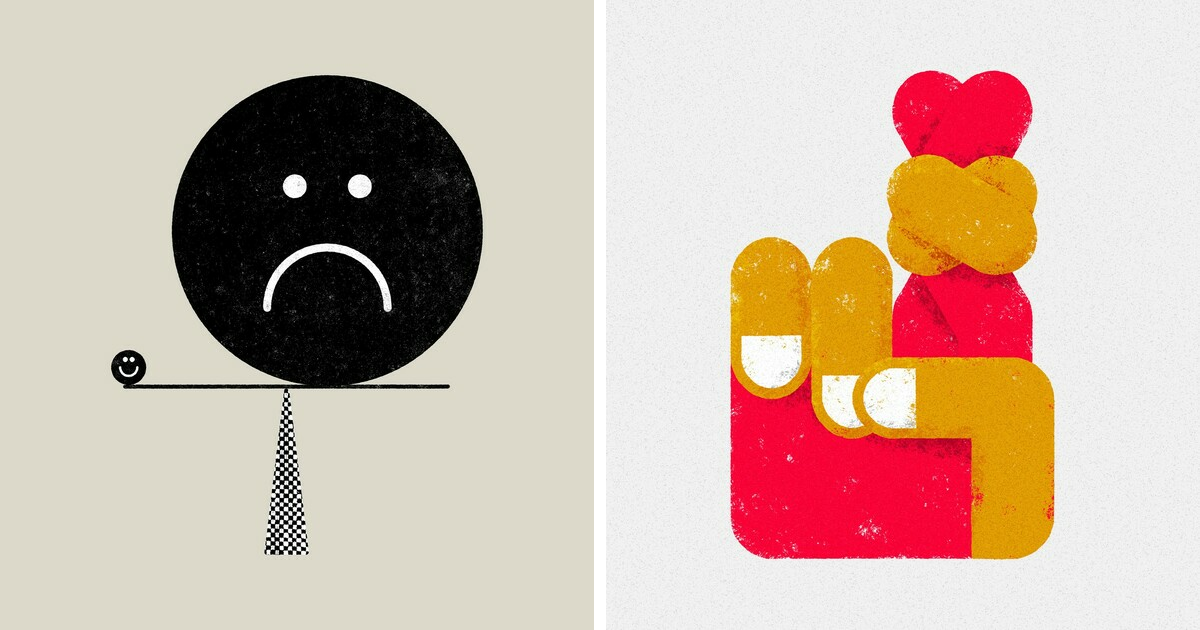
If your brain enjoys a good workout but your eyes prefer something prettier than a spreadsheet, Jardel Vieira has entered the chat. His collection of 45 visual riddles turns minimalist illustration into a guessing game, a conversation starter, and occasionally a tiny identity crisis. You look once and think, “Oh, I get it.” Then you look again and realize the image is doing far more than showing off a clever shape.
That is the magic of Vieira’s work. He strips an idea down to a few objects, a punchy color palette, and a composition so clean it practically dares you to underestimate it. Then, without using a paragraph of explanation or a big neon sign that says “THIS IS THE MESSAGE,” he gets viewers to do the one thing the internet rarely encourages: slow down and think.
These 45 visual riddles are not traditional brain teasers in the “find the hidden cat” sense. They are closer to conceptual puzzles. Some feel funny. Some feel sharp. Some feel like social commentary wearing a stylish little disguise. And nearly all of them ask the same question: can you decode meaning from as little information as possible?
That challenge is exactly why this collection works so well. It blends visual storytelling, symbolism, minimalism, and a dash of mischief into a format that is instantly scroll-stopping. One second you are casually browsing. The next, you are staring at an illustration like it just insulted your intelligence in a very elegant font.
Who Is Jardel Vieira?
Jardel Vieira is a Brazilian graphic designer and illustrator with more than a decade of experience in advertising agencies and design studios. That background matters because his images do not just look polished; they communicate like ads, editorials, and conceptual posters rolled into one. He understands how to say a lot with very little, and that skill is the entire engine behind this collection.
Vieira has described his creative goal as making images that viewers can decode immediately or after deeper interpretation, almost like solving a puzzle. He also explores a wide thematic range, from everyday life and emotions to social issues and news-driven ideas. In other words, he is not simply drawing stylish objects. He is building visual shortcuts to bigger thoughts.
That is what makes these pieces memorable. They are compact, but they are not empty. They are simple, but they are not simplistic. Every line, shape, and omission is doing a job.
Why These 45 Visual Riddles Hit So Hard
1. Minimalism forces your brain to participate
Busy images spoon-feed information. Minimalist images make you earn it. Because Vieira uses limited elements, your mind has to fill in gaps, compare symbols, and test interpretations. That little burst of mental effort is exactly what makes the work satisfying. You are not just looking at the image. You are collaborating with it.
And yes, that sounds dramatic, but it is true. The less an image explains, the more the viewer has to interpret. That is why minimalist visual riddles can feel more engaging than technically dense artwork. The design is clean, but the thinking is not lazy.
2. They reward second and third looks
Great visual riddles are built on delayed recognition. The first glance gives you structure. The second reveals tension. The third is where the meaning lands and you mutter, “Ohhh, that’s smart.” Vieira understands this rhythm well. His images are designed for the tiny pause between seeing and understanding.
That pause is powerful. It creates suspense without needing motion, sound, or a clickbait headline. The image itself becomes the hook.
3. The work balances wit with meaning
One reason these illustrations stand out is that they are not trying to be clever for cleverness’ sake. There is usually a real idea underneath the visual trick. Sometimes the point is emotional. Sometimes it is cultural. Sometimes it is satirical. The wit opens the door, but the meaning keeps you in the room.
That balance matters. A puzzle with no emotional or social resonance is just a puzzle. A strong visual riddle, on the other hand, lets a viewer feel smart while also feeling something else: surprise, discomfort, recognition, or even a laugh that arrives half a second late.
How To Read A Jardel Vieira Illustration Like A Pro
You do not need an art history degree, a gallery tote bag, or a mysterious habit of saying “interesting use of negative space” at dinner parties. You just need a better viewing strategy.
Start with the obvious object
Look at the most recognizable item first. Is it a hand, a face, a tool, a food item, a household object, or a body part? Vieira often begins with something familiar because recognition creates comfort. Then he disrupts that comfort by combining the object with something unexpected.
Notice what has been replaced
A lot of visual riddles work through substitution. One object stands in for another idea. A shape might double as a symbol. A missing piece might be the message. If something feels slightly off, that is usually where the meaning lives.
Think in metaphors, not just objects
This is where many viewers get stuck. They stay literal. But visual riddles thrive on metaphor. A cracked object may suggest fragility, stress, or loss. A repeated symbol may point to routine, control, or obsession. Scale shifts can imply power. Empty space can imply isolation. The image is rarely asking, “What is this?” It is asking, “What does this stand for?”
Pay attention to contrast
Contrast does more than make an illustration look good. It directs thought. Light and dark, full and empty, sharp and soft, human and mechanical, playful and grim: these oppositions create tension. And tension is where interpretation begins.
Common Themes Across The 45 Visual Riddles
What makes this collection stronger than a random pile of clever images is that it feels thematically rich. Even without a paragraph under every illustration, you can sense recurring concerns running through the work.
Everyday life, reimagined
Some of the most effective visual riddles begin with ordinary situations and twist them just enough to reveal something hidden beneath routine. A simple daily object can suddenly become a comment on burnout, distraction, loneliness, ambition, or modern habits. That makes the work relatable. The riddles do not belong to some distant abstract world. They start in the kitchen, the office, the phone screen, the mirror, the commute.
Emotions made visible
Feelings are messy. Vieira’s illustrations often make them legible. Through compressed symbols and visual metaphors, abstract emotions become concrete enough to grasp. Anxiety might look like pressure. Love might look like fusion. Isolation might look like distance or emptiness. The result is artwork that feels both cerebral and human.
Social commentary without a lecture
Some images clearly lean into cultural critique. That is another reason the collection has staying power. Vieira does not need an essay to comment on consumption, media, technology, or social behavior. He lets objects do the talking. The image becomes the argument, and the audience finishes the sentence.
Why Visual Riddles Are So Addictive
There is a psychological reason these images are hard to forget. Riddles and insight problems often expose the assumptions we bring to a question before we even realize we have made them. When the answer arrives, we are not just learning something new; we are correcting a hidden mental shortcut. That little jolt is satisfying because it feels like the mind rearranging furniture at top speed.
Visual riddles add another layer to that process because they recruit perception as well as interpretation. You are scanning, comparing, recognizing, rejecting, revising, and suddenly arriving at meaning. It is part observation, part problem-solving, part “I cannot believe a simple drawing just humbled me.”
That is also why minimalist design helps here. When unnecessary details are removed, the main idea becomes easier to detect, but only if the viewer is willing to engage. Strong minimalism does not flatten meaning. It sharpens it.
Why This Collection Works So Well Online
The internet loves images, but it does not always reward depth. Vieira’s work sneaks depth into a format built for speed. A bold, clean composition stops the scroll. The hidden meaning keeps attention. The urge to interpret creates comments, shares, and debate. Suddenly an illustration becomes interactive without any actual buttons.
That shareability is a huge part of the collection’s appeal. People do not just want to look at these images; they want to test themselves against them. They want to guess the meaning, compare answers, and see whether other viewers noticed the same clue. It is social media fuel, but the premium kind. Less empty sugar, more brain crunch.
In a crowded visual culture, that is no small achievement. To make people pause is hard. To make them think is harder. To make them think and enjoy it is where this collection wins.
What Designers, Writers, And Content Creators Can Learn From Jardel Vieira
These 45 visual riddles are not just entertaining. They are instructive. They show that audiences do not always need more information; sometimes they need better framing. One powerful image can carry the weight of a paragraph when it is built on a clear concept. One unexpected metaphor can communicate faster than a long explanation. One carefully chosen omission can create more curiosity than a page full of detail.
For writers, the lesson is to trust implication. For designers, it is to strip away decoration that does not serve the idea. For marketers and publishers, it is a reminder that smart content does not have to scream. It can whisper and still get quoted.
That is probably why Vieira’s collection feels so modern. It understands attention spans without surrendering intelligence. It respects the viewer enough to leave room for interpretation.
The Experience Of Deciphering 45 Visual Riddles
Spending time with a collection like this is a strangely personal experience. At first, it feels casual. You expect to scroll through a few clever illustrations, nod politely, and move on with your day. Then one image catches you off guard. You understand it instantly, and that tiny burst of satisfaction makes you hungry for the next one. Another arrives and refuses to open up so easily. Now you are leaning closer, mentally rotating symbols, testing meanings, and wondering why a few shapes on a screen suddenly feel like a final exam in symbolism.
That push and pull is part of the charm. Some riddles reward instinct. Others make you work. Some feel funny because the idea clicks with almost cartoon-like elegance. Others land in a heavier place, where the image stops being a game and starts feeling like commentary. The emotional range is what keeps the experience from becoming repetitive. You are not just solving visual puzzles. You are moving between humor, surprise, recognition, discomfort, and admiration.
There is also a quiet pleasure in being wrong. A strong visual riddle often leads you toward an obvious interpretation before revealing a better one. That shift can be humbling, but it is also what makes the image memorable. You remember the moment your brain changed its mind. It is the same little thrill people chase in wordplay, plot twists, and good satire. Only here, the turnaround happens visually, often without a single sentence telling you what to think.
Another part of the experience is how social it becomes, even when you are looking alone. You start imagining how other people would read the same image. Would they see the joke faster? Would they catch the social criticism you almost missed? Would they interpret the symbol in a completely different way? These riddles naturally invite discussion because they sit in that delicious zone between clarity and ambiguity. They are not meaningless, but they are open enough to create conversation.
And then there is the cumulative effect of seeing 45 of them together. One riddle is clever. Five are impressive. Forty-five start to reveal a worldview. You begin to notice the artist’s habits, the recurring tension between simplicity and complexity, the way objects are used as emotional stand-ins, the way color and emptiness are treated almost like language. The collection stops feeling like a gallery of disconnected ideas and starts feeling like a coherent method of seeing the world.
By the end, you are left with more than admiration for technical skill. You come away with the sense that visual language can still surprise us, even in an age when everyone is bombarded with images from morning until midnight. That may be the most rewarding part of the experience. These riddles remind you that looking is not the same as noticing, and noticing is not the same as understanding. Jardel Vieira’s work lives in the gap between those three steps, and that is exactly where the fun begins.
Final Thoughts
Jardel Vieira’s 45 visual riddles succeed because they do more than look smart. They make the viewer participate. They invite interpretation without becoming pretentious, and they turn minimal design into a storytelling tool with real bite. Whether the subject is everyday life, emotion, social commentary, or pure symbolic wit, the result is the same: you stop, you decode, and you remember.
That is rare. Plenty of images are attractive. Plenty are clever. Far fewer manage to be attractive, clever, emotionally resonant, and genuinely interactive without saying a word. Vieira’s collection does all of that while keeping the compositions tight, the concepts sharp, and the experience fun.
So if you find yourself staring at one of these illustrations a little longer than expected, congratulations: the riddle is working. And if you suddenly feel compelled to send it to a friend with the caption “What do you think this means?” congratulations again. That is how great visual storytelling spreads.