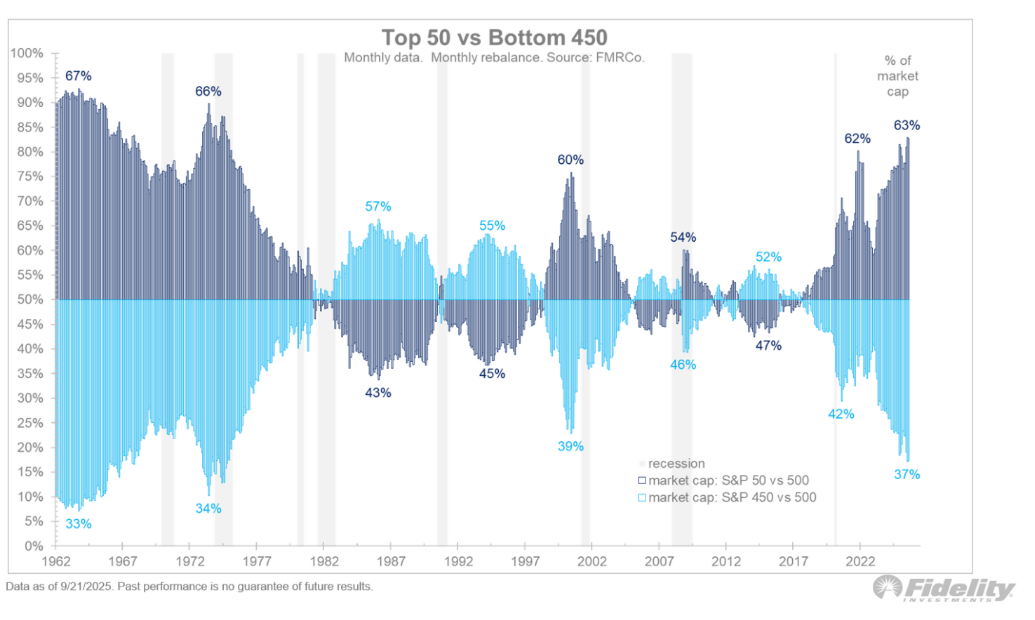
Picture the stock market as a giant buffet with 500 dishes on the table. In theory, you can sample everything. In practice, a handful of trays keep getting refilled, photographed, reposted, and fought over by the crowd. That is the new normal of stock market concentration.
For decades, investors treated the S&P 500 as the shorthand for broad exposure to corporate America. It still is, in one important sense: the index remains a core gauge of large-cap U.S. stocks. But the meaning of “broad” has changed. Today, the index may contain 500 companies, yet an outsized share of performance, attention, and risk can come from a very small group of mega-cap names. The market is still big. It is just not spreading the spotlight around very evenly.
That shift matters more than it first appears. Stock market concentration affects index performance, diversification, active fund results, valuations, and even the way ordinary investors understand risk. It shapes headlines, portfolio construction, and the annoying modern habit of pretending that owning one index fund automatically means you are diversified enough to nap peacefully through volatility. Sometimes you are. Sometimes you are just taking a very elegant group project with seven overachievers.
What Stock Market Concentration Actually Means
Stock market concentration describes how much of an index or market is controlled by its biggest companies. When the largest stocks account for a growing share of market value, concentration rises. In a market-cap-weighted index, the biggest companies naturally receive the biggest weights. If those companies keep outperforming, they become even bigger. Then the index allocates even more to them. Then investors buy the index. Then the biggest names get an even larger share of flows. Congratulations: the flywheel is now humming.
There is nothing inherently wrong with this structure. In fact, cap-weighting is popular because it is low-cost, rules-based, tax-efficient, and hard to beat over time. The problem is that when concentration gets extreme, the index can start behaving less like a broad market basket and more like a superstar playlist with 493 opening acts.
This is why concentration is not just a math issue. It is a behavior issue, a benchmark issue, and a storytelling issue. When people say “the market went up,” they often mean “a few huge stocks went up enough to drag the index higher.” Those are not the same statement, and the difference matters.
Why Concentration Has Become the New Normal
Winner-Take-Most Business Models Got Bigger
The modern economy has been unusually friendly to companies that scale fast and stay dominant. Software, cloud infrastructure, digital advertising, semiconductors, e-commerce, and platform ecosystems have all rewarded firms that can spread fixed costs over gigantic user bases. Once a company builds the network, data advantage, developer ecosystem, or hardware-software moat, it can grow revenues without growing costs at the same speed.
That makes the largest firms look less like bloated industrial dinosaurs and more like profit machines with turbochargers. Investors have noticed. So have index weights.
This is one reason concentration today looks different from older episodes. The largest companies are not merely large in stock-market terms. Many are also highly profitable, cash-generative, and strategically central to the digital economy. They are not just expensive stories in fancy sneakers. In many cases, they are real businesses with real margins and an uncanny ability to colonize adjacent markets before breakfast.
Passive Investing Reinforced the Trend
Passive investing did not invent concentration, but it has helped reinforce it. Cap-weighted funds buy more of what is already bigger. As more money flows into index funds and ETFs, the largest companies receive a larger share of those inflows simply because of how the indexes are constructed.
That does not mean passive investing is villain twirling a mustache in a dark room. It means structure matters. A market that rewards size with higher weights can create a feedback loop, especially when investors prefer the simplicity of index products. Once a handful of stocks become essential index positions, they can attract constant demand even when investors are not making an active call on them individually.
The result is a market that can become top-heavier without every investor consciously deciding, “Yes, I would like one more serving of mega-cap exposure, please.”
AI Turned Leadership Into a Stampede
The AI boom gave concentration another jolt. Companies linked to chips, cloud computing, model training, data-center demand, and digital productivity tools enjoyed a surge in investor enthusiasm. Some of that enthusiasm was speculative, sure. Some of it was rational. The point is that AI created a powerful narrative, and narratives attract capital the way porch lights attract moths.
In this environment, the biggest firms had a built-in advantage. They already had the infrastructure, customers, balance sheets, and engineering talent to spend heavily on AI. That gave investors a reason to believe that the richest companies could become even richer. Whether that ends brilliantly or awkwardly, it clearly accelerated concentration.
Why Concentration Is Not Automatically a Bubble
Here is where the discussion gets more interesting. High concentration makes people nervous because it feels fragile. If a few names are driving everything, then any stumble by those names can hit the whole index. Fair point. But high concentration does not automatically prove a bubble is forming.
That is because concentration can reflect strong fundamentals. Some of the largest U.S. firms have delivered enormous earnings, huge free cash flow, fortress-like balance sheets, and genuine economic power. In other words, they are not all smoke and laser pointers. The market may be paying up for size, but it is often paying up for profitability, durability, and dominance too.
This helps explain why today’s concentration is not a perfect replay of the dot-com era. Back then, valuation excess often outran business reality. Today, in many cases, valuations are elevated but anchored to companies with proven scale and massive cash generation. That does not make them cheap. It makes them harder to dismiss with the old “this feels like 1999” shortcut.
So yes, concentration can be risky. But it can also be a rational outcome in an economy where a small number of firms command extraordinary economic profit. The market is not always wrong just because it is crowded.
Why Concentration Still Matters a Lot
The Diversification Illusion
Many investors assume that buying a broad index fund eliminates concentration risk. It reduces single-stock risk, absolutely. But it does not eliminate dominance by the largest holdings. If a third or more of the index is tied up in a small cluster of companies, your “broad market” exposure may be narrower than you think.
This is especially important when those companies share similar drivers: digital advertising, cloud demand, semiconductor cycles, AI spending, or platform economics. On paper, you own different stocks. In practice, you may be betting on related themes wearing different corporate logos.
Market Breadth Can Look Weak Beneath the Surface
Concentration can make headline indexes look healthier than the typical stock actually feels. If the giants are climbing while hundreds of smaller companies lag, the index may post respectable gains even though the average stock is having a much less glamorous year.
That creates a strange market mood. Investors glance at the benchmark and think everything is fine. Then they open a watchlist full of laggards and start wondering whether their portfolio has offended the market gods. Often, the answer is simply that leadership has narrowed.
It Changes the Active Versus Passive Debate
Highly concentrated markets can be brutal for active managers who do not own enough of the giants. A manager can be right about valuations, balance sheets, and diversification, and still trail badly if the market keeps rewarding the same mega-cap leaders. In that kind of environment, benchmark risk becomes career risk.
That is one reason concentration has become such a big institutional topic. It is not just about whether the market is too narrow. It is also about how difficult it becomes to manage money differently from the index when the index itself is increasingly dominated by a few names.
Valuation Gaps Can Become Uncomfortable
Even if the biggest companies deserve premium valuations, concentration can stretch those premiums further than fundamentals alone justify. At that point, the issue is not whether the leaders are good businesses. It is whether the market has become so eager, so crowded, and so benchmark-dependent that expectations leave little room for disappointment.
That is where concentration becomes less of a scorecard and more of a stress test. How much perfection is already priced in? How much future growth is assumed? How much of the index depends on a small number of firms continuing to execute flawlessly while investors remain impressed?
That is a lot to ask from any group of stocks, even the glamorous ones.
Specific Examples of the Concentration Era
The easiest example is the gap between cap-weighted and equal-weighted versions of the same index. When the standard S&P 500 meaningfully outperforms the equal-weight version, it is often a sign that the largest companies are doing most of the heavy lifting. That performance gap has become one of the clearest visual summaries of modern concentration.
Another example is earnings contribution versus index weight. The biggest companies may produce an enormous share of profits, but their market weights can still grow even faster than their share of earnings. When that happens, concentration is no longer just about strong fundamentals. It is also about valuation expansion, enthusiasm, and structural flows.
Then there is the “Magnificent Seven” phenomenon. Whatever nickname comes next, the underlying point remains the same: a very small group of mega-cap companies has exerted unusual influence over market performance in recent years. Their returns, their earnings outlooks, and even their public product announcements can shape the tone of the entire market.
That is not normal in the old-school diversified sense. But it may be normal in the modern large-cap U.S. market sense. And that is exactly the issue.
How Investors and Institutions Are Adapting
Looking Beyond Classic Cap Weighting
One response has been increased interest in equal-weight and capped indexes. These approaches do not banish concentration, but they reduce dependence on the very largest stocks. They also create more exposure to the rest of the market, which can help if leadership broadens.
The catch is obvious: these approaches can lag badly when mega-caps keep winning. Diversification is wonderfully sensible and occasionally deeply annoying.
Revisiting Mid-Caps, Small-Caps, and International Stocks
Another response is broader diversification across size and geography. If the S&P 500 is increasingly dominated by a handful of mega-caps, then investors may look to mid-cap stocks, smaller companies, or non-U.S. markets for balance. This is not a rebellion against U.S. large caps. It is simply an acknowledgment that a portfolio can become unintentionally lopsided when one segment of the market gets too powerful.
Paying More Attention to Valuations and Breadth
Market watchers are also spending more time on breadth indicators, valuation spreads, and earnings quality. In a concentrated market, those measures can say more about risk than the headline index return does. A market that rises because most stocks are participating feels very different from one that rises because a tiny leadership club refuses to share the podium.
What Happens Next?
The honest answer is that concentration can persist far longer than skeptics expect. Markets do not hand out trophies for spotting a risk early. Sometimes the concentrated leaders keep compounding, keep beating estimates, and keep absorbing more weight. Sometimes breadth improves without a dramatic crash in the leaders. Sometimes the giants cool off and the rest of the market finally gets a turn.
That is why the most useful takeaway is not “concentration means doom” or “concentration does not matter.” Both are too neat. The better takeaway is that concentration changes the character of the market. It changes what diversification means. It changes how benchmarks behave. It changes how risk hides in plain sight.
The new normal is not that big stocks exist. Big stocks have always existed. The new normal is that a broad index can now become structurally dependent on a very small set of corporate superpowers, and many investors may not fully appreciate that dependence until leadership changes.
Real-World Experiences in the Age of Stock Market Concentration
One of the most common experiences in this environment is the investor who buys an S&P 500 fund believing it represents evenly spread exposure to the American economy, only to discover later that the portfolio is far more dependent on a handful of giant technology and platform companies than expected. That investor is not foolish. The label “500 stocks” sounds diversified. The lesson arrives only after a volatile stretch, when a selloff in a few mega-caps suddenly makes the whole portfolio feel much less broad than advertised.
Another familiar experience belongs to the active manager who looks wrong for a painfully long time. Imagine building a disciplined portfolio with valuation controls, diversified sector exposure, and a preference for solid companies outside the glamour trade. In a concentrated market, that manager can still underperform simply because the benchmark is increasingly driven by a few enormous winners. The manager may have a coherent process and a respectable long-term case, yet still spend quarters looking like a person who brought a salad to a fireworks competition.
Then there is the investor who diversifies too early and feels punished for being sensible. This person trims mega-cap exposure, adds equal-weight strategies, maybe buys some mid-caps or international stocks, and then watches the concentrated leaders keep running. It is a deeply human frustration. Diversification usually feels smartest right before it feels dumb. The emotional challenge is that broadening a portfolio can be correct in principle and uncomfortable in practice for longer than expected.
There is also the opposite experience: the investor who stayed concentrated because it worked, and then gradually realized that success had created a hidden risk. What began as a strong position in a few winning stocks becomes a portfolio where gains are increasingly dependent on one theme, one sector cluster, or one style regime. This investor may not notice the shift until a sudden earnings miss, regulatory shock, or sentiment reversal hits the leaders all at once. The portfolio was profitable, yes, but also quietly narrowing.
Finally, many ordinary investors now experience concentration as a confusion gap between the headlines and their actual portfolios. The news says the market is up. Their diversified holdings say something else entirely. Or the market looks weak, but a broader set of stocks is improving underneath the surface. In concentrated markets, the index can become a misleading narrator. That mismatch can frustrate people, but it can also make them better investors. It teaches a valuable lesson: owning the market and understanding the market are not the same thing.
Conclusion
Stock market concentration is no longer a temporary quirk or a niche concern for professionals staring at spreadsheets under fluorescent lighting. It is a defining feature of modern U.S. equity investing. The largest companies have become so dominant that they shape index returns, investor psychology, and the practical meaning of diversification.
That does not guarantee disaster. In fact, many of the firms driving concentration are genuinely exceptional businesses. But their dominance does mean investors need a more precise vocabulary. “The market” is not always the same as “most stocks.” “Diversified” is not always the same as “not concentrated.” And “broad exposure” is not always as broad as it sounds.
The new normal of stock market concentration is, above all, a reminder to look under the hood. Because when a small handful of companies are steering a 500-stock index, it helps to know who is driving, where they are headed, and whether everyone else in the car is actually along for the ride or just technically present.