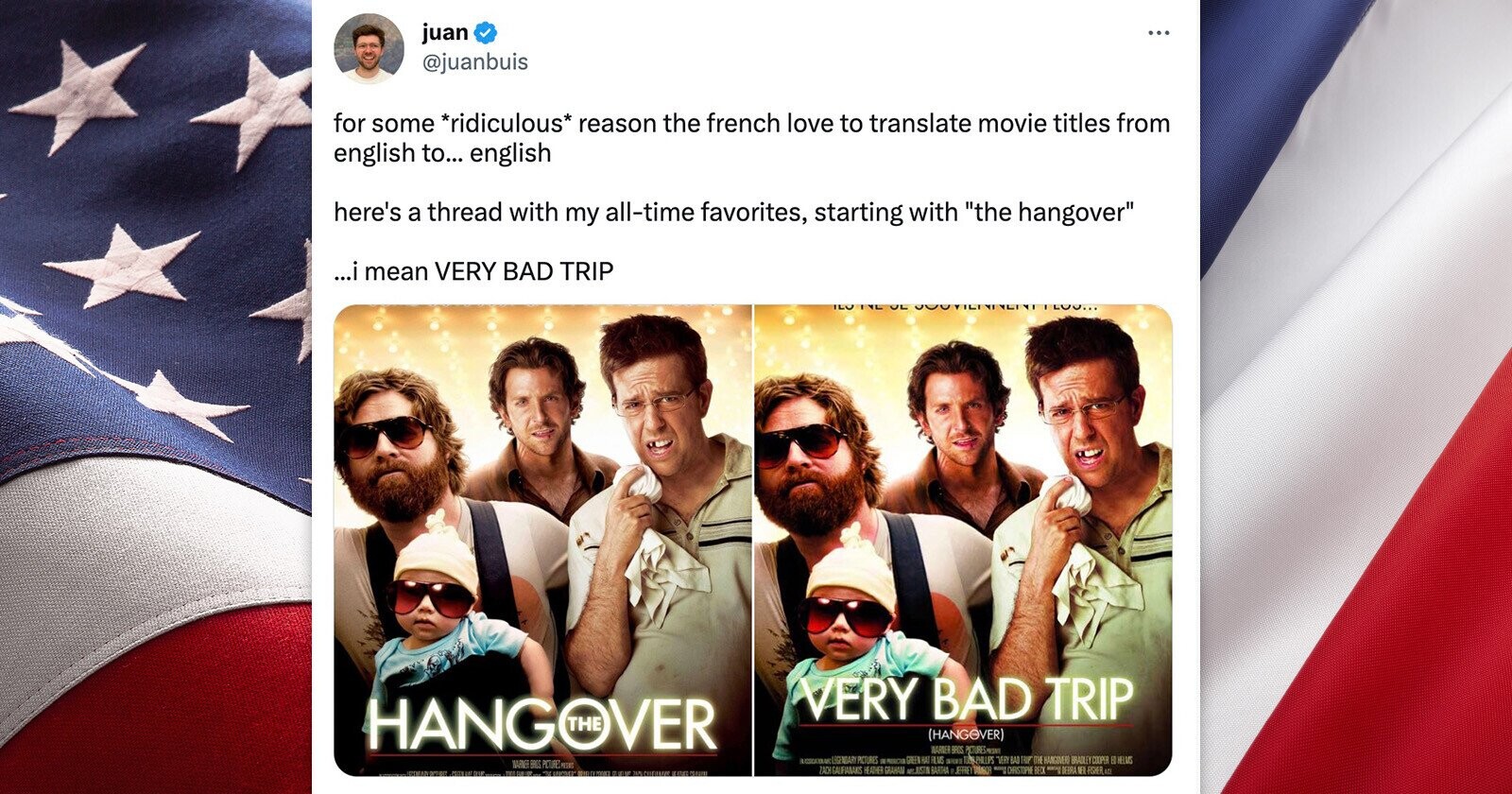
Some movie titles travel abroad with dignity. Others go through customs, lose their passport, buy sunglasses at the airport, and reintroduce themselves as Very Bad Trip. Welcome to one of the funniest quirks in international film marketing: France’s long-running habit of taking American movie titles that are already in English and “translating” them into different, usually simpler, louder, and occasionally sillier English.
At first, it sounds like a joke someone made while waiting in line for popcorn. Surely, if a Hollywood movie is called The Hangover, French distributors would either keep the title or translate it into French, right? Not always. In France, The Hangover became Very Bad Trip. Step Up became Sexy Dance. No Strings Attached became Sex Friends. Silver Linings Playbook became Happiness Therapy. These are not rejected Wi-Fi names. These are real movie titles used to sell American films to French audiences.
The result is a strange, hilarious subgenre of localization: English-to-English movie title translation. It is not quite translation, not quite branding, and not quite the work of a person who has had enough sleep. But behind the comedy is a serious marketing logic. French distributors are not changing titles because they hate art. They are changing them because movie posters have one job: get attention fast. Sometimes, apparently, the fastest route to attention is replacing nuance with the verbal equivalent of a neon sign.
Why France Changes English Movie Titles Into Other English Titles
Movie title localization is normal. Every country adapts foreign titles to fit language, culture, humor, and audience expectations. A pun that works in Los Angeles may land with the grace of a dropped croissant in Lyon. A phrase that feels mysterious in English may sound meaningless to a non-native audience. Even among English speakers, titles are often changed between the United States and the United Kingdom for clarity or marketing.
France’s twist is that distributors often keep the foreign glamour of English while replacing difficult or subtle English with easier, more marketable English. In other words, the title remains “international,” but the meaning becomes more direct. English can signal modernity, Hollywood, youth culture, romance, comedy, action, and imported cool. But the original title may be too idiomatic, too hard to pronounce, too vague, or too tied to American slang.
The Hangover is a perfect example. “Hangover” is a common English word, but it may not be instantly meaningful or memorable to every French moviegoer. Very Bad Trip, however, is blunt. It sounds chaotic. It sounds like a comedy. It practically walks up to the audience wearing a party hat and says, “Things will go wrong.” Is it elegant? No. Does it communicate the premise? Absolutely.
The “Very Bad” Universe: When Subtlety Leaves the Building
Once Very Bad Trip became recognizable in France, it helped create a naming pattern that could be reused. That is how The Other Guys became Very Bad Cops. Instead of leaning on the original title’s casual buddy-comedy tone, the French title tells you exactly what you are getting: cops, but not the polished action-hero kind. Very bad ones. Thank you, poster. No further questions.
The “Very Bad” formula works because it is easy to understand and genre-friendly. It signals comedy before the viewer even reads the cast list. The words are basic, memorable, and punchy. They also create a family resemblance between unrelated films. If viewers enjoyed Very Bad Trip, a title like Very Bad Cops may give them a familiar comic flavor, even when the movies are not connected.
From a branding perspective, this is not as foolish as it looks. Hollywood itself does the same thing with sequels, spin-offs, and title formulas. Think about how many American comedies use words like “bad,” “super,” “crazy,” “night,” “wedding,” or “party.” The French version simply turns the dial from “marketable” to “a raccoon wrote this on a billboard,” and somehow it still works.
“Sexy Dance,” “Sex Friends,” and the Art of Saying the Quiet Part Loudly
Another famous pattern in French movie-title localization is the generous use of “sex” or “sexy.” Step Up became Sexy Dance. Step Up 2: The Streets became Sexy Dance 2. No Strings Attached became Sex Friends. The To Do List became The Sex List. Not Another Teen Movie became Sex Academy.
To American ears, these titles can sound hilariously blunt, like someone summarized the marketing brief after spilling coffee on the nuance. But to understand why they exist, consider the job of a title. It does not need to preserve every shade of meaning. It needs to position the film. Is this a dance movie? A romantic comedy? A teen comedy? A cheeky adult comedy? The French title often skips metaphor and goes straight to category.
No Strings Attached is an idiom. It suggests a casual relationship without emotional obligations. That phrase is natural in American English, but idioms do not always travel cleanly. Sex Friends is not poetic, but nobody misunderstands the shelf it belongs on. It is direct, compact, and easy to remember. The same applies to Sexy Dance. The original title Step Up has motivational energy, but it does not instantly scream “dance movie” to everyone. Sexy Dance may lack grace, but it wears tap shoes in a thunderstorm.
The “Therapy” Trend: When Every Movie Needs a Couch
French distributors also seem fond of titles ending in “Therapy.” Silver Linings Playbook became Happiness Therapy. She’s Funny That Way became Broadway Therapy. Thanks for Sharing became Sex Therapy. This pattern is especially interesting because it transforms original titles with metaphor, ambiguity, or character-specific meaning into tidy emotional categories.
Silver Linings Playbook is a very American title. It plays on the phrase “every cloud has a silver lining” and the idea of a “playbook,” which suggests strategy, sports, and a plan for recovery. That is a lot of cultural freight for four words. Happiness Therapy, by contrast, is easy to process. It promises a story about healing, romance, and emotional repair. It may sound like a wellness app that sends too many notifications, but it communicates the movie’s tone quickly.
This is where “dumber English” becomes more complicated. These titles are often less clever, but they may be more commercially efficient. A title like Happiness Therapy tells casual viewers what emotional lane the film occupies. It may flatten the movie’s personality, but it improves instant readability. In poster design, instant readability is gold.
Why Not Just Translate Everything Into French?
The obvious question is: why not translate the title into French? France is, after all, famously protective of its language. The country has a strong film culture, a powerful domestic industry, and a long tradition of defending French cultural identity. Yet American films remain popular in France, and English carries a certain commercial shine in youth-oriented entertainment.
English titles can feel modern, global, and connected to Hollywood. Keeping English on the poster can signal that the film is an American import, which may be a selling point for comedies, romances, dance movies, action films, and teen entertainment. But the original English title may not always do the work French marketers need it to do. So they create a new English title that sounds more accessible to local audiences.
This approach also separates France from Quebec, where film titles are more often translated into French due to language policy and cultural expectations. In France, the choice is more flexible. A movie might keep its original English title, receive a French title, or be reborn as simplified English. That third option is the one that makes the internet laugh hardest.
Specific Examples That Show the Pattern
The Hangover → Very Bad Trip
This is the superstar example. The original title relies on a common English term for the painful aftermath of drinking too much. The French title reframes the movie as a chaotic journey gone wrong. It is not elegant, but it is very clear. It also became recognizable enough to influence other titles.
The Other Guys → Very Bad Cops
The original title suggests second-string heroes. The French title turns the concept into a blunt joke. These are cops, and they are very bad at being cops. It is basically the trailer in three words.
Step Up → Sexy Dance
The original title suggests ambition, movement, and personal growth. The French title tells viewers the movie contains attractive people dancing. Is it subtle? No. Is it false advertising? Also no.
No Strings Attached → Sex Friends
The American title depends on an idiom. The French title replaces the idiom with direct description. It is less witty, but more immediately understandable.
Silver Linings Playbook → Happiness Therapy
The original title has layered meaning tied to optimism, recovery, and personal strategy. The French title turns it into an emotional promise. You may not know the plot, but you know the mood.
Trainwreck → Crazy Amy
The original title uses a metaphor for personal chaos. The French title centers the lead character and her messy energy. It sounds simpler, but it is also easier to sell as a character-based comedy.
Is This Actually Bad Translation?
Calling these titles “bad translation” is funny, but not always accurate. Many of them are not translations at all. They are retitles. A translation attempts to carry meaning from one language into another. A retitle attempts to sell a product in a new market. Those are different jobs.
A translator might ask, “What does the title mean?” A marketer asks, “What will make someone buy a ticket?” Sometimes those goals overlap. Sometimes they wrestle in the lobby while the popcorn machine watches. The French English-to-English title often favors marketing over literary faithfulness.
That does not mean the results are immune from mockery. Some titles truly do sound like a non-native speaker’s first draft or a search-engine keyword experiment from 2009. But the pattern reveals how film distribution works. Posters must communicate genre, tone, and appeal in seconds. If a title is clever but unclear, marketers may choose clear and clumsy over clever and invisible.
The Comedy of Global English
One reason these titles are so entertaining is that they reveal how English functions globally. English is not only a language spoken by native speakers. It is also a branding tool, a style, a mood, and sometimes a decorative object. Around the world, English words appear in fashion, tech, music, advertising, and entertainment because they can feel modern or international even when the phrasing sounds odd to native speakers.
French movie titles like Very Bad Trip or Sexy Dance belong to this global English ecosystem. They are not designed primarily for Americans. They are designed for French audiences who recognize enough English to catch the vibe. Native-level nuance is not the goal. Commercial impact is.
That is why Americans often find these titles hilarious. We are reading them as native English speakers, expecting natural phrasing. French distributors may be using English more like a design element: short, stylish, genre-coded, and easy to remember. The result sits somewhere between marketing genius and fridge-magnet poetry.
What American Marketers Can Learn From France’s Weird Titles
As silly as these titles seem, they teach a useful lesson: clarity sells. American entertainment marketing often loves irony, ambiguity, and layered references. That can be great when the audience shares the cultural context. But when a movie crosses borders, the clever title may become foggy.
The French approach strips titles down to their most obvious selling points. Comedy about a disastrous night? Very Bad Trip. Dance movie with romance and attitude? Sexy Dance. Emotional recovery story? Happiness Therapy. Buddy-cop comedy with incompetent heroes? Very Bad Cops. It is almost embarrassingly practical.
For SEO writers, advertisers, and content marketers, there is a lesson hiding in the joke. A headline must attract attention, but it also has to communicate quickly. If readers cannot tell what your article is about, they may never click. The French movie poster strategy is basically search intent with a beret: identify the audience, identify the genre, and make the promise obvious.
When the Joke Becomes the Brand
Some French retitles become so memorable that they develop their own cultural life. Very Bad Trip is not just a translation oddity; it is a brand that many French viewers recognize. The same is true of Sexy Dance, which turned the Step Up franchise into something instantly legible for its target market.
This matters because audiences do not experience movie titles in a vacuum. They see posters, trailers, actor names, genre cues, release timing, and word-of-mouth. A title that sounds ridiculous on a list may work perfectly on a poster outside a theater. It may help viewers understand what kind of night out they are buying.
Of course, the internet removes that context. When Americans see a screenshot of Sex Friends or Very Bad Cops, they are not seeing the full French marketing environment. They are seeing a phrase that sounds like it was translated by a vending machine. That mismatch is what makes the trend so shareable.
Are the French Laughing Too?
Many French viewers are fully aware that these titles can sound silly. The trend has been discussed, joked about, and mocked online by French speakers as well as English speakers. This is not a simple story of Americans laughing at France or France misunderstanding English. It is a shared comedy of marketing excess.
French audiences know when a title sounds awkward. They also know that distributors are trying to sell tickets, not win poetry awards. The humor comes from the gap between France’s reputation for linguistic elegance and the brute-force simplicity of titles like Very Bad Trip. It is the cinematic equivalent of seeing a Michelin-star chef serve dinner on a paper plate labeled “Tasty Food.”
Experience Section: Living With the Weird Joy of English-to-English Movie Titles
The first time you notice this trend, it changes how you look at movie posters forever. You walk past a familiar Hollywood face, glance at the title, and your brain hits a speed bump. Wait, why is this American movie not called what it is called in America? Why is the title still English? Why does it sound like the movie was renamed by someone describing it to a taxi driver?
That moment is oddly delightful. It reminds you that pop culture is not universal in the way we think it is. A movie may be the same movie, but the wrapper changes. The title, poster, tagline, and marketing angle can shift dramatically depending on the country. What feels clever in one market may feel confusing in another. What feels ridiculous to native English speakers may feel direct and useful to people encountering the film through a different cultural lens.
There is also something charming about the boldness of these French titles. American marketing can be polished to the point of exhaustion. Every superhero poster looks like twelve people are standing in front of a weather event. Every prestige drama title sounds like it was whispered by a haunted lighthouse. Then France strolls in and says, “This one is called Very Bad Cops.” Honestly, respect. At least you know what is in the box.
These titles also create a funny kind of memory hook. I may forget a perfectly tasteful title, but I will never forget Happiness Therapy. It sounds like a spa package, a self-help podcast, and a Bradley Cooper movie all at once. Sexy Dance is impossible to forget because it is so direct that it circles back around to being iconic. Very Bad Trip may be clumsy, but it has rhythm. It is three simple words with comic energy. Try saying it without imagining someone waking up in Las Vegas next to a tiger. You cannot. The title has already won.
From a viewer’s perspective, the best way to enjoy this trend is not to treat it as proof that anyone is “bad” at English. It is more interesting than that. It is proof that language in advertising is flexible, strategic, and sometimes gloriously weird. These titles are built for a specific audience, in a specific market, with specific assumptions about what sells. They are little cultural artifacts, and yes, some of them are also extremely funny.
For writers, marketers, and SEO professionals, the experience offers a practical reminder: a title is not only a label. It is a promise. It tells people what emotional door they are about to open. Sometimes that promise is elegant. Sometimes it is shameless. Sometimes it is Very Bad Trip, waving from across the street with a giant foam finger. But if people remember it, talk about it, and buy a ticket, the title has done its job.
So the next time you see an American movie poster in France with a title that looks like English took a wrong turn and ended up in a marketing meeting, pause before judging too hard. Laugh, absolutely. The laughter is part of the fun. But also appreciate the strange genius of it. These titles may be dumber English, but they are often smarter marketing than they first appear.
Conclusion
The French habit of translating American movie posters from English to simpler, stranger English is one of those cultural quirks that sounds fake until you see the posters. The Hangover becomes Very Bad Trip. Step Up becomes Sexy Dance. Silver Linings Playbook becomes Happiness Therapy. Each example feels like a tiny marketing crime scene, complete with fingerprints made of keywords.
But the deeper story is not just “France makes funny titles.” It is about how movies are sold across cultures. English can be a status symbol, a genre signal, and a shortcut to Hollywood cool. When original titles are too idiomatic or subtle, French distributors may replace them with English phrases that are easier to process and harder to ignore. The results can be goofy, but they also reveal a powerful truth: clarity often beats elegance when the goal is to fill theater seats.
Note: This article is written from real, publicly known examples of French film-title localization and industry patterns. Source links are intentionally not inserted in the body, as requested, to keep the article clean for web publishing.