Working from home was supposed to flatten the office hierarchy. Everyone got the same rectangle on a video call, the same “you’re on mute” moment, and the same awkward glimpse of someone’s laundry pile in the background. But according to Microsoft’s workplace research, remote and hybrid work did not affect everyone equally. Bosses, especially senior leaders, often reported doing better than the people they managed.
That finding matters because it exposes a quiet but powerful divide in modern work. Leaders may feel productive, connected, and in control, while employees may feel overworked, isolated, watched, or unsure what success even looks like anymore. The result is not simply a debate about office versus home. It is a debate about power, visibility, trust, communication, and whether remote work is being designed for the whole teamor mostly for the people already sitting closest to the decision-making table.
Microsoft’s research helped put numbers to a feeling many workers already had: the work-from-home experience can look very different depending on your job level. A manager with a private home office, flexible schedule, established relationships, and control over meetings is not living the same workday as a junior employee sharing Wi-Fi with three roommates and trying to network through calendar invites. Same laptop. Totally different game.
The Microsoft Finding: Leaders Were Thriving While Teams Were Struggling
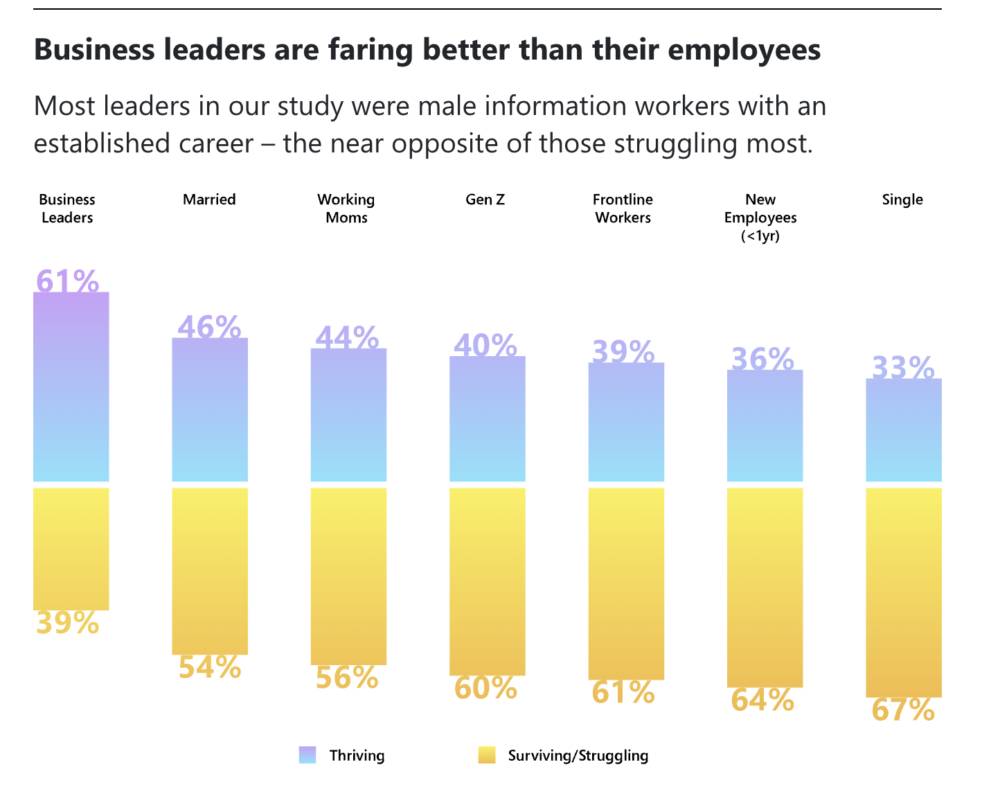
Microsoft’s 2021 Work Trend Index found that business leaders were more likely to say they were thriving during remote work than employees without decision-making authority. The report also noted that leaders tended to have stronger relationships with colleagues and leadership, and were more likely to take their allotted vacation time.
On the other side, the groups struggling most included Gen Z workers, women, frontline employees, and people newer to their careers. This gap is important because it shows that remote work did not automatically create a fairer workplace. In some cases, it widened existing advantages. People who already had status, networks, and autonomy carried those benefits home with them. People still trying to build credibility, learn the culture, or get noticed had a much steeper climb.
Why Bosses May Be Doing Better During Work-from-Home
1. Leaders Have More Control Over Their Time
One of the biggest perks of seniority is control. Managers and executives often have more influence over when meetings happen, which conversations matter, and how work gets prioritized. That control becomes even more valuable in a remote environment, where the calendar can quickly become a digital traffic jam.
Employees, meanwhile, often experience remote work as a stream of interruptions: meetings, chat pings, urgent emails, “quick syncs,” and surprise requests that somehow all arrive five minutes before lunch. A boss may see a packed schedule as a sign of importance. A team member may see the same schedule as a slow-motion battery drain.
2. Bosses Already Have Social Capital
Social capital is the invisible network of trust, relationships, inside jokes, shared history, and reputation that helps people get work done. Senior leaders usually have more of it. They know who to call, how decisions are made, and which problems can be solved with one private message.
Newer employees often do not have that luxury. In an office, they might learn by listening, observing, or asking small questions after a meeting. At home, those casual learning moments are harder to create. Nobody wants to schedule a 30-minute meeting titled, “Can I ask the basic question I would have whispered after the meeting?” As a result, early-career workers can feel disconnected even while attending more meetings than ever.
3. Managers May Have Better Home Setups
Work-from-home comfort is not evenly distributed. A senior leader may have a quiet room, ergonomic chair, large monitor, reliable internet, and a door that closes. A junior employee may have a kitchen table, a folding chair, noisy neighbors, and a router that gives up every time someone starts streaming a movie.
Microsoft’s research noted that many employees lacked office essentials or adequate support for remote-work expenses. This matters because productivity is not just about motivation. It is also about tools, space, bandwidth, and the ability to work without turning your spine into a question mark.
The Productivity Paranoia Problem
Microsoft later described a major remote-work tension as “productivity paranoia”a situation where employees feel productive, but leaders struggle to trust that productivity because they cannot see it happening. In an office, managers often mistake visibility for value. Someone sitting at a desk looks busy, even if they are mentally planning dinner. At home, the same employee may produce better work, but the manager sees only a green status dot and hopes for the best.
This creates a dangerous loop. Leaders worry people are not working. Employees sense that mistrust and start performing busyness. More meetings get scheduled. More status updates are requested. More dashboards appear. Soon, the company has built a beautiful productivity theater where everyone is exhausted and nobody remembers what the actual play was about.
The better approach is to measure outcomes instead of activity. Did the project move forward? Did customers get what they needed? Did the campaign launch? Did the code work? Did the team solve the problem? These questions are more useful than asking whether someone typed continuously between 9:00 a.m. and 5:00 p.m.
Remote Work Can Help EmployeesWhen It Is Managed Well
It would be a mistake to read Microsoft’s findings and conclude that work-from-home is bad. The research actually points to a more nuanced truth: flexibility is valuable, but poorly managed flexibility can become chaos with better lighting.
Many employees want remote or hybrid options because they reduce commuting time, improve work-life balance, and allow people to focus. Pew, Gallup, McKinsey, BLS, and Federal Reserve data all show that remote and hybrid work remain significant parts of the American workplace. Gallup research has found that many remote-capable employees prefer hybrid work, while Pew has reported that a large share of workers with remote-capable jobs work from home at least some of the time.
The issue is not whether employees should ever work from home. The issue is whether companies are creating systems that support fairness, clarity, connection, and trust. Remote work can be excellent for deep focus. Office time can be excellent for collaboration, mentoring, and relationship-building. Hybrid work can combine bothbut only if leaders resist the urge to turn every office day into a parade of meetings that could have been emails wearing business shoes.
Who Struggles Most in a Remote-First Workplace?
Early-Career Employees
Newer employees often need more feedback, coaching, and informal learning. Remote work can make it harder for them to understand company culture, build confidence, and find mentors. They may also worry that being less visible means being less promotable.
Women and Caregivers
Remote work can offer critical flexibility for parents and caregivers, but it can also blur boundaries. A worker may be answering emails, helping with homework, planning meals, and joining a video call where someone says, “Let’s all turn cameras on,” as if everyone’s home life is a neatly staged showroom.
Frontline and On-Site Workers
Not every job can be done remotely. When office employees receive flexibility that frontline workers cannot access, companies must think carefully about fairness. Flexibility may need to mean different things in different roles: better scheduling, shift choice, paid leave, predictable hours, or more autonomy in how work gets done.
Gen Z Workers
Younger employees entered the workforce during a strange era: onboarding by video, networking through chat, and learning office etiquette without much office. They may value flexibility, but they also need connection, coaching, and chances to be seen for more than a tiny square on a screen.
How Leaders Can Close the Gap
Set Clear Priorities
Remote teams need clarity more than charisma. Leaders should define what matters most, what can wait, and what does not need to be done at all. Without clear priorities, employees may try to treat every task as urgent, which is how burnout sneaks in wearing a productivity badge.
Replace Surveillance With Trust
Monitoring tools may show activity, but they do not necessarily show impact. A worker can move a mouse and still contribute very little. Another worker can spend two quiet hours thinking and then solve a problem that saves the team a week. Trust-based management focuses on outcomes, deadlines, quality, and communicationnot digital hovering.
Create Better Meeting Rules
Meetings should earn their place on the calendar. Leaders can reduce overload by using agendas, shortening default meeting lengths, protecting focus blocks, and canceling recurring meetings that no longer serve a purpose. A meeting without a goal is just a group subscription to confusion.
Build Social Capital Intentionally
Remote and hybrid teams need structured chances to connect. This does not mean forced fun or virtual trivia every Friday until morale improves. It means mentorship programs, onboarding cohorts, team rituals, thoughtful office days, manager check-ins, and spaces where employees can ask questions without feeling exposed.
Make Hybrid Work Team-Based
Gallup research suggests that teams benefit when they coordinate hybrid schedules together. Random office mandates can produce the worst of both worlds: employees commute in, sit on video calls, eat an overpriced salad, and wonder why their living room had to be abandoned for this. Better hybrid planning brings people together for collaboration, problem-solving, training, and relationship-building.
What Microsoft’s Finding Teaches Us About Modern Management
The big lesson is not that bosses are villains twirling mustaches from ergonomic chairs. Many managers are under pressure too. They are asked to deliver results, maintain culture, prevent burnout, retain talent, adopt new tools, and somehow keep meetings “energizing,” which may be the most unrealistic KPI ever invented.
The lesson is that leaders can misread the workplace when their own experience is going well. If a boss feels productive at home, they may assume everyone else does too. If a manager has strong relationships, they may underestimate how lonely a new employee feels. If an executive has a quiet office, they may forget that some workers are taking calls from bedrooms, kitchens, or shared spaces.
Good leadership in remote and hybrid work requires curiosity. Leaders should ask employees what is working, what is not, where bottlenecks exist, and which processes are quietly making everyone miserable. Then they must act on that feedback. A survey with no follow-up is just a digital suggestion box floating in space.
Experience-Based Section: What This Looks Like Inside Real Teams
In many remote and hybrid workplaces, the divide between bosses and teams shows up in small daily moments rather than dramatic conflicts. A manager may open the day with a clean schedule, a clear view of priorities, and the authority to move deadlines. An employee may open the same day to six unread messages, three overlapping priorities, and a calendar that looks like it was designed by a raccoon with access to Outlook.
One common experience is the “always available” trap. Because people are not physically visible, they feel pressure to respond instantly. A team member may answer chat messages during lunch, keep email open at night, or join meetings while sick because they fear silence will be misread as slacking. The boss, meanwhile, may see fast replies and assume the system is working. In reality, the employee is slowly turning into a human notification bell.
Another familiar experience is unequal confidence in meetings. Senior employees often speak easily because they know the context and the politics. Newer workers may hesitate, especially on video calls where timing is awkward and interruptions feel larger. By the time they find the courage to speak, the conversation has moved on to “next steps,” which somehow always means more work for someone who did not talk much.
Remote work can also create hidden overload. In an office, a manager might notice that an employee looks tired, skips lunch, or seems frustrated after a difficult call. At home, those cues are harder to see. The employee may appear calm on camera while juggling childcare, caregiving, loneliness, or simple exhaustion. This is why managers need regular one-on-one conversations that go beyond project updates. “How are you doing?” should not be a decorative phrase before discussing spreadsheets.
At the same time, many employees genuinely love remote work. They value the quiet, the saved commute, the ability to focus, and the dignity of not pretending that fluorescent lighting is a personality enhancer. For deep work, writing, analysis, coding, planning, and individual problem-solving, home can be a powerful environment. The challenge is protecting those benefits while fixing the weak spots: isolation, unclear expectations, weak onboarding, and reduced career visibility.
Teams that handle remote work well tend to create simple agreements. They define core collaboration hours. They decide which conversations belong in chat, email, documents, or meetings. They document decisions so people in different time zones are not punished for sleeping like normal mammals. They make promotion criteria visible. They train managers to coach rather than hover. Most importantly, they treat flexibility as a system, not a perk handed out unevenly.
The best hybrid teams also use office time with purpose. They do not ask people to commute just to sit alone on calls. They plan office days around brainstorming, mentoring, team lunches, workshops, customer problem-solving, and relationship-building. When employees understand why they are coming in, office time feels less like a mandate and more like a useful tool.
For bosses, the practical takeaway is simple: do not manage remote teams based only on your own comfort. Ask what the team experiences. Watch for invisible work. Reward outcomes. Make space for quieter voices. Protect focus time. And remember that flexibility without clarity is not freedomit is just confusion with a laptop.
Conclusion
Microsoft’s finding that bosses were doing better than their teams during work-from-home should be a wake-up call for every organization. Remote and hybrid work are not automatically good or bad. They are management systems, and like all systems, they can either reduce inequality or quietly reinforce it.
Leaders often have more autonomy, stronger networks, better equipment, and greater control over their schedules. Employees may have the flexibility they want, but still struggle with burnout, loneliness, unclear expectations, and reduced visibility. The companies that win the future of work will not be the ones that argue endlessly about home versus office. They will be the ones that build smarter work: fewer pointless meetings, clearer goals, better manager training, fairer flexibility, and stronger trust.
In the end, the real question is not where people work. It is whether the way they work helps them do their best work without draining the life out of them. That is the boss-level challenge now.