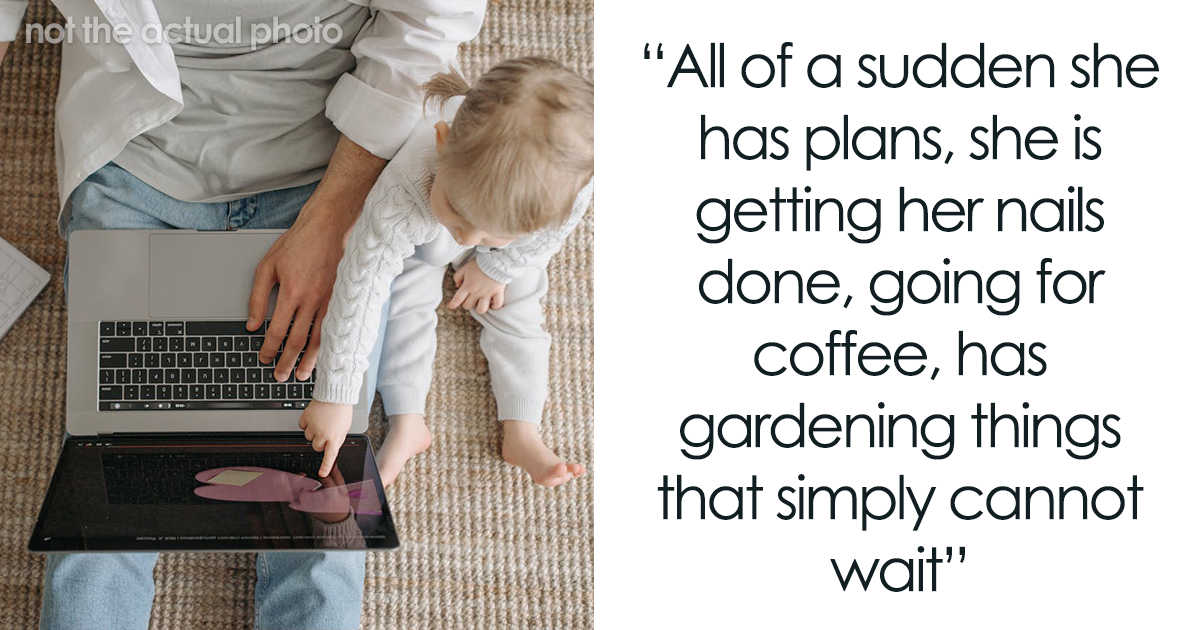
There are days off, and then there are “technically not at work but still being chased by a tiny human with suspiciously sticky hands” days off. A viral family conflict about a husband taking emergency time off to recover from burnout has struck a nerve online because it sits right in the messy intersection of modern parenting, unpaid labor, work stress, and the dangerous fantasy that one exhausted adult can magically become two fully rested adults by drinking coffee from a mug that says “World’s Best Dad.”
The story centers on a new father who said he was drowning at work after a key staff member left, leaving him with extra pressure, failing projects, and the kind of mental fatigue that makes opening an email feel like defusing a toaster. He took time off because he felt close to falling apart. But instead of recovering, he said his wife treated those days as a chance to hand him the baby, chores, and household responsibilities. By the end, he was not refreshed. He was wrecked.
At first glance, this sounds like another internet courtroom drama: husband versus wife, stay-at-home parent versus working parent, “who has it harder?” versus “who forgot to buy diapers?” But the deeper issue is more useful than picking a villain. This situation exposes how families often fail when they do not clearly define what “rest,” “help,” “parenting,” and “emergency” actually mean.
The Viral Conflict: A Day Off That Became Another Shift
According to the widely discussed story, the husband was a 35-year-old new dad whose daughter had been born earlier that year. His wife was a stay-at-home mother, a role they had apparently planned for together. The arrangement sounded simple on paper: he worked outside the home, she managed much of the home and baby care. In real life, however, babies do not read family strategy documents. They cry, spit up, skip naps, and occasionally turn a clean living room into a soft-play disaster zone with impressive artistic confidence.
The husband said work had become especially brutal. Losing an important staff member left him carrying more responsibility than usual. He took emergency time off not for a vacation, not for a hobby marathon, and not to disappear into a gaming cave with snacks. He took it because he felt burned out.
But when he was home, his wife saw an available adult. She handed over the baby and assigned chores. From her perspective, she may have finally seen a chance to breathe. From his perspective, his emergency recovery days turned into unpaid overtime at home. That mismatch is the heart of the problem.
Why This Story Hit So Many Nerves
This conflict went viral because many families recognize the pattern. One parent feels invisible at work. The other feels invisible at home. One says, “I need rest.” The other thinks, “Welcome to my Tuesday.” Nobody is lying, but everyone is exhausted, and suddenly the dishwasher becomes a constitutional crisis.
Research on American families shows that childcare and domestic labor are still unevenly felt, even in households that believe they are being fair. U.S. time-use data shows that adults with children under age six spend hours each day on primary childcare, and women still average more time than men on childcare tasks. Pew Research has also found that mothers and fathers often disagree about who does more childcare, with mothers more likely to say they carry the heavier load while fathers often report that duties are shared equally.
That perception gap matters. A husband may honestly believe he is doing a lot because he compares himself with an older model of fatherhood where “being present” meant not fleeing to a bowling league until bedtime. A wife may honestly feel abandoned because the daily mental load of bottles, naps, laundry, appointments, meals, and baby supplies never really clocks out.
Burnout Is Not Just Being Tired
The word “burnout” gets tossed around casually, but genuine burnout is more than needing a nap and a sandwich. It usually involves deep exhaustion, detachment or negativity, and a drop in performance. When someone says they are on the verge of burnout, it should not be translated as “Great, you are home, please reorganize the pantry.”
For this husband, the time off appears to have been a pressure valve. He needed a pause before he snapped emotionally or became useless at work and home. That does not mean he gets a permanent parenting exemption. It means the family needed to treat his time off like a recovery plan, not a surprise home-staffing bonus.
Emergency time off should have boundaries. If a parent takes leave because of mental overload, the family should discuss what that leave is for. Is it sleep? Doctor appointments? Therapy? A reduced workload? A shared schedule where both adults get protected rest? Without that conversation, resentment rushes into the room wearing muddy shoes.
The Stay-at-Home Parent Is Also Working
It would be unfair to frame the wife as simply “dumping” tasks without acknowledging the reality of stay-at-home parenting. Caring for a baby all day is not lounging around in cute socks while sunlight hits the nursery just right. It is feeding, changing, soothing, cleaning, planning, monitoring, and constantly being interrupted by someone who cannot say “thank you” yet but can absolutely scream with opera-level commitment.
A stay-at-home parent may be physically at home, but that does not mean they are resting. The home is the workplace. The baby is the supervisor. The supervisor has no respect for lunch breaks.
If the wife had been carrying most of the baby care and household labor, she may have seen her husband’s time off as the first real chance to get relief. That reaction is understandable. But understandable is not the same as workable. If one parent is collapsing from job burnout and the other is collapsing from caregiving overload, simply transferring the entire burden from one tired person to another is not teamwork. It is hot potato with a diaper bag.
The Real Problem: No Shared Recovery Plan
The most important lesson from this story is not “husbands need rest” or “wives need help.” Both are true. The real lesson is that overwhelmed parents need a shared recovery plan before the situation becomes an emotional garage sale where everyone is yelling over broken expectations.
A better conversation might have sounded like this: “I am taking three emergency days because I am close to burning out. I need at least one day with minimal responsibilities and two days where I can help in defined blocks. What do you need most during that time?”
That kind of sentence is not romantic, but neither is fighting over laundry while the baby chews a sock. Specificity saves relationships. Instead of saying “I need a break,” say “I need Saturday morning from 8 to noon to sleep.” Instead of saying “You never help,” say “I need you to handle bedtime on Monday, Wednesday, and Friday.” Clarity is not cold. It is kindness with a calendar.
Household Labor Includes the Mental Load
One reason these conflicts escalate is that couples count visible tasks but forget invisible ones. Washing bottles is visible. Remembering that the bottles need washing before midnight is mental load. Taking out trash is visible. Noticing the diaper pail smells like a crime scene and adding liners to the shopping list is mental load.
Many stay-at-home parents do not just perform chores; they manage the system. They remember nap windows, baby supplies, pediatric appointments, grocery needs, laundry cycles, and which onesie is cute but impossible because it has 47 snaps apparently designed by a puzzle villain.
At the same time, paid work has its own mental load: deadlines, income pressure, office politics, performance anxiety, job security, and the fear that one dropped ball could affect the whole family. In this story, the husband was not asking to avoid fatherhood. He was asking for recovery during a crisis. The wife may not have fully understood that his “day off” was not leisure. It was emergency maintenance.
When Both Parents Are Right, the System Is Wrong
The internet loves choosing sides, but this situation is more complicated. The husband was right that emergency time off should not automatically become chore overflow. The wife was right that parenting and household labor do not stop just because one adult is stressed. The baby, rudely, remains a baby.
The system failed because there was no backup plan. No outside help. No protected rest windows. No discussion about what tasks were urgent and what could wait. No shared understanding of what each person’s breaking point looked like.
Families often operate like tiny companies with no HR department, no staffing plan, and one employee who keeps removing socks. When crisis hits, they improvise. Sometimes improvisation works. Sometimes it ends with one parent crying in the laundry room while the other wonders why everyone is mad about towels.
What Couples Can Learn From This Blowup
1. Define Emergency Time Off Before It Starts
If time off is for burnout recovery, say so clearly. A parent who needs rest should explain what recovery requires: sleep, quiet, medical care, therapy, reduced stimulation, or a temporary break from decision-making. The other parent should also state what support they need. The goal is not to win; it is to prevent two adults from collapsing in shifts.
2. Create a Minimum Household Standard
During crisis weeks, not everything gets done. The house does not need to sparkle like a cleaning commercial where nobody actually lives. Decide what is essential: baby fed, baby safe, adults fed, basic laundry, dishes under control, trash removed. Anything beyond that can wait unless guests are coming, and even then, guests may simply need to accept that a baby lives there.
3. Schedule Protected Rest for Both Parents
One exhausted parent should not be rescued by exhausting the other. Each adult needs protected recovery time. That might mean one parent sleeps Saturday morning while the other gets Sunday afternoon off. It might mean hiring help, asking relatives, swapping childcare with trusted friends, or lowering expectations until the family stabilizes.
4. Talk Before the Blowup
The best time to discuss resentment is before someone is shaking with frustration beside a basket of laundry. Weekly check-ins help: What was hardest this week? What task is making you feel invisible? What can we drop, delay, or divide differently?
Why New Parenthood Magnifies Everything
A baby changes the emotional weather in a home. Sleep becomes fragmented. Routines vanish. Small issues feel huge because nobody has enough energy to process them calmly. Even loving couples can become defensive when they feel unseen.
New fathers can also struggle with postpartum depression and anxiety. Medical experts have increasingly emphasized that paternal mental health matters, too. When fathers are overwhelmed, irritable, detached, or emotionally exhausted, it can affect the whole family. That does not reduce the mother’s burden; it expands the family’s responsibility to notice distress in both parents.
Likewise, mothers may experience postpartum depression, anxiety, isolation, and identity shock. A stay-at-home mother may feel that her work is endless and undervalued. When her partner comes home, she may not see “a person recovering from burnout.” She may see “finally, another adult with hands.”
That is why the solution cannot be based on assumptions. Parents need to say the quiet parts out loud: “I am scared I cannot keep doing this.” “I need sleep.” “I feel like you do not see what I do.” “I want to help, but I am breaking.”
Conclusion: This Is a Warning Sign, Not Just a Marriage Fight
The story of a wife unloading baby duties and chores onto a husband during his emergency time off is not just a viral argument. It is a snapshot of how modern families can buckle under pressure when paid work, unpaid labor, childcare, and mental health collide.
The husband’s breakdown matters. The wife’s exhaustion likely matters, too. The baby’s needs matter most in the immediate sense, but a baby is safest and happiest when the adults are not running on fumes and resentment. The real villain is not one spouse. It is the absence of a sustainable plan.
Couples do not need perfect fairness every day. Some weeks, one person carries more. Other weeks, the load shifts. But they do need honesty, recovery time, and a shared understanding that “being home” is not the same as “being available for everything.”
In the end, the healthiest response is not to ask, “Who had it worse?” It is to ask, “How do we make sure neither of us falls apart next time?” That question may not go viral, but it might save the household.
Experience Notes: What This Kind of Burnout Feels Like in Real Homes
In many families, the hardest part of a conflict like this is that nobody feels like the bad guy. The working parent may leave the house before sunrise, spend the day solving problems, answering messages, managing pressure, and pretending to be calm in meetings where everyone is one spreadsheet away from panic. By the time they come home, they want silence. Instead, they walk into crying, dishes, laundry, and a partner who looks like they have been negotiating with a tiny dictator since breakfast.
The stay-at-home parent, meanwhile, may have spent the day doing tasks that reset themselves instantly. Feed the baby, clean the baby, change the baby, wash the clothes, fold the clothes, watch the baby unfold the clothes emotionally if not physically. Nothing feels finished. There is no applause, no clock-out time, and no coworker saying, “Great job keeping a human alive today.” That kind of invisibility can build resentment fast.
One common real-life pattern is the “false break.” A parent asks for help, and the other parent technically helps, but still asks questions every five minutes: Where are the wipes? What should she eat? Is this pajama clean? Where does this go? The helper is doing tasks, but the manager is still managing. That does not feel like rest. It feels like supervising an intern while holding a baby monitor.
Another pattern is the “silent scoreboard.” Each person secretly counts what they have done. He counts work hours, bills paid, and nights he handled the baby. She counts feedings, laundry, appointments, dishes, and every time she ate lunch standing up. The problem is that nobody can win a scoreboard the other person cannot see.
Families that recover from this kind of tension often stop trying to prove who is more tired. Instead, they build systems. They divide nights. They assign full ownership of tasks, not just occasional help. They create emergency rules: if one parent takes mental health leave, the first block of time is protected rest; after that, duties are shared in planned shifts. They also lower standards. Dinner can be simple. Laundry can sit. The floor can survive a few crumbs. Nobody ever looked back on early parenthood and said, “I wish we had polished the baseboards more.”
The most useful experience from couples who navigate this well is simple: say what you need before resentment writes the speech for you. “I need three uninterrupted hours.” “I need you to own bath time.” “I need one morning where nobody touches me unless there is fire.” These statements may sound blunt, but they are much kinder than exploding later.
This viral story feels dramatic because it ended in a breakdown. But many homes are only a few bad nights, missed naps, and work emergencies away from the same place. The fix is not perfection. It is communication, compassion, and a plan that treats both paid labor and home labor as real work.