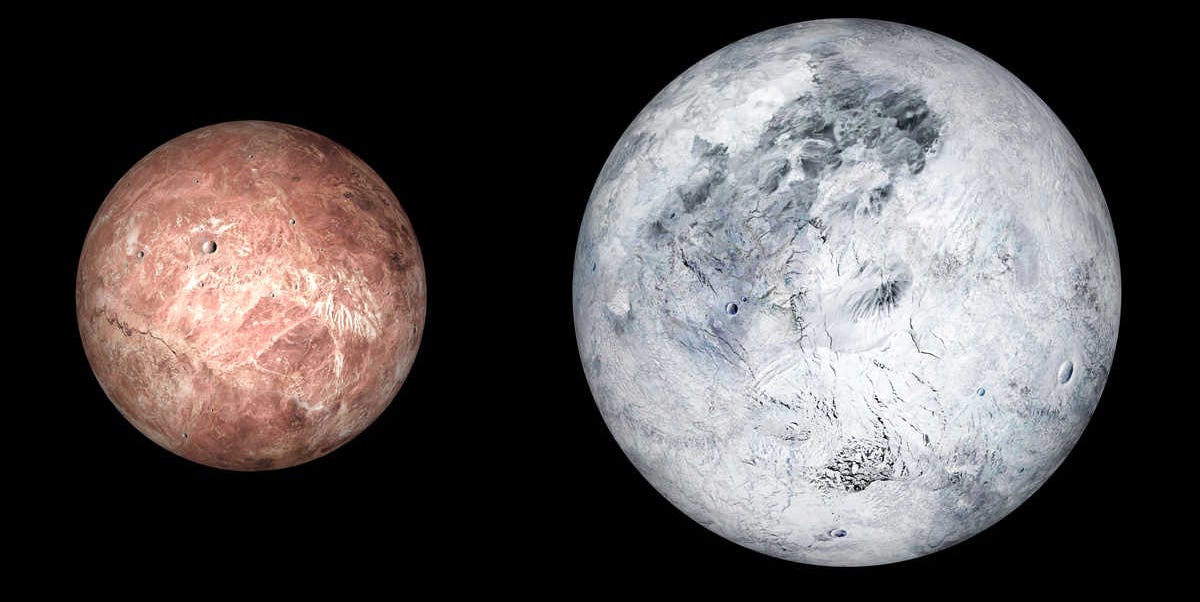
Far beyond Neptune, where sunlight arrives with the enthusiasm of a dying flashlight, two icy dwarf planets may be concealing surprisingly warm interiors. Eris and Makemake look like deep-frozen leftovers from the solar system’s construction site, yet observations from the James Webb Space Telescope suggest they may be far more chemically and geologically complicated than their frosty appearances imply.
The clue is methanenot merely its presence, but the atomic fingerprints hidden inside it. By measuring rare forms of methane ice, scientists have attempted to reconstruct where the material came from and what happened deep inside these distant worlds. One interpretation points toward heated rocky cores, internal methane production, possible outgassing, and perhaps even layers of liquid water beneath thick shells of ice.
That does not mean astronomers have discovered warm alien swimming pools beyond Pluto. The evidence is indirect, and competing models remain on the table. Still, Eris and Makemake have delivered an important message: the outer solar system may contain active worlds where almost everyone expected frozen geological retirement homes.
Meet the Two Dwarf Planets Beyond Pluto
Eris and Makemake belong to the population of icy bodies orbiting beyond Neptune. This broad region includes the Kuiper Belt and the more widely dispersed objects of the scattered disk. It contains ancient material left over from the formation of the solar system roughly 4.5 billion years ago.
Because these objects are distant, cold, and difficult to observe, they were once commonly imagined as uncomplicated mixtures of rock and frozen gases. Pluto’s 2015 encounter with NASA’s New Horizons spacecraft thoroughly wrecked that assumption. Pluto revealed glaciers, haze layers, moving nitrogen ice, towering water-ice mountains, and terrain that looked geologically young.
Eris and Makemake have never received close spacecraft visits. They appear as tiny points of light even through powerful observatories. Webb, however, can separate that light into infrared wavelengths and identify chemical signatures that older telescopes could not measure clearly.
Eris: The World That Helped Demote Pluto
Eris is approximately the same size as Pluto but more massive. Its discovery helped force astronomers to reconsider what should count as a planet, eventually contributing to the creation of the dwarf-planet category in 2006.
The dwarf planet travels around the Sun on a long, tilted, highly elliptical orbit. Its average distance is about 68 astronomical units, or 68 times Earth’s distance from the Sun. Sunlight requires more than nine hours to reach it, and one Eris year lasts approximately 557 Earth years. It also has a small moon named Dysnomia.
Surface temperatures can fall below minus 400 degrees Fahrenheit. At such temperatures, substances that are gases on Earth can freeze onto the ground. Eris is therefore less like an Arctic winter and more like a cosmic freezer whose thermostat has been snapped off.
Makemake: Bright, Reddish, and Increasingly Strange
Makemake is smaller than Pluto but remains one of the largest known Kuiper Belt objects. It orbits at an average distance of about 45.8 astronomical units and requires approximately 305 Earth years to circle the Sun. Despite the long year, its day lasts only about 22.5 hours.
Its reddish-brown surface contains abundant methane ice and chemically related hydrocarbons such as ethane. Makemake also has a small, dark moon informally called MK 2. The contrast between the moon and the bright dwarf planet is so extreme that discovering it was rather like noticing a charcoal briquette beside a snowball under a stadium light.
These physical details established Eris and Makemake as interesting worlds. Webb’s measurements transformed them into potential laboratories for deep planetary chemistry.
What the James Webb Space Telescope Actually Detected
Webb did not photograph underground oceans or erupting ice volcanoes on these dwarf planets. Instead, its Near-Infrared Spectrograph examined sunlight reflected from their methane-rich surfaces across wavelengths between approximately one and five microns.
Within that spectrum, researchers detected rare versions of methane molecules known as isotopologues. Ordinary methane contains one carbon atom and four hydrogen atoms. Some methane molecules contain carbon-13 instead of the more common carbon-12, while others contain deuterium, a heavier isotope of hydrogen.
The relative abundance of deuterium and ordinary hydrogen is called the D/H ratio. That ratio can preserve information about the temperature and environment in which a substance formed. It functions somewhat like a chemical return address, although nature occasionally smudges the envelope.
Webb measurements produced moderate D/H ratios in methane ice on both Eris and Makemake. The values were lower than the ratio previously measured in methane associated with comet 67P but resembled D/H ratios found in water from several outer solar system reservoirs. Researchers also measured carbon-isotope ratios that were broadly consistent with typical solar system material.
Why Methane Could Point to Hot Rocky Cores
The initial interpretation was startling. If the methane were simply primordial material inherited directly from the cloud that formed the solar system, researchers expected a different isotopic signature. Instead, the observed ratios appeared compatible with methane produced or chemically modified inside the dwarf planets.
Scientists investigated two major internal production routes. In an abiotic pathway, water reacts with carbon-bearing compounds such as carbon dioxide or carbon monoxide under warm conditions, creating methane without biology. In a thermogenic pathway, internal heat breaks down ancient organic material trapped in the rocky core, again releasing methane.
Models associated with the original interpretation suggested that these reactions could require temperatures above roughly 300 degrees Fahrenheit. That is astonishingly warm compared with the surfaces of Eris and Makemake, but a dwarf planet’s interior does not depend entirely on weak sunlight.
Radioactive elements incorporated into rock during formation slowly decay and release heat. Large objects also cool less efficiently than small ones. If Eris and Makemake contain substantial rocky cores insulated by thick mantles of ice, they could have retained enough radiogenic heat to support chemical reactions for billions of years.
The methane would then need a route from the interior to the surface. Possibilities include fractures, gradual diffusion, cryovolcanic eruptions, or episodes of outgassing. Once exposed, the methane could condense as fresh ice, helping explain why these distant surfaces do not look entirely depleted or chemically exhausted.
Could Eris and Makemake Have Hidden Oceans?
If their rocky cores became hot enough to alter methane chemistry, the same heat might have melted part of the water-ice layer above them. This raises the possibility of subsurface oceans sandwiched between rocky interiors and frozen outer crusts.
A potential ocean would not necessarily resemble Earth’s open seas. It could be dark, pressurized, salty, mixed with ammonia, or divided into pockets of liquid and slush. The overlying crust could be tens or hundreds of miles thick. Anyone planning a beach vacation should cancel immediately.
Hydrothermal circulation is one proposed scenario. Liquid water could move through warm fractures in the rocky core, react with minerals and carbon compounds, and generate methane. That gas might later migrate upward and refresh the surface.
However, the existence of liquid water has not been directly confirmed. Webb detected surface chemistry, not an ocean. Scientists must use thermal models, laboratory experiments, isotope measurements, and comparisons with other icy worlds to infer what might be occurring below.
The difference matters. Evidence consistent with an ocean is not the same as evidence that uniquely proves an ocean. Eris and Makemake have supplied an intriguing trail of footprints, but astronomers have not yet caught the underground suspect on camera.
A Scientific Plot Twist: The Methane May Be Primordial After All
Planetary science rarely permits a mystery to remain conveniently solved. In 2025, another team published modeling work arguing that the measured D/H ratios could be compatible with methane inherited from the early solar nebula.
The researchers modeled chemical and isotopic changes in the young disk around the Sun. Their results suggested that primordial methane could have been trapped in the building blocks of Eris and Makemake as frozen condensates or inside cage-like water-ice structures called clathrates.
Under that interpretation, internally generated methane is not required to explain the observations. The dwarf planets may still possess warm interiors or oceans, but the methane isotope measurements alone would not prove it.
This disagreement does not make the Webb observations less valuable. It shows why isotope science is powerful and difficult. A measured chemical ratio must be compared with models of disk chemistry, atmospheric escape, internal reactions, surface irradiation, and billions of years of geological evolution.
The competing studies therefore frame a productive scientific debate. One explanation emphasizes methane cooked inside warm dwarf planets. The other emphasizes methane preserved from the solar system’s birth. Additional observations are needed to determine whether either explanation is completeor whether the answer contains an inconvenient helping of both.
Makemake Added Another Surprise: Methane Gas
Later Webb observations made the story even more interesting. In 2025, researchers reported the first detection of gaseous methane associated with Makemake. That made it only the second trans-Neptunian world after Pluto with confirmed gas above its surface.
The detection does not yet reveal whether Makemake possesses a stable global atmosphere. The gas could form an extraordinarily thin, gravitationally bound atmosphere maintained by sublimating surface methane. Alternatively, it could be emerging from localized plumes or other outgassing activity.
A global atmosphere would be far thinner than Pluto’s. The plume scenario, meanwhile, could involve methane escaping from a limited region, perhaps connected to a warmer patch, a fracture, or cryovolcanic activity. Current models cannot fully distinguish between these possibilities.
Either scenario undermines the traditional picture of Makemake as a perfectly dormant ice ball. Surface methane is being released, redistributed, or chemically processed todayor at least recently enough for Webb to detect the result. Higher-resolution spectra and repeated observations will be needed to determine whether the gas changes with location, rotation, season, or distance from the Sun.
Does Any of This Mean There Could Be Life?
The presence of methane and possible liquid water naturally attracts astrobiological attention. On Earth, some microorganisms produce methane, and hydrothermal environments provide chemical energy without relying on sunlight.
Nevertheless, methane is not automatically a sign of life. It can be produced through several nonbiological reactions. The research on Eris and Makemake specifically explored geological and chemical mechanisms capable of explaining the methane without biology.
Even if a hidden ocean exists, habitability would depend on temperature, pressure, chemical ingredients, energy sources, stability, and the length of time liquid conditions survived. Scientists currently possess no evidence of organisms, biological methane, or any other biosignature on either dwarf planet.
The more defensible conclusion is still exciting: small worlds far from the Sun may retain heat, liquid reservoirs, and ongoing chemistry. That greatly expands the range of places where complex planetary environments might develop.
Why These Dwarf Planets Matter to Solar System Science
The Kuiper Belt preserves material from the solar system’s earliest era. Studying its dwarf planets helps researchers understand how volatile compounds were distributed, how giant planets migrated, and how small icy worlds evolved after formation.
Eris and Makemake also challenge the assumption that geological activity requires a large planet, intense sunlight, or strong tidal forces from a nearby giant. Neither world receives meaningful solar warmth, and neither has a massive neighboring planet kneading its interior through powerful tides.
If radioactive heating alone can sustain substantial internal evolution, other large trans-Neptunian objects could also contain differentiated interiors, buried water, active chemistry, or temporary atmospheres. The outer solar system may be populated not by inert debris but by a spectrum of slowly changing worlds.
NASA describes the Kuiper Belt as an enormous frontier containing millions of icy objects. More than 2,000 trans-Neptunian objects have been cataloged, yet these represent only a small fraction of the predicted population. Eris and Makemake could be prominent examples of a much broader phenomenon.
How Scientists Could Solve the Mystery
Repeated Webb observations can search for seasonal changes, map methane variations, refine isotope ratios, and test whether Makemake’s gas forms a global atmosphere or localized plume. Stellar occultations can provide another test by measuring how light from background stars bends or fades as it passes behind a dwarf planet.
Laboratory work is equally important. Researchers must reproduce methane formation, clathrate storage, isotope exchange, and organic breakdown under the pressures and temperatures expected inside distant icy worlds.
The most decisive evidence would come from spacecraft. A flyby could map surface geology, search for fractures and cryovolcanic deposits, measure escaping particles, determine composition, and estimate internal structure. An orbiter would be even more powerful, although reaching and orbiting such distant, low-gravity targets would be a formidable engineering challenge.
New Horizons demonstrated how one close encounter can overturn decades of assumptions. A spacecraft arriving at Eris or Makemake might produce a similar scientific ambush.
The Experience of Exploring Eris and Makemake From Earth
Readers do not need a multibillion-dollar telescope to appreciate the scale of this discovery. A useful first experience is to open a solar system simulator or astronomy program and zoom outward from Earth. Pass Mars, Jupiter, Saturn, Uranus, and Neptune. Continue until Pluto’s orbit appears small enough to fit comfortably on the screen. Makemake travels farther out on average, while Eris follows a much larger and more sharply tilted path.
That simple exercise makes the distances feel less abstract. Radio signals traveling at light speed would require hours to cross the gap in one direction. A command sent to a future spacecraft near Eris could not receive an immediate response. By the time mission controllers learned that something had gone wrong, the probe would have been dealing with the problem alone for most of a working day.
Amateur observers can also attempt to locate Makemake or Eris using accurate star charts, a capable telescope, a sensitive camera, and exposures taken on multiple nights. Neither object reveals a visible disk through ordinary backyard equipment. Each resembles a faint star. The rewarding moment comes when two images are aligned and the target has shifted slightly against the background stars.
This is an unexpectedly appropriate way to experience dwarf-planet science. The object does not announce itself with rings, clouds, or colorful surface details. Its identity appears through motion. Webb follows a similar philosophy at a far more advanced level: the most important information is not always an obvious picture but a subtle pattern hidden in carefully measured light.
A second experience is to compare the worlds conceptually. Place an image of Pluto from New Horizons beside an artist’s rendering of Eris or Makemake. Pluto is covered with recognizable terrain because a spacecraft flew past it. The other two remain mostly unresolved. Their interiors must be studied through spectra, orbital behavior, surface brightness, and physical models.
This contrast demonstrates how scientific knowledge is assembled. Researchers rarely begin with a complete portrait. They combine a methane absorption band, a moon’s orbit, a stellar occultation, a laboratory experiment, and a computer simulation. Each observation resembles one puzzle piece discovered under a different piece of furniture.
Following the scientific debate is part of the experience as well. The warm-interior model is compelling because it connects methane isotopes with radiogenic heating and water-rock reactions. The primordial-methane model is compelling because it shows that early disk chemistry may reproduce the same measurements. Makemake’s gaseous methane introduces yet another constraint.
Rather than choosing a favorite explanation immediately, readers can track what evidence would separate them. Does methane emerge from a localized region? Does its abundance change during Makemake’s rotation? Are additional isotopes detectable? Can thermal models keep water liquid for billions of years? Do other dwarf planets show similar signatures?
This approach turns a dramatic headline into a genuine scientific investigation. The incredible thing hiding beyond Pluto may be an ocean, a heated core, ancient methane, active plumes, or some combination not yet imagined. The pleasure comes from watching increasingly precise observations narrow the possibilities.
Conclusion: The Outer Solar System Is Not as Dead as It Looks
Eris and Makemake occupy a region where temperatures are brutally low and sunlight is little more than a distant rumor. Yet Webb has shown that their methane contains a detailed record of chemical history. That record may point toward internal heating, geological processing, outgassing, and hidden liquid water.
The evidence does not establish that both dwarf planets currently contain oceans, nor does it demonstrate biological activity. Alternative models suggest that at least some of their methane could have survived from the solar system’s formation. Makemake’s newly detected methane gas, however, reinforces the broader lesson that these worlds are not necessarily static.
Pluto once surprised scientists with a dynamic landscape. Eris and Makemake may be preparing a similar revelation from much farther away. The solar system’s coldest neighborhoods, it turns out, may have remarkably warm stories buried beneath the ice.