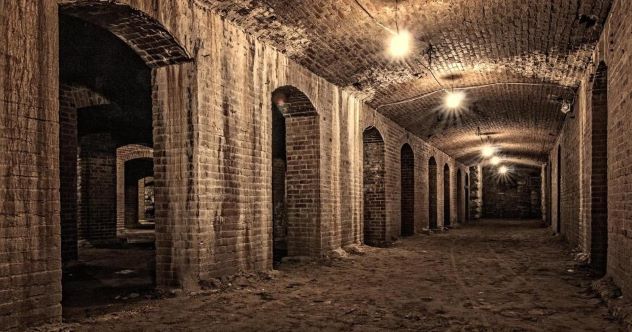
Europe may have cornered the market on bone-lined tunnels, candlelit ossuaries, and monks who decorate with femurs, but the United States has its own impressive collection of underground burial chambers. Hidden beneath churches, cemeteries, hotels, and city streets, American catacombs and crypts preserve stories that rarely make it into cheerful sightseeing brochures.
Some contain the remains of colonial settlers, bishops, military officers, architects, and prominent families. Others are called “catacombs” because of their shadowy corridors and vaulted brickwork, even though nobody was buried there. Either way, they deliver the same irresistible combination of history, architecture, silence, and just enough uneasiness to make you reconsider that mysterious noise behind you.
These ten creepy cool American catacombs and crypts can be visited through regular admission, scheduled tours, or limited special events. Access policies change frequently, so always confirm current hours and reservation requirements before arriving with your flashlight and bravest friend.
What Counts as an American Catacomb?
Traditional catacombs are underground networks containing burial chambers, while a crypt is usually a smaller chamber beneath a church or mausoleum. American sites do not always follow those definitions precisely. Some are true burial vaults. Others are subterranean ruins, replica catacombs, lower churches, or enclosed cemeteries protected beneath later buildings.
That variety is part of the fun. On one trip, you might stand beside a centuries-old gravestone under a New England meetinghouse. On another, you may explore a California hotel tunnel created for art storage rather than eternal rest. The common ingredients are history, enclosed spaces, dramatic architecture, and an atmosphere that whispers, “Perhaps do not wander away from the guide.”
1. Basilica of St. Patrick’s Old Cathedral Catacombs
New York City, New York
Hidden beneath Manhattan’s Nolita neighborhood, the catacombs of the Basilica of St. Patrick’s Old Cathedral are among the most atmospheric underground burial sites in the country. The cathedral’s cemetery and vaults have served as resting places for prominent New York Catholics for more than two centuries.
The guided candlelight tour enters areas normally closed to casual visitors, including underground family vaults and the cathedral’s historic walled cemeteries. Bishops rest near influential merchants, politicians, military figures, and members of families that helped shape New York. The experience feels surprisingly intimate, especially when the city’s traffic becomes a muffled rumble somewhere above your head.
The official tour generally lasts around 80 to 90 minutes. It combines burial history with stories of immigration, religious conflict, architecture, and the cathedral’s role in early New York. This is the closest many Americans will get to a classic European catacomb experience without purchasing a transatlantic plane ticket.
2. Green-Wood Cemetery Catacombs
Brooklyn, New York
Green-Wood Cemetery is already a Gothic wonderland of rolling hills, elaborate mausoleums, sculptures, obelisks, and famous residents. Its underground catacombs add another layer of beautiful gloom.
Dating to the 1850s, the catacombs are built into a hillside and contain 30 burial vaults arranged along a long central corridor. Skylights admit thin shafts of natural light, creating an effect that is less horror-movie dungeon and more Victorian meditation chamberalthough your imagination may disagree after sunset.
The catacombs are normally closed to general visitors. Green-Wood periodically opens them during after-hours walks, moonlight tours, concerts, and other ticketed programs. Current event listings should be checked carefully because access is limited and popular tours often sell out. Green-Wood’s nighttime programs are especially memorable: few settings can compete with an underground cemetery chamber reached after walking through hundreds of acres of monuments in the dark.
3. Old North Church Crypt
Boston, Massachusetts
Old North Church is best known for the lantern signal associated with Paul Revere’s midnight ride, but its basement contains a quieter and considerably more crowded chapter of Boston history. More than 1,100 people were laid to rest beneath the sanctuary.
The crypt contains 37 brick burial vaults. Each could hold numerous coffins, allowing generations of church members to be interred beneath the building. Notable occupants have included Captain Samuel Nicholson, the first commander of the USS Constitution, and British Major John Pitcairn, who was mortally wounded during the Battle of Bunker Hill.
Visitors can access the crypt through Old North’s admission options, including self-guided experiences and selected guided programs. Exhibits explain colonial burial customs, archaeological research, and changing attitudes toward death. It is educational, solemn, and unsettling in the most historically productive way possible. You may enter thinking about Paul Revere and leave thinking about brick vault capacity.
4. Center Church on the Green Crypt
New Haven, Connecticut
The crypt beneath Center Church on the Green is not merely attached to an old cemetery. It is part of the cemetery. When the current church was constructed between 1812 and 1814, builders placed it over a portion of New Haven’s colonial burying ground.
Approximately 137 identified graves remain visible within the crypt, while the likely remains of more than 1,000 unidentified people lie beneath the church. Thousands more are believed to remain under the surrounding New Haven Green. Some surviving stones date to the late 1600s and display skulls, angels, wings, and other examples of early New England funerary art.
The preserved headstones stand in rows beneath low ceilings, making the crypt feel like a cemetery that has been carefully folded into a basement. Public tours are offered on a limited monthly schedule, traditionally on the second Sunday of the month. Visitors should verify the latest arrangements and remember that these fragile stones are historical records, not props for dramatic leaning poses.
5. Franciscan Monastery Catacombs
Washington, D.C.
The Franciscan Monastery of the Holy Land in America allows visitors to experience a carefully constructed interpretation of early Christian catacombs without leaving Washington, D.C. Its lower level includes passageways, chapels, shrines, and replicas inspired by important religious sites in Rome and the Holy Land.
These are not sprawling ancient tunnels excavated beneath the capital. They are devotional recreations designed to help American pilgrims understand sacred places that many could not visit overseas. The result is still wonderfully atmospheric, with narrow corridors, arched recesses, subdued lighting, and spaces that seem far removed from the busy city outside.
The catacombs and lower church are accessible only on guided tours, while parts of the upper church and gardens may be explored independently. Tours also include replicas connected to Calvary, the Holy Sepulchre, Bethlehem, and other biblical locations. It is equal parts architecture lesson, pilgrimage, and subterranean adventure.
6. Crypt Church at the National Shrine
Washington, D.C.
The Basilica of the National Shrine of the Immaculate Conception contains a vast lower-level Crypt Church that proves underground spaces do not need cobwebs to feel mysterious. Rather than functioning primarily as a burial chamber, this crypt level is an immense sacred interior filled with chapels, mosaics, sculptures, polished stone, and shadowed passageways.
The building is one of the largest Roman Catholic churches in the world, and the contrast between its soaring upper church and enclosed lower level is striking. The Crypt Church feels quieter and more intimate despite its scale. Its numerous chapels honor different cultural traditions, saints, and Marian devotions represented by Catholic communities across the United States.
Visitors may explore during normal opening hours, attend services, or reserve a guided tour. Official tours generally last just under an hour and include both the Crypt Level and Great Upper Church. It is less macabre than other entries on this list, but architecture fans seeking a grand American crypt will find plenty to admire.
7. Rafael Guastavino’s Crypt at the Basilica of St. Lawrence
Asheville, North Carolina
The Basilica of St. Lawrence is both the masterpiece and final resting place of Spanish-born architect Rafael Guastavino. He became famous for a tile-vaulting system used in major American landmarks, including portions of Grand Central Terminal, Carnegie Hall, and the Boston Public Library.
In Asheville, Guastavino helped create an enormous freestanding elliptical dome using layers of tile and mortar. His crypt rests inside the building he designed, giving the basilica a poetic architectural symmetry: the builder remains permanently housed within his own greatest work.
The crypt is relatively small compared with the networks beneath Old St. Patrick’s or Green-Wood, but its glazed tilework and personal connection to the building make it fascinating. The basilica has undergone restoration work, and visiting hours have recently been limited to selected days. Travelers should consult the current schedule before making a special trip. Apparently even eternal resting places occasionally require construction updates.
8. Cathedral Basilica of St. Louis Crypt
St. Louis, Missouri
The Cathedral Basilica of St. Louis is famous for its overwhelming mosaic collection, but visitors who descend to its museum encounter a far more restrained space: the cathedral crypt.
The remains of several former leaders of the Archdiocese of St. Louis are interred there, including Archbishop John May and Cardinals John Glennon, Joseph Ritter, and John Carberry. The crypt also contains a needlepoint prie-dieu, or prayer kneeler, made for Pope John Paul II’s 1999 visit to the cathedral.
This is a compact ecclesiastical crypt rather than a maze of tunnels. Its power comes from the transition between environments. Upstairs, millions of pieces of glass and stone shimmer across enormous domes. Downstairs, the atmosphere becomes simple, enclosed, and contemplative. The crypt is associated with the cathedral museum, while guided cathedral tours are generally offered by arrangement or on selected weekdays.
9. St. Louis Cemetery No. 1
New Orleans, Louisiana
St. Louis Cemetery No. 1 is not underground, but its dense collection of above-ground crypts creates one of America’s most famous cities of the dead. Established in the late 18th century, the cemetery contains family tombs, society vaults, wall crypts, and monuments packed into narrow pathways behind high walls.
The best-known burial is associated with Marie Laveau, the legendary New Orleans Voodoo practitioner whose life has accumulated almost as many myths as facts. Visitors also encounter the unusual white pyramid tomb commissioned by actor Nicolas Cage, which looks as though an ancient pharaoh hired a modern Hollywood agent.
The cemetery is not open for independent public wandering. Entry is available only through the authorized official tour, and advance reservations are strongly recommended because group sizes are limited. Respectful guided access protects the fragile tombs from vandalism while helping visitors understand New Orleans burial traditions beyond exaggerated ghost stories.
10. The Mission Inn Catacombs
Riverside, California
The Mission Inn’s so-called catacombs offer an important warning: in America, a place named “catacombs” may contain considerably more hotel history than human remains. These underground corridors are part of the sprawling Mission Inn, a resort that grew from a modest guesthouse into an eccentric architectural complex filled with towers, courtyards, chapels, art, and international curiosities.
The subterranean spaces appear to have been created during the property’s early-20th-century expansion and were reportedly connected to owner Frank Miller’s enormous collection of art and antiques. They are tunnels and storage areas rather than burial chambers, but their stone walls, dim corners, damp atmosphere, and maze-like layout have inspired decades of rumors.
Current historic tours advertise access to the legendary catacombs, although particular rooms may be unavailable depending on maintenance, private events, or property conditions. Closed-toe shoes are sensible, both for uneven surfaces and for fleeing imaginary Victorian hotel ghosts with dignity.
How to Visit Catacombs and Crypts Respectfully
These sites may be fascinating attractions, but many remain active churches, cemeteries, memorials, or functioning places of interment. Speak quietly, follow photography rules, remain with your group, and never touch human remains, monuments, headstones, or burial doors. Decorative carving that has survived three centuries does not need help from your index finger.
Wear stable shoes because crypt floors can be uneven, narrow, or damp. Visitors with claustrophobia, mobility limitations, respiratory conditions, or sensitivity to discussions of death should review accessibility information in advance. Some locations involve stairs and cannot accommodate every guest.
Most importantly, distinguish documented history from entertainment. Ghost legends can add flavor, but the real storiesimmigration, epidemics, warfare, religious communities, changing funeral customs, and urban developmentare usually stranger and more meaningful than invented tales about glowing eyes.
The Catacomb Experience: What a Visit Really Feels Like
The Temperature Changes Before the Mood Does
One of the first things visitors notice when entering an underground crypt is not a ghostly whisper but a drop in temperature. Stone, brick, and earth hold cool air, even when the street outside is hot. Your eyes take longer to adjust than expected. Footsteps become louder. Ordinary soundsa guide unlocking a gate, a coat brushing a wall, somebody clearing a throatgain theatrical importance.
Then comes the mental adjustment. A burial chamber is not simply an old room. Names and dates turn abstract history into individual lives. A person who previously existed as one line in a textbook suddenly occupies a specific vault three feet away. That physical proximity can make the past feel uncomfortable, immediate, and deeply human.
Architecture Becomes Part of the Story
American crypts reveal how builders solved practical and symbolic problems. Brick vaults supported heavy churches while providing burial space. Hillside catacombs offered families an alternative to private mausoleums. Above-ground New Orleans tombs reflected local traditions, environmental conditions, available materials, and the needs of multigenerational families.
Even non-burial sites such as the Mission Inn catacombs demonstrate how underground spaces acquire new meanings. A storage corridor becomes mysterious when its original purpose is forgotten. Add dim lighting, conflicting legends, and a century of curious guests, and suddenly an old basement has a mythology larger than the hotel above it.
The Best Tours Balance Humor and Respect
A good crypt guide understands that visitors need occasional humor. Without it, an hour of mortality, coffin construction, and decomposition customs can become emotionally heavy. The best jokes acknowledge the strangeness of the setting without mocking the dead.
Strong tours also separate evidence from folklore. A guide may explain that a site has several ghost stories while being honest that no documentation proves them. That distinction does not ruin the fun. In fact, it makes genuine mysteries more compelling. Why was a particular vault sealed? Why were some names lost? What happened when burial space ran out? Historical uncertainty can produce better chills than a rehearsed tale involving a suspiciously punctual phantom.
You Leave More Thoughtful Than Frightened
Many visitors enter catacombs expecting fear and emerge feeling reflective. Crypts compress centuries into a small space. They show how communities remembered their leaders, how families displayed status, and how societies responded when cities became too crowded for traditional burial grounds.
They also offer a rare pause from modern noise. Phones lose signals. Conversations become quieter. Nobody is rushing to check a notification while standing beside a colonial gravestone carved with a winged skull. For a brief period, the underground environment forces attention onto materials, stories, names, and the limited duration of every human life.
That may be the real appeal of America’s creepy cool catacombs and crypts. They provide a safe encounter with uncomfortable subjects while surrounding visitors with remarkable architecture and carefully preserved history. The darkness is entertaining, but the human stories are what follow you back into daylight.
Final Thoughts
America’s catacombs and crypts may not hold millions of carefully arranged skeletons, but they offer something equally compelling: intimate encounters with local history. Beneath famous churches and quiet city blocks are colonial gravestones, family vaults, architectural masterpieces, replica sacred spaces, and corridors shaped by stories that refuse to stay buried.
Whether you prefer candlelit Manhattan catacombs, a Revolutionary-era Boston crypt, New Orleans’ above-ground cities of the dead, or a California hotel tunnel with more legends than corpses, each destination rewards curiosity. Book ahead, obey the rules, keep your voice down, and resist the urge to investigate mysterious side passages. That is how horror movies acquire sequels.